Cardinal Pietro Parolin meets with South Sudan President Salva Kiir Mayardit on Aug. 14, 2023, in Juba, South Sudan. / Credit: Office of the President of South Sudan
ACI Africa, Aug 16, 2023 / 09:15 am (CNA).
Vatican Secretary of State Cardinal Pietro Parolin in his visit to South Sudan this week urged the people of God in the east-central African country to continue to work toward building a united nation by embracing a spirit of peace and reconciliation.
Speaking to the media after his meeting with South Sudan President Salva Kiir Mayardit on Monday, Aug. 14, Parolin underscored the importance of peace and reconciliation in building a stable country.
“Embrace the spirit of peace and reconciliation in order to build a harmonious society in the country,” said Parolin, who is in the country for a four-day official visit, in his address in Juba.
He urged South Sudanese leaders to fully implement the Revitalized Agreement on the Resolution of the Conflict in South Sudan (R-ARCSS), which was signed in 2018 to end the country’s civil war and to sustain lasting peace in the country.
Parolin left Juba on Tuesday, Aug. 15, and headed to the Diocese of Malakal, where he had been invited by Bishop Stephen Nyodho to meet refugees from war-torn Sudan.
Thousands of returnees and refugees displaced by the ongoing war between the Sudan Armed Forces (SAF) and paramilitary Rapid Support Forces (RSF) are being hosted in the Diocese of Malakal, which serves South Sudan’s Upper Nile State. The number of those in dire need of humanitarian assistance continues to rise daily.
Parolin will end his four-day visit to South Sudan on Thursday, Aug. 17, in the Diocese of Rumbek, where he will preside over Mass and meet with Church leaders and more government officials.
In an Aug. 13 interview with ACI Africa ahead of Parolin’s visit, Archbishop Hubertus van Megen, the apostolic nuncio to South Sudan and Kenya, reiterated the message of Pope Francis to South Sudanese leaders, saying: “The message of the Holy Father remains the same. It is the message of reconciliation as indicated in the motto for his visit that ‘I pray that all may be one.’”
The nuncio recalled that the Holy Father’s visit to South Sudan in February brought people of diverse backgrounds together and that the Holy Father’s intention was that all South Sudanese “truly become one nation of South Sudan.”
“In order to achieve the unity of the South Sudanese, the people need to first reconcile with one another,” he added.
Van Megen, who was appointed apostolic nuncio to South Sudan and Kenya in 2019, urged the people of God in the country to look at themselves as brothers, not as members of the many ethnic groups in the country.
This story was first published by ACI Africa, CNA’s partner news agency in Africa, and has been adapted by CNA.
If you value the news and views Catholic World Report provides, please consider donating to support our efforts. Your contribution will help us continue to make CWR available to all readers worldwide for free, without a subscription. Thank you for your generosity!
Click here for more information on donating to CWR. Click here to sign up for our newsletter.
A priest celebrates Mass in Sudan before the outset of war. / Credit: ACN
ACI Prensa Staff, Apr 13, 2024 / 08:30 am (CNA).
The third Sudanese civil war has terribly affected the entire country but especially the local Catholic Church, which — a… […]
At the end of the Mass of consecration on Nov. 1, 2023, María Ruiz Rodríguez shows the ring symbolizing her membership in the Ordo Virginum. That’s the only outward sign of her consecration. / Credit: Latin Patriarchate of Jerusalem
Jerusalem, Nov 12, 2023 / 07:00 am (CNA).
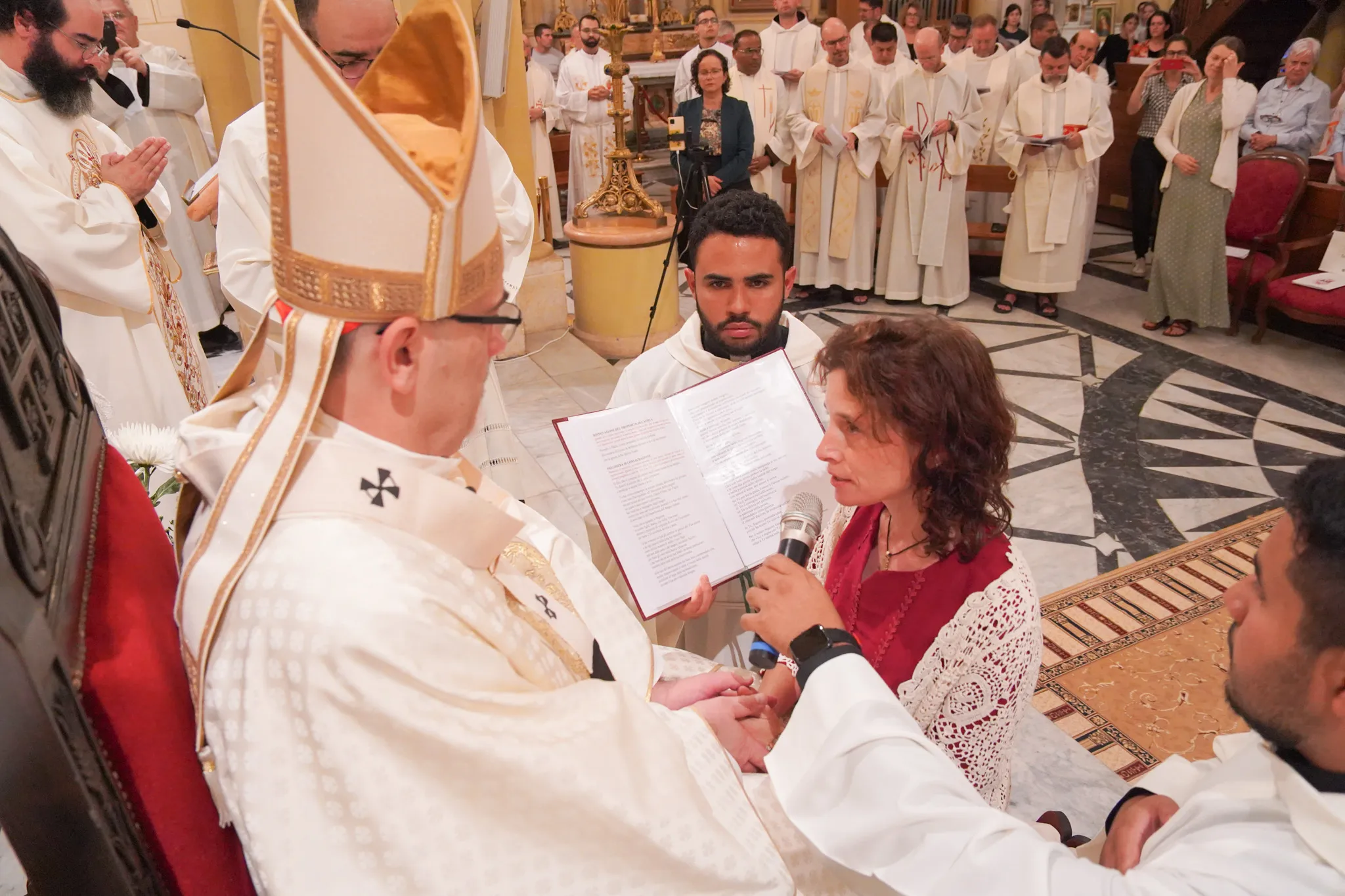
On the 25th day of the ongoing conflict between Israel and Hamas, the Church in Jerusalem welcomed a new consecrated member into its fold. María Ruiz Rodríguez made her consecration in the Ordo Virginum on Nov. 1, permanently rooting herself in the local ecclesiastical community.
“A thought crossed my mind, a temptation: ‘What purpose does this step serve in the midst of current events? Doesn’t the Church have more urgent matters to attend to than to stop and celebrate the consecration of a humble woman like me?’” Ruiz shared with CNA a few days later. But she said she was immediately aware of something else.
“I told myself: I cannot delay this commitment… In fact, uniting my life with the Church in a time of suffering is even more meaningful,” she said.
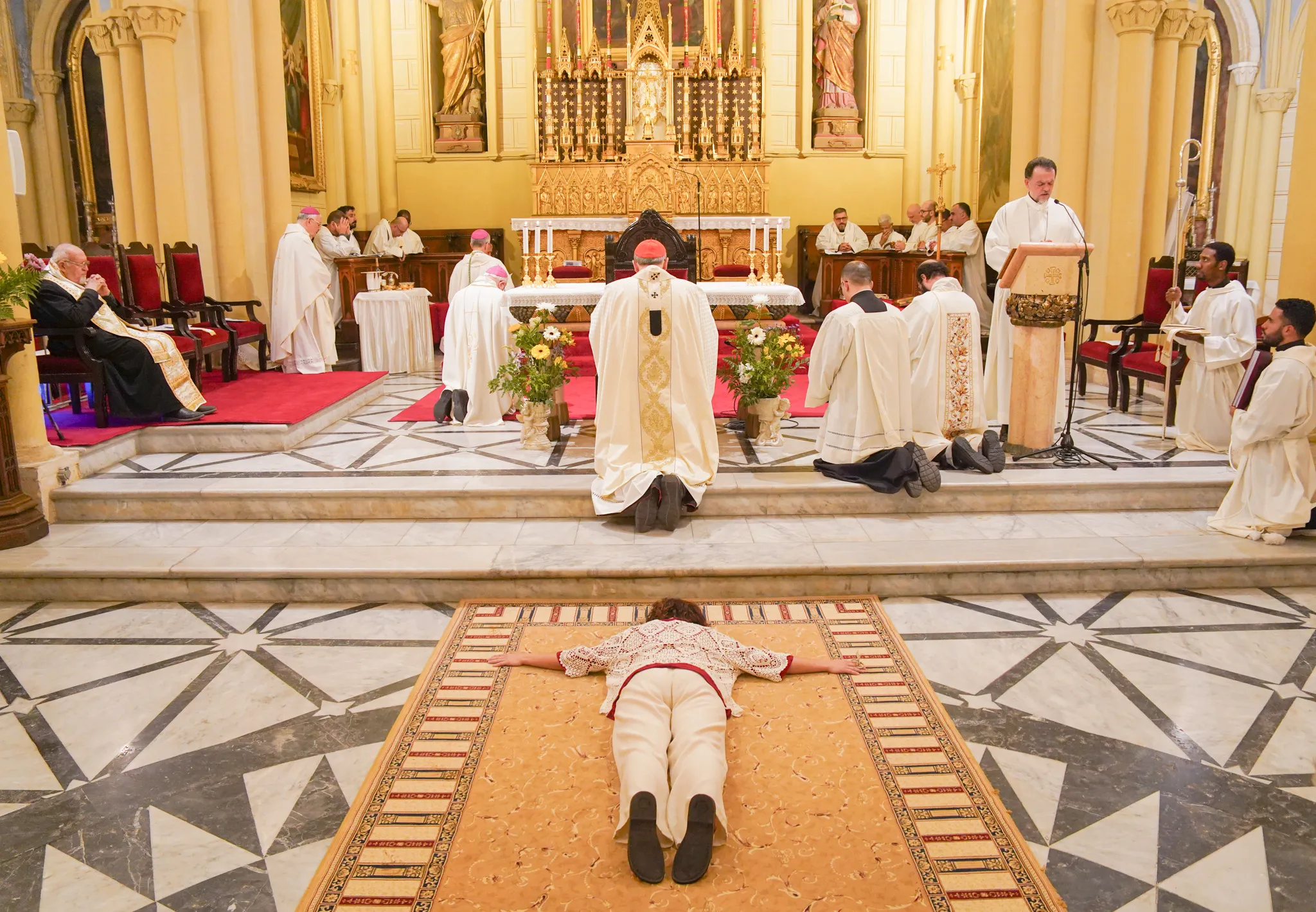
Cardinal Pierbattista Pizzaballa, Latin patriarch of Jerusalem, presided over the consecration of María Ruiz Rodríguez in the Ordo Virginum on Nov. 1, 2023, in the Church of the Latin Patriarchate of Jerusalem. With this consecration, Ruiz permanently rooted herself in the local Church. Credit: Marinella Bandini
Ruiz, now 42, is originally from Spain and arrived in Jerusalem in 2018 for a period of discernment. At that time, she was a member of the “Monastic Family of Bethlehem, the Assumption of the Virgin Mary and St. Bruno,” an institute of consecrated life established in France in 1950.
It was Ruiz’s first time in the Holy Land, even though the desire to visit the sacred places in the Holy Land had long been a dream in her heart.
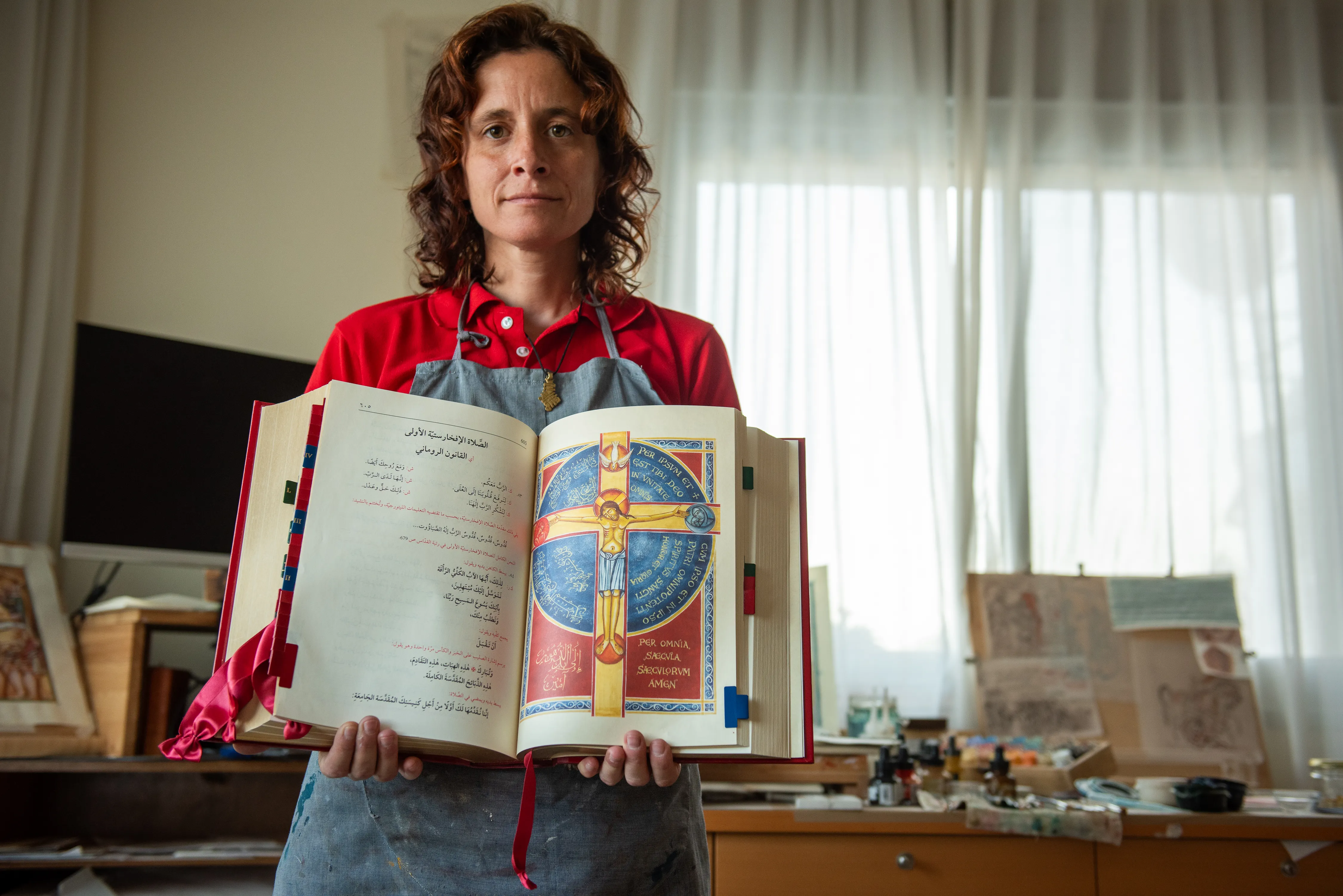
Iconographer María Ruiz Rodríguez with the new Roman Missal in Arabic. The book is open on the page where she depicted the Crucifixion of Jesus. Credit: Marinella Bandini
“For two years, I set aside my savings to make a pilgrimage in 2000, the year of the Great Jubilee. However, in that very year, I entered the convent, so I gave up. I felt that Jesus was saying to me: ‘I am your Holy Land.’ In a way, I had already arrived in Jerusalem,” Ruiz said.
It was in the Holy Land that Ruiz first came into contact with some consecrated women of the Ordo Virginum.
“I was looking for my place and I felt called,” she said.
The Ordo Virginum, Ruiz continued, “is the oldest form of consecration in the Church”. Abandoned over the centuries in favor of the religious life, it was rediscovered with the Second Vatican Council as a form of life that, “in a radically transformed historical context” possesses “a surprising force of attraction” and is “capable of responding not only to the desires of many women to dedicate themselves totally to the Lord and to their neighbors, but also to the concurrent rediscovery by the particular Church of its own identity in communion with the one Body of Christ” (cf. Instruction “Ecclesiae Sponsae Imago” on the “Ordo Virginum”).
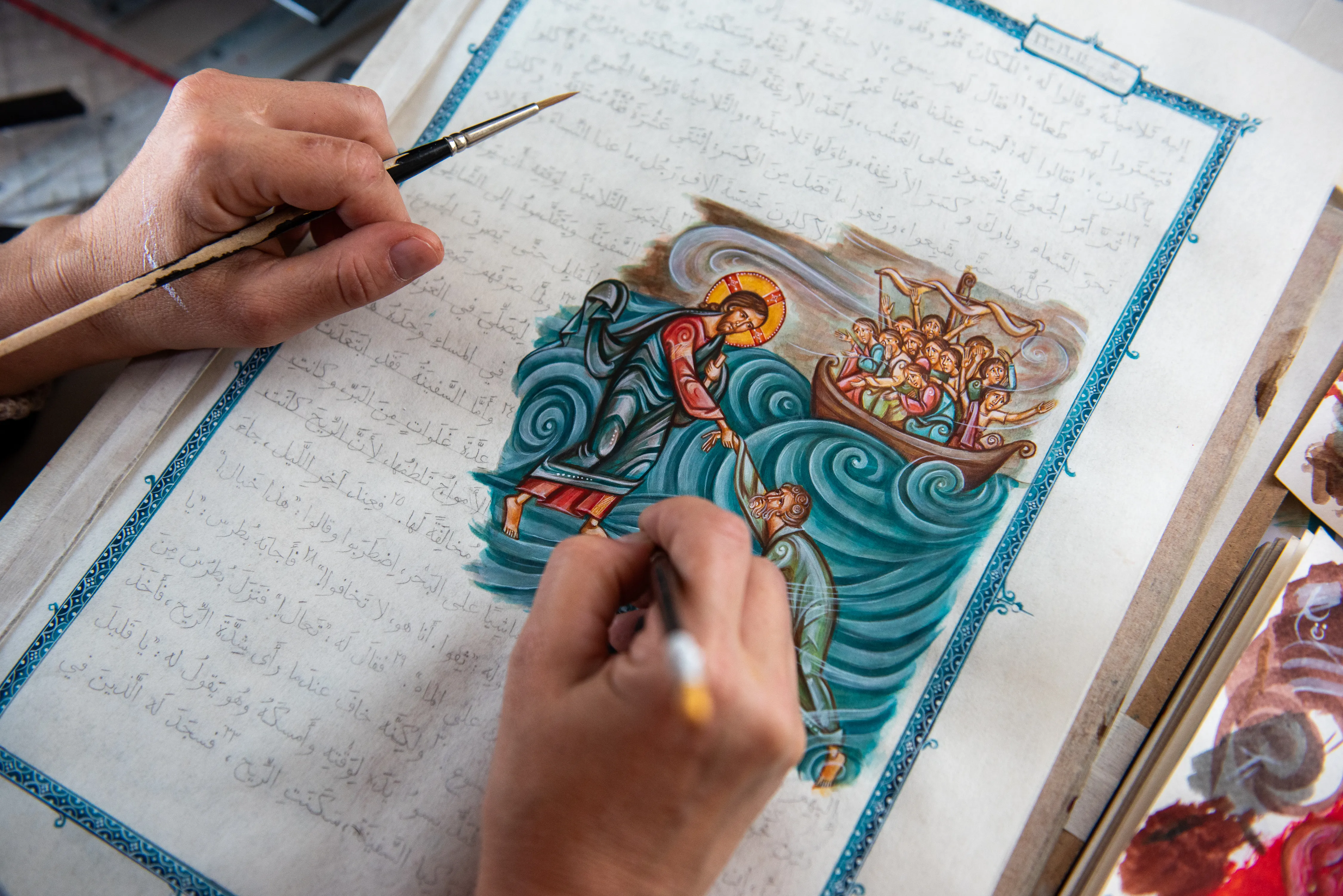
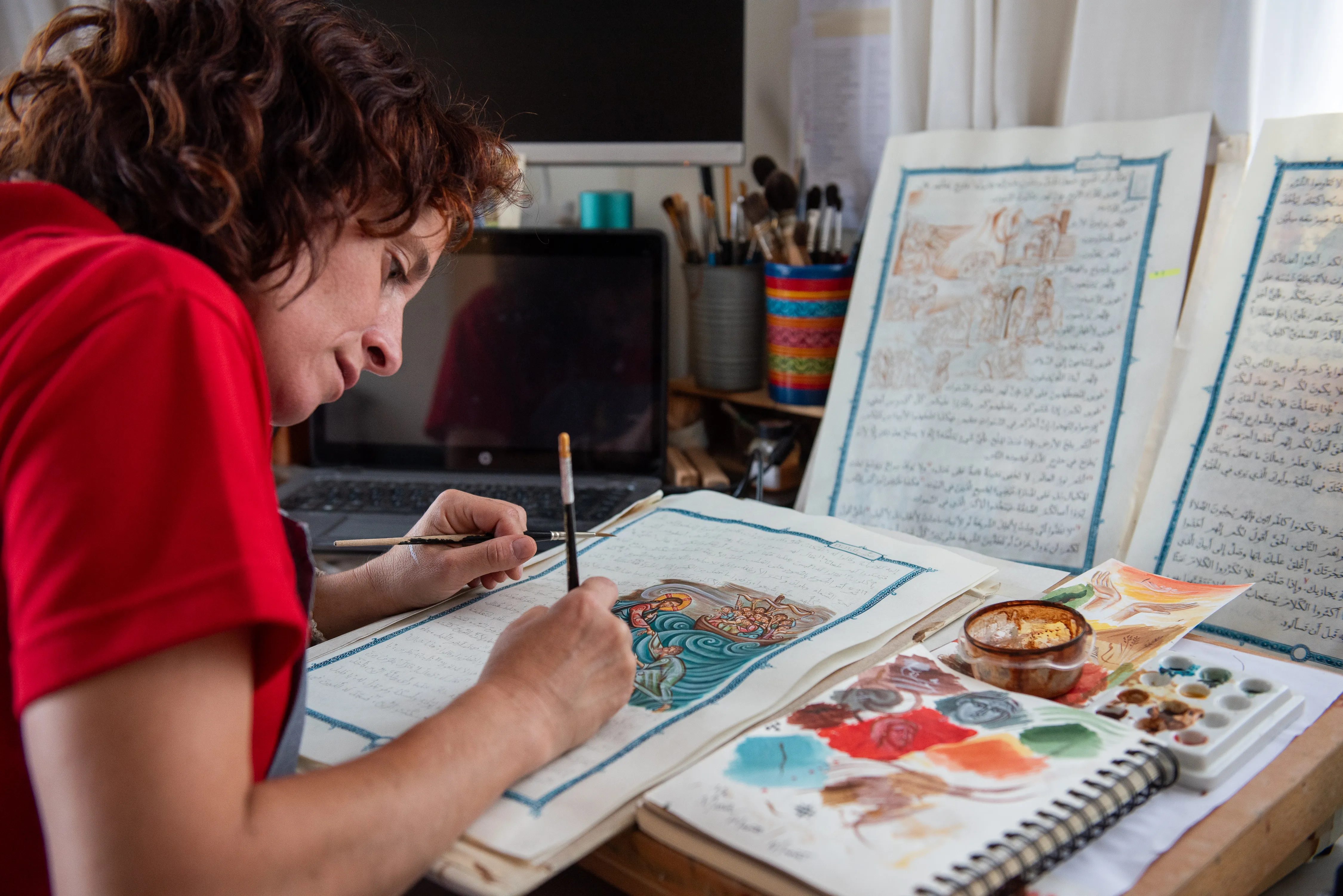
Iconographer María Ruiz Rodríguez at work in her studio. The image depicts Jesus walking on water and taking St. Peter’s sinking hand (Mt 14:22-33). Credit: Marinella Bandini
Consecrated women in the Ordo Virginum choose to live a life of virginity “for the sake of the kingdom of heaven” in a lay form of life. They do not wear religious habits, do not live in communities, have no common statutes or rules, or even superiors. Instead, they maintain a personal reference to the local bishop — in this case, Cardinal Pierbattista Pizzaballa — who acts as guarantor of their journey of discernment and presides over their consecration.
The sole commitment these consecrated women make is the “resolution of chastity,” which they express during the Rite of Consecration. The only symbol they wear is a ring, emphasizing the spousal character of this vocation, which reflects the mystery of the Church as “Bride of Christ.” Engraved in Ruiz’s ring is an inscription in Hebrew meaning “O my life,” referring to Christ, and the date of her consecration.
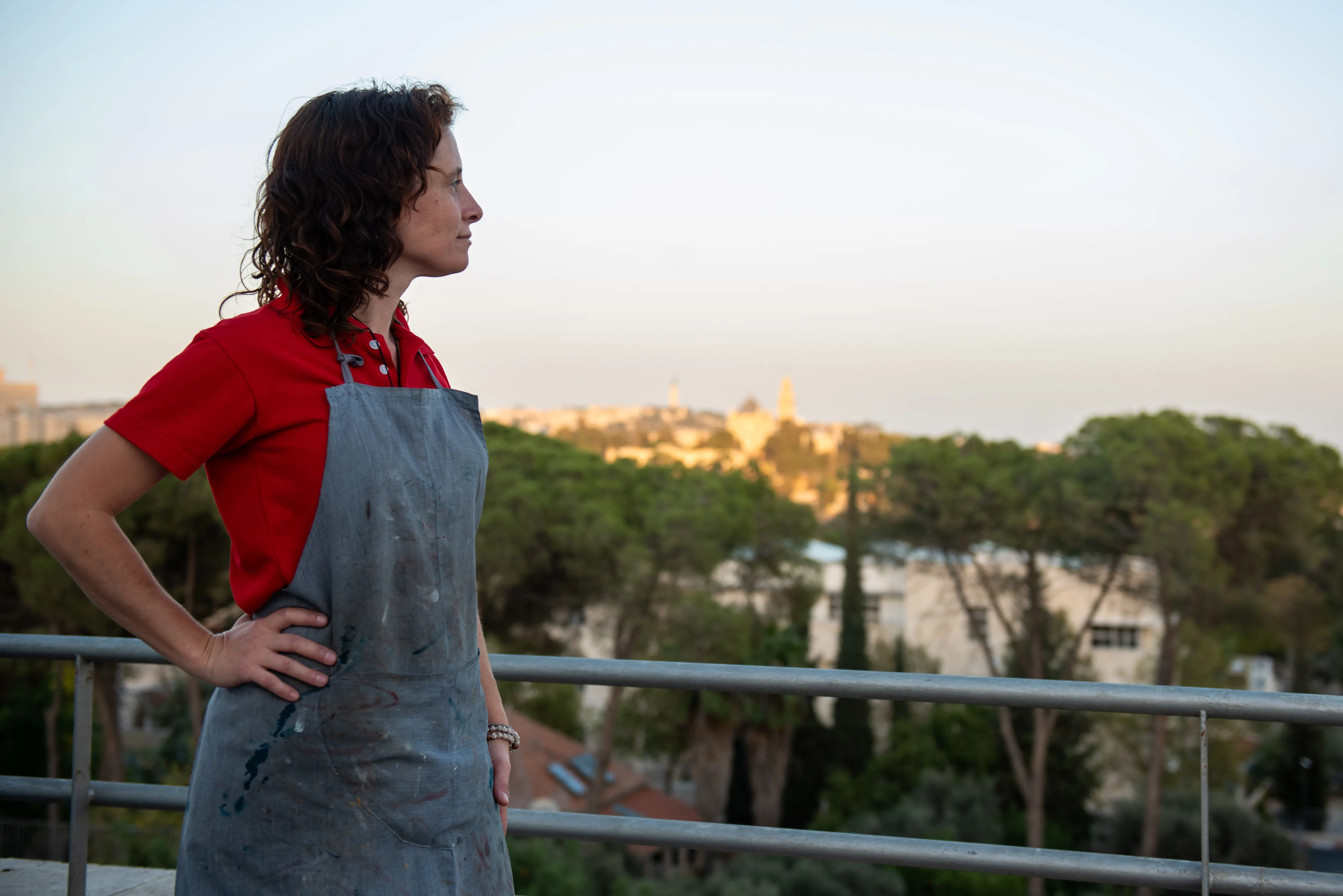
Iconographer María Ruiz Rodríguez on her terrace looking at the horizon. In the background are the walls of Jerusalem and the outline of the Basilica of the Dormition, November 2023. Credit: Marinella Bandini
Women who consecrate themselves in the Ordo Virginum support themselves through their jobs. Ruiz is an iconographer and has been working for the Latin Patriarchate of Jerusalem for about four years. She was drawn into a project aimed at renewing liturgical books — the Missal and the Evangeliary — with her artwork.
“I first approached iconographic art when I was a nun. It was first of all a spiritual journey, a path of prayer. More than an artistic expression, an icon is a profession of faith. Before beginning the work, I invoke the Holy Spirit and ask for forgiveness for my own sins and for those who will venerate these images. I was interested in this dimension of relationship,” Ruiz shared. She spent a year researching the style and colors.
“The patriarch asked me to create something that would speak to local Christians, who are Latin by tradition but Eastern by culture. A style that was uniquely mine yet rich in the entire iconographic tradition of the Church of Jerusalem. The art of Armenian manuscripts certainly had a significant influence on me.”
Iconographer María Ruiz Rodríguez at work in her studio. Currently, Ruíz is in the process of creating the images for the Gospels of Matthew and Mark. Credit: Marinella Bandini
The patriarch takes a personal interest in overseeing Ruiz’s work. “We read the Gospel together and choose which scenes to represent, taking into account the particularity of each evangelist. He particularly enjoys highlighting passages that are less frequently represented in the artistic tradition. This is a project close to his heart,” she told CNA.
Currently, Ruíz is in the process of creating images for the Gospels of Matthew and Mark.
“The process is very laborious and involves multiple stages for each page: the pencil lettering, the crafting of the icons, then the ink lettering and finally the gilding.” The plan is for a volume of about 200 pages with 250 images.
“Making this work in Jerusalem has a special value: I can visit the places where that Gospel was lived” but also “immerse myself in Jewish culture,” she said. “This has opened my eyes to the richness that Judaism brings to Christianity. There is a perfect continuity and at the same time an unprecedented newness in the person of Christ.”
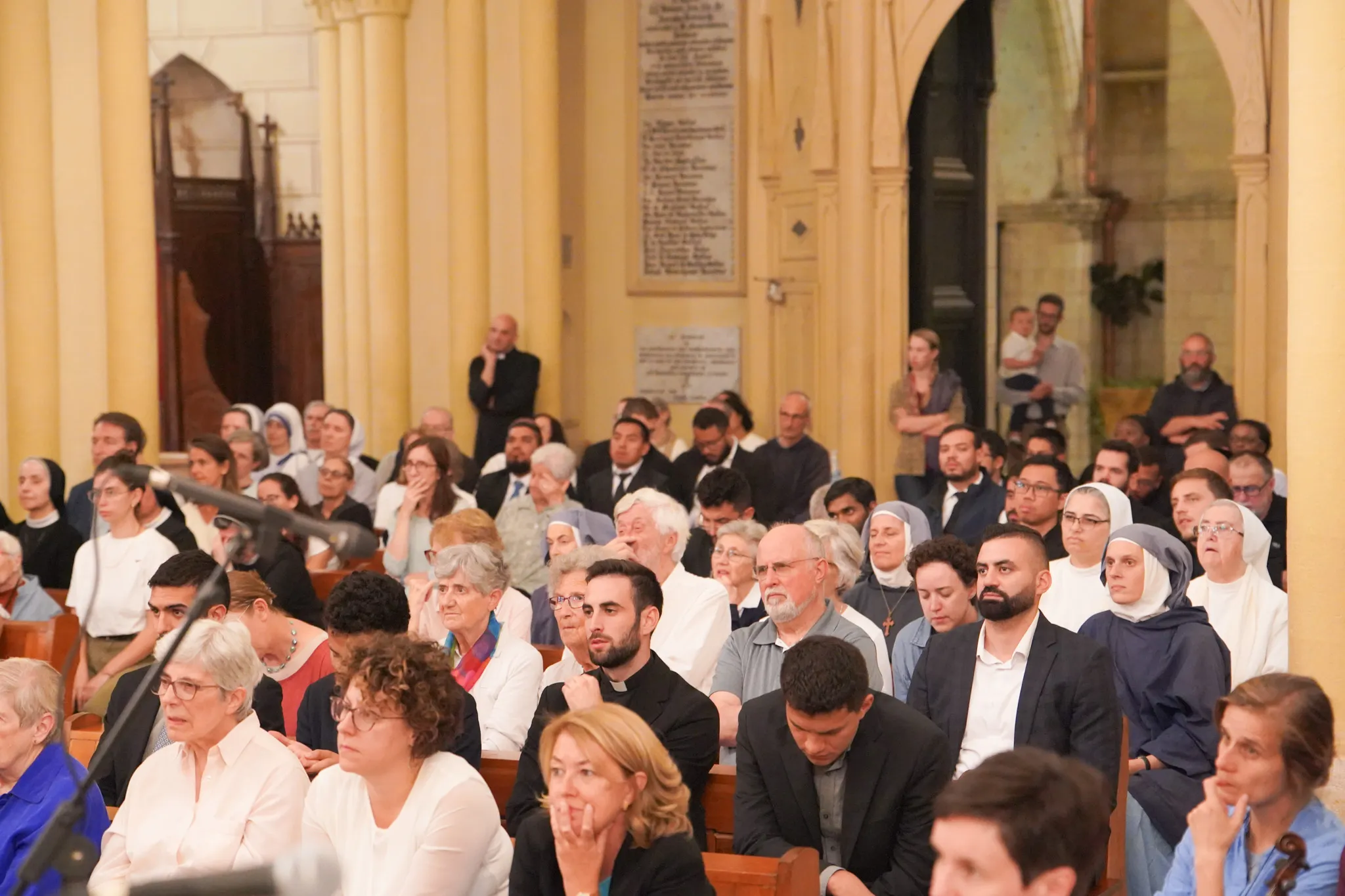
The Church of the Latin Patriarchate of Jerusalem full of people on Nov. 1, 2023, for the Mass of consecration of María Ruiz Rodríguez in the Ordo Virginum. Credit: Latin Patriarchate of Jerusalem
Ruiz learned the local languages — Arabic and Hebrew. The Mass of her consecration brought together within one place all the diverse “souls” of the Jerusalem Church: priests, friars, religious, and laity, Arab Christians and Hebrew-speaking Christians, each hearing the word of God in their own language. There were migrants, foreigners, Jews, and Christians of various denominations.
The culminating moment of María Ruiz Rodríguez’s consecration in the Ordo Virginum. The celebration took place on Nov. 1, 2023, in the Church of the Latin Patriarchate of Jerusalem. Credit: Latin Patriarchate of Jerusalem
“I believe my being a foreigner is a blessing for this Church,” Ruiz said. “Why were there such different people in the church that day? Because I am neither Arab nor Jewish, and this allows me to bring both of these peoples into my heart together. In the praise of God we were one people, transcending the divisions that usually separate us. The Church in Jerusalem also needs this, to remember its universal vocation.”
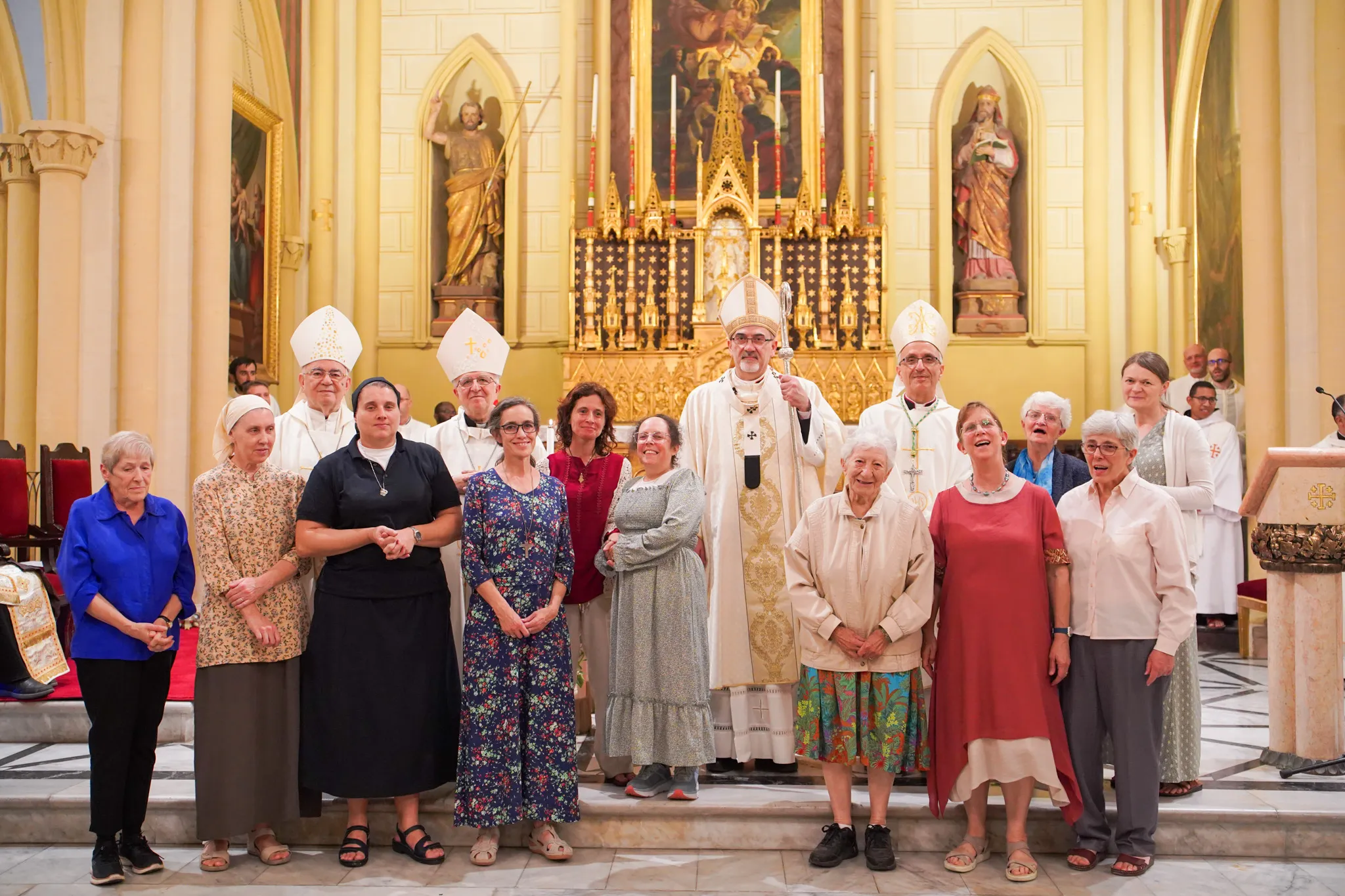
Group photo at the end of the Mass of consecration of María Ruiz Rodríguez in the Ordo Virginum. With her (in the middle, with red shirt) there are other members of the Ordo Virginum, and the bishops of the Latin patriarchate of Jerusalem (from left to right: Giacinto-Boulos Marcuzzo, bishop emeritus; Monsignor William Shomali, general vicar and patriarchal vicar for Jerusalem and Palestine; Cardinal Pierbattista Pizzaballa, Latin patriarch of Jerusalem; Monsignor Rafic Nahra, patriarcal vicar for Israel). Credit: Latin Patriarchate of Jerusalem
With her consecration, Ruiz embarks on her new journey as a “living stone” of the Jerusalem Church: “I am certain that I am finally in the right place. It is not an act of heroism. I am simply where God wants me to be.”
A photo of Deborah Emmanuel’s photo on her Facebook page. Emmanuel, a Christian student in Nigeria, was killed by an Islamic mob on her college campus on May 12, 2022. / CNA
Washington, D.C. Newsroom, Jun 23, 2022 / 14:01 pm (CNA).
Deborah Emmanuel, the Nigerian Christian student who was murdered by a Muslim mob last month, spent her final hours with a close friend who has shared exclusive details of the brutal killing with CNA.
CNA is using the pseudonym “Mary” for the woman’s protection. A Christian herself, she nearly was killed by the same mob.
Significantly, Mary’s account contradicts the claim of authorities that they attempted to rescue Emmanuel from the mob but were “overwhelmed.”
On the contrary, the police “could have stopped the murder if they had really tried,” Mary told CNA.
Emmanuel’s so-called “blasphemy murder” took place on May 12 on the campus of Shehu Shagari College of Education in Sokoto, Sokoto State, a major city located in the northwest corner of Nigeria. The city is home to the Muslim Sultan who serves as the top religious authority for Nigeria’s 100 million Muslim believers.
Prior to the attack, Emmanuel, a home economics major who attended Evangelical Church Winning All, was bullied by fanatical Muslim students at the teacher’s college for audio statements she made on WhatsApp, a messaging platform. She credited Jesus Christ for her success on a recent exam, and when threatened and told to apologize she refused, invoking the Holy Spirit, saying “Holy Ghost fire! Nothing will happen to me,” according to WhatsApp messages reviewed by CNA.
In the aftermath of these heated exchanges, a Muslim mob attacked Emmanuel on the college’s campus. After an hours’ long siege, the mob beat and stoned her to death, then set her body on fire with burning tires, according to graphic video footage posted online. The rioters also rampaged in a Catholic Church compound in Sokoto, according to reports. The riots spread to other Christian-owned properties over two days.
A relative of Emmanuel’s, who said he was standing approximately 60 feet from the mob, also told CNA he believes the police could have saved her. He, too, asked that his identity be withheld for his safety.
Unarmed campus security personnel made a futile attempt to rescue Emmanuel, according to a campus security report shared with CNA. But Emmanuel’s relative said there were dozens of armed police officers on the scene who didn’t fire their weapons.
The commissioner of police in the state also said officers did not fire their weapons. However, he maintained that only 15 of his officers were at the scene, according to a report in The Epoch Times.
Bishop Matthew Hassan Kukah of the Diocese of Sokoto has strongly condemned the attack and called on Emmanuel’s killers to be brought to justice..
“This matter must be treated as a criminal act,” he said. You can read his full statement here.
A plea for help
On the day of Emmanuel’s death, Mary received a frantic phone call from her around 9 a.m, asking for help. By that time, women who lived in her dormitory had begun slapping Emmanuel, Mary told CNA.
Mary arrived at the campus to see her friend surrounded by a mob and being led by a campus staffer to a gatehouse building for her protection. The Muslim students had bloodied her face and head with blows from rods and were joined by male students who believed their duty was to execute a blasphemer on the spot, Mary said.
“Allahu Akbar!” meaning “God is Great” was bellowed for hours, she said.
Mary initially stayed outside the building and tried to intercede for her friend, but she said it wasn’t long before the mob turned on her, too. Within moments Mary was trying to ward off punches and blows from sticks as she backed away from the gatehouse and toward the gate of the college 40 feet away.
Mary said a college lecturer rescued her and brought her to join Emmanuel inside the gatehouse by 10 a.m.
At 10:25 a.m., the relative said, six officers of the Department of State Security (DSS) — the equivalent to the FBI in the U.S. — arrived, firing their rifles in the air but with no effect. Five minutes later, he said, a group of Sokoto police came on the scene and fired tear gas, temporarily scattering the mob.
The above map is based on eyewitness accounts of the murder of Nigerian Christian student Deborah Emmanuel on her college’s campus on May 12, 2022. Graphic by Alexander Hunter
For about 10 minutes police had an opportunity to disperse the mob and force their way to the gatehouse to extract Mary and Emmanuel, Emmanuel’s relative believes. But that did not happen.
By 11 a.m., the mob had returned to the building, holding cloths against their faces to ward off the tear gas. The mob tried hurling stones at Mary through the windows of the locked gatehouse, but Mary barricaded herself behind a table.
The mob then threw gasoline on the women through the front windows and attempted to burn them alive, Mary said.
“Deborah was soaked with gasoline, but when lighted plastic was pitched in through the windows, I quickly stamped the flames out,” Mary said.
No escape
All of this transpired as police and DSS officers watched from a safe distance, according to Emmanuel’s relative.
The traumatized women said little to each other, but Emmanuel was still hoping to do her examination that day, Mary said. At one point, she recalled, Emmanuel asked, “What time is it? I have an examination at noon.” Mary said she looked at her cell phone and told her it was 1 p.m.
After another excruciating hour of siege, the mob pushed down a single Sokoto policeman guarding the door, broke the padlock on the door, and rushed in to find Mary and Emmanuel hiding behind furniture, Mary and the relative related. Two rioters placed a chain around Mary’s neck and pulled it hard, trying to strangle her, she recounted.
“Let this girl go! She is not an offender,” Mary recalled one of the rioters shouting. But as they released her, a young man in the mob grabbed Emmanuel and took her to the front steps of the gatehouse. There she was bludgeoned with steel pipes and wooden rods and stoned, the relative said.
Two DSS officers attempted to rescue Emmanuel but were hit by stones and pushed aside, the relative said. The police officers remained in position and did not come to her aid, he alleged.
Mary collapsed inside the gatehouse gasping from the strangulation. Approximately 40 minutes later, she said, she was roused by one of the mob to leave the building, which was on fire.
As she walked through the smoke, Mary saw the gatehouse burning and Emmanuel’s lifeless body in flames.
The face of Christian persecution
In the aftermath of Emmanuel’s murder, human rights advocates and others have leveled sharp criticism at Nigeria’s government leaders for not doing enough to stem the rising tide of violence directed at Christians and other non-Muslims.
Relatives of Deborah Emmanuel at her burial in Niger State, Nigeria. Courtesy of the Emmanuel family
Anti-Christian hatred was evident in days of rioting in Sokoto following the arrest of two suspects in Emmanuel’s murder. The rioters reportedly were incensed that there were any arrests at all.
“Deborah Emmanuel, like kidnapping victim Leah Sharibu (who was enslaved by Boko Haram insurgents in 2019), has become the face of Christian persecution in Nigeria,” said Kyle Abts, executive director of the International Committee on Nigeria (ICON). “There has not been an official report from the security forces on the lynching of Ms. Emmanuel. Her killing and subsequent riots show clear government complicity and coverup.”
Tina Ramirez, founder of the international nonprofit Hardwired Global, also believes the Nigerian government has been unwilling to take a strong stand against blasphemy killings.
“The recent attacks on students are reminiscent of the attacks at Nigerian colleges two decades ago that were the precursor to the growth of extremist groups across Nigeria’s North and Middle Belt,” Ramirez wrote in a text to CNA.
Leave a Reply