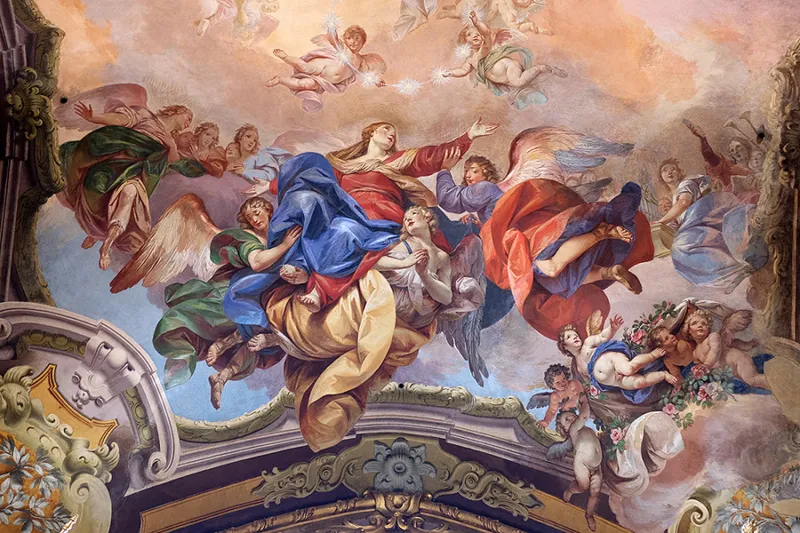
Assumption of the Virgin Mary, fresco painting in San Petronio Basilica in Bologna, Italy. / Zvonimir Atletic / Shutterstock.
Washington D.C., Aug 15, 2023 / 02:30 am (CNA).
On Aug. 15, Catholics around the world mark the Feast of the Assumption of Mary, commemorating the end of her earthly life and assumption into Heaven.
But while the feast day is a relatively new one, the history of the holiday — and the mystery behind it — has its roots in the earliest centuries of Christian belief.
The Catholic Church teaches that when Mary ended her earthly life, God assumed her, body and soul, into heaven.
The dogma of the Assumption of Mary — also called the “Dormition of Mary” in the Eastern Churches — has its roots in the early centuries of the Church.
While a site outside of Jerusalem was recognized as the tomb of Mary, the earliest Christians maintained that “no one was there,” theologian and EWTN News Vice President and Editorial Director Dr. Matthew Bunson explained.
According to St. John of Damascus, the Roman emperor Marcian requested the body of Mary, Mother of God at the Council of Chalcedon, in 451.
St. Juvenal, who was Bishop of Jerusalem told the emperor “that Mary died in the presence of all the Apostles, but that her tomb, when opened upon the request of St. Thomas, was found empty; wherefrom the Apostles concluded that the body was taken up to heaven,” the saint recorded.
By the 8th century, around the time of Pope Adrian, the Church began to change its terminology, renaming the feast day of the Memorial of Mary to the Assumption of Mary, Bunson noted.
The belief in the Assumption of Mary was a widely-held tradition and a frequent meditation in the writings of saints throughout the centuries. However, it was not defined officially until the past century.
In 1950, Pope Pius XII made an infallible, ex-cathedra statement in the Apostolic Constitution Munificentissimus deus officially defining the dogma of the Assumption.
“By the authority of our Lord Jesus Christ, of the Blessed Apostles Peter and Paul, and by our own authority, we pronounce, declare, and define it to be a divinely revealed dogma: that the Immaculate Mother of God, the ever Virgin Mary, having completed the course of her earthly life, was assumed body and soul into heavenly glory,” the pope wrote.
The decree was seen as the formalizing of long-held Christian teaching.
“We have throughout the history of the Church an almost universal attestation of this,” Bunson said of the Assumption.
“We have this thread that runs throughout the whole of the history of the Church in support of the dogma. That’s significant because it supports the tradition of the Church, but it also supports a coming to a deeper understanding of the teachings of the Church of how we rely upon the reflections of some of the greatest minds of our Church.”
What’s also notable about the dogma, he added, is that it “uses the passive tense,” emphasizing that Mary did not ascend into heaven on her own power, as Christ did, but was raised into heaven by God’s grace.
Today, the Feast of the Assumption is marked as a major feast day and a public holiday in many countries. In most countries, including the United States, it is a Holy Day of Obligation.
Bunson explained that on major feast days, it’s fitting to mark the significance of the feast as especially vital by emphasizing the necessity of celebrating the Eucharist that day.
“What is more fitting than on the Assumption of the Blessed Mother to, once again, focus on her Son, on the Eucharist?” he asked.
This article was previously published on CNA on Aug. 15, 2021, and has been updated.
If you value the news and views Catholic World Report provides, please consider donating to support our efforts. Your contribution will help us continue to make CWR available to all readers worldwide for free, without a subscription. Thank you for your generosity!
Click here for more information on donating to CWR. Click here to sign up for our newsletter.
“Wheel of Fortune” host Pat Sajak attends a taping of the show’s 35th anniversary season at Epcot Center at Walt Disney World in Orlando, Florida, in 2017. / Credit: Gerardo Mora/Getty Images
Boston, Mass., Sep 3, 2023 / 06:00 am (CNA).
Pat Sajak, the longtime host of the popular television game show “Wheel of Fortune,” will be retiring after this upcoming season.
After more than 40 years in that role, Sajak is like a member of the family for the show’s millions of fans.
A lesser-known fact about the Emmy winner is that he’s the chair of the board of trustees at Hillsdale College, a small Christian, classical liberal arts school in southern Michigan that is often branded as “conservative” and which one magazine has even described as being “at the heart of the culture wars.”
Founded by Freewill Baptist slavery abolitionists in 1844, Hillsdale defines itself as “nonsectarian Christian.” But Sajak’s many Catholic fans might be interested to know that Hillsdale has a thriving Catholic community of students and faculty — and has become something of a hub for converts to the Catholic faith.
An average of about 15 students from Hillsdale convert to Catholicism each year, Kelly Cole, a staff member from the local St. Anthony Catholic Church, which ministers to the students, told CNA.
Additionally, in recent years certain Catholic prelates have made visits to campus including Winona-Rochester Bishop Robert Barron, who gave the college’s graduation commencement address in May, and German Cardinal Gerhard Müller, former head of the Vatican’s doctrinal office, who offered a lecture on campus in 2021.
Is Pat Sajak Catholic?
Sajak declined an interview with CNA. While his religious affiliation isn’t clear, a 1993 article from the Los Angeles Times reported that Sajak received an annulment from the Catholic Church. Sajak’s first marriage was with Sherril Sajak, but after they divorced, he married Lesly Brown, his current spouse of over 30 years, according to Hollywood Life.
People magazine reported that Sajak married Brown at a Catholic church in Annapolis, Maryland, in 1989. Outsider reported that this church was St. Mary’s.
A Chicago native, Sajak, who called himself an “unapologetic conservative” in a 2012 interview with the Hoover Institution, has Polish roots and described his upbringing as blue-collar. A Vietnam veteran, he served as a television weatherman before his time at “Wheel of Fortune.”
“Wheel of Fortune” host Pat Sajak speaks at the Hillsdale College graduation ceremony on May 17, 2019, in his first year as chairman of the board of trustees at the college, located in Hillsdale, Michigan. Credit: YouTube/Hillsdale College
Since 2019, Sajak, who is 76 according to the History Channel, has been serving as chairman of the board for the school. But he’s been involved with the school long before he was the chair, serving as the vice chairman of the board of trustees beginning in 2003.
He said in his interview with the Hoover Institution that he came to Hillsdale as a result of his relationship with the school’s president, Larry Arnn, whom Sajak met when he served on the board of the Claremont Institute, a conservative think tank.
In that interview, he praised the school for not taking government funding, something that Hillsdale prides itself on.
The school was included in the Princeton Review’s 2024 edition of the nation’s best colleges, earning a No. 3 ranking of “most conservative students,” a No. 2 ranking of “most religious students,” and a No. 2 ranking of having the “friendliest students.”
A Great Books curriculum
Why is Catholic life at Hillsdale so vibrant?
On Hillsdale’s website, the school prides itself on a core curriculum that “considers the spiritual and intellectual inheritance of the Western Tradition and provides a fuller perspective on the world and its workings.”
From the school’s longtime English professor David Whalen’s perspective, the college’s “traditional, Great Books-heavy curriculum” inevitably brings students into contact with many ideas that are influenced by the Catholic faith.
The Great Books curriculum consists of literature courses mandatory for every student.
Professor David Whalen has been teaching English at Hillsdale College for almost 30 years. Credit: YouTube/Catholic Diocese of Lincoln
Whalen, a Catholic who is also the school’s associate vice president for curriculum, said that the amount of Catholic conversions each year is a result of “grace” but “also the natural consequence of young people reading deeply in the Western intellectual and spiritual tradition and reflecting on their own beliefs.”
While the “great majority” of Hillsdale’s faculty and students are not Catholic, Whalen said that the atmosphere on campus is “highly collegial” and the Catholic community flourishes at the school.
“There are enough Catholic students, faculty, and staff to sustain a quite vibrant Catholic community and, at the same time, integrate with the campus as a whole,” he said. “This makes the college attractive to Catholic students, as does its traditional curriculum and strong academics.”
Being a minority on campus, Catholics would do well to brush up on their faith, Whalen said.
“This is a highly intelligent place, and people with different beliefs are going to be articulate and thoughtful about them. So, the Catholics here need to be so as well,” he said.
Taking Catholicism seriously
Cole, who converted to Catholicism the year she graduated from Hillsdale in 2002, said that she took Whalen’s literature course and it had a major impact on her conversion.
But it wasn’t just the literature classes that pushed her to convert, it was mainly the history courses, she said.
“And my history courses were taught by Protestants; it wasn’t Catholics that were teaching this or anything,” she noted.
Kelly Cole, who is seen in this photo with two of her seven children William (right) and Alex (left), graduated from Hillsdale College and converted to Catholicism in 2002. Credit: Kelly Cole
Cole, 43, said that “trying to faithfully engage with history and the history of Christendom and talking about our Judeo-Christian heritage just led to me feeling like I needed to take Catholicism seriously.”
Earlier this year, the Diocese of Lansing posted a video highlighting the 2023 Easter Vigil at St. Anthony’s in which 24 people, 22 of them Hillsdale students, were received into the Catholic Church.
Today, Cole, her husband, Lee Cole — a professor at the college — and her seven children all reside in Hillsdale, where she serves on staff at the city’s St. Anthony Catholic Church, where she was received when she converted more than 20 years ago.
Defenders of the faith
Just as it did then, St. Anthony is the sole institution providing the sacraments to students on campus. But the church works hand in hand with the school’s “Catholic Society,” a student-led club that organizes social events and opportunities for students to receive the sacraments and brings speakers to campus.
Noah Hoonhout, a 2023 graduate who led the school’s Catholic student organization, said that the Catholic Society is “the most active” club on campus.
Among the recent speakers the society has sponsored are German Cardinal Gerhard Müller and American theologian George Weigel, both of whom drew large crowds, according to Hoonhout.
Noah Hoonhout, 22, a 2023 graduate, was the president of Hillsdale’s Catholic Society in his senior year. Credit: Noah Hoonhout
According to the Hillsdale Daily News, the school’s president called Weigel and Müller “ardent defenders of the immemorial teachings of the Christian faith and of the liberty of the human soul before God that Hillsdale College holds so dear” following their lectures in 2021.
Whalen told CNA that when Müller visited campus he was invited to say a few words at a dinner in his honor at the school’s president’s house.
Whalen said that Müller “gave an extemporaneous short talk that was both brilliant and beautiful. It was a great moment.”
The Catholic Society points students toward St. Anthony’s many ministries, one of which is specifically established for Hillsdale students called “The Grotto.”
The Grotto is a house located near campus where students can come and pray before the Blessed Sacrament.
Each week, the Grotto offers Mass, confession, eucharistic adoration, the recitation of the rosary, formation events, and social gatherings for the students, such as “convivium,” where dozens of students will gather for dinner at the house on Thursday nights and hear a talk on the Catholic faith from a professor at the school.
Hoonhout, 22, said that the Grotto is one of the “centers of Catholic culture” on campus.
What’s next?
In Sajak’s long tenure at “Wheel of Fortune,” he has earned several awards, including a Daytime Emmy Lifetime Achievement Award and a star on the Hollywood Walk of Fame.
In 2019, Guinness World Records deemed him to have “the longest career as a game show host for the same show,” which was 35 years and 198 days at the time, according to abc.com.
Although not much is known about what Sajak will do following retirement from “Wheel of Fortune,” Hillsdale has said that he will continue serving in his role as chairman of its board of trustees.
His role at the game show will be taken over by celebrity host Ryan Seacrest. Sajak’s longtime co-host, Vanna White, reportedly will remain with the show.
“Well, the time has come. I’ve decided that our 41st season, which begins in September, will be my last,” Sajak tweeted on June 12. “It’s been a wonderful ride, and I’ll have more to say in the coming months. Many thanks to you all.”
Pope Francis says Mass in St. Peter’s Basilica, Dec. 24, 2021 / Vatican Media
Washington, D.C. Newsroom, Jan 5, 2022 / 17:00 pm (CNA).
“And I keep my Christmas lights on, on my front porch all year long/and I know all the words to every Charlie Daniels song…”
While Gretchen Wilson was probably (hopefully?) not being literal in the lyrics to her 2004 Grammy Award-winning single “Redneck Woman,” she actually has a bit of a point. There’s nothing wrong with keeping the Christmas decorations up longer than December and keeping the Christmas spirit flowing past December 25.
But just how many days is Christmas? When should you finally take those lights off the porch, or remove the tree? Read on for some of the arguments for and against commonly agreed-upon end dates for Christmas.
“Christmas is one day”
This, of course, is the simplest answer. Christmas is typically celebrated on Dec. 25 for most of the world, and on Jan. 7 for Churches using the Julian calendar, and on Jan. 6 for yet another, considerably smaller, part of the world. On this day, the liturgy celebrated is the “Feast of the Nativity of Our Lord.” Priests wear white vestments on Christmas, which is different from the violet they wear during Advent.
So there you have it. Christmas is one day, either at the end of December or in the first week of January.
Or is it?
“Christmas is eight days”
There’s also an argument to be made that Christmas is eight crazy nights eight days long. The Church regards Christmas as an octave, or eight-day celebration. The octave of Christmas begins on the Feast of the Nativity of Our Lord and concludes on the Solemnity of Mary, Mother of God on Jan. 1.
During the eight days of Christmas, clergy wear white, except during the St. Stephen’s Day and the Feast of the Holy Innocents, when they wear red.
In a liturgical sense, Christmas is eight days.
But wait, there’s myrrh!
“Christmas is 12 days”
We’ve all heard the Christmas carol “Twelve Days of Christmas.” While it’s unclear as to why someone would give someone 23 separate birds, a pear tree, and the services of 50 people over a 12-day period, there actually is a liturgical precedent for claiming that Christmas is 12 days long.
Twelve days after Christmas is the Feast of the Epiphany. This day marks when the Magi arrived to Jesus, Mary, and Joseph, and gave Jesus the gifts of gold, frankincense, and myrrh.
In the Latin Rite of the Catholic Church, Epiphany celebrates the revelation that Jesus was the Son of God. It focuses primarily on this revelation to the Three Wise Men, but also in his baptism in the Jordan River and at the wedding at Cana.
In the Eastern rites of the Catholic Church, Theophany – as Epiphany is known in the East – commemorates the manifestation of Jesus’ divinity at his Baptism in the River Jordan.
But here’s where it gets a little confusing: While the traditional date for the feast is Jan. 6, in the United States, the celebration of Epiphany is moved to the second Sunday after Christmas in the Novus Ordo.
During the 12 days of Christmas, clergy wear white, except during the St. Stephen’s Day and the Feast of the Holy Innocents, when they wear red.
So, there. By the liturgical calendar, one can argue Christmas is also 12 days.
“Christmas ends January 13”
In the usus antiquior of the Roman rite, per the general rubrics of the Roman Breviary, “Christmastide” includes both “the season of Christmas” – the 12 days seen earlier – and “the season of Epiphany” – the eight days from the Epiphany on Jan. 6 to the commemoration of the Baptism of the Lord on Jan. 13.
And what is now called the season of Epiphany was, until 1955, observed as the Octave of the Epiphany.
The Baptism of Christ, which the USCCB states is the end of Christmas, is observed on the first Sunday after Jan. 6 in the Novus Ordo.
After the Baptism of Christ, clergy are to wear the green vestments of Ordinary Time.
What about other customs?
“Christmas is from the day after Thanksgiving until Jan. 15”
In the eyes of my condominium association, that is.
While most places do not have a hard-and-fast date like my complex, it is not uncommon for regions to have either secular or religious traditions centered around Christmas decorations.
For instance, in Colorado, it is supposedly customary to keep Christmas lights up until after the National Western Stock Show, which goes until the third week of January.
In parts of the world that do not observe Thanksgiving in November, Christmas markets open around the second week of November, kicking off the holiday season.
In these cases, Christmas is synonymous with “start of winter. Ish.”
In the liturgical calendar, clergy wear violet and rose vestments during Advent, followed by the white and red of the Octave of Christmas.
Does the celebration of Christmas always have to start in winter?
Here’s looking at you, Southern Hemisphere.
“Christmas goes from mid-October until after the first week of January”
This is only true if you are decorating a Disney theme park.
There is no liturgical or traditional basis for this timeline. However, the decorations are nice, the mood is festive, and I’m not going to complain.
What’s the absolute last possible concrete day of Christmas?
“Christmas is until Candlemas”
Now we’re talking.
Candlemas, or the Feast of the Presentation of the Lord, is Feb. 2. On this day, many Catholics bring candles to the church to be blessed. They can then light these candles at home during prayer or difficult times as a symbol of Jesus Christ, the Light of the World.
Candlemas is the last day that the Alma Redemptoris Mater is the Marian antiphon appended to hours of the Divine Office. The Alma Redemptoris Mater is used from the beginning of Advent through Feb. 2, and so Candlemas has come to be associated with the close of the Christmas season.
Candlemas is still observed with public, Christmas-esque celebrations throughout the world, including in Peru, Puerto Rico, France, and Belgium.
On the other hand, Septuagesima Sunday – which is definitely not part of Christmas – has been known to fall before Feb. 2, giving the lie to the ‘Christmas is until Candlemas’ party.
Is that all, though?
“If there is love in your heart and your mind, you will feel like Christmas all the time”
Now you’re just singing the lyrics to Faith Hill’s “Where Are You Christmas.”
To be clear, this song is a bop, but it is not exactly relevant for this discussion. Using this line is an excuse, albeit a very creative excuse, for why there’s still a wreath on your door in June. By this point, you’re well into Ordinary Time, and it’s time to put the decorations away.
There should, however, be love in your heart and in your mind at all times, as you are a child of God and loved by your creator.
So when does Christmas end? When should the decorations come down?
That is largely a personal call, based on your own traditions, customs, and other factors. For safety reasons, CNA recommends that you take your tree down as soon as it starts shedding a ton of pine needles, but other than that, there’s an argument for leaving things up as late as Feb. 2. Of course, your neighbors may disagree, but that’s a them problem, not a you problem.
CNA Staff, Jul 14, 2020 / 09:50 am (CNA).- The federal government executed its first federal inmate in 17 years on Tuesday, following numerous delays and requests for clemency from the family of the victims.
Daniel Lewis Lee was executed on Tuesday morning and pronounced dead at 8:07 a.m. He was executed at the U.S. Penitentiary in Terre Haute, Indiana. An eyewitness told the Indianapolis Star that it took approximately two to three minutes for Lee to die after the lethal injection drugs were administered.
The execution was permitted by the Supreme Court one day after a lower court blocked it due to overwhelming evidence that the drug protocol the government wanted to use causes “extreme pain and needless suffering,” including feelings of panic and the sensation of drowning as fluid accumulates in the lungs.
A Catholic organization opposed to the death penalty condemned the execution as “unnecessary and avoidable.”
“The federal government relentlessly plotted its course to execute Daniel Lee despite a historic decline in public support for the death penalty, clear opposition by the victims’ family, unwavering Catholic opposition to the restart of federal executions, and an unyielding global pandemic which has already taken more than 135,000 American lives,” said a statement from Kirsanne Vallancourt Murphy, the executive director of Catholic Mobilizing Network.
Lee was sentenced to death in the 1996 murders of a family of three, including an eight-year-old girl. He insisted upon his innocence, and his final words were, “I didn’t do it. I’ve made a lot of mistakes in my life but I’m not a murderer. You’re killing an innocent man.”
Lee, a onetime white supremacist, along with a man named Chevie Kehoe, was found guilty of robbing William Mueller, a gun dealer in Tilly, Arkansas, of cash, ammunition, and firearms before killing him, his wife Nancy, and stepdaughter Sarah. Kehoe and Lee were part of the Aryan People’s Republic, a white supremacist group which Kehoe reportedly founded. The two reportedly planned to use the stolen goods to establish a whites-only nation.
Kehoe was sentenced to life in prison. Family members of the Muellers had requested that Lee also receive a life sentence.
In June, Nancy Mueller’s mother Earlene Peterson stated that she did not wish to see Lee executed.
“As a supporter of President Trump, I pray that he will hear my message: the scheduled execution of Danny Lee for the murder of my daughter and granddaughter is not what I want and would bring my family more pain,” said Peterson.
Family members of the victims were also concerned about the safety of doing an execution during the coronavirus pandemic, as they were nervous about traveling to a prison and being in a confined room to view the execution. Prisons have been the sites of widespread coronavirus outbreaks.
The last federal execution took place in 2003. In 2014, President Barack Obama ordered a Department of Justice (DOJ) review of the federal death penalty after several botched executions by lethal injection in states including Oklahoma and Ohio.
Last summer, Attorney General William Barr instructed the Bureau of Prisons to resume execution of federal prisoners on death row.
Two more federal inmates are set to be executed this week.
On July 7, Archbishop Joseph Kurtz of Louisville, Bishop William Medley of Owensboro, Kentucky, Bishop Oscar Solis of Salt Lake City, Bishop Thomas Zinkula of Davenport, Iowa, and Bishop Richard Pates who is the apostolic administrator of Joliet, Illinois, all joined more than 1,000 faith leaders in calling for a stop to scheduled executions of four federal death row inmates.
“As our country grapples with the COVID 19 pandemic, an economic crisis, and systemic racism in the criminal legal system, we should be focused on protecting and preserving life, not carrying out executions,” the faith leaders stated.
The Catechism of the Catholic Church paragraph 2267 on the death penalty was updated in 2018 with a statement from Pope Francis, calling the death penalty “inadmissible because it is an attack on the inviolability and dignity of the person.”






Happy feast of Mary’s Assumption.