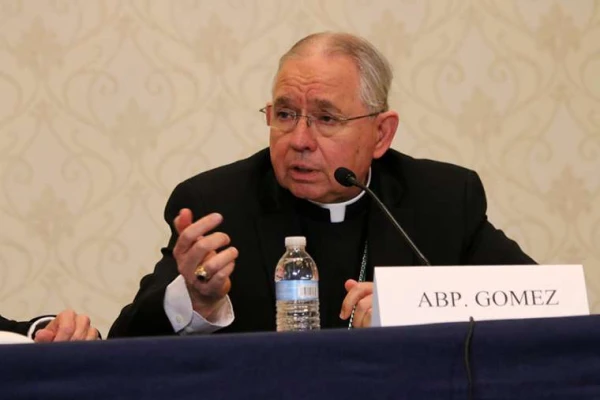
Washington D.C., Jun 17, 2019 / 06:00 pm (CNA).- While the spring meeting of the U.S. bishops’ conference has only just concluded, some bishops are already looking to the election of new conference officers at their November meeting. While the elections are still five months away, bishops are already discussing their options – particularly in light of the scandal the Church in the U.S. has faced in the last year.
It is widely expected that Archbishop Jose Gomez of Los Angeles, the bishops’ conference vice president, will be elected to succeed Cardinal Daniel DiNardo as conference president. Gomez has several factors working in his favor. Most notably is the sheer force of custom: With only one recent exception, the conference vice president has been elected president as a matter of course. That Gomez has served in the second slot for the last three years is likely sufficient by itself for him to secure the votes of most bishops.
Within the conference, Gomez is perceived to cut across traditional ideological and social lines. He was ordained a priest of Opus Dei, and he has a long history of leadership on pro-life and marriage issues. But, an immigrant himself, he is also among the most outspoken advocates for the conference’s call for just immigration reform and advocacy for the poor. He is, in short, difficult to pigeonhole into a partisan camp, and at a time when the Church is increasingly segmented by politics, many bishops see that as an important advantage.
Some bishops have also mentioned to CNA the symbolic significance of electing a Hispanic archbishop, a Mexican-American immigrant, in advance of the 2020 U.S. presidential election. While the bishops have a working relationship with the Trump administration on issues pertaining to abortion, marriage, and religious liberty, they remain strongly opposed to the president’s immigration policies, and if Trump wins a second term, they will likely be at odds with him over that issue throughout. Gomez is seen to be the right voice to lead advocacy on behalf of their immigration agenda.
If a Democrat wins the presidency in 2020, Gomez’ well-known advocacy on immigration could make it easier for him to gain a hearing from a Democratic administration, especially during the battles over religious liberty on gender and sexuality that would be sure to come.
Because Gomez, who leads the largest U.S. diocese, has not been made a cardinal, it is sometimes speculated that he might have a difficult working relationship with Pope Francis, or that the Holy Father might consider him to be too conservative.
This speculation seems to be grounded in particularly American misunderstandings of both men: characterictures of Gomez as a doctrinaire conservative and Francis as a freewheeling progressive work only if the frame of reference is the U.S. left-right divide. Those with experience in Latin and South America are far more likely to see the common threads running through the thought of both: especially a common concern for solidarity with the powerless and the marginalized, including both the unborn and the immigrant.
Ultimately, that Gomez is not yet a cardinal could reflect more about the hermeneutics of the Congregation for Bishops than about any actual division between Pope Francis and the Archbishop of Los Angeles.
Whatever the reason that Gomez is not a cardinal, the archbishop is not perceived to be ineffective in engagement with Rome. Gomez is seen to have successfully manned the point position in negotiating with the Holy See an approach to establishing sexual abuse policies that would be acceptable in both Rome and the U.S. The archbishop became an especially active figure in deliberations after the breakdown in communications that led to the cancelled votes at the bishops’ November meetings.
He does not seem most comfortable at a podium, presiding over the full assembly of bishops, though his aptitude in that role has grown over the course of recent meetings. While DiNardo leads the room with a poise that seems at once fraternal and efficient, Gomez is more reserved in a large public setting. But if this is seen as a liability by some bishops, it is unlikely to overcome both the archbishop’s personal reputation and the force of precedent.
Of course, in recent history, custom has been overcome in conference elections. In 2010, Cardinal Timothy Dolan was unexpectedly elected conference president ahead of Bishop Gerald Kicanas, who was then vice president. Dolan was elected through the work of a cadre of bishops who thought a Kicanas presidency would be out of step with the leadership and emphases of Pope Benedict XVI.
It is possible that Gomez could face a credible and organized opponent in November 2019. Most frequently discussed at the conference, and mentioned to CNA by a few bishops, is the idea that the newly-installed Archbishop Wilton Gregory of Washington, DC, could challenge Gomez for the presidency.
As it stands, though, electing Gregory seems a very remote possibility. In the first place is, again, the sheer force of custom. For Gregory’s supporters to overcome that force would require a great deal of organization, and a good amount of time spent convincing bishops to make a change.
Making their task especially difficult is that Gregory was conference president from 2001 to 2004, and presided over the bishops’ conference response to the sex abuse crisis of 2002. Gregory was the bishop who ushered into being the “Charter for the Protection of Children and Young People” and the accompanying “Essential Norms.”
While the Charter is widely thought to have changed ecclesial culture for the better with regard to child and youth protection, it has been panned during the last year because it is understood to pertain to priests and deacons only, using language that explicitly delineates the exclusion of bishops from some norms.
The shortcomings of the “Dallas Charter,” are not Gregory’s fault, but bishops who want to convey that the Church is moving on from “business as usual” may be reticent to elect as president someone so directly connected to the Charter.
There is also Gregory’s task in Washington. The archbishop is 71, and is largely understood to have only a four-year mandate to begin the process of restoring trust among Catholics in the Archdiocese of Washington, which has been the epicenter of the McCarrick affair, through which Gregory’s predecessor, Cardinal Donald Wuerl, lost a great deal of trust among his priests, and among ordinary Washington Catholics. This task, Gregory is known to understand, will require a considerable investment of personal and pastoral time, and for that reason, the archbishop may not find the prospect of running the bishops’ conference a temptation.
But if he does want the job, there is at least one thing Gregory could do to improve his chances of being elected: He could release from the Archdiocese of Washington’s files on Theodore McCarrick as many records as possible, and encourage other diocesan bishops to do the same. Gregory has the opportunity in Washington to establish a new paradigm of transparency in Church governance – a paradigm much discussed but not yet much demonstrated – by releasing as much as possible on McCarrick, his finances, his friends and protectors, and then encouraging the other dioceses where McCarrick served to do the same.
While Cardinal Joseph Tobin of Newark told CNA this week that he is precluded from issuing a full report on McCarrick by an attorney general’s investigation in the state, Gregory has not indicated that he is under any similar restriction. A comprehensive release of information from his archdiocese would do a great deal to restore confidence in Church leadership among practicing Catholics, and it would likely raise esteem for him considerably among the younger bishops in the conference, who have been calling for just such a release from Rome.
If that does happen, Gomez could face more of a challenge for election as conference president than expected.
Who will be elected vice president?
Some bishops have mentioned to CNA that Tobin could be a natural candidate for the position.
The Archbishop of Newark is affable and friendly to other bishops, well-known, and articulate. He has the experience of leading his own religious community, the Redemptorists, of a senior leadership position at the Congregation for Institutes of Consecrated Life and Societies of Apostolic Life at the Vatican, and has led archdiocesan sees in both the Midwest and on the East Coast. As chairman of the USCCB Committee on Consecrated Life, Clergy, and Vocations, Tobin has played a prominent role in the Church’s response to the McCarrick crisis, and he presented one of the major policy documents on sexual abuse approved by the bishops at their November meeting.
The cardinal, in short, has considerable experience and qualifications that seem relevant to a leadership position at the conference.
But even if he were nominated as a candidate, Tobin might not accept the nomination. The cardinal withdrew from participating in the October 2018 synod on youth, which came just a few months after the McCarrick scandal began. At the time, Tobin recognized the havoc wrought by the McCarrick revelations on his archdiocese, which McCarrick led for more than a decade, and he explained the priority he placed on being present to the people of his own archdiocese, and especially to his priests.
Tobin is a cardinal, which means that he already has responsibilities taking him to Rome with regularity. Given his clear aversion to becoming an “airport bishop,” the cardinal might decline the possibility of adding even more frequent trips to Washington, DC to his schedule, especially as his archdiocese will soon grapple with fallout from the New Jersey attorney general’s investigation, and from the eventual release of Rome’s report on McCarrick.
If he were to stand for election, Tobin would face both episcopal support and criticism for his endorsement of “Building a Bridge”, a 2017 book by Fr. James Martin, SJ, who is a frequent writer and speaker on the topic of Church engagement with those who identify themselves as LGBT or LGBT activists. Bishops are divided on how best to approach that kind of engagement, and Martin’s work is at the center of that divide, because some bishops say that Martin’s work is not faithful to the teachings of the Church, while others actively promote it. While some bishops might be reticent to support a Tobin candidacy because of this, others would take Tobin’s position as a positive sign in the conference.
Tobin’s work on the U.S. implementation of Vos estis lux mundi is appreciated by bishops, as is his work on revisions to the national directory for deacons. But during the last year, Tobin has been the subject of rumors and questions about his personal life from some blogs and websites. The cardinal has denied rumors of misconduct, and scant evidence has turned up to support conjectures made about him. It is unlikely that Tobin would allow such rumors to keep him from serving the Church in whatever way he thinks himself to be called, but there are likely some members of the bishops’ conference who, given the sensitivities surrounding McCarrick and the Archdiocese of Newark, might judge this an inopportune time for the cardinal to stand for election.
Another frequently named possibility for conference vice president is Archbishop Paul Coakley of Oklahoma City. Coakley has been a bishop for 15 years, and served a term as chairman of Catholic Relief Services, the bishops’ international humanitarian aid apostolate.
In his role at CRS, he is generally regarded as having addressed lingering issues pertaining to the Catholic identity of the institution and its partners, in part by bringing together a coalition of moral theologians and international development experts to work through thorny issues. Coakley is also thought to have capably overseen leadership transitions amid a complex period of expansion during his term as CRS board chairman.
Bishops also noted to CNA that Coakley’s archdiocese, Oklahoma City, is perceived to have handled safe-environment related matters well, and that Coakley is perceived to have prioritized recruiting lay collaborators for the administration of his archdiocese.
Though he has a relatively low public profile, some bishops told CNA that Coakley has a moderating voice, is calm under pressure, a clear teacher and an organized administrator. And Coakley is already set to begin in November 2019 a term as chair of the bishops’ influential Domestic Justice and Human Development committee.
While some bishops might prefer a bishop with more name recognition beyond the conference, others told CNA that because he is not seen to carry any “baggage” into the election, the choice of Coakley for vice president could be exactly the right move after the bishops’ year of scandal.
Other names that have been mentioned as candidates for conference vice president are Archbishop Gregory Aymond, Archbishop Allen Vigneron, and Archbishop Bernard Hebda of St. Paul-Minneapolis, who is well regarded for his work to heal an archdiocese deeply wounded by grave clerical abuse scandals.
Of course, none of these figures have yet been nominated to the slate. Nomination requires that diocesan bishops propose the names of the candidates they would like to see considered for the post; a process that will take place over the next few months. But bishops have already begun talking about the needs of the Church, and the needs of their conference. The results of their discussion will be clear in November.
 […]
[…]








What better way to encourage marriage between a man and a woman than for “rabbit hole” Cardinal Cupich & Co. to split hairs on what it means, or doesn’t mean, or could mean, for the Church to possibly or possibly not bless homosexual unions, or such friendships, or whatever.
https://www.catholicworldreport.com/2023/07/14/cupich-on-german-processes-same-sex-blessings-role-of-women/
I was visiting my friend. While browsing the pictures on the wall, I exclaimed, “That sure looks like a Catholic Church!”. My friend said, “Oh yes, my brother got all his three marriages annulled and she got all her three marriages annulled, and they got married in the Catholic Church. My brother was pretty upset with the Church though, because it took a year or so. Mom didn’t like them living together before marriage, so he wanted to get married in the Catholic Church for mom. It isn’t like my brother goes to Church or anything.
Once I read an article in a Catholic Magazine. A wife of twenty years, raising her five Catholic children, had written in desperately begging for help. Her marriage was under attack! A friend of hers had told her that her husband had filed for an annulment. Her Archdiocese refused to talk to her about it. They told her it was none of her business. Her husband of twenty years had decided to go live with his, twenty years younger, secretary. The wife had been praying to God that God guide her prodigal husband back home to put their Catholic family back together. The priest, whom I always liked, replied to her, “That is correct, it was none of her business.” I was overwhelmingly shocked!
It is the Catholic Church who is destroying Holy Matrimony through annulments. The Catholic Church focuses too much on that “1.3 billion Catholics” big number, rather than aiding our much smaller number of True Disciple Catholics.
Wisdom 14:22
Then it was not enough for them to err in their knowledge of God; but even though they lived in a great war of ignorance, they called such evils peace. For while they celebrate either childslaying sacrifices or clandestine mysteries, or frenzied carousals in unheard of rites, They no longer safeguard either lives or pure wedlock; but each either waylays and kills his neighbor, or aggrieves him by adultery. And all is confusion– blood and murder, theft and guile, corruption, faithlessness, turmoil, perjury,…
“Mom didn’t like them living together before marriage, so he wanted to get married in the Catholic Church for mom. It isn’t like my brother goes to Church or anything.”
.
My son and his wife had a civil marriage at the height Covid. (I didn’t appreciate them getting cohabitating either, but there seemed no way around it since they already knew they were getting married and were in a location pretty much by themselves with no family or friends, etd–and it was Covid). Even assuming a Church was willing to host, and a priest willing to officiate, I would have opposed them getting married in a Catholic Church because even though both were baptized/confirmed Catholics, neither had any intention as living that way–going to Mass, being involved in a parish, etc
.
They “saved” nearly $30,000 in unnecessary wedding debt.
.
The Church needs much, much higher standards for those who may have a “Catholic” wedding (and who is truly eligible for an annulment once the wedding happens and marriage falls apart). If that cuts the wedding rates down even further, so be it.
The circumstances were a bit unusual but our Catholic wedding cost us $20. for the marriage license. Period.
The refreshments & flowers were donated & everything was “something old, something new, something borrowed, & something blue”. Really.
🙂
That’s an extreme example perhaps but the current wedding-industry is absolutely ridiculous. Between student loans & wedding debt young couples start off marriage with the odds stacked against them. Financial troubles are one of the biggest sources of stress for couples & causes for divorce.
If engaged couples would spend just half as much time discussing their ideas on budgeting, child rearing, & faith as they do on wedding photos & reception planning, we might see better results.
Agreed
.
DIL’s parents were (reportedly) willing to shell out $30K on a wedding…but not her college debt. No way would I have agreed to such a sum. We did send them a nice little sum as a gift. I think some of it went to college debt.
Much here to meditate upon, thanks.
It would be interesting to see a chart of the correlation between contraception use and marriage. It will likely resemble stocks and bonds. If the value of one goes up, the other decreases.
I heard a podcast in which the interviewee (sorry, can’t remember who he was but it was someone of some stature) said that the trend is that cohabiting is less and less a precursor to marriage. I don’t see much discussion on why non-marital cohabitation is today widely considered to be no big deal.
I can’t count how many women I’ve heard of recently who have shacked up with a man for years & years & then he decides to move on when she’s in her mid-late 30’s & approaching the end of her fertility. He can begin a new relationship & father children almost indefinitely but women’s opportunities for that are much more finite.
It’s so sad. I think women keep hoping for commitments that never come.
Marriage is declining because a greater number of young people do not have a correct understanding of love and of thinking about other. Probably to due their family dysfunction. When the young adults meet others one or the other, or both, are selfish and cannot get out of themselves. Without these basics, the other reasons will not matter. Young adults that turn inward do not are not able to connect enough and get discuouraged or hurt in not finding someone who is capable of love.
Love REQUIRES commitment. We don’t have a problem with Marriage, per se. We have a LOVE problem. For too many generations dating back to the early 1980’s at least, “latch-key” kids were being pampered, doted on, served, adored and spoiled. They bring that same self-centered, self-esteem into relationships and when they fail, which they most certainly will, they can’t imagine themselves stepping over the abyss of a “life long” commitment in marriage. Let’s face it, they can get the gravy of sexual satisfaction now without having to pay to put the meat and potatoes on the plate. Make no mistake about it – we’re not going to win back hearts, minds and souls to a self-LESS love, a self-LESS life until, en masse (IN MASS) we see what real love looks like, i.e. the King of Kings hanging on the cross above the High Altar and given the glory He rightly deserves for the self-LESS, ALL-IN Love that yearns for self-effacement and lives FOR THE SAKE of the well-being of the other. It’s good to keep in mind that the very nature of the sacramental element of Marriage relies on appreciating the love that Christ shows for His bride the church and her love for Him. My wife and I would have had 8 children all together – some we lost to natural causes in the womb; but, we raised 5 wonderful souls with God’s grace and mercy. You don’t mind having multiple copies of your spouse surrounding you at the dinner table when love forms the essence of your commitment to one another. Sadly, all the catechetical programs, polished videos, live streams and podcasts are not going to be enough to promote the kind of love required to make life-long commitments. What is needed has to come FROM THE MASS and FROM THE AMBO. We need our priests to feed us AT THE MASS. In turn, we need to trust the priests who (God willing) live chaste celibate lives to provide us the spiritual nourishment that we can use to build commitments satisfying to God. I don’t with to pontificate here; but, after 33 years of marriage and raising (home schooling) 5 souls, I have the modicum of confidence needed to speak with some authority on the blessing of Catholic Marriage. Deo Gratias!
Perhaps we should prepare for the possibility that soon marriage will become illegal. It may well be considered immoral to be faithful to one exclusively. Wouldn’t that be selfish in depriving others? There is no end to the unraveling of morality. Great persecution ahead. Read the Bible! But -I am an optimist because I know the end of the story.
““Marriage is a wealth-generating institution,” he told CNA. “Having kids outside of marriage puts you at risk of family instability and accumulating kids with more than one partner. That starts you up for men, for child support; for women, single parenthood. Both of which are financially exceedingly difficult to navigate.””
So people start getting a bigger paycheck once they marry? There certainly is a relationship, but it likely isn’t a matter of causation. It is more likely that economic issues are causing people to believe that it is necessary to “hold off” to marry.
Why the need to speculate about this? Why not ask people?
“Garrison suggested lawmakers could play a role in reversing these declines. “Encouraging education and policies which create stable, well-paying blue collar jobs … could have some impact on marriage rates,” she said …”
It pretty much always comes down to law.
If we didn’t allow for the attempted “dissolving” of marriage by the state through divorce which started with the Protestant Revolution then people would know that marriage is permanent.
If we outlawed fornication or otherwise created laws which worked against it, then things would change. In one state it was a CRIME to “cohabit in a state of fornication” until 1974 (repealed in 1972).
The fact is that a job needs to be closely tied to family life. The Catholic Church teaches that it is the needs of the family of the husband which ought to determine income.
The “free market ideology” is one of the worst errors. It “survives” due to the greed and evil of those in business, corrupt judges, and those who know or should know better, but, despite their duty to teach/preach, are silent.
We need guaranteed employment at a just wage relative to the needs of the family. It isn’t impossible, just “heretical.” A likely good book would be helpful in this regard is “The Ends of Freedom: Reclaiming America’s Lost Promise of Economic Rights.” (Also, watch https://www.youtube.com/watch?v=KJD-o6Htr4k .) Technically, refusal to employ with just terms is a form of (attempted) MURDER.
Marriage must not be seen as a luxury/option to people who are “living as spouses” or who are fornicating and the government can’t totally regulate it. Marriage is a Catholic sacrament, so laws – applicable to the baptized – surrounding it come from the Catholic Church, not the government.
I am not married because I haven’t been able to find a good spouse who shares my religious beliefs, and it looks to me like I might remain unemployed for a long time for the foreseeable future.
I know what my personal issues are, but the “justice” system is EVIL – a true INjustice system.
My grandfather got remarried in the 1950s after Grandma passed on. The questionnaire the priest gave him asked if he realized the main reason to get married was to have children, and he replied “no,” possibly because they both had raised families.
Raising children is not the reason these days, and I agree the annulment on demand, almost, has ruined a lot. I remember when those rules were loosened in the 70’s several of our staid families in our parish left the church. Maybe we live too long these days.
This is crass, but I’m gonna come out and say it: Why buy the cow if you can get the milk for free? Artificial contraception has removed the need for marriage. You can just have the benefits (sex) and there’s no responsibility necessary. Men love it, it keeps them in an adolescent smorgasbord, women agree to it in hopes the man will commit to her someday and grow up. While she pursues her career. The thinking is, why bother with marriage?
Wow. I was going to say the same but you beat me to it. Yes, why buy the cow? Once you have free sex I would wager a lot of men’s interest in marriage drops. Its all the fun with no responsibility. I have also seen women wait around for years for a commitment which then never comes. And finally, I place much of the blame on the church and the local pastors. They dont talk about a marriage commitment or chastity because they are afraid of alienating more people. Or afraid of complaints about them to the Bishop ( who is sadly apt to be yet another “free thinker”) I have NEVER heard my priests talk about this subject. And they are certainly aware the couples are living together but again I would wager say nothing to them when they come to arrange a wedding. Maybe confession would be a suggestion to make in that circumstance, along with an obviously needed explanation about why they are in a state of sin. If they “leave” the church, so what? They have already made the decision to remain outside the church by virtue of their choices. I also agree that annulment has become much too available, too much of an automatic OK. That has created a scandal and some smug non-church goers have delighted to throw that in my face as an example of church hypocrisy. We need to stop the tyranny of “nice” and get back to teaching morality, no matter WHO is offended.