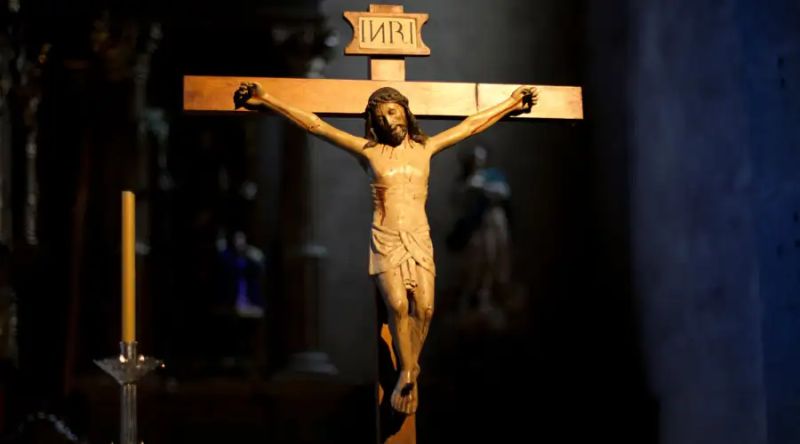
Researcher and lawyer Martha Patricia Molina on May 3 presented the third installment of her report “Nicaragua: A Persecuted Church?”
The document gives an account of the at least 529 attacks perpetrated by the Daniel Ortega dictatorship in the last five years with 90 committed so far in 2023.
In her Zoom presentation made from exile, the researcher exposed the “hostilities, persecution, sieges, desecration, destruction, robbery, expulsions, and confiscations” perpetrated by the dictatorship.
Molina also condemned the “imprisonment of committed religious and lay leaders” of the Church in Nicaragua.
“In this work, I propose to systematize in order to show and contribute to the political, cultural, and social history of Nicaragua facing future and current upcoming generations so as to not forget the events and decisions” of the parties involved and for the purpose of “turning the study into a collection of human lessons and social and political experiences so that we don’t repeat the present mistakes,” Molina explained in the document.
The report details that in 2018 the Catholic Church in Nicaragua suffered 84 attacks, 80 in 2019, 59 in 2020, 55 in 2021, 161 in 2022 — the highest number in the last five years — and 90 in just the first four months of this year.
The attacks by the dictatorship include unjustly sentencing Bishop Rolando Álvarez to 26 years and four months in prison, expelling 32 religious from the country, confiscating seven Church-owned buildings, and shutting down various media.
Molina, who holds a master’s degree in corruption and rule of law, explained that “this report outlines a meticulous study of each hostile action carried out” and that all of the data has been verified.
The purpose of this report “is to show in concrete figures the attacks and onslaughts suffered by the Catholic Church in Nicaragua,” the specialist said.
The report is divided into four chapters that present the hostilities against the Catholic Church from April 2018 to so far in 2023. The attacks include the prohibition of 176 processions during last Holy Week; the systematization of hostilities; and a chronology of desecrations, sacrileges, assaults, robberies, and attacks against the Church.
“It’s important to highlight the work of the laity to support their Church under attack, following up on each incident of damage done to the churches, the attacks on priests and nuns, and day-to-day occurrences in their parishes,” the expert stressed.
“Despite this, we can’t deny that there is an underreporting of data that occurs because there is little or no reporting by the religious authorities” as well as a “growing fear and prudence on the part of the laity or members of religious groups in documenting hostile acts.”
This story was first published by ACI Prensa, CNA’s Spanish-language news partner. It has been translated and adapted by CNA.
If you value the news and views Catholic World Report provides, please consider donating to support our efforts. Your contribution will help us continue to make CWR available to all readers worldwide for free, without a subscription. Thank you for your generosity!
Click here for more information on donating to CWR. Click here to sign up for our newsletter.
Sister Scholastica Radel (left) and Mother Abbess Cecilia Snell of the Benedictines of Mary, Queen of Apostles, discuss the recent exhumation of the order’s foundress, Sister Wilhelmina Lancaster, in an interview with EWTN News In Depth on May 30, 2023, at their abbey in Gower, Missouri. / EWTN News
Washington, D.C. Newsroom, Jun 4, 2023 / 08:00 am (CNA).
Her flashlight was dim, so when Mother Abbess Cecilia Snell first peered inside the cracked coffin lid and saw a human foot inside a black sock where one would expect to find only bone and dust, she didn’t say anything.
Instead, she took a step back, collected herself, and leaned in for another look, just to be sure. Then she screamed for joy.
“I will never forget that scream for as long as I live,” recalled Sister Scholastica Radel, the prioress, who was among the members of the Benedictines of Mary, Queen of Apostles, who were present to exhume the remains of their foundress, Sister Wilhelmina Lancaster.
“It was a very different scream than any other scream,” the abbess agreed. “Nothing like seeing a mouse or something. It was just pure joy. ‘I see her foot!’”
What the sisters discovered that day would cause a worldwide sensation: Roughly four years after her burial in a simple wooden coffin, Sister Wilhelmina’s unembalmed body appeared very much intact.
In an exclusive TV interview with EWTN News In Depth, the two sisters shared details of their remarkable discovery — revealing, among other things, that Sister Wilhelmina’s body doesn’t exhibit the muscular stiffness of rigor mortis — and reflected on the deeper significance of the drama still unfolding at their Abbey of Our Lady of Ephesus in rural Gower, Missouri.
They also clarified that Sister Wilhelmina’s coffin was exhumed on April 28, nearly three weeks earlier than CNA had understood. The sisters explained that it took about two weeks to remove dirt, mold, and mildew before they moved her body to the church. You can hear excerpts from the interview and other commentaries in the video at the end of this story.
Pilgrims visit the body of Sister Wilhelmina Lancaster, the foundress of the Benedictines of Mary, Queen of Apostles, in Gower, Missouri. EWTN News
Of particular significance to the members of the contemplative order, known for their popular recordings of Gregorian chants and devotion to the Traditional Latin Mass, is that the traditional habit of their African American foundress also is surprisingly well-preserved.
“It’s in better condition than most of our habits,” Mother Cecilia told EWTN’s Catherine Hadro.
“This is not possible. Four years in a wet coffin, broken in with all the dirt, all the bacteria, all the mildew, all the mold — completely intact, every thread.”
For the sisters, the symbolism is profound. A St. Louis native, Sister Wilhelmina spent 50 years in another religious order but left after it dispensed with the requirement of wearing its conventional habit and altered other long-established practices. She founded the Benedictines of Mary in 1995 when she was 70 years old.
“It’s so appropriate, because that’s what Sister Wilhelmina fought for her whole religious life,” Mother Cecilia said of the habit.
“And now,” Sister Scholastica said, “that’s what’s standing out. That’s what she took on to show the world that she belonged to Christ, and that is what she still shows the world. Even in her state, even after death, four years after the death, she’s still showing the world that this is who she is. She’s a bride of Christ, and nothing else matters.”
‘I did a double take’
The Benedictine community exhumed Sister Wilhelmina, almost four years after her death, after deciding to move her remains to a new St. Joseph’s Shrine inside the abbey’s church, a common custom to honor the founders of religious orders, the sisters said.
Members of the community did the digging themselves, “a little bit each day,” Mother Cecilia said. The process began on April 26 and culminated with a half-dozen or so sisters using straps to haul the coffin out of the ground on April 28.
The abbess revealed that there was a feeling of anticipation among the sisters to see what was inside the coffin.
“There was a sense that maybe God would do something special because she was so special and so pure of heart,” Mother Cecilia said.
It was the abbess who looked through the cracked lid first, shining her flashlight into the dark coffin.
“So I looked and I kind of did a double take and I kind of stepped back. ‘Did I just see what I think I saw? Because I think I just saw a completely full foot with a black sock still on it,'” she recalled saying to herself.
Members of the Benedictines of Mary, Queen of Apostles, lead a procession with the body of their foundress, Sister Wilhelmina Lancaster, at their abbey in Gower, Missouri, on May 29, 2023. Joe Bukuras/CNA
Sister Wilhelmina’s features were clearly recognizable; even her eyebrows and eyelashes were still there, the sisters discovered. Not only that, but her Hanes-brand socks, her brown scapular, Miraculous Medal, rosary beads, profession candle, and the ribbon around the candle — none of it had deteriorated.
The crown of flowers placed on her head for her burial had survived, too, dried in place but still visible. Yet the coffin’s fabric lining, the sisters noted, had disintegrated. So had a strap of new linen the sisters said they used to keep Sister Wilhelmina’s mouth closed.
“So I think everything that was left to us was a sign of her life,” Sister Scholastica reflected, “whereas everything pertaining to her death was gone.”
Another revelation from the interview: Contrary to what one would expect in the case of a four-year-old corpse, Sister Wilhelmina’s body is “really flexible,” according to Sister Scholastica.
“I mean, you can take her leg and lift it,” Mother Cecilia observed.
EWTN News In Depth also spoke with Shannen Dee Williams, an author and scholar who is an expert on the history of Black Catholicism. Sister Wilhelmina’s story, she said, is an important reminder of “the the great diversity and beauty of the Black Catholic experience across the spectrum.”
“It’s a really important story that reminds us of what is the great diversity of what is the Black Catholic experience.” – @BlkNunHistorian explains the significance of Sister Wilhelmina choosing a traditional habit for her community. pic.twitter.com/nJmyQ6UYjA
— EWTN News In Depth (@EWTNNewsInDepth) June 3, 2023
‘A unifying moment’
There has been no formal declaration by Church authorities that Sister Wilhelmina’s body is incorrupt, nor has an independent analysis been conducted of her remains, the condition of which has puzzled even some experienced morticians. Neither is there any official process yet underway to put the African American nun on a possible path to sainthood.
Pilgrims visit the body of Sister Wilhelmina Lancaster, foundress of the Benedictines of Mary, Queen of Apostles, in Gower, Missouri. EWTN News
In the interview, Mother Cecilia called what’s happening at the abbey “a unifying moment for everybody” in a time of discord.
“There’s so much division, and it’s crazy,” she said. “We’re children of God the Father, every single one of us. And so you see, Sister Wilhelmina is bringing everyone together . . . I mean, this is God’s love pouring forth through people of every race, color,” she said.
“They come and they’re blown away, and it makes them think,” the abbess said. “It makes them think about God, about, ‘OK, why are we here? Is there more than just my phone, and my job, and my next vacation?’”
As for what comes next, no one can say. “We love God so much, his sense of humor, the irony, this humble little black nun hidden away in a monastery is a catalyst for this. It’s like a spark to send fire to the world,” Mother Cecilia said.
“It’s just remarkable,” she said. “But this is the kind of thing that God does when we need a wake-up call.”
The flag of Nigeria on a military uniform. / Bumble Dee/Shutterstock.
Rome Newsroom, Nov 18, 2021 / 09:00 am (CNA).
After the U.S. State Department released its list of countries with the most egregious religious freedom violations this week, h… […]
Leave a Reply
