




St. Louis, Mo., Apr 25, 2023 / 15:50 pm (CNA).
The Vatican’s Dicastery for the Laity, Family, and Life is preparing a document that will address divorced and remarried couples at the request of Pope Francis, according to the dicastery’s prefect, Cardinal Kevin Farrell.
Farrell mentioned the in-progress document in a speech delivered in Italian on April 22 that opened a meeting of the dicastery, which promotes the pastoral care of the family and the mission of the lay faithful. Farrell spoke about the importance of providing help and guidance to “those experiencing marital crises of all kinds.”
“On this front, the dicastery is also working on the preparation of a text that will specifically concern — as you wished, Your Holiness — men and women who, having a failed marriage behind them, live in new unions,” Farrell said in his opening address.
Farrell did not say when the document will be released.
The Church teaches that Catholics who are divorced and remarried without an annulment are not to take holy Communion, a teaching reaffirmed by St. John Paul II in the 2005 apostolic exhortation Familiaris Consortio. Pope Francis has said during his pontificate that there may be case-by-case situations where divorced and remarried Catholics can access the Eucharist, including situations where the spouses practice continence within their marriage.
In a recent interview, Pope Francis responded to a question about whether divorced and remarried Catholics could receive the Eucharist by saying: “We cannot reduce a human situation to a prescriptive one.” In the interview, Pope Francis advised looking to what his predecessor Benedict XVI said on the subject of annulments, affirming that “a large part of church marriages are invalid for lack of faith.”
“And think about it: Sometimes [one] goes to a wedding and it seems more like it’s a social reception and not a sacrament,” Pope Francis said. “When young people say ‘forever,’ who knows what they mean [by] ‘forever.’”
If you value the news and views Catholic World Report provides, please consider donating to support our efforts. Your contribution will help us continue to make CWR available to all readers worldwide for free, without a subscription. Thank you for your generosity!
Click here for more information on donating to CWR. Click here to sign up for our newsletter.


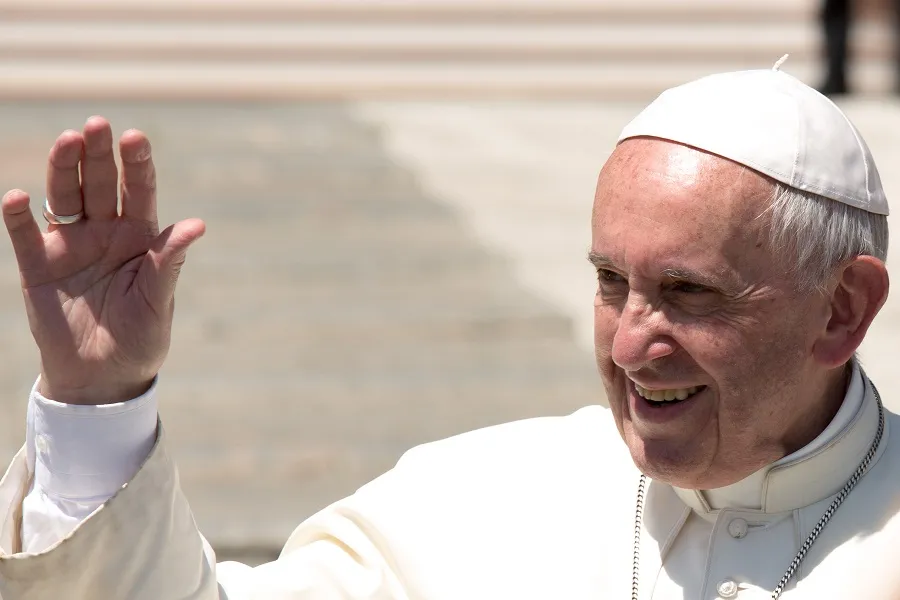
With the lead-in picture of the ring hand, reminds me of the “diamonds are forever” jingle; often seems more of a fantasy with earthly marriages.
“We cannot reduce a human situation to a prescriptive one” [Francis] translates the Roman Pontiff does not want the Church to be constricted by [to adhere to] doctrine. Whether Benedict XVI expressed an opinion [neither is an opinion a proscription] that a given number of marriages are invalid due to lack of faith that cannot be made an assumption that every divorced and remarried outside the Church falls into that category. If we accept that assumption on invalidity [Benedict’s alleged opinion] as a standard for judgment then that doubt must be presumed for all.
Pope Francis immediately after publication of Amoris Laetitia announced that most presumed sacramental marriages are invalid. Then walked it back following the expected uproar. That has been his gradual process of seeking to modify doctrine. Timing is essential.
A person unless retarded knows what an affirmation is [when exchanging vows]. If they don’t [due to lack of faith] they will likely remain as oblivious even if after a similar process of instruction they’re conferred the Holy Eucharist. Based on these premises this new document on divorced and remarried may well be footnote 351 on steroids.
Card Kevin Farrell, McCarrick associate when assigned to DC is one of the fast rising stars selected by His Holiness to complete the large tent Church renovation. Numbers versus quality, secular religiosity versus adherence to revelation. Unless I’m wrong and happily surprised.
“…without an annulment.” The easy-annulment mentality of the last fifty years has in effect amounted to being a Church endorsement for divorce. Oh, but annulments are NOT Catholic divorce, said Bishop James Conley in the Denver Catholic newspaper a decade ago or so. Sorry, bishop. they really are, in every way but officially. And every time the Church grants an annulment, it guarantees that there will be many more — the annulment mentality is part of the Church now. Thank you, New Springtime of Vatican II.
Yes!
This document like so many others emanating from this pontificate are DOA.
Excerpt: Pope Francis said. “When young people say ‘forever,’ who knows what they mean [by] ‘forever.’”
It is not just YOUNG people. My new wife and her maniacal first husband were divorced since she could no longer deal with his bipolar disorder. He died before I met Gail. I am a widower who lost my first wife at age 42. For 13 years I was single and alone. Then I met Gail and after a year we decided to get married. We were deeply in love and planned a lifetime together. That was when we experienced the harshness Catholic Church. Our parish priest would not marry us because Gail was divorced without an annulment. The fact that her first husband was now dead meant little. Across from St. Josephs was the Old Dutch Church where my friend Rev Paul Bennis was rector. After several “pre-cana” sessions he married us. We returned to St. Josephs, but were not given the Host. We have settled in and look forward to a long life.
When people get married, they are no longer free to take another partner, in other words, they are “reserved”. When Gail’s husband died, she was no longer “reserved”, and was free to marry for a second man. As for her civil divorce, I don’t know if she incurred any censure or canonical penalty. The remedy would have been a good confession with a knowledgeable priest. How could her parish priest refuse to marry her to a single man, and then refuse her Communion? As recounted by morganD, it seems altogether a bad decision. Another question: where was her bishop?
Marriage ends at death. It is unbelievable that a priest would claim a woman is not free to marry after for the sole reason that she is already married to a dead man.
“Practice continence within their marriage”??? Really?? Excuse me while i roll on the floor laughing. Who on earth does that?? There are a few anecdotal stories of some saintly couples in the long past supposedly doing that. But certainly that is beyond rare. Expect the report to approve of more secular practices for the divorced and remarried. To be kind and merciful of course, which appears to now trump standards if amy kind. And if the Pope assumes most catholic marriages are invalid, dispense with marriage as a sacrament and call in a govt justice of the peace. People are not improved when LESS is expected of them. Is the request for this report the popes way of distracting attention from the results of the recent German synod??? I think the tesults of this report will be sadly predictable.
Marriage is about the procreation and education of children for heaven. But in 1969, Rotal Judge Lucian Anne (accent over the “e”) proclaimed that from then on it was about much more as in a partnership of the whole of life.
But there is no list of how this partnership is defined. Couples can violate it in ignorance; only tribunal judges know how to find evidence that invalidates their marriage under, almost always, canon 1095.2 and 1095.3.
American diocesan marriage tribunals are corrupt. Ask those children who cried themselves to sleep for years, only wanting Mom and Dad back together. And the ” church” let them down again and again.
Using marriage as an indicator of anything relevant to the Church is useless. Casual sex, cohabiting, exploitation of children are rampant, and the wedding ceremony itself is given far more effort than the actual marriage. The truth is that the only one who can police Communion is Christ Himself.
I look forward to the day the Church implements our existing canon law and doctrine about those “having a failed marriage behind them.” The Church, not the government, has competence to decide spouses’ obligations toward each other and their children. No-fault divorce is virtually illegal for Catholics who are bound to follow canon law. For every so-called failed marriage there is one person (or two) who chose to break marriage promises by abandonment, abuse, or adultery. See my blog https://marysadvocates.org/please-stop-saying-those-who-experience-divorce/
Thank you for that post. My wife walked out of our marriage with no effort, no care, no apology, no remorse. She had committed adultery for several years and left for the other man. I would have done anything to save my marriage and took my vows seriously. She did not. Now I suffer as do my adult children.
70 testimonies of adult children of divorce is a must read in Primal Loss by Leila Miller for all clergy and lay Catholic counselors
I have so many questions about this. I was Catholic for almost 20 years, a convert as an adult. My first marriage was not in the church and he was abusive. My priest basically told me to leave him or I might die and he didn’t want to preach my funeral mass. I did, and we divorced. I got married again, once again not in the Church and we were married for 10 years. I had left the Church due to the marriage thing. After the 10 years, he announced he never loved me and he was in love with another woman and basically threw me out. I moved 800 miles away to my sister’s and went to the local church to talk about this and what to do about coming back. That priest told me to go home, throw her out, and tell my husband he had to stay with me. Uh, not happening, and I walked away from the church again.
A year and a half later I met a man who was perfect for me. We were in a whirlwind romance and after doing a handfasting with friends, got the JP ceremony. That was 30 years ago and we’re happier than we’ve ever been. He was divorced too, just getting over it. We worked through the baggage from our pasts and we have grown into a really comfortable, loving marriage.
Now I’m feeling the call to go home to the Church. I keep reading I have to get annulments, I have to live like “brother and sister” with my beloved husband while that’s going on. My first husband is dead, I’ve not had contact with the other one in about six years (at a wedding for our daughter). I don’t know what to do about this whole thing. If I can’t have sacraments, why go back? I can pray at home, I can read on my own. I can watch mass online.
My husband wouldn’t be adverse to conversion, depending on how he finds things. He grew up Methodist, very active since he played piano for the church and his father was a deacon and a lay minister. He has said he will accompany me to mass if I wanted to go.
So, when the Church talks about having to annul a marriage, if you’ve never been married in the Church, is that still valid? I’m very convused.