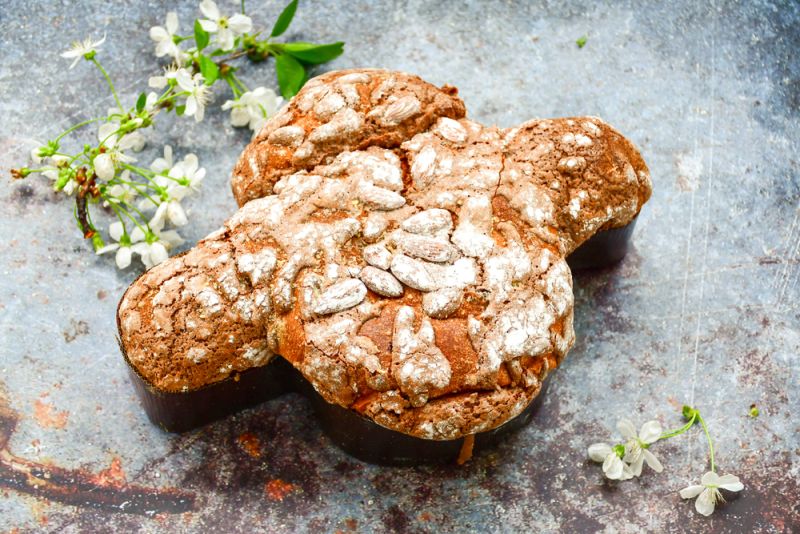
The quintessential Easter treat in Italy is a dove-shaped sweet bread known as the “Colomba di Pasqua” — or “Easter dove” in English.
The fluffy dough can include nuts, chocolates, or candied fruit and is often topped with sugar or a flavored icing glaze.
The dessert, like the traditional Christmas treats of panettone and pandoro, is said to come from northern Italy. But a popular legend also recounts the sweet bread’s possibly miraculous origins.
The incredible story dates to the sixth or seventh century and includes a queen, a feast, and a group of Irish monks.
According to the legend, Queen Teodolinda, who was living where the town of Pavia, Italy, now lies, had heard the great reputation for holiness of an Irish missionary and abbot who had arrived in her kingdom.
In Italy, the saint is called Colombano, but he is also variously known as Columba, Columbkille, Columcille, or Colmcille.
The name Colmcille means “dove of the Church,” providing a hint to how this legend may have originated.
According to an account on the Italian website saintcolumban.eu, Queen Teodolinda really wanted to meet the Irish abbot she had heard so much about. So when she knew he was in her lands, she invited him and his fellow missionaries to visit her castle for lunch.
Given the importance of her guests, Queen Teodolinda ordered the best food to be served at her table that day, including roasted meats with gravies, sausages, and platters of fresh game.
St. Colmcille’s monks were shocked at the sight of all the rich food, especially given their practice of poverty and fasting.
There was also another problem: It was Lent.
As Queen Teodolinda, her husband, King Agilulfo, and their courtiers began to dig into the feast, the monks sat still, waiting for a sign from their abbot about what to do. They were hungry after their long travels but saw there was only meat at the table.
Colmcille bowed his head to the monarchs in thanks for the meal but did not reach for any food.
Queen Teodolinda was offended by her guests’ refusal of her meal. She said, in a sardonic tone, “You aren’t eating, brothers?”
A young monk piped up in response: “We are monks: We can’t eat this.”
St. Colmcille interrupted his rude confrere. He told the queen they could not eat food that had not been blessed and humbly asked for permission to bless the meal.
Given the queen and king’s permission, Colmcille pulled toward him the nearest plate of food and bowed his head in prayer.
He then held his hand over the platter — which held a large roasted dove — to bless it.
As he concluded, everyone present was shocked to see that the roasted bird and its fragrant dressings had been transformed into a simple loaf of bread.
The only trace of what had been there before was the bread’s shape, which was the form of a dove.
This, St. Colmcille said, is food appropriate for the season of Lent, and he and his followers began to eat the loaf.
Today, the Colomba bread is associated with Easter and is usually sweetened in order to be fitting for the celebration of Christ’s resurrection.
And though most biographies do not record the great Irish missionary St. Colmcille’s visit to Italy, the story of the dessert’s origin is sweet, indeed.
If you value the news and views Catholic World Report provides, please consider donating to support our efforts. Your contribution will help us continue to make CWR available to all readers worldwide for free, without a subscription. Thank you for your generosity!
Click here for more information on donating to CWR. Click here to sign up for our newsletter.
Miami, Fla., Feb 26, 2020 / 05:00 pm (CNA).- It took ten parishioners to restrain Thomas Eisel after he attacked a deacon during an anticipated Mass on Saturday.
Deacon George Labelle was tackled by Eisel, 28, while the clergyman offered a homily Feb…. […]
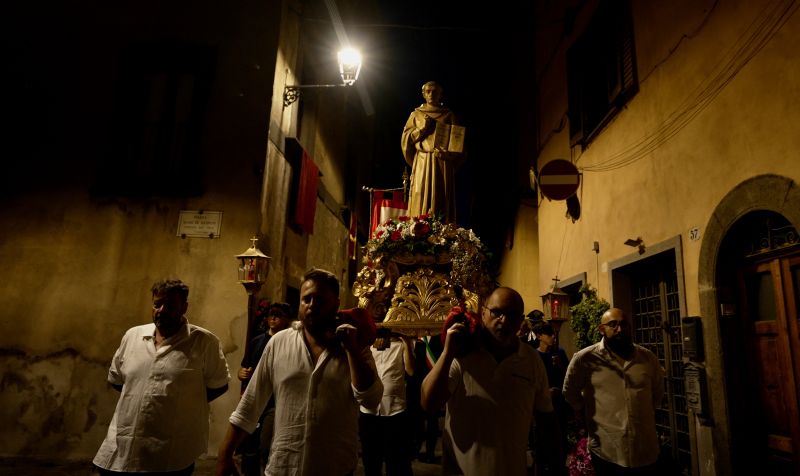
Four men carry a statue of St. Bonaventure during a candlelight procession on July 14, 2023, in Bagnoregio, Italy, his birthplace, on the vigil of the saint’s feast day. / Patrick Leonard/CNA
Bagnoregio, Italy, Jul 15, 2023 / 12:15 pm (CNA).
The birthplace of St. Bonaventure, a 13th-century intellectual giant now revered as a doctor of the Church and the “second founder” of the Franciscans, paid homage to its patron Friday night on the vigil of his feast day with music, prayers, and a candlelight procession.
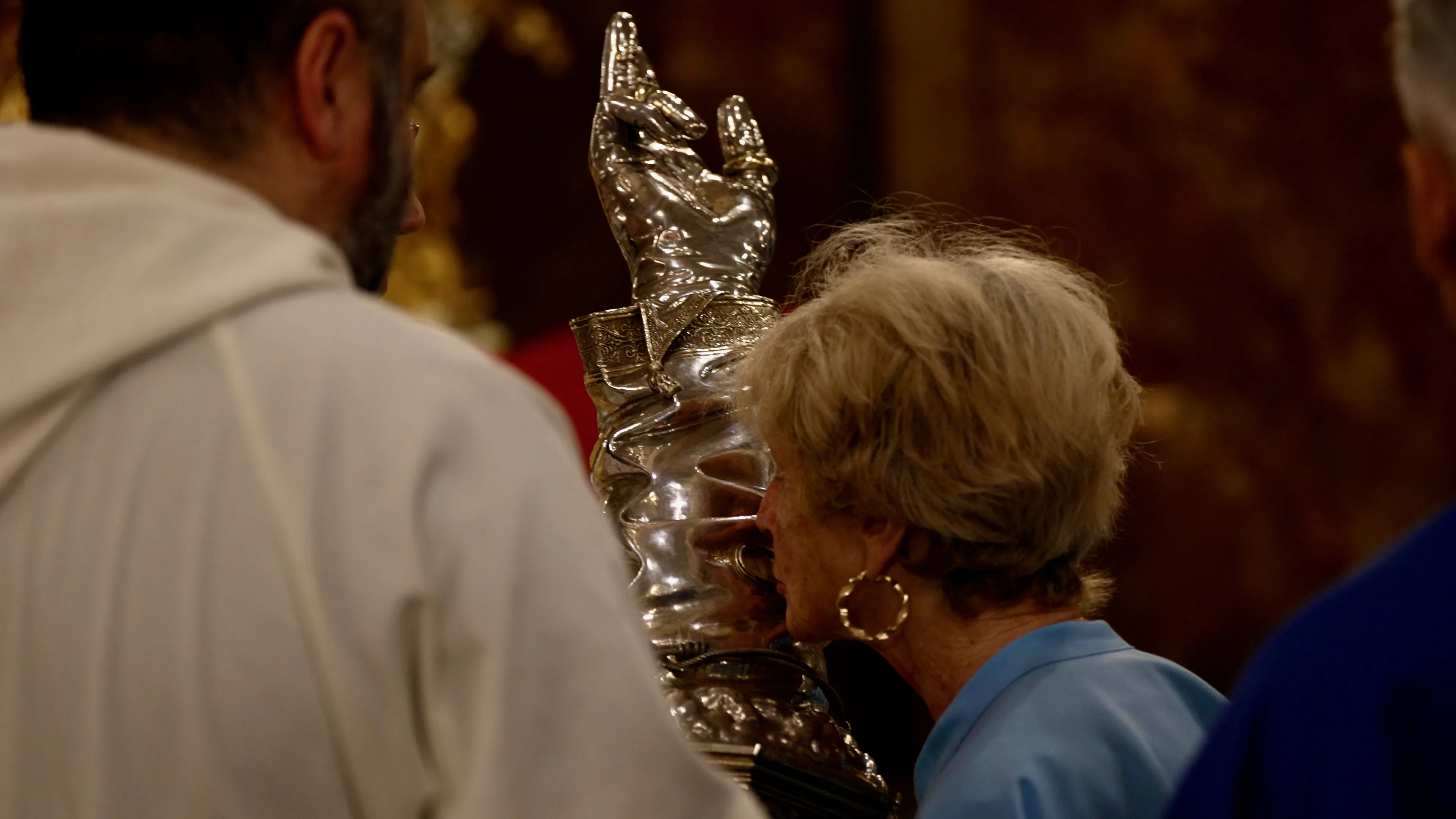
For the citizens of Bagnoregio, an idyllic town nestled in Italy’s Lazio region about a 1½ drive north of Rome, the July 15 feast is both a solemn holy day and a wellspring of civic pride. Bonaventure’s “braccio santo,” or holy arm — the only surviving relic of the saint — is kept in a silver, arm-shaped reliquary housed in a side chapel of Bagnoregio’s Cathedral of San Nicola and San Donato.
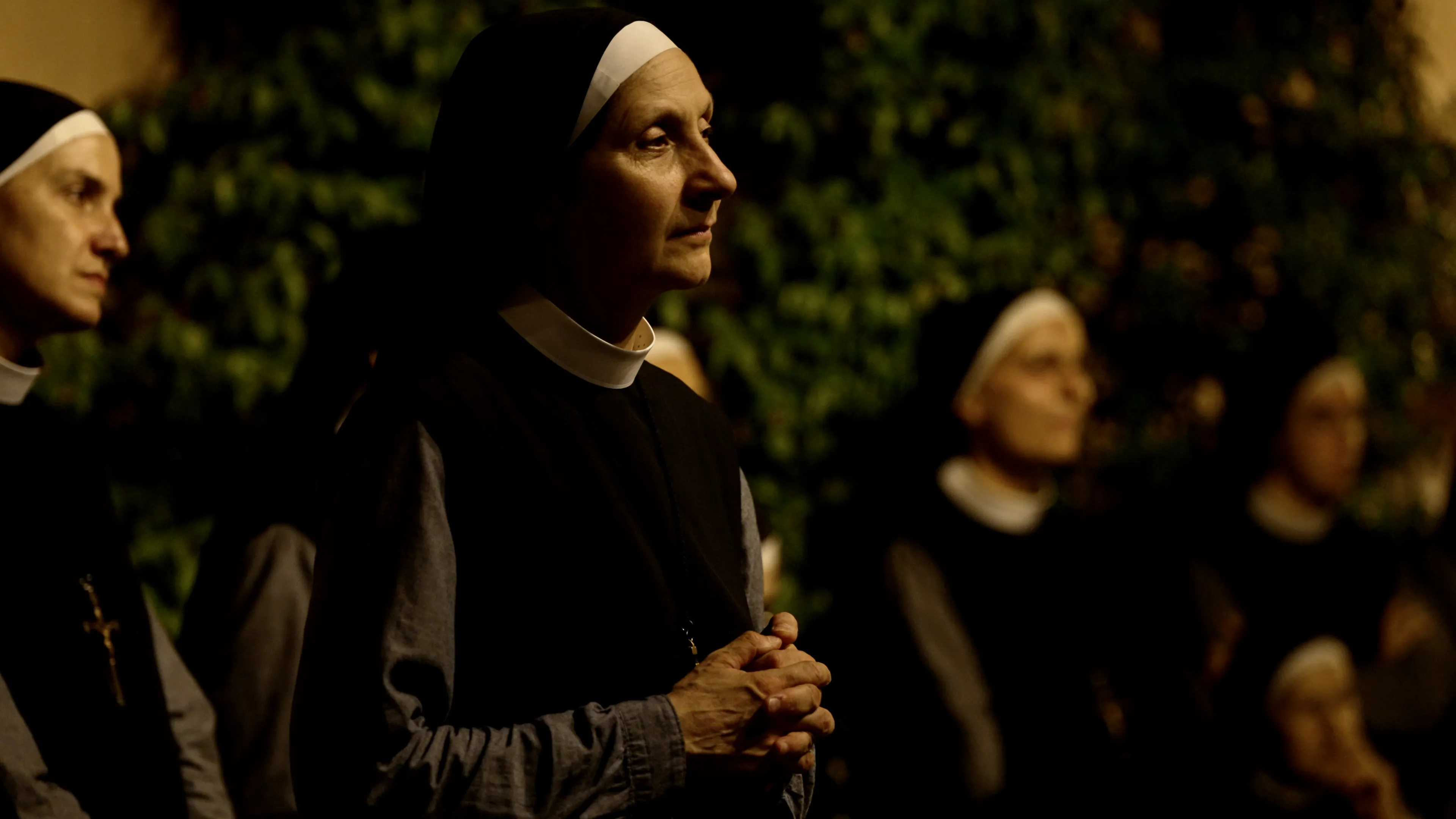
Religious sisters participating in a candlelight procession on July 14, 2023, in Bagnoregio, Italy, in honor of the town’s patron saint and native son, St. Bonaventure. Patrick Leonard/CNA
Friday’s procession, which commenced at the cathedral, was led by the town’s confraternities of the Most Blessed Sacrament, St. Francis, and St. Peter. Following them were a brass band, a statue of the saint adorned with flowers and carried by four men, and a priest carrying the holy arm. Then came Cardinal Fortunato Frezza, numerous priests, and this year’s first communicants, followed by other religious and residents.
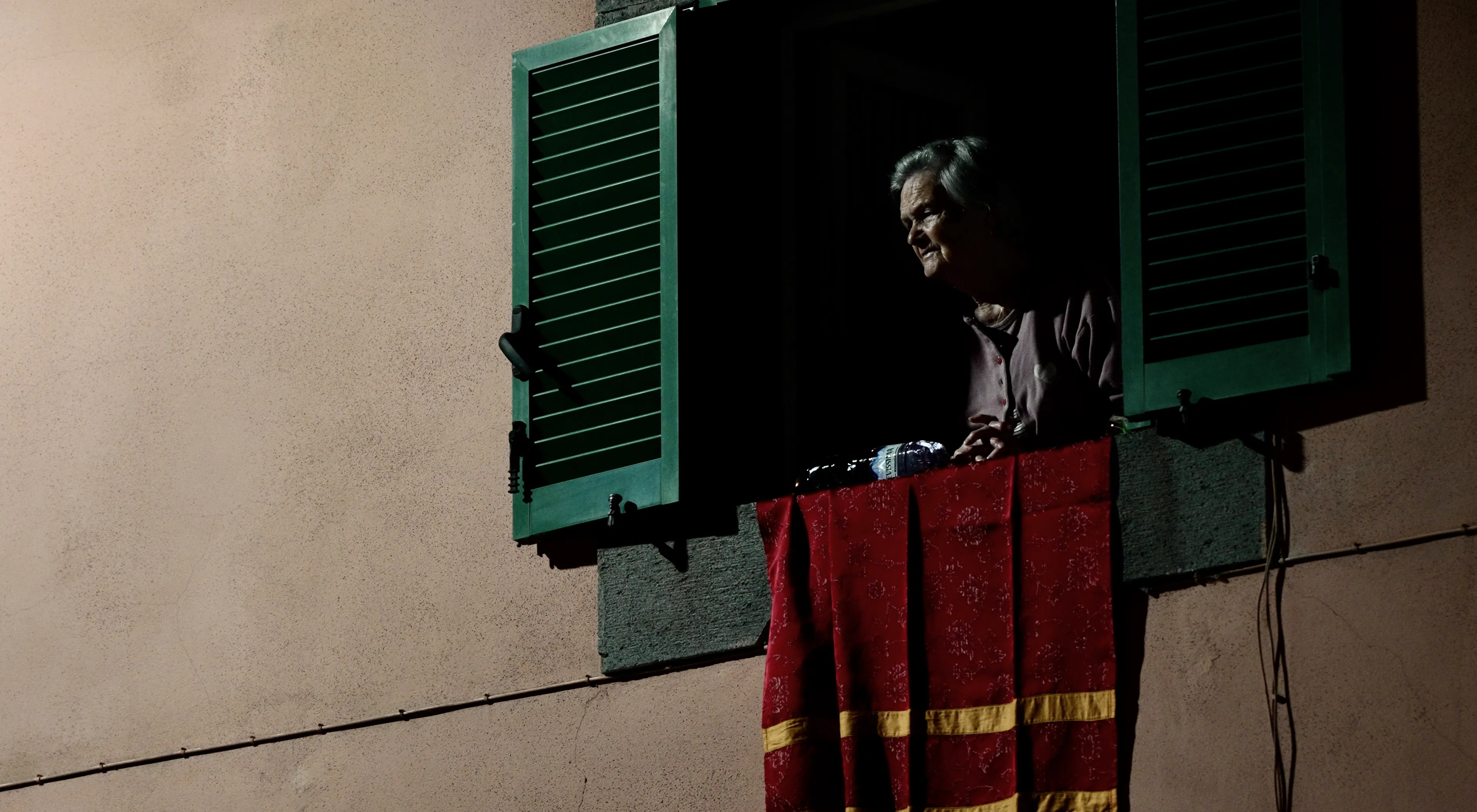
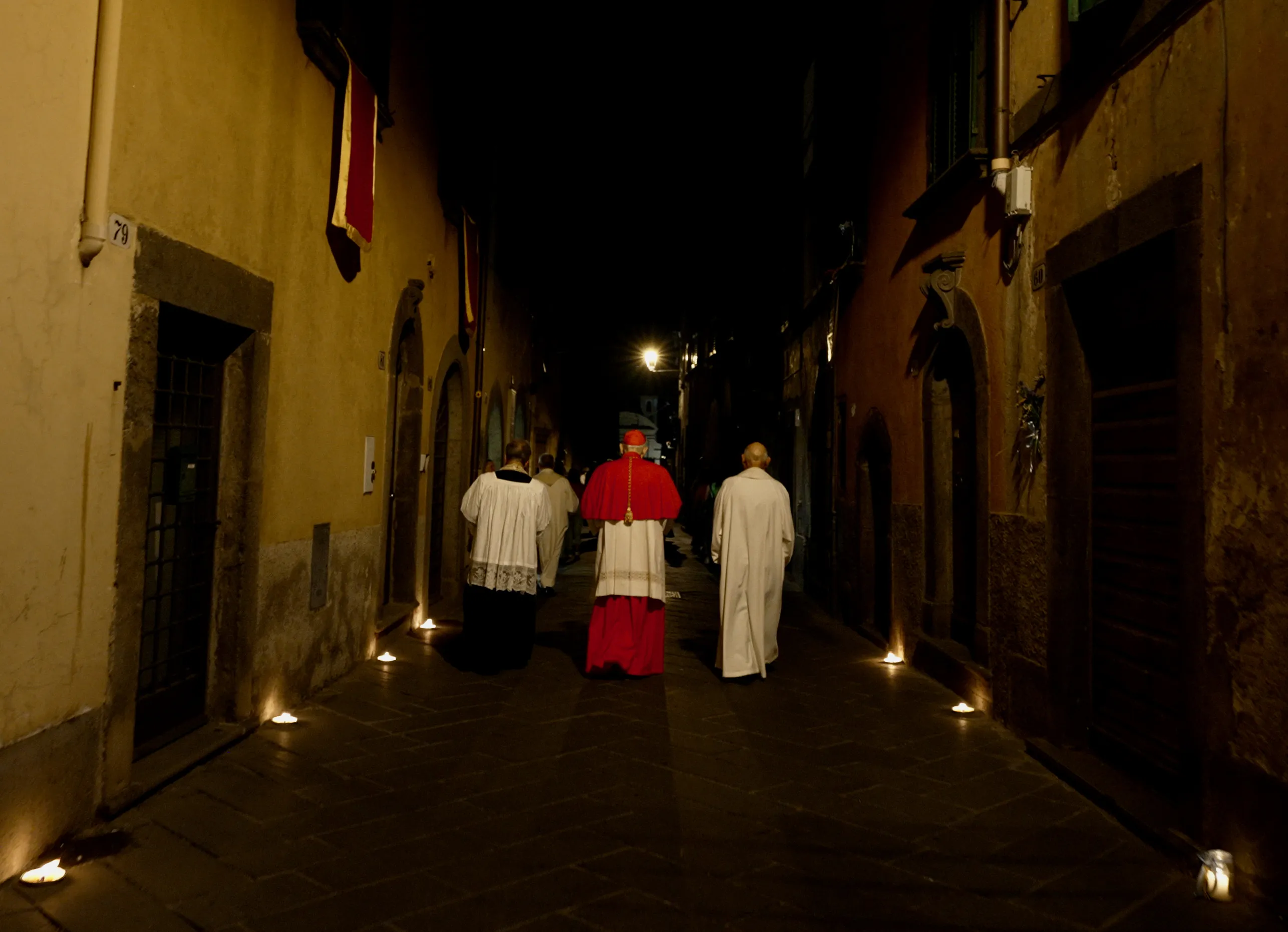
As the participants made their way down the candlelit Via Roma, onlookers watched from windows, balconies, and restaurants bustling with patrons on a warm summer evening.
A resident of Bagnoregio, Italy, watches a candlelight procession through the streets of the town in honor of its patron saint, St. Bonaventure, on July 14, 2023. Patrick Leonard/CNA
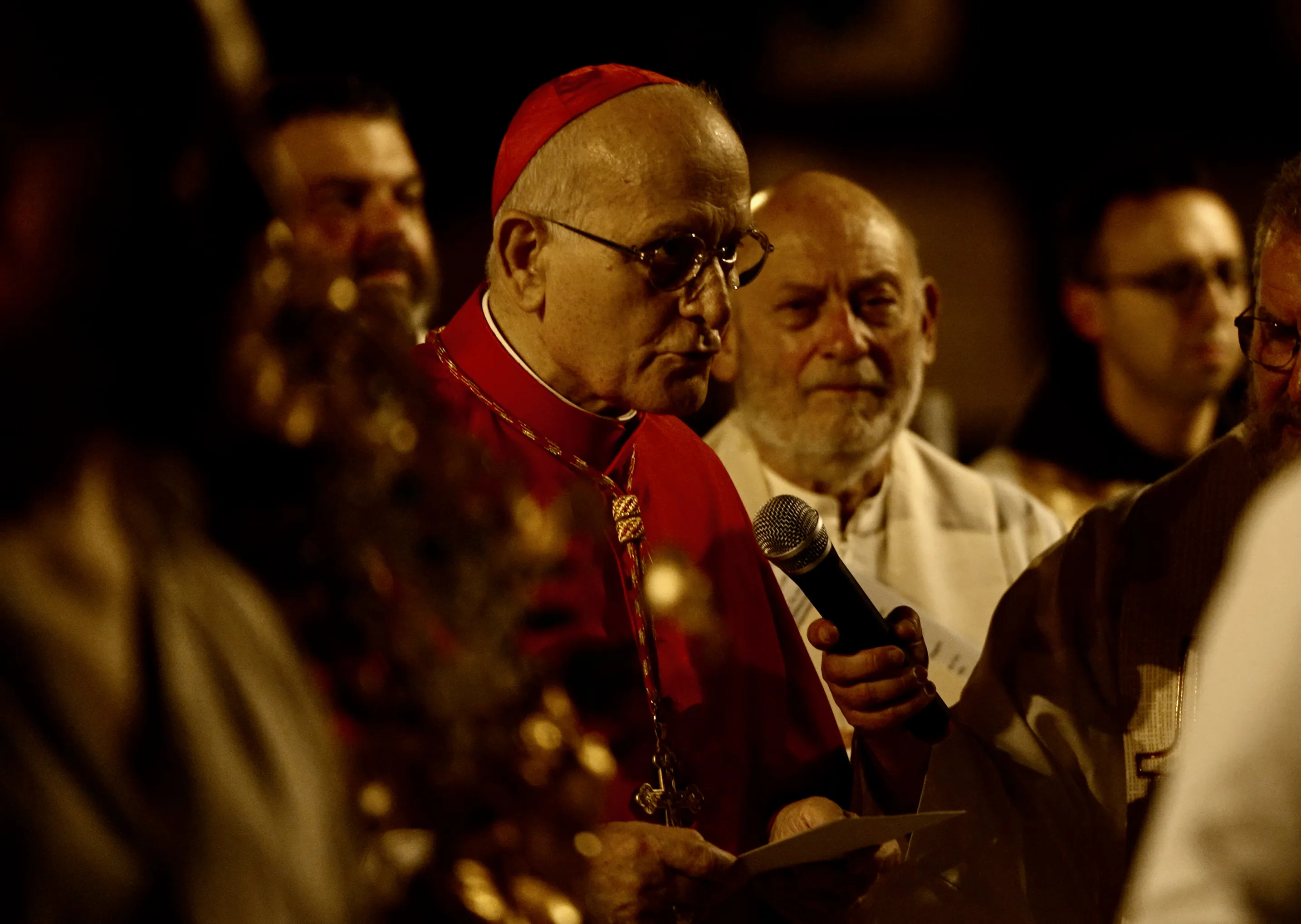
Arriving at the piazza Sant’Agostino, Cardinal Frezza, standing beneath a monument of Bonaventure, offered a brief reflection on the importance of the saint and of procession as a form of popular devotion.
The relic “gives us strength to sustain our weakness … It is a relic that is alive and active,” observed the cardinal, a noted biblical scholar. It is “an arm that teaches,” he said, the very right arm that “wrote his works of great intellect and wisdom.”
The cardinal closed his brief catechesis by saying “our life is a holy procession, an itinerary of the mind towards God.” Here he was playing on the title of one of Bonaventure’s most important theological works, Itinerarium Mentis in Deum, “The Journey of the Mind to God.” Following a benediction with the relic, the procession continued down Via Fidanza, looping around the main gate and then back up Via Roma to the cathedral. The faithful entered and Cardinal Frezza imparted the final blessing, again with the relic.
Cardinal Fortunato Frezza leads a prayer service on July 14, 2023, in Bagnoregio, Italy, in honor of the town’s patron saint and native son, St. Bonaventure. Patrick Leonard/CNA
The Franciscans’ ‘second founder’
Born in 1217 (or 1221, according to some accounts) as Giovanni Fidanza in Civita di Bagnoregio (then in the territory of the Papal States), he displayed great acumen and intellectual curiosity. He was, however, plagued by ill health in his youth. His mother called upon the intercession of St. Francis of Assisi, and he was, according to the legend, miraculously cured.
The young Bonaventure studied at the nearby Franciscan convent. Given his great talent, at 18 he left Bagnoregio to study in Paris, then the intellectual capital of Europe.
He joined the Franciscan Order of Friars Minor in 1243. At the University of Paris, he studied under the renowned Franciscan theologian Alexander de Hales; in 1257 he earned his teaching license (magister cathedratus) in theology there. Bonaventure was a contemporary of St. Thomas Aquinas, whom he met as they were both teaching at the university. The two future doctors of the Church were united in defending the then-nascent Franciscan and Dominican orders, whose orthodoxy was called into question by the secular clergy.
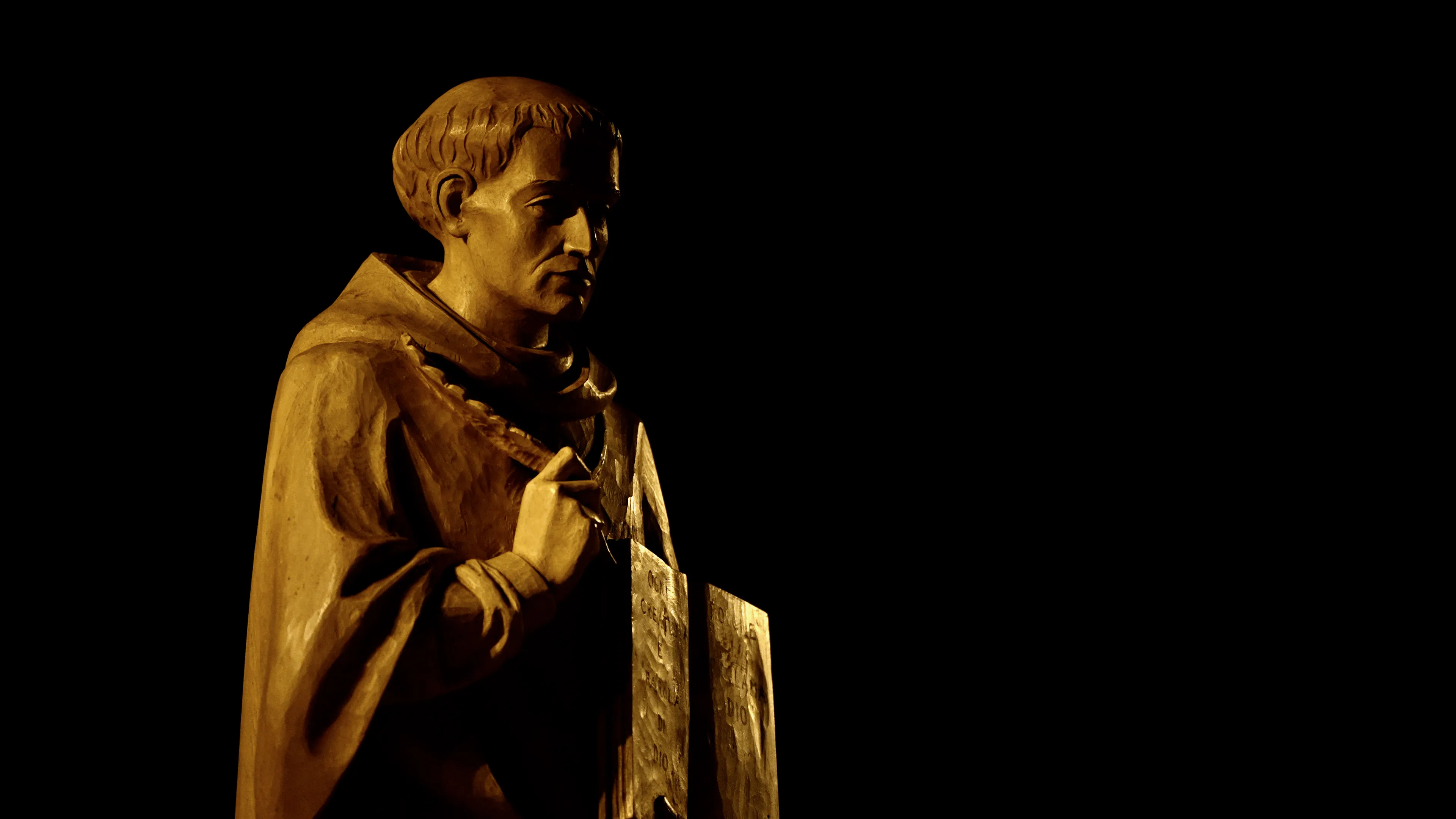
A statue of St. Bonaventure is shown during a candlelight procession on July 14, 2023, in Bagnoregio, Italy, his birthplace, on the vigil of the saint’s feast day. Patrick Leonard/CNA
Bonaventure’s teaching career was cut short; in 1257 when he was appointed minister general of the Franciscan order, which was then plagued by internal factionalism due to divergent understandings of Francis’ spirituality following his death.
To rectify this, Bonaventure spent much time traveling around Europe to help maintain the unity of the order. In 1260 went to Narbonne, France, to solidify the rule of the order and that same year he started writing (which was completed three years later in 1263) the Legenda Maior, “The Major Legend,” considered the definitive biography of St. Francis. For Bonaventure, the key to righting the order lie in Francis’ ideals of obedience, chastity, and poverty, which he re-established as the Franciscans’ guiding principles.
A woman venerates the “braccio santo,” or holy arm, of St. Bonaventure on July 14, 2023, the vigil of the saint’s feast day, at the Cathedral of San Nicola and San Donato in his hometown, Bagnoregio, Italy. Patrick Leonard/CNA
Enduring influence
In addition to his contributions as the “second founder” of the Franciscans, Bonaventure had a profound impact on the papacy. Following the chaos of the three-year conclave in Viterbo that elected Gregory X in 1271 (the longest papal election in the history of the Church), the new pontiff, also a Franciscan, entrusted Bonaventure with preparing many of the key documents for the Second Council of Lyon (1272-1274) which sought to unify the Latin and Greek Churches.
He was made a cardinal in the consistory of May 28, 1273. He did not, however, see the end of the council, as he died on July 15, 1274. He was canonized in 1482 by Pope Sixtus IV and proclaimed Doctor of the Church by Pope Sixtus V in 1588.
A candlelight procession through the streets of Bagnoregio, Italy, on July 14, 2023, honors the town’s native son and patron saint, St. Bonaventure. Patrick Leonard/CNA
In 2009, Pope Benedict XVI, who was a great admirer of Bonaventure, visited the saint’s birthplace to venerate the relic and address the faithful. In 2010 he dedicated three consecutive Wednesday audiences on the saint, outlining the importance of his governance of the Franciscans and his theological, philosophical, and mystical works. Bonaventure’s writings, Benedict observed, demonstrate that “Christ’s works do not go backwards, they do not fail but progress.”
“For St. Bonaventure, Christ was no longer the end of history, as he was for the Fathers of the Church, but rather its center; history does not end with Christ but begins a new period,” Benedict said.
“The following is another consequence: Until that moment the idea that the Fathers of the Church were the absolute summit of theology predominated, all successive generations could only be their disciples,” Pope Benedict explained.
“St. Bonaventure also recognized the Fathers as teachers forever, but the phenomenon of St. Francis assured him that the riches of Christ’s word are inexhaustible and that new light could also appear to the new generations,” he said. “The oneness of Christ also guarantees newness and renewal in all the periods of history.”
Theodore McCarrick / U.S. Institute of Peace / CC BY NC 2.0
Washington D.C., Jul 31, 2021 / 12:00 pm (CNA).
Former cardinal Theodore McCarrick now faces a fifth civil sex abuse lawsuit in New Jersey, after he was criminally charged in a Massachu… […]
2 Comments
Why not put a link to the recipe on your article or are you fearful that it’ll turn back into meat!?!
The Italian site is talking about St. Columbanus, founder of the monastery of Bobbio in northern Italy (d. 615). He is not Colmcille, better known as St. Columba, the Abbot of Iona (d. 597). Although Columbanus did meet Theodelinda and Aigulf, this story is–I hate to say–fakelore.
According to THE ITALIAN BAKER by Carol Field, a reliable authority on Italian cusine, the Columba pasquale doesn’t actually have anything to do with Easter. In Pavia, the old Lombard capital, it’s supposed to have been invented by a girl who gave the Lombard king Albion the loaf so he’s spare her virtue. In Milan, they claim it commemorates the appearance of doves during the Battle of Legnano (1176) where the locals defeated Frederick Barbarossa. Field’s book has a recipe, as does A CONTINUAL FEAST by Eleanor Vitz. It shouldn’t be hard to find a version online. And it’s delicious!





Why not put a link to the recipe on your article or are you fearful that it’ll turn back into meat!?!
The Italian site is talking about St. Columbanus, founder of the monastery of Bobbio in northern Italy (d. 615). He is not Colmcille, better known as St. Columba, the Abbot of Iona (d. 597). Although Columbanus did meet Theodelinda and Aigulf, this story is–I hate to say–fakelore.
According to THE ITALIAN BAKER by Carol Field, a reliable authority on Italian cusine, the Columba pasquale doesn’t actually have anything to do with Easter. In Pavia, the old Lombard capital, it’s supposed to have been invented by a girl who gave the Lombard king Albion the loaf so he’s spare her virtue. In Milan, they claim it commemorates the appearance of doves during the Battle of Legnano (1176) where the locals defeated Frederick Barbarossa. Field’s book has a recipe, as does A CONTINUAL FEAST by Eleanor Vitz. It shouldn’t be hard to find a version online. And it’s delicious!