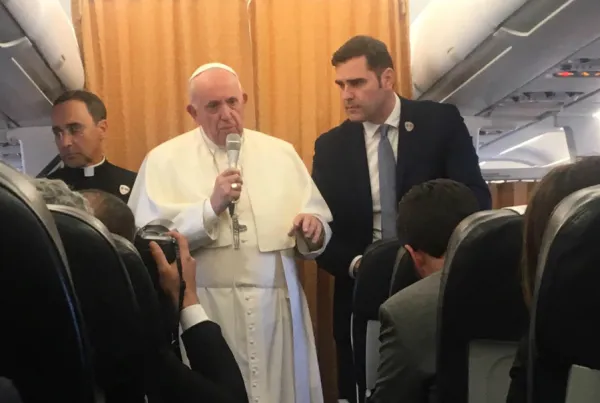
Aboard the papal plane, May 7, 2019 / 04:30 pm (CNA).- Please read below for CNA’s full transcript of the pope’s May 7 in-flight press conference from Skopje, North Macedonia to Rome:
Alessandro Gisotti:
Good evening Holy Father, thank you after such intense days for being here to share a thought about this journey that was so intense and so beautiful. A short trip, inevitably a short press conference, I will not add words other than these: Holy Father you have already walked in the footsteps of Mother Teresa, a great witness of Christian love, and we have all been struck today, as you know it, by the death of Jean Vanier, another friend, brother of the least of these, another great witness. Here, before the questions I wanted to ask if you wanted to share a thought about Jean Vanier.
Pope Francis:
Yes, I knew of the illness of Jean Vanier. His sister, Geneviève Jeanningros, informed me on a regular basis. One week ago, I called him on the phone, he listened to me, but could hardly speak. I would like to express my gratitude for this testimony. He was a man who knew how to read the Christian existence from the mystery of death on the cross of illness, from the mystery of those who are despised and rejected in the world. He worked, not only for the least of these, but also for those who before birth face the possibility of being sentenced to death. He spent his life like this. I am simply thankful to him and thankful to God for giving us this man with a great witness.
Gisotti:
Thank you, Holy Father, the first question will be from Biljana Zherevska of TV Macedonia.
Biljana Zherevska, MRT: [In English] Your Holiness, it is a great pleasure to have you in our country. We feel honored by your visit. What is interesting for us is to hear from you what is your greatest impression from the two countries, what touched you the most? The persons, objects, atmosphere. What will you remember of these two countries when you go [back] to the Holy See?
Pope Francis: They are two totally diverse nations. Bulgaria is a nation of a tradition from centuries ago. Macedonia, on the other hand, has a tradition from centuries, but not as a country: as a people, that ultimately rose to form as a nation… It is a beautiful fight! For us Christians Macedonia is a symbol of the entrance of Christianity in the East. Christianity entered in the East through you all.. those Macedonians that appeared to Paul in a dream: “come to us, come to us.” He was leaving for Asia, it is a mystery that call… And the Macedonian people are proud of this, they do not lose the opportunity to say that Christianity entered Europe through us, through our door, because Paul was called by a Macedonian.
Bulgaria has had to fight so much for its identity as a nation. The mere fact that in the 1800s, I believe 1823, more or less, 200,000 Russian soldiers died to regain independence from the hands of the Turks … we think of what 200,000 means. So much struggle for independence, so much blood, so much mystique to find consolidation of identity.
Macedonia had the identity and now it has come to consolidate it as a people, with small, big problems, like its name, and this we all know. Both have Christian, Orthodox, Catholic and Muslim communities. The percentage of Orthodox is very strong in both with a small amount of Muslims and even fewer Catholics, in Macedonia more so than Bulgaria. A thing I saw in both nations is the good relationship between the different faiths. In Bulgaria we saw it in the prayer for peace. This is a normal and beautiful thing for Bulgarians, because they have a good relationship, each person has the right to express his own religion and has the right to be respected. This touched me. Then the dialogue with Patriarch Neophyte was a beauty… he is a man of God, a great man of God. In Macedonia I was struck by a phrase the president told me: “Here there is not religious tolerance, there is respect.” They have respect. In a world like this respect is missed very much. Respect for human rights, we miss respect for so many things, respect for children, for the elderly, that the mystique of a country would be respect is striking. I do not know if I answered more or less briefly.
Gisotti:
Holy Father, the next question will be asked by Peter Nanev from Bulgarian television.
Peter Nanev, BTV: Good evening. Peter Nanev, BTV Bulgaria. [In English] It is more of a personal question, as Your Holiness, you’re like a human being, from where do you find strength in your body, in your spirit in cases when you have to give even more strength for a heavily sick child?
Pope Francis: First of all I would like to tell you that I do not go to the witch… [laughs]. I do not know. I do not know, really. It is a gift from the Lord. When I am in a country, I forget everything, but not because I want to forget it, I forget it, and I am only there. And then this gives me perseverance, I don’t know, but [when] I am on the trip I am not tired! Then I am tired! After! But where do I take the strength from? I believe that the Lord gives it to me, there is no explanation. I ask the Lord to be faithful, to serve him in this work of travels, that the trip will not be tourism. I ask. All is his grace. Nothing else comes to me to say. But then I do not do so much work, huh? Thank you.
Gisotti:
He will now address a question. We remain in Eastern Europe, Silvije Tomasevic of Croatian press and television, Vecernij List.
Silvije Tomasevic, Vecernij List: The national Orthodox Churches are not always in agreement among them, for example, they have not recognized the Macedonian Church. But when they have to criticise the Catholic Church they are always in unison, for example the Serbian Church does not want Cardinal Stepinac to be canonized. Your comment on this situation?
Pope Francis: In general, the relationships are good, they are good and there is good will. I can tell you sincerely that I have met men of God among the patriarchs. Neophyte is a man of God, and then him that I carry in my heart, a favorite, Ilia II of Georgia is a man of God, that has been good to me, Bartholomew is a man of God, Kirill is a man of God. They are great patriarchs that give witness. You can tell me. But everyone, we have defects. Everyone. But in the patriarchs I have found brothers and some… I do not want to exaggerate, but I would like to say the word ‘saints’ and this is important.
Then there are historic things between our Churches, some old things, for example today the president was saying to me that the Eastern schism began here in Macedonia.
Now the pope comes for the first time, to mend the schism I do not know, but to say we are brothers, because we cannot adore the Holy Trinity without hands united as brothers. This is not only my conviction, also the patriarchs’, everyone.
Then there is a historic world… you are Croatian? It was seeming to me I sensed the aroma of Croatia. The canonization of Stepinac is a historic case. He is a virtuous man for this Church, which has proclaimed him Blessed, you can pray [through his intercession]. But at a certain moment of the canonization process there are unclear points, historic points, and I should sign the canonization, it is my responsibility, I prayed, I reflected, I asked advice, and I saw that I should ask Irenej, a great patriarch, for help. We made a historic commission together and we worked together, and both Irenej and I are interested in the truth. Who is helped by a declaration of sanctity if the truth is not clear? We know that [Stepinac] was a good man, but to make this step I looked for the help of Irenej and they are studying. First of all the commission was set up and gave its opinion. They are studying other sources, deepening some points so that the truth is clear. I am not afraid of the truth, I am not afraid. I am afraid of the judgment of God.
Gisotti: There is time for another question. Joshua McElwee.
Josh McElwee, National Catholic Reporter: Thank you so much, Holy Father. In Bulgaria you visited an Orthodox community that has continued a long tradition of ordaining women deacons. In a few days you will meet with the International Union of Superiors General*, that three years ago requested a commision for women deacons. Can you tell us something you have learned from the report of the commission on the ministry of women in the early years of the Church? Have you made some decision?
Pope Francis: I did not hear the first part of your question.
McElwee: [repeats a part of the question.]
Pope Francis: The commission was made, it worked for almost two years. They were all different, all toads from different wells, all thinking differently, but they worked together and were in agreement until a certain point. But each of them then has her own view that does not agree with that of the others. And there they stopped as a commission and each is studying [how] to go forward.
For the female diaconate, there is a way to imagine it with a different view from the male diaconate. For example, the formulas of female deacon ordination found until now, according to the commission, are not the same for the ordination of a male deacon and are more similar to what today would be the abbatial blessing of an abbess. This is the answer of some of them. I’m speaking a little from the ear, from memory.
Others say that it is a female deacon formula, but they argue that it is not clear. There were female deacons, but was it a sacramental ordination or not? And that is discussed, it is not clear. That they helped in liturgy, in Baptisms by immersion, when the woman was baptized the deaconesses helped, also for [unclear] the woman’s body. Then a document came out where diaconesses were called by the bishop when there was a matrimonial argument for the dissolution of the marriage or divorce or separation. When the woman accused her husband of beating her and the bishop called the deaconesses to look at the woman’s body for the bruises and so they testified in the judgment. These are the things I remember.
But fundamentally, there is no certainty that it was an ordination with the same form, in the same purpose as male ordination. Some say there is doubt, let’s go ahead and study. I am not afraid of studying, but up to this moment it does not proceed.
Then it is curious that where there were deaconesses it was almost always a geographic zone, especially in Syria. And then in another part, it does not touch or nothing. All these things I received from the commission. Each one continues to study, and [they have] done a good job, because up to a certain point [they were] in agreement. And this can be an impetus to go ahead and study and give a definitive answer, yes or no, according to the characteristics of that time.
An interesting thing. Some theologians of a few years ago, 30 years ago for example, said that there were no deaconesses because women were in the background in the Church, not only in the Church. Always women… But it is a curious thing: in that period there were so many pagan priestesses, the female priesthood in pagan cults was ordinary in that day. As it is understood as a female priesthood, a pagan priesthood in women, it was not done in Christianity. This is being studied also. They have arrived at a point, now each of the members is studying according to her theory. This is good. Varietas delectat.
Gisotti: Holy Father, thank you for your availability. The press conference finishes here, at this point, because in a little while they will serve the dinner. And so, thank you to you all. Especially during this trip when we woke up at night to move [from place to place].
Pope Francis: I would like to say one thing about the trip: Something I found much consolation in and which has touched me profoundly during the trip. Two extreme experiences. The experience with the poor today here in Macedonia at the Mother Teresa Memorial. There were so many poor people, but to see the meekness of those sisters: they were caring for the poor without paternalism, but as children. But a meekness, the ability to caress the poor, the tenderness of these sisters. Today, we are used to insulting each other. One politician insults the other, one neighbor insults the other, even in families they insult each other. I cannot say that it is a culture of insult, but the insult is a weapon in the hand, even to speak ill of others, slander, defamation, and to see these sisters that care for every person as Jesus. It hit me, a good young man approached and the superior told me, ‘this is a good boy’ and caressed him and she said it with the tenderness of a mom and made me feel the Church a mother. It is one of the most beautiful things to feel the maternity of the Church. Today I felt it there.
I thank Macedonia for having this [inaudible]. Another extreme experience was the First Communion in Bulgaria. I was moved because my memory went back to October 8, 1944, to my First Communion, when they sang [the hymn] ‘O santo altare custodito dagli angeli’ (who here remembers it?), I saw those children that open themselves to life with a sacramental decision. The Church guards the children, they are limited, they have to grow, I am promised, and I lived it very strongly, I felt in that moment those 249 children were the future of the Church, they were the future of Bulgaria. These are two things that I lived with much intensity I wanted to communicate. Thank you very much, pray for me. I do not want to leave without speaking about these days, the centenary of trips. They are roses from Bulgaria, a small thought to mark the 100th trip.
They tell us that now there will be whiskey.
 […]
[…]






And every cardinal who values his career more than the faith and the good of the Church is complicit with this catastrophic papacy. These, who donned red to display a willingness to be martyrs for the faith, are nothing more than cowardly careerists and lapdogs. They can’t even stand up to the threat within. Shame on them. As for Bergoglio, he is beyond hope.
I don’t know if Francis is consciously trying to wire the next conclave that elects his successor, but the appointment as Cardinals of such stalwarts as Cupich, Tobin, McElroy, etc. certainly make you wonder.
CWR’s stated policy:
“…comments containing obscene language or personal attacks—or those that are deemed by the editors to be needlessly combative or inflammatory—will not be published.”
You cannot possibly hold us to this impossible standard when the topic we are addressing is the crepuscular, assiduous, blepharitic mess Bergoglio has made of our beloved 2,000-year-old Church in a mere ten years.
It’s positively Jesuitical.
For the love of Christ what successes are you talking about. Success of a pope should be to let the truth of Christ shine forth, to unite the Church and to greatly increase the number of believers because of the mesmerizing proclamation of the love of Christ our Incarnate God Redeemer the Savior of humankind without chipping away at the holy faith deposit that we already treasure in the Church while instead he supports the rebels who defy the truth to replace it with their own will of evil desires. This papacy is a “nightmare”.
Well done.
deeply apologize to CWR and its readers for the language used in my earlier comment.
The people of God should never have to be subjected to a glutenous, tumescent term like, “Jesuitical,” or any of its fatuous derivatives.
The beauty of irony!
Evangelization is his forte. In our time, when it comes to evangelization, Pope Francis is second to none. Cardinals, bishops, priests, religious women, men, and each and every person of goodwill keep wishing the Pontiff good health and long life.
How do you come by your assessment that evangelization is his greatest forte? Evangelization is more than words or good intentions; its success can only be judged by its fruits. Please enlighten us.
Evangelization? Perhaps no pope in history has done more to attempt to drive believing Catholics out of the Church. May God deliver us from this appalling fraud of a papacy!
Why then, I wonder, does Mass attendance continue to decline and vocations to the priesthood and religious life drop as well?
How dreary! While disproportionate kudos are given to Papa, Jesus is left outside the door! Yet, Papa is in need of constant pick-me-ups and your just the man to provide them!
I’m going on memory but was it about a year ago there was an article where the author interviewed about 30 US bishops off the record. One of the questions was “Are you aware of any seminarians who entered the seminary because of being inspired by Pope Francis?” To a man, the answer was “No.”
You are, I think, referring to Francis X. Meier and this piece from two years ago: https://www.firstthings.com/web-exclusives/2021/02/somebody-needs-to-be-dad
Carl – you da man. Here is the relevant quote: “When pressed, none of the bishops I queried could report a single diocesan seminarian inspired to pursue priestly life by the current pope. None took any pleasure in acknowledging this.”
Yes, it’s a brief but important piece by Fran. And my own experience, talking to a smaller number of bishops, is the same.
Sadly, with many young men – including my own youngest son – the “Francis effect” has been the opposite. They do not even want to think of the priesthood until knowing that Francis is gone, and that his successor is not made in his image.
Through the action (and inaction) of Pope Francis, the true state of our beloved Catholic Church has been revealed. There may be a few more closets or secret dungeons yet to be opened, but it seems to me it’s all out there on full display. Doctors will wait for the full condition of their patient to declare before taking action. There’s a whole lot of declaring going on right now!
All of the priests and bishops who shock and amaze us on an almost daily basis have been priests and bishops for many years, much longer than a decade. And those that the Pope has “elevated” and “honored” are bathed in glaringly bright lights. This wasn’t the case before. Men and women of goodwill will do good no matter where they are placed.
We’re all sitting on the edge of our seats, watching closely, listening attentively. Could this be “The Francis Effect”?
Actions speak louder than words, and his actions give the lie to his words.
“Persons in the prince’s orbit not only subject to his power but dependent upon it are willing to let the prince do what he will, so long as he would not harm them. Pope Francis has taken that to heart” (extract of Altieri).
Prince Francis does what he wants independent of opinion. Intimidation and feeling safe extend beyond his inner circle of glorified rogues to the ordinaries in the field, many of them good men who lost their voice.
What else with the Church as it has become. If anything, I repeat what was apparent from the start of the German Synodale Weg operetta, that the outrages there were the prelude for the great stage opera the Synod on Synodality.
At present there’s widespread confusion in what to believe as a Christian. That will be clarified 2024 to mean that there really are no permanent beliefs to be confused about. All that will be required is merciful tolerance of sin, quickly becoming, by then an irrelevant word, and inclusiveness no longer required to be called radical.
That’s not to say all will go along, there certainly will be resistance. And with that resistance, our loyalty to the eternal Word there certainly will be greater hope for justification before Christ’s judgment. Our compassionate mission, effort for conversion of the misled.
I like to look at the brighter side of things. Upon the Second Coming of Jesus, Jesus will wipe away His Bride, the Catholic Church’s, every tear, and there will be Peace on Earth. Hallelujah! What Jesus tells us to look for, which will indicate His Second Coming, is the Matthew 24:15 “the desolating abomination spoken of through Daniel the prophet standing in the holy place”. Both Jesus and the Blessed Mother, through locutions to St. Faustina, have confirmed that Jesus is, in fact, now Coming.
To survive ‘The Great Tribulation’ which comes when we see the, Matthew 24:15 “the desolating abomination spoken of through Daniel the prophet standing in the holy place”, is to flee to Jesus’, recently instituted, year 2000, gifts of Divine Mercy Sunday. “a person on the housetop must not go down to get things out of his house, a person in the field must not return to get his cloak”.
Please receive Jesus Gifts of Divine Mercy Sunday, this April 16th, in preparation for the Second Coming of Jesus! Jesus will Rule on earth for tens of thousands of years, and those Catholics in a State of Grace, will live in paradise on earth, married to Jesus.
Matthew 24:15 The Great Tribulation
“When you see the desolating abomination spoken of through Daniel the prophet standing in the holy place (let the reader understand), then those in Judea must flee to the mountains, a person on the housetop must not go down to get things out of his house, a person in the field must not return to get his cloak. Woe to pregnant women and nursing mothers in those days. Pray that your flight not be in winter or on the sabbath, for at that time there will be great tribulation, such as has not been since the beginning of the world until now, nor ever will be.
Divine Mercy in My Soul, 965
Jesus looked at me and said, Souls perish in spite of My bitter Passion. I am giving them the last hope of salvation; that is, the Feast of My Mercy. If they will not adore My mercy, they will perish for all eternity. Secretary of My mercy, write, tell souls about this great mercy of Mine, because the awful day, the day of justice, is near.
Divine Mercy in My Soul, 699
I desire that the Feast of Mercy be a refuge and shelter for all souls, and especially for poor sinners. On that day the very depths of My tender mercy are open. I pour out a whole ocean of graces upon those souls who approach the fount of My mercy. The soul that will go to Confession and receive Holy Communion shall obtain complete forgiveness of sins and punishment. On that day all the divine floodgates through which grace flow are opened. Let no soul fear to draw near to Me, even though its sins be as scarlet.
Divine Mercy in My Soul, 635, The Blessed Virgin Mary :
… you have to speak to the world about His great mercy and prepare the world for the Second Coming of Him who will come, not as a merciful Savior, but as a just Judge. Oh, how terrible is that day! Determined is the day of justice, the day of divine wrath. The angels tremble before it. Speak to souls about this great mercy while it is still the time for [granting] mercy. If you keep silent now, you will be answering for a great number of souls on that terrible day.
http://www.apocalypseangel.com/married.html
Ron above – Yes, Francis Maier.
Fr. Fessio of Ignatius Press also said recently, I believe on EWTN, that there are JPII priests and BXVI priests but there are no Francis priests. Doesn’t it say somewhere, “By their fruits you shall know them”?
The image of humility paying for his bill getting on the bus and the only really good thing: the year of mercy! After that the Vatican version of an Eton mess! The put downs, the angry fist waving,the castigating of those who love tradition as mentally deranged and other things! I wonder what is Catholicism any more? Just to have a good holy Pope and give us solid spiritual food rather than the gruel currently on offer!!!!
These past ten years Pope Francis has repeatedly reminded Catholics that the Church’s Pro-Life teaching and active care extends through the whole range of life from womb to tomb as this quotation from his apostolic exhortation, “On the Call to Holiness in Today’s World,” exemplifies: “Our defence of the innocent unborn, for example, needs to be clear, firm and passionate, for at stake is the dignity of a human life, which is always sacred and demands love for each person, regardless of his or her stage of development. Equally sacred, however, are the lives of the poor, those already born, the destitute, the abandoned and the underprivileged, the vulnerable infirm and elderly exposed to covert euthanasia, the victims of human trafficking, new forms of slavery, and every form of rejection. We cannot uphold an ideal of holiness that would ignore injustice in a world where some revel, spend with abandon and live only for the latest consumer goods, even as others look on from afar, living their entire lives in abject poverty.” (Gaudete et Exsultate 101)
“On the call to holiness”! One sentence for the “defense of the unborn” and back to his principal cardinal message: tend to the poor! THE CALL TO HOLINESS for Bergoglio is to take care of the poor. After he was elected pope he chose the name Francis because Saint “Francis loved the poor”. Wrong, Saint Francis, the Poverello, wanted to be the poorest one because by the love of God he was on fire for Christ called the seraphic saint. Certainly, we have to give alms and fight injustice but as Jesus said to Saint Faustina: “I demand deeds of mercy…for love of Me.” “For it is love that I desire” (Hosea 6:6). “that the love with which you loved me may be in them and I in them” (Jn 18:26) HE is the King of Glory and the God of love. He made us for his glory and that is what brought forth saints and martyrs. Georgio Bergoglio said when he was young, he wanted to be a politician or a priest. He might have been a great politician.
For a regular Catholic in the pew like me with a little knowledge of theology, the most significant and meaningful act made by Pope Francis was the suppression of the pre-Vatican II Mass. He abrogated Benedict XVI’s decree Summorum Pontificum, which allowed any priest to celebrate the old Mass. Essentially, Francis declared this a failed experiment. Instead of leading to the mutual enrichment of two different forms of the Roman rite, the older form was being abused as a rallying point for opposition to the Second Vatican Council. Francis rescinded Benedict’s permission, reverting to the status quo under Paul VI and John Paul II: each bishop can decide — within the authority granted to them by the Church’s universal norms — to what extent to allow the older form, and even then only in chapels, not parish churches. Francis’s stated goal is to have all Latin Rite Catholics worship together with the reformed Roman Rite called for by Vatican II. While the severity of his decision surprised almost everyone, the Pope feels it is his duty, as Bishop of Rome, to ensure the full implementation of the Second Vatican Council. The Council demanded, for good theological reasons, that the Church’s rituals be reformed.
Sorry, but I can’t see the connection between Sacrosanctum Concilium, VII’s document on the liturgy, and the decision of Francis to revoke his predecessor’s generosity in allowing Mass to be celebrated in the old rite. The decision seems more motivated by the Pope’s personal dislike for the TLM than by any legitimate pastoral consideration.
Dictionary please.
F. Connell
Summorum Pontificum was no experiment. It was a righting of a wrong by eliminating an illegal restriction on the celebrating of the TLM, that illegal construct called an indult. You seem to have unquestionably accepted the argument that just because one attends the TLM that one rejects VII. The two are not necessarily related.
Read the ancient church document Quo Primum. As I have posted here in the past I state again; an enemy of the Mass of the Ages is an agent of Satan. I pray for the conversion of the Pope’s soul.
Joseph Meynier:
I invite you to get a copy of and read the book: “The Pope, The Council, and The Mass” by James Likoudis and Kenneth Whitehead. There is a chapter about “Quo Primum.” You’ll be enlightened about the reformed Mass of Vatican II as indeed containing elements of both continuity and change (reform, or actually more of return to the original and more ancient sources) of the Mass of the Ages: its essence of being the memorial sacrifice of Christ remains and has not changed, while its ceremonial flow and ritual order has been reformed. What is even of happy development for us the laity is the retrieval of the more ancient understanding that got lost in the passage of church history about the “celebrant” of the Mass being the whole gathered assembly participating in the priesthood of Christ with the priest as “presider.” Today we don’t call the priest “celebrant,” for we all who are gathered for Mass are the “celebrant.” I hope you spend time in study and prayer in reading the book.
But once again: Why does any of this preclude the celebration of Mass according to the TLM?
F.Connell, some of us would prefer to have both the Novus Ordo and the traditional Mass. Neither is perfect. Why does Francis need to directly contradict his far more learned, experienced and intelligent predecessor? What could possibly be the problem with having two forms of the Latin Rite Mass for a while?
Is the Novus Ordo so bad that it can’t survive if any competition to it allowed? Is that why only a minority of Catholics attend Mass anymore? I don’t think so but then why is Francis so upset that he wants to suppress the competition? The TLM Mass is always crowded on Sundays and always has families with young children.
Is Francis upset that there are still Catholics that believe that not going to Mass on Sunday is a mortal sin?
As Weigel has said it is hard to understand why Francis would be so upset with the TLM and shows no concern with the enormous drop in attendance at Mass on Sundays.
Please read my first comment above. And if you want to know the Pope’s reasons, please read the actual text of Traditiones Custodes (easily accessible online!), not the commentators.
Your first comment above which has the obvious error where you said that TC reverts to the “status quo”… “where “each bishop can decide”? That status quo no longer exists. Bishops now need temporary permission granted from the Vatican to allow the TLM. Any TLM Mass is not even allowed to be mentioned in the parish bulletin. Was that the policy of John Paul II? I guess you also think that the gutting of the JPII Institute by Francis was also what JPII would have wanted.If you are not even aware of the simple facts how could anyone trust that you have any understanding at all of the new policy on the TLM of Francis?