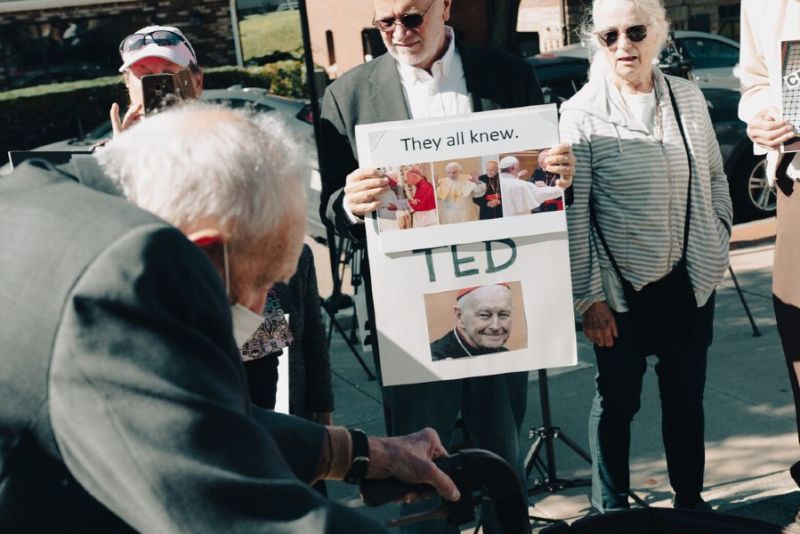
Former cardinal Theodore McCarrick arrives outside Massachusetts’ Dedham District Courthouse for his arraignment on Sept. 3, 2021. / Andrew Bukuras/CNA
Boston, Mass., Feb 27, 2023 / 16:57 pm (CNA).
Former cardinal Theodore McCarrick, 92, filed a motion in a Massachusetts court claiming he is “legally incompetent” to stand trial for sex abuse charges, citing “significant, worsening, and irreversible dementia.”
McCarrick is charged with three counts of indecent assault and battery on a person over the age of 14 relating to allegations that he sexually abused the teenager who was a family friend at a wedding ceremony in the 1970s at Wellesley College in Wellesley, Massachusetts.
McCarrick, laicized by Pope Francis in 2019, held one of the highest offices in the Catholic Church and has been accused of serially abusing his priestly authority by sexually abusing minors and seminarians.
The state of Massachusetts told CNA that it wants an opportunity to examine McCarrick’s competency to stand trial.
McCarrick’s motion to dismiss the charges comes about a month after his legal team said a neurological exam of him was being conducted by Dr. David Schretlen, a professor of psychiatry and behavioral sciences at Johns Hopkins University School of Medicine.
That exam remains unavailable to the public, as Schretlen’s final report includes “extensive confidential information” about McCarrick’s health and personal life, and would be “harmful” to McCarrick if it were available to the public, one of McCarrick’s lawyers, Daniel Marx, said in a separate court document.
However, there are certain details from the report that were available in McCarrick’s motion to dismiss the case, such as his consistently low performance scores on cognitive tests.
The document says that McCarrick performed “below expectation” on nearly two-thirds of the cognitive tests administered to him. Quoting the report, the document says that he performed “worse than 92% of reasonably healthy men of similar background and estimated premorbid on 38% of the cognitive measures.”
The report on McCarrick says that his “reported inability to retrieve memories of the alleged incident and potential witnesses” and “any exculpatory factors related to it” are consistent with his performance on the exams and testimony from those who know him well, according to the document.
Schretlen’s report concluded that McCarrick has a “severe cognitive disorder” and “everyday functional disability” that classifies as dementia and is most likely due to Alzeimer’s disease, the document says.
McCarrick is not legally competent to stand trial, the document says. It adds that his dementia is also “irreversible” and “likely to progress over time” with no expectation of improvement.
The document says that although McCarrick “remains intelligent and articulate,” he is unable to stand trial because his dementia prevents him from “meaningfully consulting with counsel and effectively participating in his own defense.”
It would be a violation of McCarrick’s 14th Amendment right in the Constitution and Article XII of the Massachusetts Declaration of Rights if he were to stand trial with his dementia, his lawyers maintain in the court document.
David Traub, director of communications for the Norfolk District Attorney’s Office, which is prosecuting the case, told CNA in an email Monday that “the Commonwealth will hire its own expert to assess competency.”
Traub said that an update court hearing in Dedham District Court on the state’s examination of McCarrick is set for April 20.
McCarrick’s lawyer Barry Coburn declined comment. Marx, his other lawyer, did not respond to a request for comment.
McCarrick hasn’t been seen publicly since his arraignment in Dedham on Sept. 3, 2021, when he pleaded not guilty to all three counts of indecent assault and battery on a person over the age of 14.
He appeared in frail condition that day, arriving at the courthouse wearing a mask and hunched over a walker. He made no comment either inside or outside the courthouse, where a demonstrator yelled, “Shame on you!” as McCarrick slowly walked past reporters and photographers alongside one of his attorneys.
The document says that McCarrick continues to maintain his innocence on all charges.
If you value the news and views Catholic World Report provides, please consider donating to support our efforts. Your contribution will help us continue to make CWR available to all readers worldwide for free, without a subscription. Thank you for your generosity!
Click here for more information on donating to CWR. Click here to sign up for our newsletter.
Brownsville, Texas, Dec 13, 2017 / 05:02 pm (CNA/EWTN News).- Nearly 60 years after Irene Garza disappeared after going to confession in her Texas hometown, the last person who saw her – who was a priest at the time – has been convicted and… […]
A photo of the earth by the crew of Apollo 8, the first manned mission to the moon, which entered lunar orbit Dec. 24, 1968. Credit: NASA/Bill Anders. / null
Denver Newsroom, Feb 18, 2022 / 15:10 pm (CNA).
A Chicago-based Catholic nonprofit has… […]
The Adoration Chapel at St. Peter’s Catholic Church in Beaufort, South Carolina. / Photo Credit: Aaron Miller, Miller Design & Marketing
Washington, D.C. Newsroom, Aug 20, 2023 / 05:00 am (CNA).
“Awesome. Awesome.”
That’s how Anna Sudomerski, the communications coordinator at St. Peter’s Catholic Church in Beaufort, South Carolina, describes the parish’s eucharistic adoration program.
St. Peter’s is among the parishes in the United States that are hosting perpetual eucharistic adoration with the Blessed Sacrament exposed 24 hours a day.
Since Church law dictates that exposition of the Blessed Sacrament requires at least one adorer present at all times, this means the parishes that opt for this extraordinary form of worship must coordinate a major year-round effort to ensure at least one volunteer is present before the Eucharist every hour of the day.
Eucharistic adoration, whether exposed or reserved in the tabernacle, is an ancient custom of the Church dating back to its earliest centuries. Yet its practice today occurs among flagging faith in the real presence of Christ in the Eucharist, with U.S. Catholics signaling a growing reluctance to believe that Jesus is truly present in the Blessed Sacrament.
Yet multiple parishes around the country in recent years have maintained vibrant adoration initiatives, including St. Peter’s, which began its perpetual adoration in the early 1990s.
Sudomerski said the St. Peter’s adoration program started at the parish’s original historic church in downtown Beaufort. With the construction of a new church building in 2006, adoration moved to a purpose-built chapel there.
For years, Sudomerski said, the adoration program was run by team captains who each supervised a specific stretch of hours within a given 24-hour period.
“They were in charge of certain times, like from midnight to 6 a.m., in case the adorer could not make it, so the captain would have to find a substitute or cover the hour themselves,” she told CNA. “We had four team captains covering midnight to 6, 6 to noon, noon to 6, and 6 to midnight.”
She said the church’s adoption of the sign-up software Adoration Pro “made it a lot easier for people to sign up.”
“From there, ever since, we’ve done several campaigns,” she said. “One to pass out interest forms to see who would be interested in what hour. We just finished another campaign because Father thought the Eucharist is the most important thing that we have. We’ve done callouts, mailings.”
Light of the World Catholic Church in Littleton, Colorado
Kathryn Nygaard, the communications director at Light of the World Catholic Church in Littleton, Colorado, outside of Denver, said the parish has maintained an adoration program since 2007.
“There are two parishioners who are the main adoration chapel coordinators and they do an incredible job,” she said. “In addition, there are 24 ‘hourly coordinators’ to assist with making sure substitutes fill in during open hours and communicating with the adorers in their specific hour.”
“There are approximately 270 people involved in adoration, as either regularly scheduled adorers or as substitutes,” she said. The church hosts two “renewal weekends” in February for adorers to re-up for the coming year; regular announcements are also made at weekend Masses to attract more interest.
Adorers at Light of the World use the church software Flocknote to communicate with one another, Nygaard said. “Most requests for substitutes are filled within 1-2 days,” she noted.
Bishops aim to ‘start a fire’ of eucharistic renewal
The U.S. bishops last year launched the National Eucharistic Revival, meant to “start a fire” of eucharistic devotion among Catholics in the United States. The initiative was first conceived following the 2019 Pew poll showing low numbers of Catholics with a belief in the Real Presence.
As part of the three-year program, parishes around the country have been encouraged to launch Eucharist-focused programs and events to draw parishioners into a deeper relationship with Jesus through the Blessed Sacrament.
Next year, the bishops will host a National Eucharistic Congress featuring multiple high-profile Catholic speakers along with what is expected to be a crowd of about 80,000 Catholics. Pope Francis in June called next year’s national congress “a significant moment in the life of the Church in the United States.”
St. Bonaventure Catholic Church in Columbus, Nebraska
At St. Bonaventure Catholic Church in Columbus, Nebraska, worshippers have been keeping perpetual adoration there for more than 62 years — since Feb. 14, 1961, according to a live clock on the parish’s website.
The exposed Blessed Sacrament at St. Bonaventure Catholic Church in Columbus, Nebraska. Credit: Tim Cumberland
The parish on its website says the roots of its adoration program go back to 1949 and expanded thereafter. The program now includes worshippers from other nearby parishes who come to participate in adoration.
Parishioner Tim Cumberland told CNA the church is “blessed to have about 550 people in the program.”
“A few years ago, we went to an automated process of managing our perpetual adoration program, using the Adoration Pro software,” Cumberland said. “This has greatly improved our ability for our adorers to find subs online when necessary. A request for a substitute is usually filled within minutes.”
Kim Waller said the 25-year-old adoration program at Holy Infant Catholic Church in Ballwin, Missouri, still uses a coordinator-led sign-up program instead of an online sign-up. Like many programs, Holy Infant breaks down management of the adoration schedule into hourly segments.
“The 24 hourly coordinators form the backbone of perpetual adoration,” she said. “They ensure that there is at least one adorer present in the chapel at all times. The hourly coordinator reviews the sign-up list weekly to ensure that their committed hourly adorer fulfills his/her commitment and contacts the adorer if she/he has not been to adoration as committed for two consecutive weeks.”
A new team of coordinators just took over in January, Waller said. “The last several years, the ministry was administered by a couple who since have passed within six months of each other,” she said.
St. Mary Help of Christians in Aiken, South Carolina
Donna Pierce told CNA she helped launch the 24/7 adoration program at St. Mary Help of Christians in Aiken, South Carolina, roughly 30 years ago.
“I think we have about 10-15 people who have maintained their Holy Hour since it began, and currently we have 318 weekly adorers and about 60 substitutes, not counting the many people that pop in the chapel when they can,” she said.
Pierce said a priest from a perpetual adoration apostolate helped the parish launch the program. “He told us that having perpetual adoration is actually much easier to run than a 40-hours or other time frame,” she said. “Adorers incorporate their hour into their schedule, so you don’t have to keep signing up from scratch.”
The exposed Blessed Sacrament in the St. Claire Chapel at St. Mary Help of Christians in Aiken, South Carolina. Credit: Lori Rainchuso
She said the parish maintains participation in the program by way of biannual talks at Masses (which Pierce described as “our fall and Lent blitzes”). These efforts usually result in upwards of a few dozen sign-ups.
On the website for the National Eucharistic Revival, the bishops say that the current year of the program is focused on “fostering eucharistic devotion at the parish level, strengthening our liturgical life through the faithful celebration of the Mass, eucharistic adoration, missions, resources, preaching, and organic movements of the Holy Spirit.”
Catholic evangelist Tim Glemkowski in a video for the revival urged parish leaders to “prioritize personal encounters with Jesus in the Eucharist” over the course of the year.
“The heart of this invitation … is to create space in our parish calendar this year for people to come and encounter Jesus in the Eucharist personally,” he said. “This could mean parishes that don’t have perpetual adoration start that opportunity, or opportunities for eucharistic processions, or different devotional experiences.”
Pierce said that starting the St. Mary program decades ago was a daunting prospect, but she went ahead with it by putting her trust in God.
“It was terrifying when Msgr. [Thomas] Evatt asked me to be head coordinator to start it so long ago — I was 30 years old with a toddler and working part time,” Pierce said. “So I made a deal with God. He would have to be responsible for sustaining it, and we would just be his instruments.”
“How many, many times he made it obvious he was running it!” she said.
Graces for eternity
St. Bonaventure’s website, meanwhile, predicts that the graces of perpetual adoration will redound not just in the present but for eternity.
“Someday far, far from now, there will be a magnificent heavenly banquet where all of the adorers in the St. Bonaventure adoration program will be reunited,” the parish’s website says.
“Won’t it be wonderful,” the website continues, “for all of us who have been in the program to share stories of how many of our lives, and the lives of those we touched as a result, were radically changed by this personal and enduring encounter with Our Lord!”
Sorry. Teddy knew or should have known that he was putting souls at risk, his own included when his ‘thinking cap’ was working. Why should we have sympathy now that medical/neurological exams from ‘Johns’ University show him to be witless? If he is that dim, how is it possible that he is aware or could care about his status in any sort of society?
If the release of the ‘Johns’ University report should cause Teddy harm, what’s that to us? Teddy has been laicized. (Has he been excommunicated? If not, why not?) Let his brain-body connection be left to rot or not as God wills. Meanwhile, let human justice seek its pound of flesh, with or without Ted’s having wits.
He seems lucid enough to ask for the charges to be dropped. A disgraceful man unwilling to acknowledge wrongdoing.
The victims have the right to seek justice as he has the opportunity to have his lawyer defend him.
How does one know whether this scandal of a (former) prelate faked the cognitive tests by intentionally giving bad answers? He has already demonstrated for many years his duplicity and deviousness.
Unrepented? Don’t believe the deflection dementia pathway….., but even if the case, this does not change the reality, it just says, ‘still dont want to acknowledge the guiltiness’…. now is the time to step up into the coliseum of martyrdom or witness to the truth of the sins done and make peace with the Beloved, those whom were sinned upon and the whole Bride of Christ and Spousal People’…now is not the time to run from God’s Judgement Throne, or towards it, with continuing a coverup and non-admission, that wont sit well upon arrival – true for him and for each and then their is this Witness: ‘to those who have given more, more will be required…
Sorry. Teddy knew or should have known that he was putting souls at risk, his own included when his ‘thinking cap’ was working. Why should we have sympathy now that medical/neurological exams from ‘Johns’ University show him to be witless? If he is that dim, how is it possible that he is aware or could care about his status in any sort of society?
If the release of the ‘Johns’ University report should cause Teddy harm, what’s that to us? Teddy has been laicized. (Has he been excommunicated? If not, why not?) Let his brain-body connection be left to rot or not as God wills. Meanwhile, let human justice seek its pound of flesh, with or without Ted’s having wits.
He seems lucid enough to ask for the charges to be dropped. A disgraceful man unwilling to acknowledge wrongdoing.
The victims have the right to seek justice as he has the opportunity to have his lawyer defend him.
How does one know whether this scandal of a (former) prelate faked the cognitive tests by intentionally giving bad answers? He has already demonstrated for many years his duplicity and deviousness.
He’s 92!
Unrepented? Don’t believe the deflection dementia pathway….., but even if the case, this does not change the reality, it just says, ‘still dont want to acknowledge the guiltiness’…. now is the time to step up into the coliseum of martyrdom or witness to the truth of the sins done and make peace with the Beloved, those whom were sinned upon and the whole Bride of Christ and Spousal People’…now is not the time to run from God’s Judgement Throne, or towards it, with continuing a coverup and non-admission, that wont sit well upon arrival – true for him and for each and then their is this Witness: ‘to those who have given more, more will be required…
