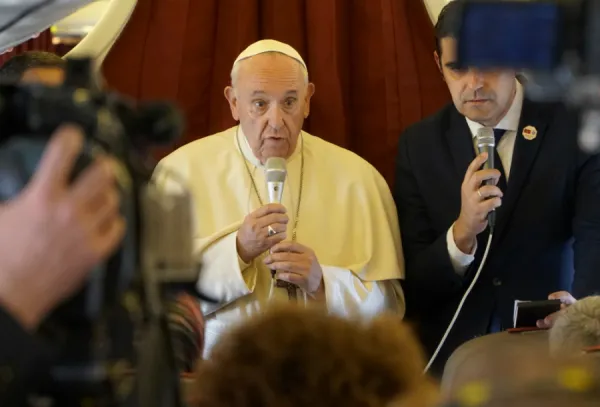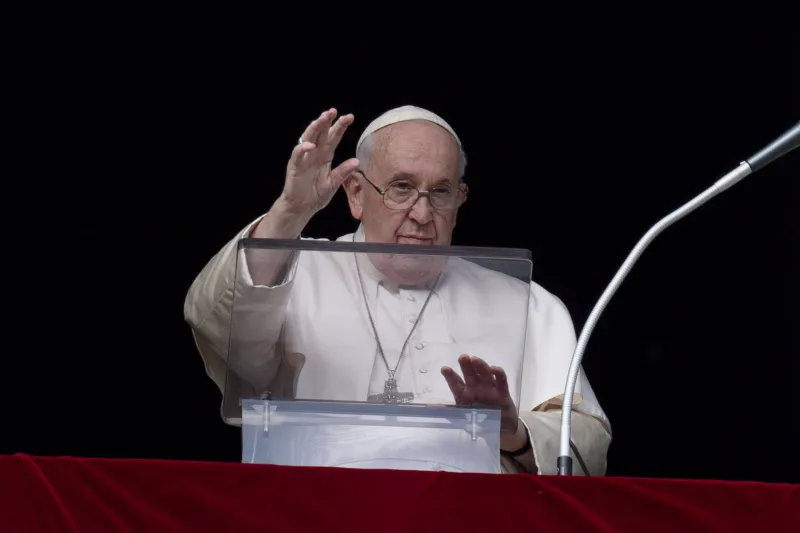
Pope Francis waves to the faithful gathered on St. Peter’s Square, Dec. 26, 2022 / Vatican Media
CNA Newsroom, Dec 26, 2022 / 06:07 am (CNA).
Pope Francis on Monday called on Catholics to pray for those who have harmed them — and those persecuted — as he renewed his Christmas call for peace in Ukraine and worldwide.
Speaking to the crowd gathered in St. Peter’s Square after praying the Angelus Dec. 26, the pontiff said: “I renew my wish for peace: peace in families, peace in parishes and religious communities, peace in movements and associations, peace for those war-torn peoples, peace for the dear and martyred Ukraine.”
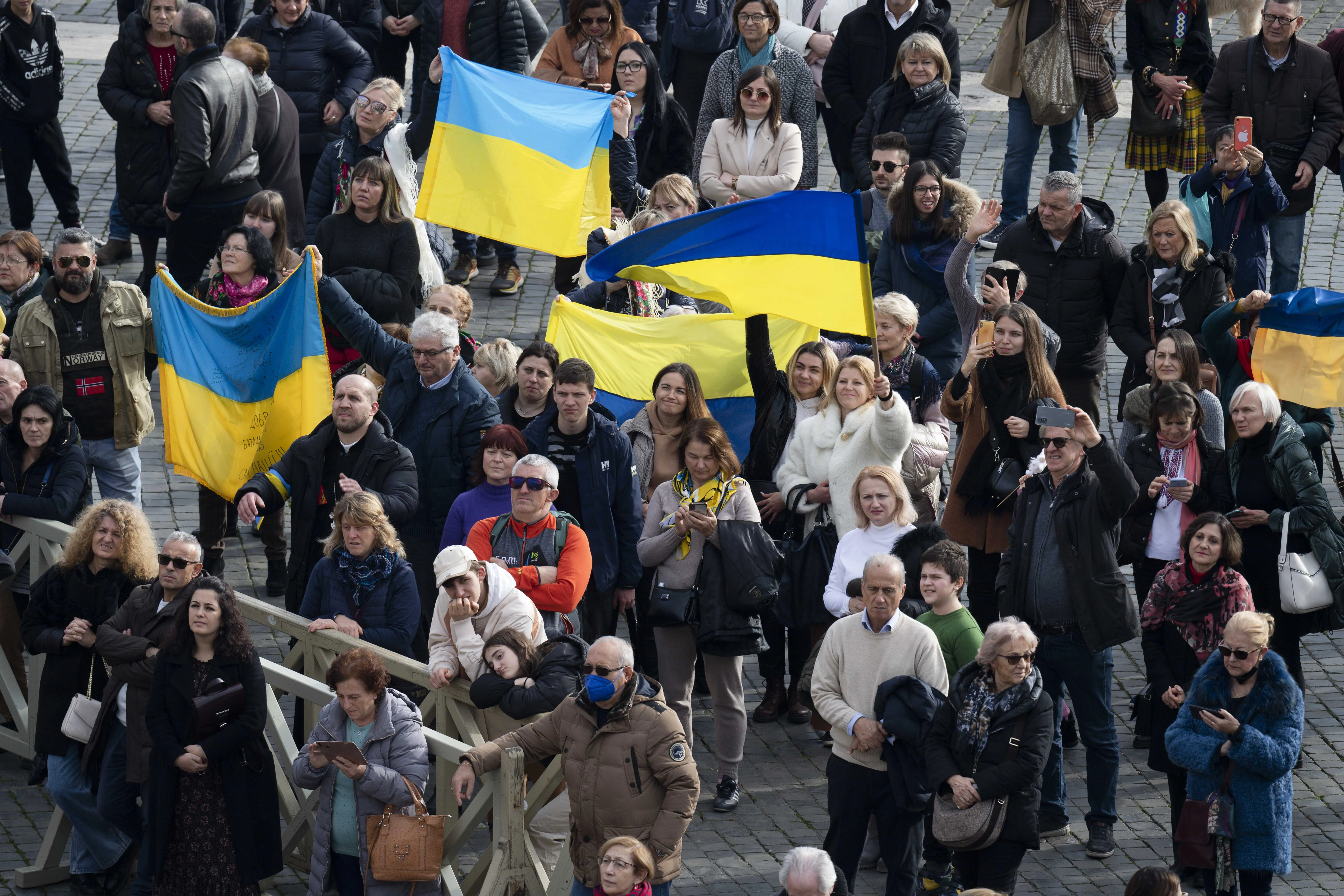
Ukrainian flags waved by visitors on St. Peter’s Square, Dec. 26, 2022. Vatican Media
On the feast of the martyr St. Stephen, the pope said “the martyrs are those most similar to Jesus.”
“Indeed, the word martyr means witness: the martyrs are witnesses, that is, brothers and sisters who, through their lives, show us Jesus, who conquered evil with mercy. And even in our day, martyrs are numerous, more so than in the early times”, Pope Francis said.
“Today let us pray for these persecuted martyr brothers and sisters, who bear witness to Christ. But it will do us good to ask ourselves: do I bear witness to Christ? And how can we improve in this? We can indeed be helped by the figure of Saint Stephen.”
Stephen, the pontiff noted, spoke of Jesus to those he met and was not intimidated even by the threats of his persecutors. “Charity and proclamation, this was Stephen. However, his greatest testimony is yet another: that he knew how to unite charity and proclamation. He left it to us at the point of his death when, following the example of Jesus, he forgave his killers.”
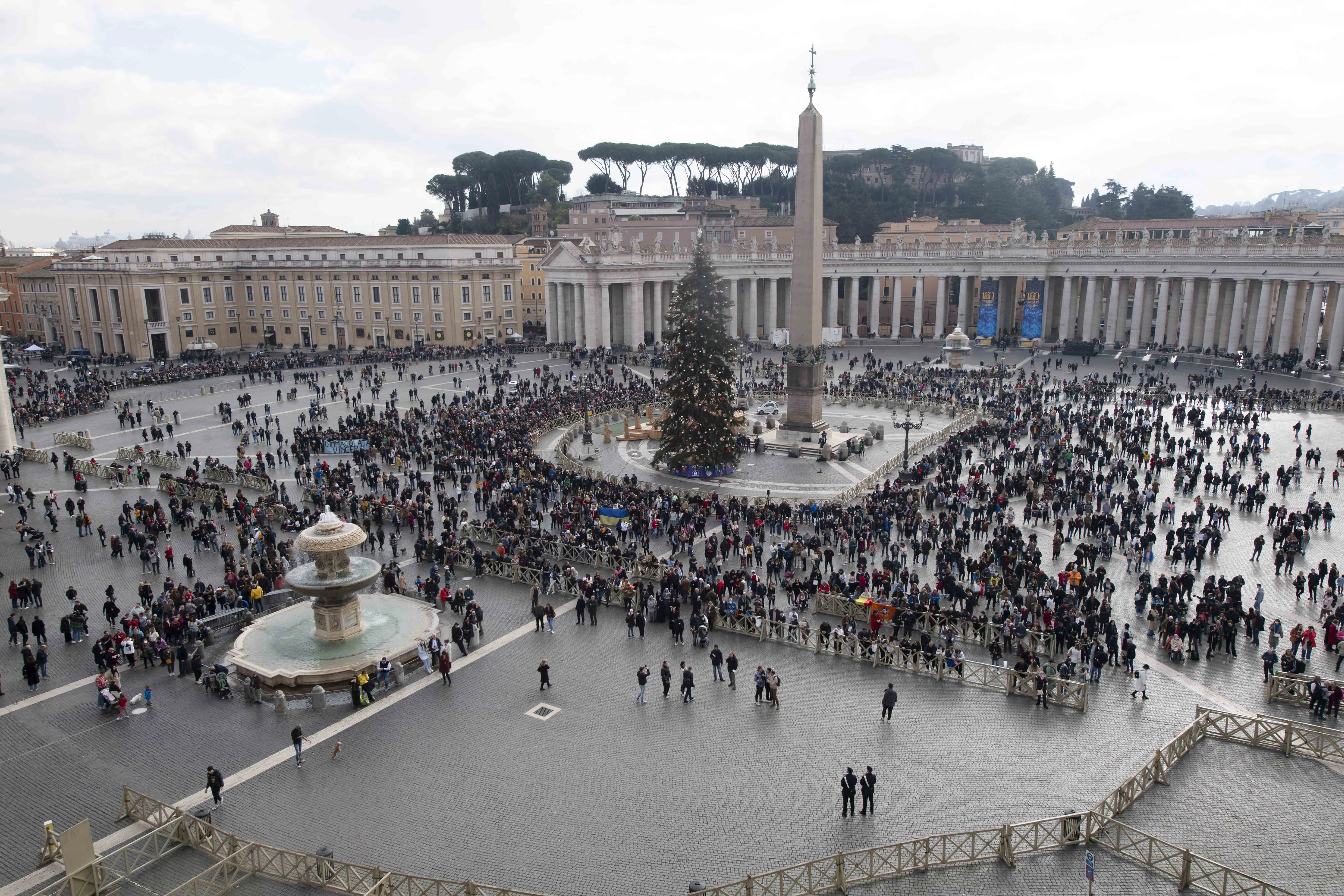
St. Peter’s Square on the feast of St. Stephen, Dec. 26, 2022. Vatican Media
The faithful “can improve our witness through charity towards our brothers and sisters, fidelity to the Word of God, and forgiveness. Charity, Word, forgiveness. It is forgiveness that tells whether we truly practice charity towards others, and if we live the Word of God.”
Playing on the connection between the Italian word for forgiveness — perdono — and the Italian word for a gift — dono — the pope explained that forgiveness is a gift “we give to others because we belong to Jesus, forgiven by him.”
The pontiff added: “Let us ask the newborn Jesus for the newness of a heart capable of forgiveness: we all need a forgiving heart! Let us ask the Lord for this grace: Lord, may I learn to forgive. Let us ask for the strength to pray for those who have hurt us, to pray for those who have harmed us, and to take steps of openness and reconciliation.”
Pope Francis concluded with a prayer to “Mary, Queen of martyrs” to “help us to grow in charity, in love of the Word and in forgiveness.”
If you value the news and views Catholic World Report provides, please consider donating to support our efforts. Your contribution will help us continue to make CWR available to all readers worldwide for free, without a subscription. Thank you for your generosity!
Click here for more information on donating to CWR. Click here to sign up for our newsletter.
Sister Scholastica Radel (left) and Mother Abbess Cecilia Snell of the Benedictines of Mary, Queen of Apostles, discuss the recent exhumation of the order’s foundress, Sister Wilhelmina Lancaster, in an interview with EWTN News In Depth on May 30, 2023, at their abbey in Gower, Missouri. / EWTN News
Washington, D.C. Newsroom, Jun 4, 2023 / 08:00 am (CNA).
Her flashlight was dim, so when Mother Abbess Cecilia Snell first peered inside the cracked coffin lid and saw a human foot inside a black sock where one would expect to find only bone and dust, she didn’t say anything.
Instead, she took a step back, collected herself, and leaned in for another look, just to be sure. Then she screamed for joy.
“I will never forget that scream for as long as I live,” recalled Sister Scholastica Radel, the prioress, who was among the members of the Benedictines of Mary, Queen of Apostles, who were present to exhume the remains of their foundress, Sister Wilhelmina Lancaster.
“It was a very different scream than any other scream,” the abbess agreed. “Nothing like seeing a mouse or something. It was just pure joy. ‘I see her foot!’”
What the sisters discovered that day would cause a worldwide sensation: Roughly four years after her burial in a simple wooden coffin, Sister Wilhelmina’s unembalmed body appeared very much intact.
In an exclusive TV interview with EWTN News In Depth, the two sisters shared details of their remarkable discovery — revealing, among other things, that Sister Wilhelmina’s body doesn’t exhibit the muscular stiffness of rigor mortis — and reflected on the deeper significance of the drama still unfolding at their Abbey of Our Lady of Ephesus in rural Gower, Missouri.
They also clarified that Sister Wilhelmina’s coffin was exhumed on April 28, nearly three weeks earlier than CNA had understood. The sisters explained that it took about two weeks to remove dirt, mold, and mildew before they moved her body to the church. You can hear excerpts from the interview and other commentaries in the video at the end of this story.
Pilgrims visit the body of Sister Wilhelmina Lancaster, the foundress of the Benedictines of Mary, Queen of Apostles, in Gower, Missouri. EWTN News
Of particular significance to the members of the contemplative order, known for their popular recordings of Gregorian chants and devotion to the Traditional Latin Mass, is that the traditional habit of their African American foundress also is surprisingly well-preserved.
“It’s in better condition than most of our habits,” Mother Cecilia told EWTN’s Catherine Hadro.
“This is not possible. Four years in a wet coffin, broken in with all the dirt, all the bacteria, all the mildew, all the mold — completely intact, every thread.”
For the sisters, the symbolism is profound. A St. Louis native, Sister Wilhelmina spent 50 years in another religious order but left after it dispensed with the requirement of wearing its conventional habit and altered other long-established practices. She founded the Benedictines of Mary in 1995 when she was 70 years old.
“It’s so appropriate, because that’s what Sister Wilhelmina fought for her whole religious life,” Mother Cecilia said of the habit.
“And now,” Sister Scholastica said, “that’s what’s standing out. That’s what she took on to show the world that she belonged to Christ, and that is what she still shows the world. Even in her state, even after death, four years after the death, she’s still showing the world that this is who she is. She’s a bride of Christ, and nothing else matters.”
‘I did a double take’
The Benedictine community exhumed Sister Wilhelmina, almost four years after her death, after deciding to move her remains to a new St. Joseph’s Shrine inside the abbey’s church, a common custom to honor the founders of religious orders, the sisters said.
Members of the community did the digging themselves, “a little bit each day,” Mother Cecilia said. The process began on April 26 and culminated with a half-dozen or so sisters using straps to haul the coffin out of the ground on April 28.
The abbess revealed that there was a feeling of anticipation among the sisters to see what was inside the coffin.
“There was a sense that maybe God would do something special because she was so special and so pure of heart,” Mother Cecilia said.
It was the abbess who looked through the cracked lid first, shining her flashlight into the dark coffin.
“So I looked and I kind of did a double take and I kind of stepped back. ‘Did I just see what I think I saw? Because I think I just saw a completely full foot with a black sock still on it,'” she recalled saying to herself.
Members of the Benedictines of Mary, Queen of Apostles, lead a procession with the body of their foundress, Sister Wilhelmina Lancaster, at their abbey in Gower, Missouri, on May 29, 2023. Joe Bukuras/CNA
Sister Wilhelmina’s features were clearly recognizable; even her eyebrows and eyelashes were still there, the sisters discovered. Not only that, but her Hanes-brand socks, her brown scapular, Miraculous Medal, rosary beads, profession candle, and the ribbon around the candle — none of it had deteriorated.
The crown of flowers placed on her head for her burial had survived, too, dried in place but still visible. Yet the coffin’s fabric lining, the sisters noted, had disintegrated. So had a strap of new linen the sisters said they used to keep Sister Wilhelmina’s mouth closed.
“So I think everything that was left to us was a sign of her life,” Sister Scholastica reflected, “whereas everything pertaining to her death was gone.”
Another revelation from the interview: Contrary to what one would expect in the case of a four-year-old corpse, Sister Wilhelmina’s body is “really flexible,” according to Sister Scholastica.
“I mean, you can take her leg and lift it,” Mother Cecilia observed.
EWTN News In Depth also spoke with Shannen Dee Williams, an author and scholar who is an expert on the history of Black Catholicism. Sister Wilhelmina’s story, she said, is an important reminder of “the the great diversity and beauty of the Black Catholic experience across the spectrum.”
“It’s a really important story that reminds us of what is the great diversity of what is the Black Catholic experience.” – @BlkNunHistorian explains the significance of Sister Wilhelmina choosing a traditional habit for her community. pic.twitter.com/nJmyQ6UYjA
— EWTN News In Depth (@EWTNNewsInDepth) June 3, 2023
‘A unifying moment’
There has been no formal declaration by Church authorities that Sister Wilhelmina’s body is incorrupt, nor has an independent analysis been conducted of her remains, the condition of which has puzzled even some experienced morticians. Neither is there any official process yet underway to put the African American nun on a possible path to sainthood.
Pilgrims visit the body of Sister Wilhelmina Lancaster, foundress of the Benedictines of Mary, Queen of Apostles, in Gower, Missouri. EWTN News
In the interview, Mother Cecilia called what’s happening at the abbey “a unifying moment for everybody” in a time of discord.
“There’s so much division, and it’s crazy,” she said. “We’re children of God the Father, every single one of us. And so you see, Sister Wilhelmina is bringing everyone together . . . I mean, this is God’s love pouring forth through people of every race, color,” she said.
“They come and they’re blown away, and it makes them think,” the abbess said. “It makes them think about God, about, ‘OK, why are we here? Is there more than just my phone, and my job, and my next vacation?’”
As for what comes next, no one can say. “We love God so much, his sense of humor, the irony, this humble little black nun hidden away in a monastery is a catalyst for this. It’s like a spark to send fire to the world,” Mother Cecilia said.
“It’s just remarkable,” she said. “But this is the kind of thing that God does when we need a wake-up call.”
Pontificio Sant’Anselmo, Rome / ElijahOwens via Wikimedia (CC BY-SA 4.0)
Vatican City, Jul 22, 2021 / 11:10 am (CNA).
The new secretary and undersecretary of the Vatican’s Congregation for Divine Worship both have studied at the Pontificio Ateneo Sant’Anselmo, an institute in Rome whose school of liturgy has had increasing influence in liturgical norms coming from the Vatican.
Created in 1637, disbanded in 1837 and restored by Pope Leo XIII in 1887, the Ateneum’s headquarters have been on the historic Aventino Hill in Rome since 1896. The Pontifical Liturgical Institute of the Pontificio Ateneo Sant’Anselmo was established in 1961 by Pope John XXIII and was entrusted to the Benedictine monks.
The Apostolic See established it as the faculty of Sacred Liturgy of the Pontificio Ateneo Sant’Anselmo; it is located just a few feet away from the Roman Church of Santa Sabina where pontiffs, including Pope Francis, traditionally celebrate Ash Wednesday Mass every year.
Archbishop Piero Marini, the pope’s master of ceremonies for his trips in Italy and a former master of ceremonies for Pope John Paul II, is also a proud alumnus of the institute. Piero Marini is regarded as responsible for the extravagant liturgical vestments that John Paul II was forced to wear during his final years. Upon entering his office, Pope Benedict XVI immediately transferred Marini to the office for Eucharistic Congresses.
Fr. Corrado Maggioni, who has been serving at the Congregation for the Divine Worship and the Discipline of Sacraments since 1990 and is now an undersecretary at the congregation, also studied at Sant’Anselmo.
During the discussions related to the liturgical reform of the Second Vatican Council and its ensuing implementation, the Pontifical Institute became a reference point for every liturgical debate – frequently taking the “progressive” side.
One of the most prominent teachers at the Sant’Anselmo is the theologian Andrea Grillo, a vigorous defender of the recent motu proprio Traditionis custodes which abrogated the liberalization of accessibility to the Ancient Rite Mass made by Benedict XVI.
Among other things, Grillo has campaigned in favor of imposing an institutional silence on the pope emeritus, and attacked repeatedly the four cardinals who presented the dubia about Pope Francis’ apostolic exhortation Amoris Laetitia.
Maggioni and Archbishop Marini were both members of the commission that drafted the motu proprio Magnum Principium of Sep. 3, 2017, where Pope Francis shifted the translations of liturgical texts to the local bishops’ conferences; this ended the Vatican’s policy of producing uniform translations.
Cardinal Robert Sarah, then-prefect of the congregation, was marginalized from those discussions.
When the Vatican officially announced that Pope Francis appointed Bishop Vittorio Viola as secretary of the Congregation for the Divine Worship, and Msgr. Aurelio Garcia Macias as undersecretary, it became evident to insiders that the more liberal Sant’Anselmo Institute had taken control of most liturgical issues.
Observers claim that the Sant’Anselmo alumni and professors are now everywhere. Msgr. Maurizio Barba, an official of the Congregation of the Doctrine of the Faith, teaches there. And so does the Carmelite Friar Giuseppe Midili, who is currently the director of the Rome vicariate’s liturgical office.
Midili is a candidate to succeed Msgr. Guido Marini as the pope’s master of ceremonies. Another candidate for the position is Fr. Pietro Muroni, dean of the Pontifical Urban University’s faculty of theology, and consultant of the Office for the Liturgical Celebrations of the Supreme Pontiff. He studied at the Sant’Anselmo too.
There are exceptions to the views of the institute’s alumni; Msgr. Guido Marini, also an alumnus of the institute, has made a great effort to balance tradition and innovation as Pope Francis’ master of ceremonies.
But the increasing influence of Sant’Anselmo’s positions on liturgical issues has not passed unnoticed among the curia ranks. And some insiders are saying that the institute’s cohort is behind Pope Francis’ motu proprio Traditionis Custodes, which abrogated the liberation of the celebration of Masses according to Pope John XXIII’s 1962 missal.
“Mary, Queen of martyrs” – Pray for us.