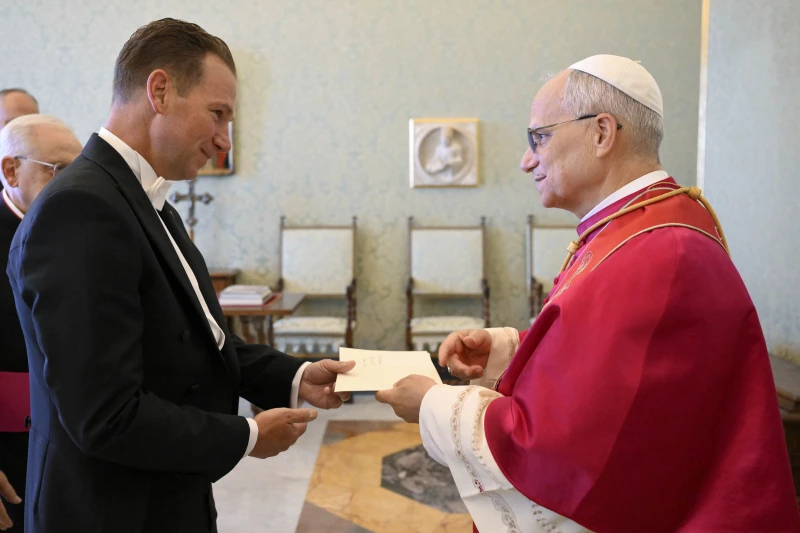
 Brian Burch, the new U.S. ambassador to the Holy See, presents his credentials to Pope Leo XIV in the Vatican’s Apostolic Palace on September 13, 2025. / Vatican Media
Vatican City, Sep 13, 2025 / 07:35 am (CNA).
Pope Leo XIV on Saturday morning received Brian Burch, the new U.S. ambassador to the Holy See, in the Vatican’s Apostolic Palace for the formal presentation of his letters of credence.
Burch, 50, was confirmed by the U.S. Senate on Aug. 2 in a 49-44 vote. He was nominated by President Donald Trump in December 2024 and succeeds former ambassador Joe Donnelly, who served under the Biden administration.
In a statement following his confirmation, Burch said he was “profoundly grateful” to the president and Senate for the opportunity to serve, and asked for the prayers of Catholics across the United States “that I may serve honorably and faithfully in the noble adventure ahead.”
A native of Phoenix, Arizona, Burch is married and the father of nine children. He graduated with a bachelor’s degree from the University of Dallas in 1997 and began his career in business before moving into Catholic nonprofit leadership. From 2005 until his confirmation this year, he was president of CatholicVote Civic Action and the CatholicVote Education Fund, organizations dedicated to promoting Catholic engagement in public life.
During his time with CatholicVote, Burch became a nationally recognized figure in Catholic political advocacy, encouraging American Catholics to participate in the democratic process and to defend religious liberty and the sanctity of life. CatholicVote’s new president, Kelsey Reinhardt, said in August that the group “joyfully celebrates” his confirmation, praising his 17 years of leadership.
On the occasion of his confirmation, Burch noted a point of personal significance for him in his new role. “In a remarkable coincidence, or what I prefer to attribute to providence, Pope Leo XIV is from Chicago, which is also my hometown,” he said.
Burch emphasized the enduring importance of the U.S.–Holy See relationship, describing it as “one of the most unique in the world,” and highlighting the Catholic Church’s “global reach and moral witness” as vital to America’s diplomatic mission to promote peace, human dignity, and prosperity.
[…]




We read: “those of our brothers and sisters deprived of their liberty whom they deem fit to benefit from such a measure…”
A complicated path, clemency vs retributive justice, where some jurisdictions use a broadened criterion: “When a criminal has been punished and a pardon can be used to enable that individual to [also] benefit society’s higher purpose, a pardon should be used.” (In the Hebrew Bible, a merciful Lord preserves the life of David—but not his first son by the seduced Bathsheba—and his later son does then rule over a unified kingdom, until he also betrays the covenant by multiplying his wives and gold [Deut 17:16-17; 1 Kings 10:14] and the now undivided kingdom, too, divides into the kind of “conflicts” we see today; human clemency in an imperfect world is still complicated.)
In any event, the selective granting of pardons varies by circumstance (false conviction, reformed life vs recidivism, disparate sentences, the deterrent effect, the nature of the crime(s) committed, extenuating mental circumstances, etc.), and by country: https://en.wikipedia.org/wiki/Pardon
To err is human. To forgive is divine. Long live mercy, forgiveness, and compassion.
Phil Lawler has a pointed response to Pope Francis’ proposal at Catholic Culture.