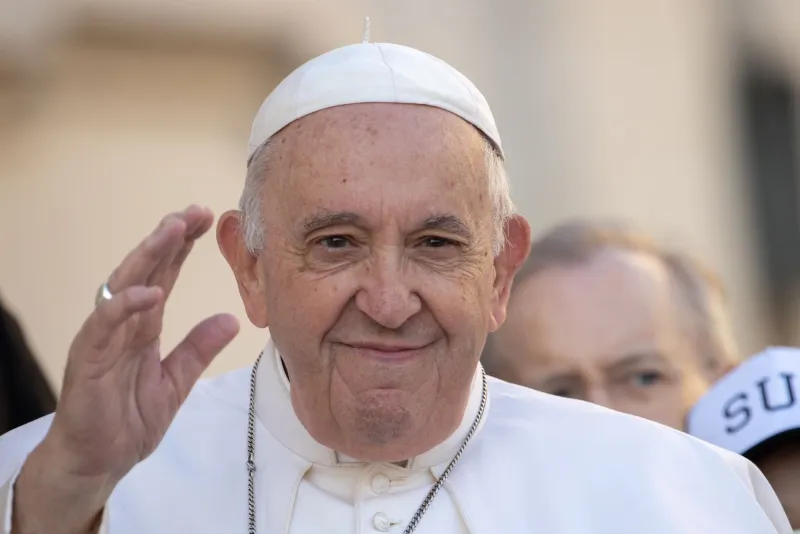
Pope Francis greeting pilgrims on St. Peter’s Square, Oct. 19, 2022. / Daniel Ibáñez / CNA
Warsaw, Poland, Oct 21, 2022 / 06:45 am (CNA).
Pope Francis has welcomed the establishment of a Center for Catholic-Jewish Relations in Poland and called for a deepening appreciation of a common heritage.
The Abraham J. Heschel Center for Catholic-Jewish Relations is a new scientific and educational institution of the John Paul II Catholic University in Lublin. Its purpose is to deepen Catholic-Jewish relations internationally on the scientific, educational, and cultural levels.
The inauguration ceremony took place Oct. 17. The inauguration was attended, among others, by the scholar Susannah Heschel, daughter of Abraham J. Heschel; the Latin Patriarch of Jerusalem Pierbattista Pizzaballa; and representatives of the Jewish and Catholic communities.
Abraham Joshua Heschel (1907–1972) was a Polish-born American rabbi and influential thinker who also contributed to Jewish-Christian relations.
On Wednesday, Pope Francis told Polish pilgrims at his general audience in Rome: “The need to research one’s own life also applies to entire nations. It is worthwhile to learn about the history of one’s own country in order to recognize the traces of God’s presence in it.”
The pope stressed that he was pleased that a center for Catholic-Jewish relations had been opened in Lublin.
“I hope it will promote appreciation of the common heritage not only of the two religions but also of the two peoples. I bless you with all my heart,” he said.
Speakers at the livestreamed opening ceremony included Rabbi Abraham Skorka; Archbishop Stanisław Gądecki, president of the Polish Bishops’ Conference; and Archbishop Stanisław Budzik of Lublin.
The initiator and founder of the Abraham J. Heschel Center for Catholic-Jewish Relations at the Catholic University of Lublin is Father Miroslaw Kalinowski, rector of the John Paul II Catholic University in Lublin.
The inaugural director is Father Miroslaw Wróbel, head of the Biblical Sciences Section of the Catholic University of Lublin.
The new center’s deputy directors are Witold Mędykowski, a historian and specialist on the history of Polish Jews and the Holocaust, and Father Paweł Rytel-Andrianik, a biblical scholar and orientalist who holds a doctorate in Judaic and Hebraic studies from Oxford University.
The Catholic Church in Poland marks an annual Day of Judaism at the start of the Week of Prayer for Christian Unity, which takes place Jan. 18–25.
In Poland, the Catholic Church also observes a Day of Islam at the end of the ecumenical week.
If you value the news and views Catholic World Report provides, please consider donating to support our efforts. Your contribution will help us continue to make CWR available to all readers worldwide for free, without a subscription. Thank you for your generosity!
Click here for more information on donating to CWR. Click here to sign up for our newsletter.
CNA Staff, Jun 16, 2020 / 12:01 pm (CNA).- The Catholic Church on the Channel Island of Guernsey is holding an all night prayer vigil Tuesday, immediately ahead of a debate on the liberalization of abortion law in the island.
Some deputies, or legislators, have called for the debate to be delayed to allow wider consultation with residents.
A bill is being considered to ‘modernize’ the territory’s abortion law and increase the abortion time limit to 24 weeks, as it is in the UK. The existing law, adopted in 1997, permits abortion up to 12 weeks.
An all-night prayer vigil, which began the evening of June 16, is being held at St. Joseph’s Church in St. Peter Port. The vigil includes music, the rosary, night prayer, and the Divine Mercy chaplet.
The parish is also urging parishioners to write their deputies, and to pray that the legislation fails.
The territory’s parliament, the States of Guernsey, are due to debate the draft law June 17. The territory is a self-governing Crown Dependency for which the UK is responsible, located off the coast of Normandy. It sets its own laws on abortion. The draft law would extend to Guernsey and its associated islands, but not Alderney and Sark, which are also part of the Bailiwick of Guernsey.
The draft law would also decriminalize the procurement of abortion outside the legal framework; drop a requirement that the mother consult with two medical practitioners; increase the time frame for procuring the abortion of a child diagnosed with ‘fetal anomaly’; allow nurses and midwives to preform medical abortions; and allow medical abortions at home.
It would also force conscientious objectors to make referrals without delay; “make clear that health practitioners may not refuse to participate in care required to save the life or prevent serious injury to the physical or mental health of a woman”; and “create a power in the Law for the Committee for Health & Social Care to make regulations making further provision in relation to the circumstances in which the right of health practitioners to conscientiously object to the provision of care in relation to abortions may be exercised.”
According to official figures, 113 abortions were performed in Guernsey in 2018, with a further three involving Guernsey residents performed in England and Wales.
Two of the 40 deputies of the States of Guernsey, Jane Stephens and Jonathan Le Tocq, have submitted a sursis motivé to stay the deliberation of the draft law, and direct the health and social care committee to form a working party “to conduct a broader and more inclusive public consultation … over atime-frame sufficient to ensure engagement with the wider community” and to research “challenges on the basis of disability and the implications of legal challenges and changes to the law in the British Isles which may effect reform in Guernsey.”
According to the Guernsey Press, Stephens said that deputies had received many emails indicating “that the public feel they have not had the time or opportunity to engage in the consultation properly because of lockdown, or actually discuss with each other about the implications of the debate.”
According to the health committee, two-thirds of responses it had received were supportive of the proposed changes.
The sursis will be considered June 17, but health committee members have said they expect it to be thrown out.
Stephens and Le Tocq have introduced several amendments to the draft law. Among these are amendments to ensure there is no discrimination on the basis of disability; to ensure that diagnosis of fatal foetal abnormality shall not include non-fatal conditions such as Down syndrome or cleft palate; to require that mothers affirm they consent to the abortion and have not been coerced; and to strengthen conscientious objection for medical professionals.
Le Tocq and another deputy, Andrea Dudley-Owen, have introduced amendments to change the time limit to 22 rather than 24 weeks; allow foetal pan relief after 18 weeks; and to offer counselling before and after an abortion.
Bishop Philip Egan of Portsmouth, the diocese which includes Guernsey, urged Catholics earlier this month to resist the “fundamentally detestable” efforts to liberalize the island’s abortion law.
In a June 7 message he argued the proposed changes would violate the commandment “Thou shalt not kill” and the injunction “Love thy neighbor as thyself”, which formed the basis of laws in civilized societies.
“This is why abortion and the current proposal to ‘modernize’ — that is, to increase — its availability in Guernsey is fundamentally detestable,” he said. “Under the bogus word ‘modernization,’ an attempt is being made to further liberalize abortion, to make it a lot easier and a lot more common.”
Egan said: “They want to allow abortions much later in pregnancy, abortions to be carried out with less red tape, abortions to take place at home and outside hospitals, and, grimly, abortions right up to birth for a disabled child, a child unwell, or a child with Downs syndrome. How must a person with Downs syndrome feel about this?”
“They refer to abortion euphemistically as a ‘procedure,’ a ‘termination’ with help from ‘the professionals.’ But what procedure can justify any professional terminating the life of an innocent baby? The more you see what an abortion is, the more you can see it is anti-life, anti-human and anti-woman.”
He added: “This is why I am appealing to all of you and to everyone of good will in Guernsey to resist and to face down these sinister proposals coming before the legislature. The post-COVID lockdown is not the right time to ram through legislation like this, not without a full, open and frank consultation and debate.”
In a joint letter, John P. Ogier, pastor of Spurgeon Baptist Church, and Fr. Bruce Barnes, the Catholic Dean of the Bailiwick of Guernsey, also criticized the timing of the debate.
They wrote: “We believe this is an entirely inappropriate time to be considering such a sensitive and morally important issue, in the midst of the current COVID-19 pandemic and with such a truncated timescale for public debate and consideration.”
St. John Paul II, circa 1992. / L’Osservatore Romano.
CNA Newsroom, Dec 7, 2022 / 08:00 am (CNA).
Journalists investigating secular and Catholic Church sources in Poland have called into question allegations by a Dutch writer that St. John Paul II “covered up” sexual abuse while still a bishop in Poland.
On Dec. 2, Ekke Overbeek, a journalist from the Netherlands living in Poland, said he had found “concrete cases of priests abusing children in the Archdiocese of Krakow, where the future pope was archbishop. The future pope knew about it and transferred them anyway, which led to new victims.”
Overbeek referred to the case of the priest Eugeniusz Surgent and “many others” whom Karol Wojtyla allegedly “covered up.”
The Dutch publication NOS, in which Overbeek’s statements appeared, reported the journalist spent three years combing “Polish archives.”
“Almost all documents collected directly about Wojtyla have been destroyed. However, in other surviving documents, he is mentioned very often. And if you put them all together, they are pieces of a puzzle that give a picture of how he dealt with it,” the writer stated, without saying which archives he was referring to.
Polish journalists Tomasz Krzyżak and Piotr Litka of Rzeczpospolita published an investigation that countered Overbeek’s accusations, stating St. John Paul II did not cover up any abuse and consistently acted against such cases during his time as archbishop of Krakow from 1964 to 1978.
The reporters point out that the priest in question, Surgent, was not from the Archdiocese of Krakow but from the Diocese of Lubaczów.
As archbishop of Krakow, the then Cardinal Karol Wojtyla made several decisions concerning Surgent, they explained, “within his competencies, leaving the final word on possible sanctioning of the priest to his ordinary, the bishop of Lubaczów.”
The journalists added that “the then archbishop of Krakow could not do anything about the fact that Surgent was working in two other dioceses.”
The Polish reporters also referred to another incident that illustrated how Cardinal Wojtyla at the time dealt with abuse, namely the case of priest Józef Loranc, who was accused of sexually abusing young girls.
“The absence of punitive measures by the ecclesiastical court does not cancel the crime and does not undo the guilt,” Cardinal Wojtyla wrote in a 1971 letter to Loranc after he was released from prison.
For Krzyżak and Litka, “this behavior” of the later Pope John Paul II “differs considerably from the practice of leniency toward those who had committed such crimes, which was common at the time.”
In the case of Loranc, a priest of the Archdiocese of Krakow until his death in 1992, “Cardinal Wojtyla made immediate decisions in accordance with canon law. And while he gradually lifted canonical penalties and showed great mercy, he remained ever vigilant,” the journalists wrote.
When Cardinal Wojtyla learned of the case in 1970, his decision came just days after learning of the accusations against Loranc.
In a letter, the future Pope John Paul II stated that the accused priest was “suspended” and “could not exercise any priestly function” and would have to “live in the monastery for a certain period of time and make a retreat and receive help.”
The journalists said that Wojtyla “made all the necessary decisions at that moment: the quick removal of the priest from the parish, the suspension until the matter was resolved, and the obligation to live in a monastery,” where civil authorities then arrested him.
The case did not reach the Vatican, they said, because the provision directing what is now the Dicastery for the Doctrine of the Faith — then the Congregation for the Doctrine of the Faith — to deal with abuse cases was not issued until 2001.
Although he was eventually allowed to celebrate Mass again, Loran could not return to the “canonical mission of catechesis of children and youth” or to the ministry of the confessional.
The Polish Bishops’ Conference, in a statement published Nov. 14, spoke of “increasingly hearing questions about John Paul II’s attitude toward the tragedy of sexual abuse of minors and vulnerable people by the clergy and about his response to such crimes during his pontificate.”
“It has been increasingly alleged that the pope did not deal adequately with such acts and did little to address the problem, or even covered it up,” the statement continued.
The bishops decried these as a “media assault” on St. John Paul II and his pontificate. The target of such criticisms was “his teaching expressed, for example, in encyclicals such as Redemptor hominis or Veritatis splendor, as well as in his theology of the body, which does not correspond to contemporary ideologies promoting hedonism, relativism, and moral nihilism.”
The statement was not the first time Polish Catholic leaders responded to allegations against St. John Paul II.
In December 2020, following criticism of the Polish pope in the wake of the McCarrick report, 1,700 professors at Polish universities and research institutes signed an appeal defending St. John Paul II.
The signatories included Hanna Suchocka, Poland’s first female prime minister; former foreign minister Adam Daniel Rotfeld; physicists Andrzej Staruszkiewicz and Krzysztof Meissner; and film director Krzysztof Zanussi.
The professors’ appeal followed an intervention by Archbishop Stanisław Gądecki, president of the Polish Bishops’ Conference. In a Dec. 7, 2020, statement, Gądecki deplored what he called “unprecedented attacks” on St. John Paul II. He insisted that the pope’s “highest priority” was combating clerical abuse and protecting young people.
Bishops process into St. Peter’s Basilica for the closing Mass of the first assembly of the Synod on Synodality on Oct. 29, 2023. / Vatican Media
Rome Newsroom, Jul 9, 2024 / 06:00 am (CNA).
The guiding document for the final part of the Synod on Synodality, published Tuesday, focuses on how to implement certain of the synod’s aims, while laying aside some of the more controversial topics from last year’s gathering, like women’s admission to the diaconate.
“Without tangible changes, the vision of a synodal Church will not be credible,” the Instrumentum Laboris, or “working tool,” says.
The six sections of the roughly 30-page document will be the subject of prayer, conversation, and discernment by participants in the second session of the 16th Ordinary General Assembly of the Synod of Bishops, to be held throughout the month of October in Rome.
Instead of focusing on questions and “convergences,” as in last year’s Instrumentum Laboris, “it is now necessary that … a consensus can be reached,” said a FAQ page from synod organizers, also released July 9, answering a question about why the structure was different from last year’s Instrumentum Laboris.
The guiding document for the first session of the Synod on Synodality in 2023 covered such hot-button topics as women deacons, priestly celibacy, and LGBTQ outreach.
By contrast, this year’s text mostly avoids these subjects, while offering concrete proposals for instituting a listening and accompaniment ministry, greater lay involvement in parish economics and finances, and more powerful parish councils.
“It is difficult to imagine a more effective way to promote a synodal Church than the participation of all in decision-making and taking processes,” it states.
The working tool also refers to the 10 study groups formed late last year to tackle different themes deemed “matters of great relevance” by the Synod’s first session in October 2023. These groups will continue to meet through June 2025 but will provide an update on their progress at the second session in October.
The possibility of the admission of women to the diaconate will not be a topic during the upcoming assembly, the Instrumentum Laboris said.
The new document was presented at a July 9 press conference by Cardinals Mario Grech and Jean-Claude Hollerich, together with the special secretaries of the synodal assembly: Jesuit Father Giacomo Costa and Father Riccardo Battocchio.
“The Synod is already changing our way of being and living the Church regardless of the October assembly,” Hollerich said, pointing to testimonies shared in the most recent reports sent by bishops’ conferences.
The Oct. 2-27 gathering of the Synod on Synodality will mark the end of the discernment phase of the Church’s synodal process, which Pope Francis opened in 2021.
Participants in the fall meeting, including Catholic bishops, priests, religious, and laypeople from around the world, will use the Instrumentum Laboris as a guide for their “conversations in the Spirit,” the method of discussion introduced at the 2023 assembly. They will also prepare and vote on the Synod on Synodality’s advisory final document, which will then be given to the pope, who decides the Church’s next steps and if he wishes to adopt the text as a papal document or to write his own.
The third phase of the synod — after “the consultation of the people of God” and “the discernment of the pastors” — will be “implementation,” according to organizers.
Prominent topics
The 2024 Instrumentum Laboris also addresses the need for transparency to restore the Church’s credibility in the face of sexual abuse of adults and minors and financial scandals.
“If the synodal Church wants to be welcoming,” the document reads, “then accountability and transparency must be at the core of its action at all levels, not only at the level of authority.”
It recommends effective lay involvement in pastoral and economic planning, the publication of annual financial statements certified by external auditors, annual summaries of safeguarding initiatives, the promotion of women to positions of authority, and periodic performance evaluations on those exercising a ministry or holding a position in the Church.
“These are points of great importance and urgency for the credibility of the synodal process and its implementation,” the document says.
The greater participation of women in all levels of the Church, a reform of the education of priests, and greater formation for all Catholics are also included in the text.
Bishops’ conferences, it says, noticed an untapped potential for women’s participation in many areas of Church life. “They also call for further exploration of ministerial and pastoral modalities that better express the charisms and gifts the Spirit pours out on women in response to the pastoral needs of our time,” the document states.
Formation in listening is identified as “an essential initial requirement” for Catholics, as well as how to engage in the practice of “conversation in the Spirit,” which was employed in the first session of the Synod on Synodality.
Pope Francis and delegates at the Synod on Synodality at the conclusion of the assembly on Oct. 28, 2023. Credit: Vatican Media
The document says the need for formation has been one of the most universal and strong themes throughout the synodal process. Interreligious dialogue also is identified as an important aspect of the synodal journey.
On the topic of the liturgy, the Instrumentum Laboris says there was “a call for adequately trained lay men and women to contribute to preaching the Word of God, including during the celebration of the Eucharist.”
“It is necessary that the pastoral proposals and liturgical practices preserve and make ever more evident the link between the journey of Christian initiation and the synodal and missionary life of the Church,” the document says. “The appropriate pastoral and liturgical arrangements must be developed in the plurality of situations and cultures in which the local Churches are immersed …”
How it was drafted
Dubbed the “Instrumentum Laboris 2,” the document released Tuesday has been in preparation since early June when approximately 20 experts in theology, ecclesiology, and canon law held a closed-door meeting to analyze around 200 synod reports from bishops’ conferences and religious communities responding to what the Instrumentum Laboris called “the guiding question” of the next stage of the Synod on Synodality: “How to be a synodal Church in mission?”
After the 10-day gathering, “an initial version” of the text was drafted based on those reports and sent to around 70 people — priests, religious, and laypeople — “from all over the world, of various ecclesial sensitivities and from different theological ‘schools,’” for consultation, according to the synod website.
The XVI Ordinary Council of the General Secretariat of the Synod, together with consultants of the synod secretariat, finalized the document.
According to the working tool, soliciting new reports and feedback after the consultation phase ended is “consistent with the circularity characterizing the whole synodal process.”
“In preparation for the Second Session, and during its work, we continue to address this question: how can the identity of the synodal People of God in mission take concrete form in the relationships, paths and places where the everyday life of the Church takes place?” it says.
The document says “other questions that emerged during the journey are the subject of work that continues in other ways, at the level of the local Churches as well as in the ten Study Groups.”
Expectations for final session
According to the guiding document, the second session of the Synod on Synodality can “expect a further deepening of the shared understanding of synodality, a better focus on the practices of a synodal Church, and the proposal of some changes in canon law (there may be yet more significant and profound developments as the basic proposal is further assimilated and lived.)”
“Nonetheless,” it continues, “we cannot expect the answer to every question. In addition, other proposals will emerge along the way, on the path of conversion and reform that the Second Session will invite the whole Church to undertake.”
The Instrumentum Laboris says, “Synodality is not an end in itself … If the Second Session is to focus on certain aspects of synodal life, it does so with a view to greater effectiveness in mission.”
In its brief conclusion, the text states: “The questions that the Instrumentum Laboris asks are: how to be a synodal Church in mission; how to engage in deep listening and dialogue; how to be co-responsible in the light of the dynamism of our personal and communal baptismal vocation; how to transform structures and processes so that all may participate and share the charisms that the Spirit pours out on each for the common good; how to exercise power and authority as service. Each of these questions is a service to the Church and, through its action, to the possibility of healing the deepest wounds of our time.”
Religions are fountains of sublime energy meant for the task of ethically correct world-building.
