 Young people from around the world held hands in St. Peter’s Square during the #NotAlone human fraternity event June 10, 2023. / Vatican Media
Vatican City, Jun 15, 2023 / 08:22 am (CNA).
The U.N. Security Council convened a high-level briefing on Wednesday to discuss the role of “human fraternity” in promoting peace, inspired by the fraternity declaration co-authored by Pope Francis and a leading Sunni imam.
U.N. Secretary-General António Guterres told the council on June 14 to look to the human fraternity declaration signed by the pope and the Grand Imam of Al-Azhar Al-Sharif, Ahmed Al-Tayeb, in Abu Dhabi in 2019 as “a model for compassion and human solidarity.”
Following the briefing on June 14, the security council unanimously adopted a resolution condemning hate speech, racism, gender discrimination, and acts of extremism that was co-authored by the United Arab Emirates and the U.K.
The resolution had originally contained a reference to Pope Francis’ human fraternity declaration, which was deleted after some members expressed concern that the use of the term “human fraternity” could be interpreted as endorsing the entire content of the 2019 document, including its condemnation of abortion, according to the Security Council Report.
France also objected that the term “fraternity” was too ambiguous and could have contradictory interpretations, adding that religious questions do not have a place in the security council and that the resolution was “too weak” on the issues of women’s rights, sexual orientation, and gender identity.
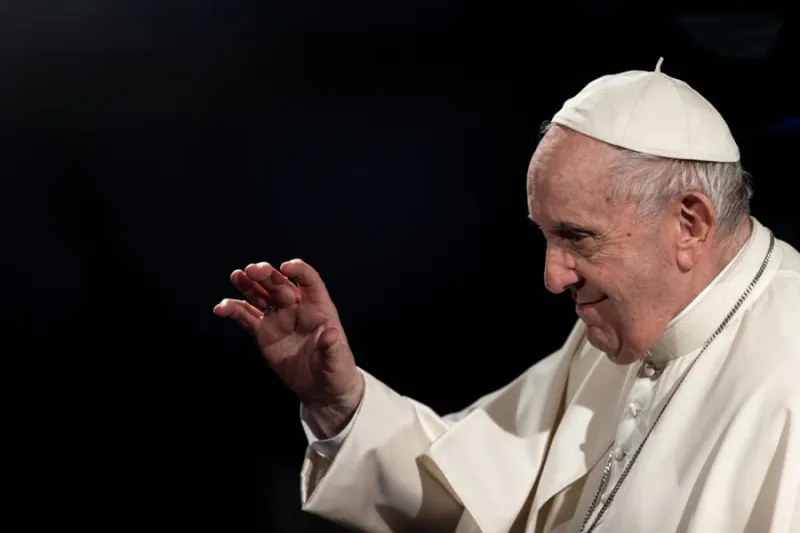
Pope Francis, in a message read aloud by the Vatican’s foreign minister Archbishop Paul Richard Gallagher, invited the security council to “face our common problems, setting aside ideologies and narrow visions, partisan ideas and interests, and to cultivate a single purpose: to work for the good of all humanity.”
“We are suffering from a famine of fraternity, which arises from the many situations of injustice, poverty, and inequality and also from the lack of a culture of solidarity,” the pope said.
“New ideologies, characterized by widespread individualism, egocentrism, and materialistic consumerism, weaken social bonds, fueling that ‘throwaway’ mentality, which leads to contempt for and abandonment of the weakest and those considered ‘useless.’”
The UAE convened the high-level meeting on human fraternity as it holds the rotating security council presidency this month.
The meeting fell under the security council’s “maintenance of international peace and security” agenda item.
Al-Tayeb, considered the highest authority in Sunni Islam, addressed the council via video conference from Egypt.
He rejected claims that Islam is a religion of the sword and said that war is only acceptable in self-defense. Al-Tayeb urged the international community to move away from pointless wars, mentioning Syria, Libya, Yemen, Iraq, and Afghanistan, and said that the war on the eastern borders of Europe is instilling fear that humanity may regress.
The UAE and the Holy See have collaborated in promoting human fraternity in the years following the 2019 declaration.
The UAE created the Higher Committee of Human Fraternity, which is co-chaired by Cardinal Miguel Ángel Ayuso Guixot, the president of the Pontifical Council for Interreligious Dialogue of the Holy See, and sponsors the $1 million Zayed Award for Human Fraternity.
A Vatican foundation also honored Abu Dhabi Crown Prince Sheikh Mohammed bin Zayed Al Nahyan with its “Man of Humanity” award in 2021.
In Guterres’ address to the security council, he said that “we are witnessing a groundswell of xenophobia, racism and intolerance, violent misogyny, anti-Muslim hatred, virulent anti-Semitism, and attacks on minority Christian communities” around the world.
The U.N. secretary general called for strengthening “the values of compassion, respect, and human fraternity anchored in international human rights norms and standards, and secure free and safe civic spaces.”
“This demands action by all of us — across international organizations, governments, civil society, and the private sector. And it requires intervention by faith leaders everywhere,” he said.
[…]




Interfaith prayer is a meaningful initiative. The community of Sant’Egidio is serving humanity with dedication and distinction. May their tribe increase.
Really? What does it mean?
For the Christens persecuted worldwide by those who deny the Blessed Trinity, the Incarnation, who worship demons that if named cause censurship?
For Catholics kicked out of Churches by the 2nd Bishop in White because they pray in Latin – first in China, and now Worldwide: what does it mean?
What does it mean to see the once honourable Catholic Church confirming gnostics, heretics, and those worshiping false idols in their error?
Simpleton headline writers, and others, continue to equate “interreligious” with the inventive non sequitur: “interfaith.” Religious beliefs are one thing; the unique faith in the person of incarnate Jesus Christ is quite another.
From their sites, it’s clear that Sant’ Egidio, itself, knows the difference. As for the spirit of Saint Francis, what was the purpose for his famous visit in A.D. 1219 with Sultan Malek al-Kamil at Damietta on the Nile Delta, then under siege by an army of the Fifth Crusade?…
The purpose was conversion, not the sharing of tea in a flat-earth dialogue of interreligious equivalency. So, without implying such equivalency, in the Roman Colosseum let there be interreligious prayer for peace. (At least it’s not the twelve-niched, polytheistic and now secularized pantheon!) But for the global spectators, also let there by some understanding and indication of the Christian Faith.
And, even some anti-cancel culture curiosity about the ins and outs of real history. In the Paradiso, Canto XI, Dante says that St. Francis sought martyrdom and that failing this he left; and implies that the Sultan might not have been attracted to Lady Poverty. Later in the mid-13th century, and fearful of the Mogul invasions, other Franciscans made their way to Mongolia (where there is now a newly minted Catholic cardinal!) in unsuccessful efforts to convert the Khan, and with the remote possibility of even joining in an alliance against Islam. One of these (John of Pian de Carpine, 1180?-1252) had been a companion of St. Francis (See Daniel Boorstin, “The Discoverers”, 1983).
The present “Francis” presented bishops to the World from the Amazon proudly announcing in his name that they “had never committed a single baptism.”
Proselytism being a “crime” in Freemasonry and a “Sin” in post-catholic Bergoglioism – not that there could possibly be even a remote connection – there should be no risk of any baptisms at the Colosseum – to the great relief to all of Francis’ “Sin-OD” friends. Perish the thought! This is the Francis who begs Anglican bishops NOT to Convert…