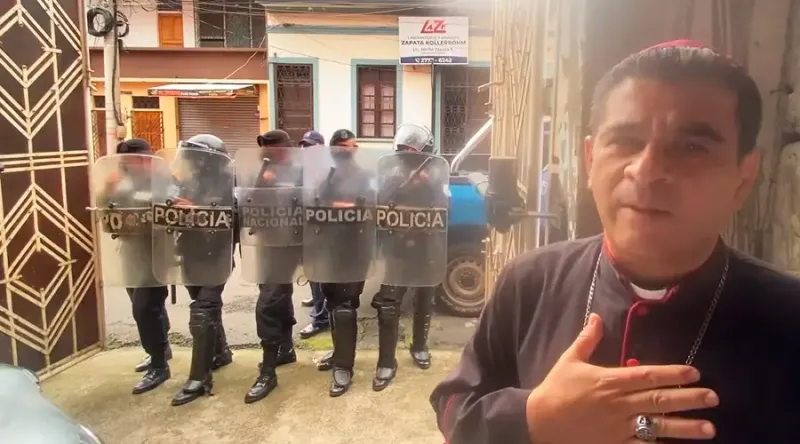
Bishop José Álvarez Lagos surrounded by police officers on Aug. 4, 2022. / Diocese Media TV Merced / Diocese of Matagalpa
Matagalpa, Nicaragua, Aug 19, 2022 / 16:07 pm (CNA).
The archbishop of Managua, Nicaragua, Cardinal Leopoldo Brenes, met with the bishop of Matagalpa, Rolando Álvarez, hours after the bishop had been abducted by the Daniel Ortega dictatorship during the early hours of August 19.
In a statement released this afternoon, the archbishop reported that the “physical condition” of Álvarez “has deteriorated,” but “his mind and spirit are strong.”
In its message this afternoon, the archdiocese of Managua expressed “its solidarity and closeness with the sister diocese of Matagalpa, in the face of the sad event experienced this morning.”
“The Archbishop Cardinal Leopoldo Brenes had the opportunity to visit and talk with Bishop Álvarez in a residence of his relatives, showing his fraternal esteem in the name of our Nicaraguan church,” the archdiocese said.
The bishop is being held there under house arrest.
“Bishop Álvarez has expressed his confidence in everyone’s prayer in the face of this difficult situation that we are going through in ecclesial communion,” the statement said.
The archdiocese of Managua stressed that “prayer is the strength of the Christian,” so “we invite you to continue imploring Christ to intercede and watch over this little flock of his.”
“We hope that reason, as well as respectful understanding, open the way to the solution of this critical and complex situation for everyone,” the message concluded.
According to police, the priests and seminarians detained in Managua are being held “in the Directorate of Judicial Assistance,” in a prison known as “El Chipote,” infamous for torture carried out on opponents of the Ortega dictatorship.
Speaking with ACI Prensa Aug. 19, the lawyer Martha Patricia Molina Montenegro said that for the abducted bishop “there are two outcomes,” which are “exile or jail.”
However, she said, Álvarez “will never tolerate” leaving Nicaragua, “and even less so when he found out that the rest of the priests and seminarians were sent to the torture prison known as El Chipote.”
If you value the news and views Catholic World Report provides, please consider donating to support our efforts. Your contribution will help us continue to make CWR available to all readers worldwide for free, without a subscription. Thank you for your generosity!
Click here for more information on donating to CWR. Click here to sign up for our newsletter.
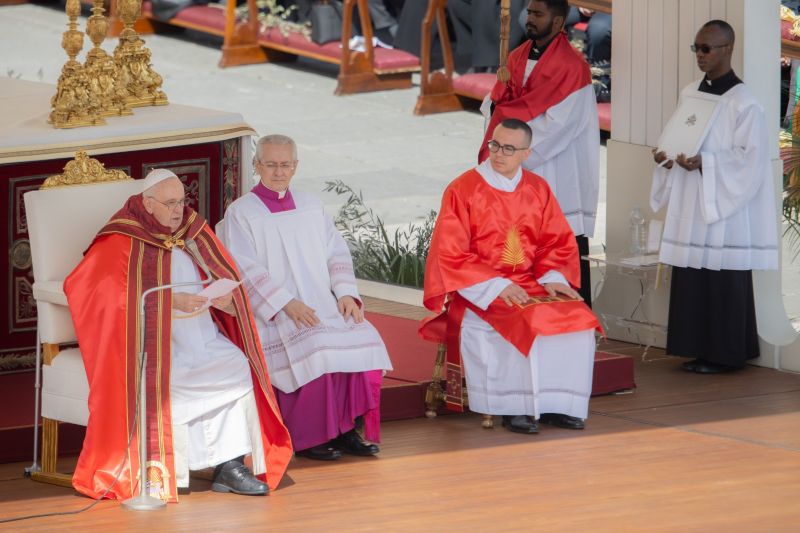
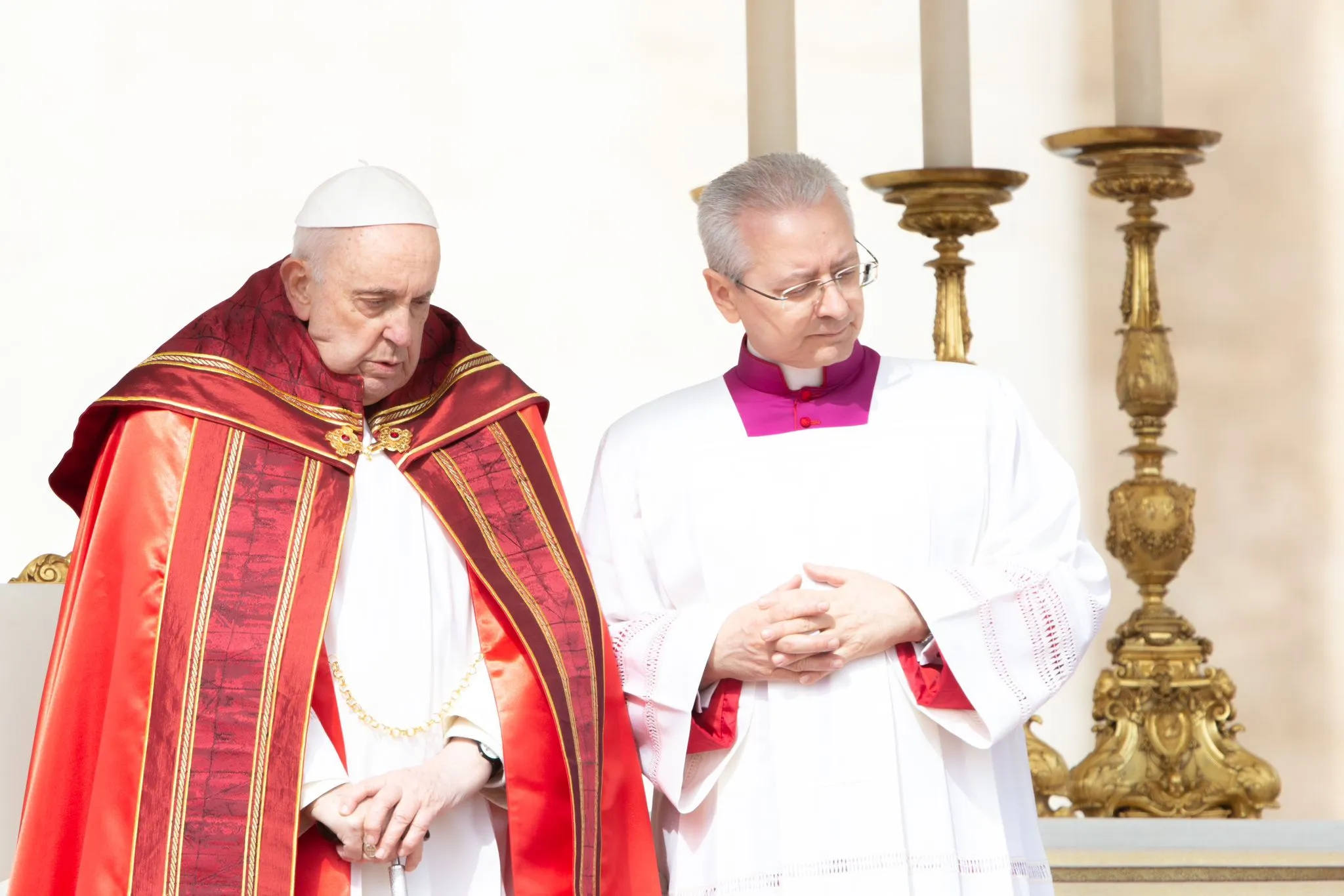
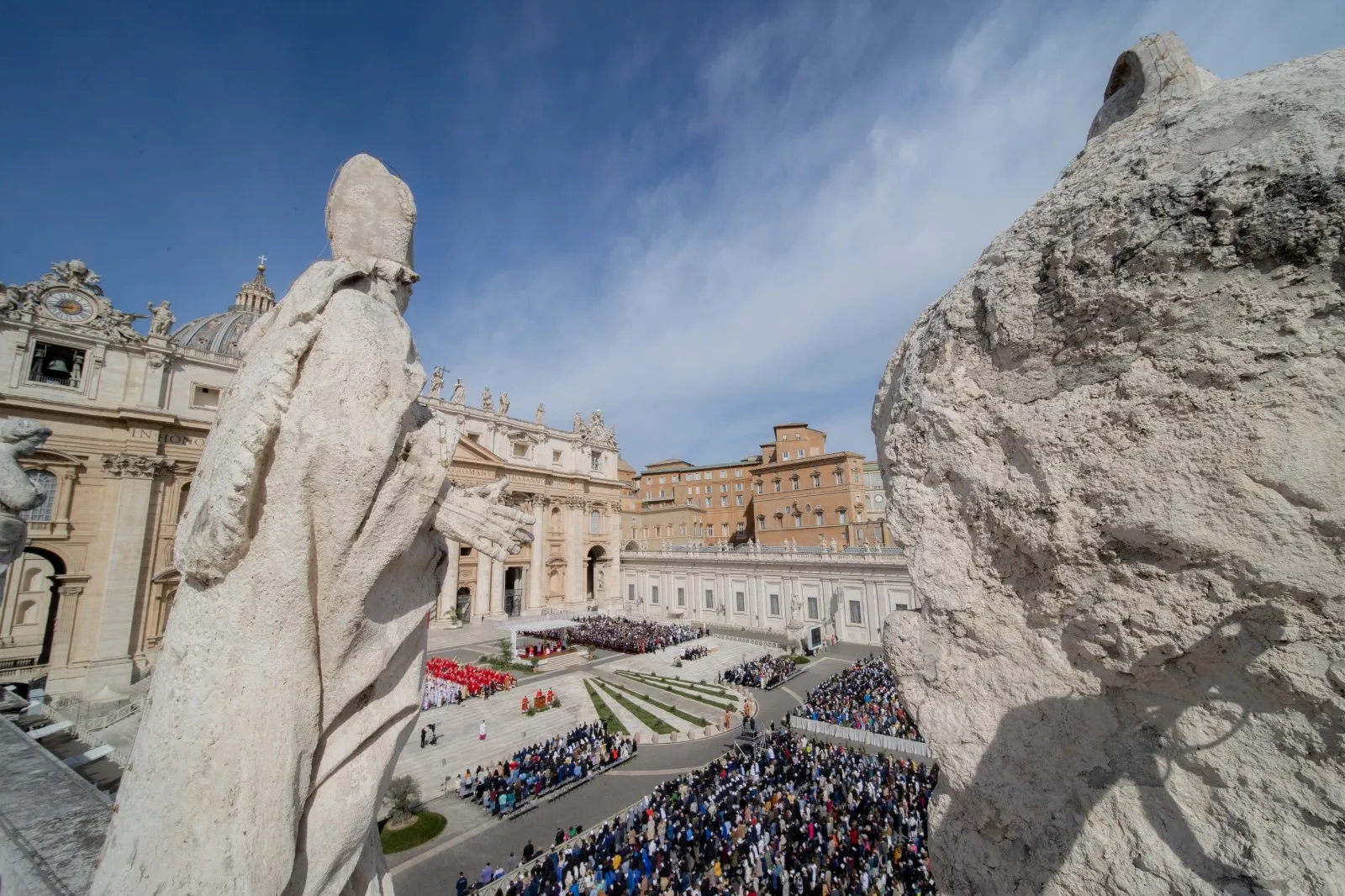
Pope Francis presided over Palm Sunday Mass in St. Peter’s Square on April 2, 2023. / Daniel Ibanez/CNA
Vatican City, Apr 2, 2023 / 05:15 am (CNA).
On Palm Sunday, Pope Francis said Jesus voluntarily took on the pain and abandonment of his Passion and Crucifixion so that he could be with us in whatever sorrow or difficulty we might be experiencing.
Jesus “experienced abandonment in order not to leave us prey to despair, in order to stay at our side forever,” the pope said during Palm Sunday Mass in St. Peter’s Square April 2.
“He did this for me, for you,” he said, “because whenever you or I or anyone else seems pinned to the wall — and we have seen someone pinned to the wall — you see someone lost in a blind alley, plunged into the abyss of abandonment, sucked into a whirlwind of ‘whys’ without answer, there can still be some hope…”
Pope Francis presided over Palm Sunday Mass in St. Peter’s Square on April 2, 2023. Daniel Ibanez/CNA
Pope Francis presided over the Palm Sunday Mass one day after being discharged from Rome’s Gemelli Hospital.
The pope was admitted to the hospital for three days beginning March 29 for treatment for a bronchitis infection, the Vatican said.
An estimated 60,000 people were at the papal Mass, according to the Vatican Gendarmes.
In his homily, Francis spoke in a soft voice as he emphasized that whatever situation of abandonment we find ourselves in, Jesus is at our side.
The pope also said that we will find Jesus in those who are abandoned, recalling the death in November last year of a homeless man from Germany, who was found under the colonnade of St. Peter‘s Square.
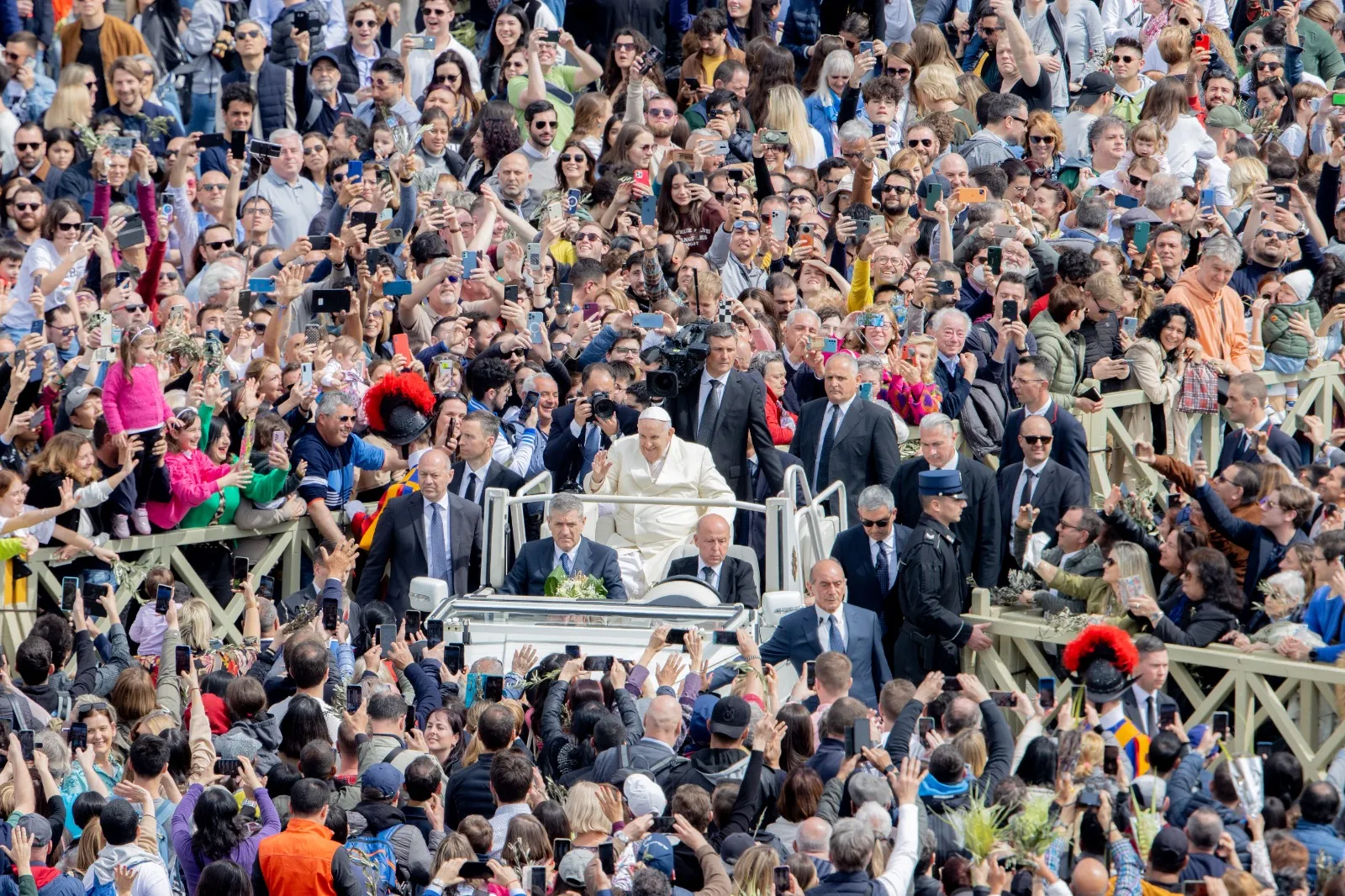
Pope Francis presided over Palm Sunday Mass in St. Peter’s Square on April 2, 2023. Daniel Ibanez/CNA
Jesus “wants us to care for our brothers and sisters who resemble him most, those experiencing extreme suffering and solitude,” he said. “Today, brothers and sisters, there are entire peoples who are exploited and abandoned; the poor live on our streets and we look the other way, we turn around; there are migrants who are no longer faces but numbers; prisoners are disowned; people written off as problems.”
Pope Francis said these people are “Christs” for us: “People who are abandoned, invisible, hidden, discarded with white gloves,” such as the unborn, the isolated elderly, the forgotten sick, the abandoned disabled, and the lonely young.
“Jesus, in his abandonment, asks us to open our eyes and hearts to all who find themselves abandoned,” he said.
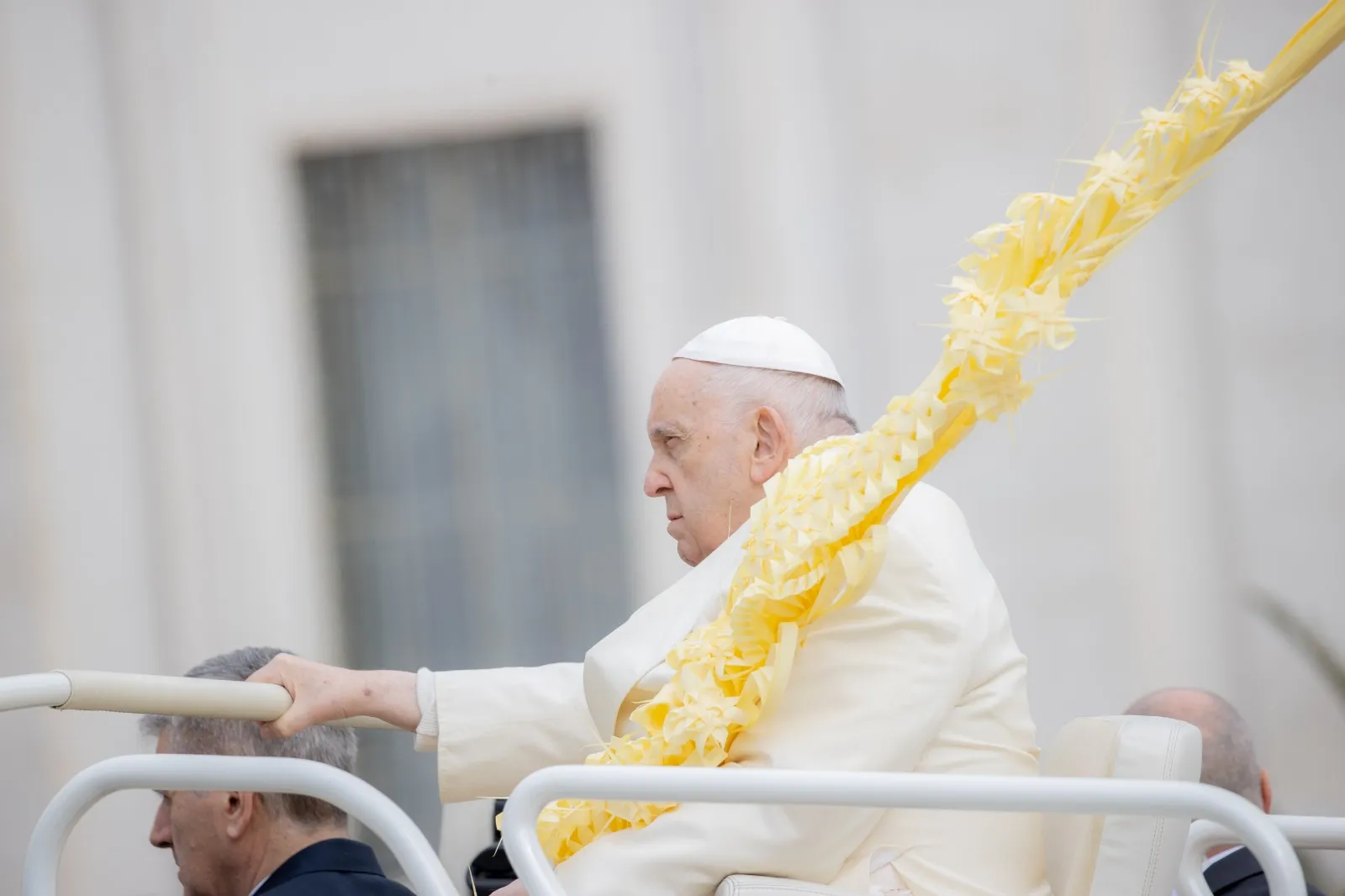
Pope Francis entered St. Peter’s Square in the popemobile April 2. He was driven to the central obelisk for the blessing of the palms and the proclamation of a reading from the Gospel of St. Matthew and the singing of Psalm 23.
Pope Francis presided over Palm Sunday Mass in St. Peter’s Square on April 2, 2023. Daniel Ibanez/CNA
The blessing followed the procession of cardinals, bishops, priests, deacons, and laypeople carrying palm fronds, olive branches, and the large weaved palms called “parmureli” to commemorate Jesus’ entrance into Jerusalem. Pope Francis has not led the procession since 2019.
For the start of Mass, the pope was again driven in the popemobile from the obelisk to the altar in front of St. Peter’s Basilica.
Palm Sunday, also called Passion Sunday, marks the beginning of Holy Week, which will lead in to the sacred Triduum of Holy Thursday, Good Friday, and Holy Saturday, and concludes with the celebration of Christ’s Resurrection beginning at the Easter Vigil.
On Palm Sunday, the Mass includes the reading of the Lord’s Passion from the Gospel of St. Matthew.
In his homily on April 2, Pope Francis focused on a line from the Gospel and repeated in the Psalm — Jesus’ cry of abandonment to the Father — “My God, my God, why have you forsaken me?”
“‘My God, my God, why have you forsaken me?’ In the Bible, the word ‘forsake’ is powerful,” the pope said.
An estimated 60,000 people attended Pope Francis’ Mass for Palm Sunday April 2, 2023. Daniel Ibanez/CNA
He noted how one might feel forsaken “at moments of extreme pain: love that fails, or is rejected or betrayed; children who are rejected and aborted; situations of repudiation, the lot of widows and orphans; broken marriages, forms of social exclusion, injustice and oppression; the solitude of sickness.”
“In a word, in the drastic severing of the bonds that unite us to others,” he said. “There [Jesus] tells us this word: abandonment. Christ brought all of this to the cross; upon his shoulders, he bore the sins of the world. And at the supreme moment, Jesus, the only begotten, beloved Son of the Father, experienced a situation utterly alien to his very being: the abandonment, the distance of God.”
“But, why did it have to come to this? For us. There is no other answer: Us,” Francis underlined. “He became one of us to the very end, in order to be completely and definitively one with us.”
At the end of his homily, Pope Francis remained in silence for over two and a half minutes before the singing of the Creed.
Jesus, the pope said, “has endured the distance of abandonment in order to take up into his love every possible distance that we can feel. So that each of us might say: in my failings — each of you has fallen many times — and I can say in my failings, in my desolation, whenever I feel betrayed or I have betrayed someone, when I feel cast aside or I have cast aside others, or when I feel forsaken or have forsaken others, we can think that Jesus was abandoned, betrayed, cast aside.”
An estimated 60,000 people attended Pope Francis’ Mass for Palm Sunday April 2, 2023. Daniel Ibanez/CNA
In our failures, we can remember that Jesus is at our side, Pope Francis said. “When I feel lost and confused, when I feel that I can’t go on, he is with me, he is there. In the thousand fits of ‘why…?’ and with many ‘whys’ unanswered, he is there.”
At the conclusion of Mass, Pope Francis led the Angelus, a traditional prayer honoring Mary.
In a brief message before the prayer, he invited Catholics to live Holy Week “as the tradition of God’s holy faithful people teaches us, that is, accompanying the Lord Jesus with faith and love.”
“Let us learn from our Mother, the Virgin Mary,” he said. “She followed her Son with the closeness of her heart; she was one soul with him and, although she did not understand everything, together with him she surrendered herself fully to the will of God the Father.”
“May Our Lady help us to be close to Jesus present in the suffering, discarded, abandoned people. May Our Lady take us by the hand to Jesus present in these people,” he said. “To all, happy journey toward Easter.”
From the popemobile, Pope Francis greeted those gathered in the square and in the adjoining thoroughfare after the Mass.
The full text of Pope Francis’ homily for Palm Sunday 2023 can be read here.
Father Marko Rupnik, SJ. / Screenshot Vatican News
Rome Newsroom, Feb 10, 2023 / 13:45 pm (CNA).
The ministry of Jesuit Father Marko Rupnik, accused of the sexual, spiritual, and psychological abuse of women from a religious community with whic… […]
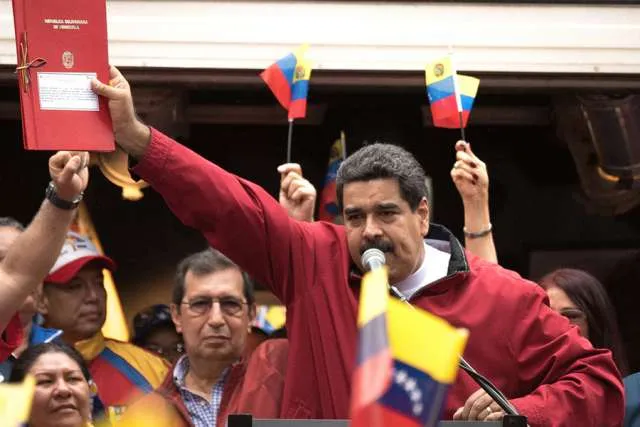
Caracas, Venezuela, Aug 2, 2017 / 04:42 pm (CNA/EWTN News).- Cardinal Jorge Urosa of Caracas has warned President Nicolás Maduro and the high command of the armed forces that they will be accountable to God for the deaths of Venezuelans killed by military personnel and Chavista groups during demonstrations against the country’s contentious Constituent Assembly.
“In the name of God, stop the repression!” exclaimed the cardinal, adding that “there are citizens who were murdered and wounded by Venezuelan military personnel and, presumably, by armed forces that act illegally and criminally. This is totally intolerable and cries out to heaven.”
In statements made to the local press, the cardinal referred to the violent repression of protests against the country’s July 30 election for a 545-member Constituent Assembly. The newly appointed assembly will be responsible for reforming the country’s 1999 constitution. Its first sitting is scheduled for Thursday.
According to the government of Venezuelan President Nicolás Maduro, more than 8 million voters – or 41 percent of the eligible population – participated in the election. However, the Democratic Election Bureau, which opposes the Maduro government, reported that only 2.4 million votes, or 12 percent of the voters, were cast in the ballot box, and a quarter of those votes were void.
The country’s opposition-controlled legislature, the National Assembly, has stated that it will oppose “all measures and actions to depose the Constituent Assembly,” and states that the country owes “no obedience” to any constitutional changes.
The governments of the United States, Peru, Colombia, Panama, Mexico, Argentina, Costa Rica, Paraguay, Canada, Brazil, as well as the European Union, announced that they will not recognize the Constituent Assembly promoted by Maduro.
Following the election, at least 10 people have died in protests against the regime, though other sources report higher numbers of dead. Over 100 people have been confirmed to have been killed in protests against the Maduro government since April, according to Venezuela’s Attorney General, Luisa Ortega Díaz.
The Venezuelan bishops have repeatedly spoken out against the ballot measure, and called to a peaceful resolution to the country’s economic and political problems.
Cardinal Urosa spoke out against the killings, saying that those in charge of the Venezuelan government who are responsible for soldiers attacking Venezuelan citizens “must give an account before God, our Lord, and before the laws.”
He also criticized the electoral process promoted by the regime despite strong opposition from the population.
“With these results, the Constituent Assembly can not be erected with the superpower to repeal the State and the Constitution of 1999. It is an illegitimate process with a comically absurd foundation that detracts from the electoral power of citizens. You can not impose a fraudulent and illegitimate and totally invalid instrument when the people did not vote,” the cardinal said.
On Wednesday Smartmatic, the company in charge of the electronic voting system used in Venezuela’s Sunday elections, stated that “in the past elections of the National Constituent Assembly there was manipulation of participation data.”
“The difference between the number announced (by the Government) and the one that the system gives is at least one million voters,” the organization said.
At a press conference from London, Smartmatic Executive Director Antonio Mugica said that for the time being they could not specify the exact amount of the voter discrepancy, but that “an audit would allow them to know the exact amount of participation.”
Smartmatic is a multinational firm that has provided the technological platform of voting and services for the elections in the South American country since 2004.
Venezuela’s electoral commission has dismissed Smartmatic’s claim as “irresponsible” and “unfounded.”
The Venezuelan bishops’ conference has tweeted asking that the “Blessed Virgin, Mother of Coromoto, heavenly Patron of Venezuela, may liberate our country from the clutches of communism and socialism.”
Previously, the Venezuelan bishops have repeatedly spoken out against the ballot measure, and called to a peaceful resolution to the country’s economic and political problems.
Venezuela faces high inflation and shortages of necessities like food, housing, and medical supplies, following dropping oil prices in recent years.
The bishops have also asked the laity to “pray for Venezuela.” In another prayer posted to Twitter, the bishops ask that the people of Venezuela be “identified with the respect for the human person, liberty, justice and a commitment to the common good.”
They also restated the importance of love for all, solidarity of the poor, and the necessity of “working for reconciliation and peace.”





Leave a Reply