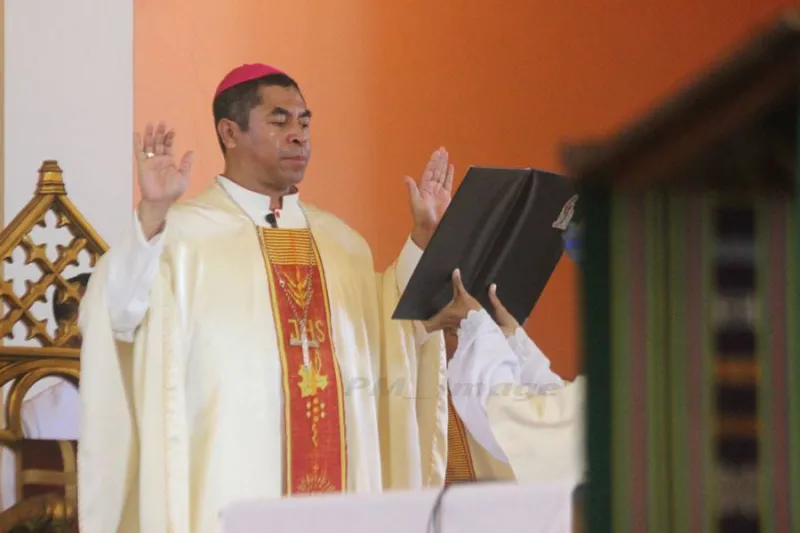
Archbishop Virgilio do Carmo da Silva of Dili, who will be made a cardinal Aug. 27, says Mass April 9, 2016. / José Fernando Real via Wikimedia (CC BY-SA 4.0)
Denver Newsroom, May 31, 2022 / 16:59 pm (CNA).
The newest — and first — cardinal-elect of the island nation of East Timor says he was completely surprised by his appointment by Pope Francis over the weekend.
“When I heard this news, I was so shocked I almost fainted,” Archbishop Dom Virgilio do Carmo da Silva told reporters May 30. “I never dreamed of this and I never looked for it.”
Pope Francis on Sunday announced the names of 21 men whom he will create as cardinals at an Aug. 27 consistory. At age 54, Da Silva could be eligible to vote in conclaves for 26 years.
President Jose Ramos-Horta of East Timor paid a courtesy call to congratulate da Silva, who leads the Archdiocese of Dili.
East Timor, or Timor-Leste, occupies the eastern half of the island of Timor, which it shares with Indonesia. The population of the country, which was colonized by Portugal, is nearly 98% Catholic and very youthful — approximately 40% of the population is below the age of 15 and the country’s median age is 20, according to the CIA World Factbook.
Da Silva, a priest of the Salesians of St. John Bosco, has led the local Church of Dili since 2016 as a bishop; he became an archbishop when the see was raised to an archdiocese in 2019. He serves as vice president of the national bishops’ conference.
He made perpetual vows in 1997, and was ordained a priest the following year.
He said he views his elevation as a blessing for the heavily Catholic country, which recently celebrated the 20th anniversary of the restoration of its independence.
Pope Francis has expressed interest in visiting the region in person. In an October 2021 interview, the pope said that in 2022 he would like to make trips to Papua New Guinea and East Timor, which had been planned for late 2020 before they were canceled because of the pandemic.
If you value the news and views Catholic World Report provides, please consider donating to support our efforts. Your contribution will help us continue to make CWR available to all readers worldwide for free, without a subscription. Thank you for your generosity!
Click here for more information on donating to CWR. Click here to sign up for our newsletter.

Illustation of St. Paul Outside the Walls in Rome, before the fire that destroyed it in 1823. / Photo courtesy of Professor Nicola Camerlenghi, from his book “St. Paul’s Outside the Walls, A Roman Basilica, from Antiquity to the Modern Era,” 2018
Rome, Italy, Jul 14, 2023 / 03:00 am (CNA).
As the bicentennial anniversary of the devastating fire at St. Paul Outside the Walls in Rome draws near, the profound significance of the July 15, 1823, event is recalled among those who love the basilica. The tragic incident left an indelible mark on the architectural landscape and the hearts of believers.
Illustration of the destruction of St. Paul Outside the Walls in Rome in 1823, depicted in Professor Nicola Camerlenghi, from his book “St. Paul’s Outside the Walls, A Roman Basilica, from Antiquity to the Modern Era,” 2018. Photo courtesy of Professor Nicola Camerlenghi, from his book “St. Paul’s Outside the Walls, A Roman Basilica, from Antiquity to the Modern Era,” 2018
To commemorate this solemn anniversary, a series of events are planned in collaboration with various embassies, universities, and choirs.
On July 11, the Benedictine friars residing in the monastery at the basilica offered a special vespers service open to the public. Additionally, a community event organized by the nearby university Roma Tre will take place in Rome’s Ostiense neighborhood on July 14 and 15 in the Parco Schuster, a small neighborhood park in the shadow of the iconic basilica. The gathering aims to honor the memory of the great fire and pay tribute to the enduring spirit of the basilica. It provides an opportunity for Catholics, architectural enthusiasts, and community members to come together and reflect on the profound impact of the fire and the subsequent reconstruction efforts, complete with 3D imaging technology developed to show what the basilica used to look like.
Cardinal James Michael Harvey, the appointed archpriest of St. Paul Outside the Walls, expressed the importance of commemorating the tragic event, stating: “We want the future to know that the memory of this event was taken seriously during its 200-year anniversary.”
Harvey also noted that the basilica is organizing an assembly of 19th-century scholars, experts, and historians to visit the basilica and discuss the significance of the tragedy sometime in November. The announcement of this event is still pending.
To gain deeper insights into the fire and its aftermath, Nicola Camerlenghi, assistant professor of Art History at Dartmouth College and a renowned expert in architectural history, shared his expertise during an interview with CNA. According to Camerlenghi, “The fire at St. Paul’s Basilica was a great tragedy. What was lost was the last imperial basilica built in Rome and one of the few monumental buildings from early Christian times that had survived relatively untouched by subsequent alterations.”
Color illustration of historic fire at St. Paul Outside the Walls in Rome, 1823, depicted in Professor Nicola Camerlenghi’s book “St. Paul’s Outside the Walls, A Roman Basilica, from Antiquity to the Modern Era,” 2018. Photo courtesy of Professor Nicola Camerlenghi from his book “St. Paul’s Outside the Walls, A Roman Basilica, from Antiquity to the Modern Era,” 2018
Reflecting on the decisions made during the meticulous reconstruction process, Camerlenghi emphasized the faithful restoration of the basilica. The architects and artisans recreated its original state while adapting to the loss of certain materials and using materials that are more fireproof. As a result of Camerlenghi’s research, 19th-century French writer Stendhal’s journal entry from his time in Rome surfaced, providing a glimpse into Rome after the fire. Stendhal wrote: “I found in it a severe beauty and an impression of calamity such as only the music of Mozart can suggest. The terrible painful traces of the misfortune were still alive… Thus perished the most ancient basilica not only of Rome, but of all Christianity. It had lasted 15 centuries.”
The fire was ruled an accident, caused by a distracted welder named Giacomo who unknowingly left a pan of coals burning on the roof. Despite initial suspicions of arson, conspiracy theories involving revolutionary movements and even the prominent Rothschild family failed to gain traction.
Lithograph image of fire at St. Paul Outside the Walls in Rome, 1823, depicted in “St. Paul’s Outside the Walls, A Roman Basilica, from Antiquity to the Modern Era,” by Professor Nicola Camerlenghi, 2018. Photo courtesy of Professor Nicola Camerlenghi from his book “St. Paul’s Outside the Walls, A Roman Basilica, from Antiquity to the Modern Era,” 2018
The reconstruction of St. Paul Outside the Walls proved to be a formidable undertaking amid the political and cultural turmoil of Rome at the time. To honor the basilica’s historical significance, Pope Leo XII decided to restore it to its former glory, without the architectural modifications and additions that had accumulated over the centuries.
At the bicentennial anniversary of this devastating fire, one is reminded of the enduring faith and unwavering spirit that define St. Paul Outside the Walls and even St. Paul himself. As Camerlenghi noted: “In turn, the reconstruction that ensued was a testament to the importance of the figure of St. Paul to the Catholic Church and indeed to the Christian community at large. No figure has been quite as ecumenical as Paul, the Apostle of the Gentiles.”
Pope Francis on Palm Sunday 2022 in St. Peter’s Square. / Daniel Ibanez/CNA
Vatican City, Apr 21, 2022 / 06:40 am (CNA).
Pope Francis has joined the head of the United Nations and the leader of the Ukrainian Greek Catholic Church in a call for a four-day truce in Ukraine for the Triduum and Easter.
The Eastern Orthodox churches and the Ukrainian Greek Catholic Church follow the Julian calendar, meaning they will celebrate Easter on April 24 this year.
The appeal for an Easter truce was launched on April 19 by Antonio Guterres, secretary general of the UN, in agreement with Major Archbishop Sviatoslav Shevchuk.
“Easter is a season for renewal, resurrection and hope. It is a time for reflection on the meaning of suffering, sacrifice, death — and rebirth. It is meant to be a moment of unity,” Guterres said at UN headquarters in New York
“This year, Holy Week is being observed under the cloud of a war that represents the total negation of the Easter message,” he said, calling for a four-day pause on fighting, beginning on Holy Thursday, April 21, to allow for the opening of humanitarian corridors and the safe delivery of aid.
The Vatican announced on April 21 that Pope Francis had joined the UN chief’s appeal, after the pope had called for an Easter truce in Ukraine during Palm Sunday Mass on April 10.
“In the knowledge that nothing is impossible for God, they invoke the Lord so that the population trapped in war zones may be evacuated and peace may soon be restored, and they ask those in charge of the Nations to listen to the people’s cry for peace,” a Vatican press release said.
At the end of Mass on Palm Sunday 2022, Pope Francis urged the laying down of weapons for an “Easter truce.”
Before an estimated 65,000 people in St. Peter’s Square, Pope Francis said that “nothing is impossible for God.”
“He can even bring an end to a war whose end is not in sight, a war that daily places before our eyes heinous massacres and atrocious cruelty committed against defenseless civilians. Let us pray about this.”
Archbishop Da Silva is young and energetic. Wishing the Cardinal designate strength and stamina. God bless East Timor, the land and its people, with peace and prosperity.
I hope he’s not too grateful.
