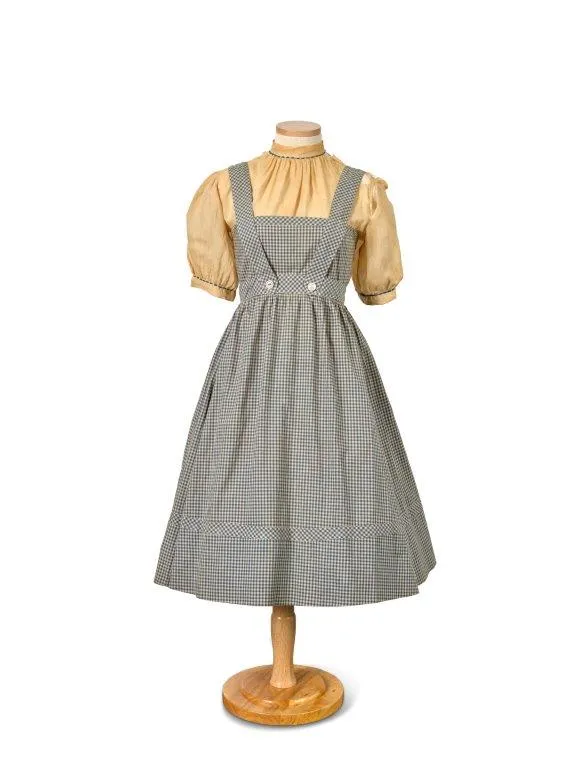
The Dorothy dress at the center of the dispute. / Bonhams
Denver Newsroom, May 23, 2022 / 18:50 pm (CNA).
The Catholic University of America cannot auction a dress from the Wizard of Oz until a court resolves a legal challenge about its ownership, a federal judge has said.
The university had scheduled an auction of the dress worn by Judy Garland for the classic movie in hopes of raising more than $1 million for its drama department. The legal challenge comes from Wisconsin resident Barbara Ann Hartke, 81, a niece of a Dominican priest and drama professor at the university. She says that the dress should be hers because she is the priest’s closest living relative.
Judge Paul Gardephe, in a May 23 temporary injunction, ruled that the niece’s lawsuit had enough merit to proceed. He blocked the planned auction until the lawsuit challenging ownership of the dress is legally settled through proceedings in Manhattan federal court. He has set another hearing in June. The ruling could postpone the sale of the dress for months or years, the Washington Post reports.
Mercedes McCambridge, an Oscar-winning actress and artist-in-residence at Catholic University in 1973, had given the dress to Father Gilbert Hartke, O.P., the founder and head of the university’s drama school. In the late 1980s, the dress went missing and the costume became the subject of rumor. Matt Ripa, a lecturer and operations coordinator for the university’s drama department, happened upon a bag atop faculty mailboxes in 2021. He opened the bag to find a shoebox, inside of which was the dress.
Barbara Ann Hartke’s lawsuit has support from at least one other relative of Hartke, who was one of six siblings. However, the university filed affidavits from other relatives who say Hartke told them the dress belonged to the university.
The university also filed an affidavit from Father Kenneth R. Letoile, O.P., the Prior Provincial of the Province of St. Joseph, who explained that the Dominican priest had made a vow of poverty and not allowed to possess anything as personal property. Any gifts to him should have proceeded to the province, and the province did not claim ownership of the Wizard of Oz dress.
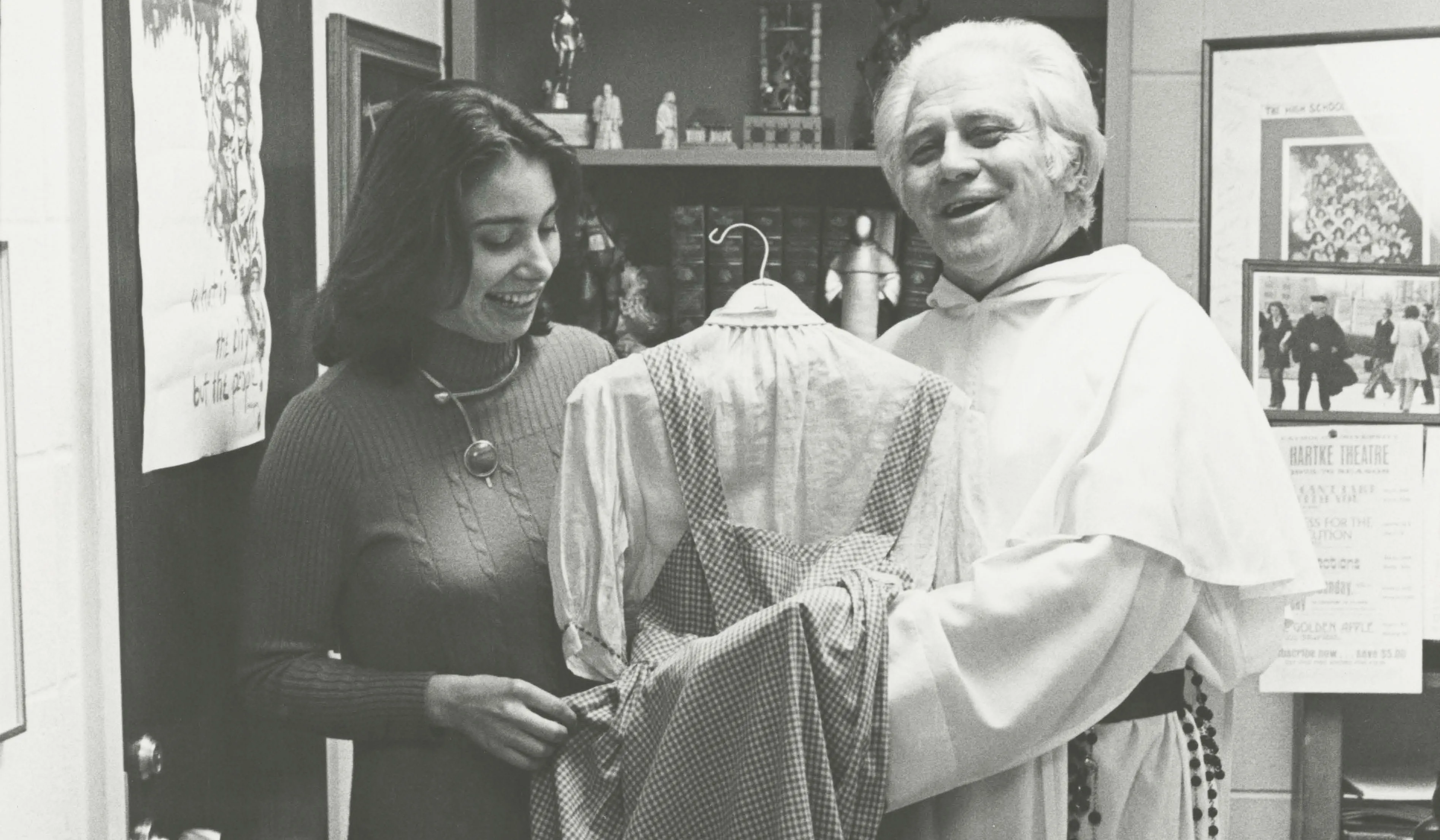
Fr. Gilbert Hartke holds a dress gifted to him that Judy Garland wore as Dorothy Gale in the 1939 film ‘The Wizard of Oz’. Courtesy of The Catholic University of America.
Shawn Brenhouse, an attorney for Catholic University, said the university will continue to defend its right to sell the dress, the proceeds of which are planned to support the drama school.
“The Court’s decision to preserve the status quo was preliminary and did not get to the merits of Barbara Hartke’s claim to the dress,” he said, according to the Washington Post. “We look forward to presenting our position, and the overwhelming evidence contradicting Ms. Hartke’s claim, to the Court in the course of this litigation.”
In court papers, Barbara Ann Hartke’s attorney Anthony Scordo III argued that his client could show that Father Hartke’s estate was the rightful owner of the dress. McCambridge had “specifically and publicly” given the dress to the priest and the dress is “therefore an asset of decedent’s estate.”
Gardephe rejected the university’s argument that the dress must be sold urgently so that potential buyers would not lose interest. He cited the enduring popularity of the film and said that controversy over the dress has generated more interest.
According to the auction company Bonhams, Judy Garland wore the gingham dress while filming a scene in which her character Dorothy Gale faces the Wicked Witch of the West in the witch’s castle.
The dress from the 1939 movie is one of only two existing dresses that retains its white blouse. It is now valued at an estimated $800,000 to $1.2 million, Bonhams said. Another surviving dress was auctioned for $1.5 million in 2015.
The university had said that proceeds from the sale of the dress would endow a faculty chair, a position that will support the current bachelor of fine arts degree in acting for theater, film, and television, as well as the development of a new formal film acting program at the university’s Benjamin T. Rome School of Music, Drama, and Art.
Jackie Leary-Warsaw, dean of the drama school, is the wife of Michael Warsaw, chairman and CEO of the EWTN Global Catholic Network, Catholic News Agency’s parent network.
If you value the news and views Catholic World Report provides, please consider donating to support our efforts. Your contribution will help us continue to make CWR available to all readers worldwide for free, without a subscription. Thank you for your generosity!
Click here for more information on donating to CWR. Click here to sign up for our newsletter.
New York City, N.Y., Jul 17, 2019 / 08:00 am (CNA).- The United States has said it will not support the United Nations Population Fund (UNFPA) for the third year in a row, the UN agency announced on Tuesday morning.
Secretary of State Mike Pompeo announced that the United States will not contribute the expected $32.5 million to the agency. The funding instead will be transferred to the US Agency for International Development, where it will be used for family planning programs in line with the Mexico City policy, as well as maternal and reproductive health activities.
Pompeo said the United States would not support the UNFPA because of its partnership with the Chinese government through its office in that country.
“China’s family planning policies still involve the use of coercive abortion and involuntary sterilization practices,” a state department spokeswoman said.
The State Department said that, according to the fund’s own materials, the agency “partners on family planning with the Chinese government agency responsible for these coercive policies.”
The UNFPA denies that its work in the country is related to sterilization or abortion. Sarah Craven, the chief of the UNFPA’s office in Washington, DC, told CNN that the agency is “trying to end (China’s) sex-selective abortion and coercive birth limits,” and that they are in no way assisting the Chinese government with these goals.
“It’s literally the opposite,” said Craven to CNN.
The UNFPA also denies that their work is contributing to abortion or sterilization, and was critical of the United States’ decision to once again forego funding the agency.
“UNFPA has not yet seen the evidence to justify the serious claims made against its work,” said the organization in a statement published to its website. “UNFPA does not perform, promote or fund abortion, and we accord the highest priority to universal access to voluntary family planning, which helps prevent abortions from occurring.”
Additionally, the UNFPA said it “opposes coercive practices, such as forced sterilization and coerced abortions,” and considers them to be human rights abuses.
While the agency maintains its separation from coercive use of abortion and sterilization, the use of both practices as tools of population control have been closely contested.
The Holy See’s Permanent Observer mission to the United Nations has long warned of the use of coercive policies in matters of population. In a major address to the International Conference on Population and Development in September 1994, the then Vatican diplomat to the UN Archbishop Renato Martino told the conference that women are often the “primary victims” of population policies which “often tended towards coercion and pressure, especially through the setting of targets for providers.”
Martino specifically cited the practice of promoting sterilization to women as a “family planning” option, often without the women understanding the permanence of the procedure. He also noted the increasing campaign to recognize abortion as a “human right.”
In April of this year, the Holy See’s current Permanent Observer to the UN, Archbishop Bernardito Auza, spoke at a conference held to evaluate the progress made since the 1994 summit.
In his speech, Auza underscored the Church’s opposition to ongoing attempts at the UN to legitimize and promote abortion as a human right and to see it as a legitimate tool in population control.
“Suggesting that reproductive health includes a right to abortion explicitly violates the language of the [1994] International Conference on Population and Development, defies moral and legal standards within domestic legislations, and divides efforts to address the real needs of mothers and children, especially those yet unborn,” he said.
Sister Deirdre “Dede” Byrne, POSC, will address participants of a rosary rally Oct. 9, 2022, at the U.S. Capitol in Washington, D.C. / EWTN News Nightly
Washington, D.C. Newsroom, Oct 7, 2022 / 13:00 pm (CNA).
On Sunday, Oct. 9, a eucharistic p… […]
The exterior of the new St. Isidore’s Catholic Student Center at Kansas State University. / Credit: Jacob Bentzinger
CNA Staff, Oct 2, 2023 / 17:15 pm (CNA).
There’s a quote from Jerome Tang, head coach of the Kansas State University (KSU) basketball team, that Father Gale Hammerschmidt likes.
“I didn’t come to rebuild. I came to elevate,” Tang said after taking the team’s helm last year. (His team bowed out of the NCAA Tournament last spring after making it to the Elite Eight.)
Hammerschmidt, chaplain at St. Isidore’s Catholic Student Center at Kansas State, said he thinks “elevation” is an appropriate word for what the Catholic community he leads is doing right now. On Jan. 28, the local bishop dedicated the Catholic center’s brand-new, $20 million church — a project more than two decades in the making.
But now that the new church is open, the real work of bringing the Catholic faith to students on campus can continue. The grand new church presents an opportunity to “elevate everything we do here at St. Isidore’s,” Hammerschmidt told CNA.
“We know that the work is just now beginning. And if we’re going to create a beautiful space, we want to be able to do beautiful things in the space. And nothing is more beautiful than a soul encountering the living God,” the priest told CNA.
Hammerschmidt, a Kansas native and 1995 Kansas State alum, was ordained to the priesthood in 2012 and was assigned to St. Isidore’s in 2017. The Catholic center sits just across the street from the Kansas State campus, which is itself the lifeblood of the small city of Manhattan. There had been discussions about the need for a new church building for several years before he arrived.
“I already knew that there was a need to build a new church. This is something that had been talked about for probably 20 years, honestly, even since right around the time that I was graduating from college,” Hammerschmidt told CNA.
Father Gale Hammerschmidt. Credit: Jacob Bentzinger
Part of the reason was that the population served by St. Isidore’s had outgrown the old space, which sat about 400 and was regularly filled to bursting on Sundays with overflow seating in the student center library.
Grace Gorges, a K-State student studying graphic design, got involved with the Catholic community at the college as soon as she arrived at KSU. From the get-go, “the Masses were always crowded, always overflowing,” she said, adding that the fallout from COVID made things even worse when parts of the sanctuary had to be roped off for distancing purposes.
The campaign to raise money for a new church was dubbed “Home Away from Home.” About $5 million had already been raised before Hammerschmidt’s arrival, and the campaign ultimately raised nearly $20 million for the project, he said. Some 1,500 individual donors contributed to the campaign.
Nebraska-based lead architect Kevin Clark came to Manhattan in 2017 and began asking the community what they wanted their new church to look like. Countless students requested a beautiful interior, “traditional-looking in nature,” the priest said.
“We want this to look like a church that has been standing forever and will stand forever,” he recalled students telling him.
“We wanted to make sure that it was an epic-looking building” with an interior that would raise hearts and minds “to the beauties of heaven,” he said.
The congregation kneels during the dedication Mass for the new St. Isidore’s Catholic Student Center at Kansas State University. Credit: Jacob Bentzinger
Given her involvement in the community and her interest in beauty and design, Hammerschmidt asked Gorges to serve on the building committee, which meant she would have a say in the church’s aesthetic. Gorges said she was invited to help design the church’s tile flooring. She researched churches online for inspiration and also drew from her personal experience of visiting numerous beautiful sacred spaces on a trip to Italy.
Ridge Pinkston, a fifth-year senior when CNA spoke with him, studying medieval history, was also chosen to be on the building committee. He told CNA that the committee — which included Hammerschmidt, diocesan board member Doug Hinkin, and others — was given almost complete control over the look of the new church.
He said the committee had numerous meetings with the architect to figure out the look of everything in the new church — they spent an entire two-hour meeting designing the look of the altar, for example. He said the building committee “represented the body of owners” to the architect and designers, similar to how when a family builds a house, the architects and contractors consult them on how they want it to look. He said it was a “huge privilege” and a great learning process to be a part of the committee as a student.
Despite his interest in medieval architecture, the churches that Pinkston primarily drew inspiration from were mainly stateside; most are located in the Archdiocese of Denver. They included the medieval revival-style chapel at St. John Vianney Theological Seminary and the Cathedral Basilica of the Immaculate Conception and Holy Ghost Catholic Church, both in downtown Denver.
Ultimately, the architects and designers of St. Isidore’s produced a neo-Gothic interior with pointed arches that dropped many a jaw when it was unveiled. The interior also features numerous instances of vine imagery — an image of Jesus himself, but also a subtle nod to the college’s agricultural heritage. Evergreene Architectural Arts, a renowned design studio in New York, provided the decoration, Hammerschmidt said.
Not everything in the interior is entirely new, however. Hammerschmidt said at the request of students, stained-glass windows depicting the seven patron saints of the seven original colleges at Kansas State (the university was originally Methodist-founded) were saved and incorporated into the new church. Among those saints are the church’s namesake, St. Isidore — an 11th-century Spaniard and patron saint of agricultural workers — as well as the namesake of the student center, St. Robert Bellarmine. A much-loved crucifix that hung over the tabernacle in the old church was also used again in the new church.
The crucifix in the new St. Isidore’s Catholic Student Center. Credit: Jacob Bentzinger
Gorges said she loves the triumphal arch over the altar in the finished church, which draws one’s eyes toward the focal point of the crucifix, and onward to heaven. A beautiful church, she said, is “not the end-all-be-all by any means. But if it’s at all possible, beauty matters. And we should be trying to live that in our daily lives.”
Pinkston said his favorite design element in the new church, apart from the ceiling of the apse, is the new altar itself, which he said really strikes him as being designed in a way that calls to mind a place where sacrifices are made.
“Rightfully, that should be one of the most beautiful features,” he said of the altar.
The designers also took care to design the exterior of the church to match the native limestone buildings of Kansas State, in an effort to make the church an integral part of the campus it serves.
Bishop Gerald Vincke of Salina, Kansas, dedicated the diocese’s newest church on Jan. 28. The 14,000-square-foot structure can accommodate about 700 for Sunday Masses.
Bishop Gerald Vincke of Salina, Kansas, sprinkles holy water during the dedication of the new St. Isidore’s Catholic Student Center on Jan. 28, 2023. Credit: Jacob Bentzinger
Hammerschmidt said daily Masses at St. Isidore’s were already attracting nearly 200 students on a regular basis. A key part of the Catholic center’s success, he said, is the presence of missionaries from the Fellowship of Catholic University Students (FOCUS). FOCUS maintains a presence on college campuses with the goal of winning people to the Catholic faith through authentic friendships and forming others to go out and do the same through Bible studies, small groups, and retreats.
“We also work closely with the high schools in the state of Kansas, especially the Catholic high schools. And we have many strong Catholic high schools in our area. And so we just have students who, the first day they show up in Manhattan, they already know about us,” Hammerschmidt said.
In addition, he said, the Catholic center is in cooperation with the local Diocese of Salina and the nearby Diocese of Wichita, whereby Wichita — which has been blessed in recent years with large vocation numbers — sends a priest to serve as Hammerschmidt’s associate. Large numbers of students come to KSU from Wichita — Gorges among them — who get involved with the Catholic center thanks to strong word of mouth.
“It’s good for them to have one of their own priests looking after them … I think it’s working phenomenally well.”
Stained-glass windows in the new St. Isidore’s Catholic Student Center. Credit: Jacob Bentzinger
Working at St. Isidore’s, Pinkston said he has gotten to know “the regulars” that came to the church before the rebuild, but now with the new church, he said he sees many more people coming in to pray whom he has never seen before. He also said it was inspirational for him to see a friend — a man who is joining the Catholic Church this Easter — weeping openly when he first saw the new church’s interior.
“That was really the first time I’d ever seen him express emotion … That’s definitely a huge blessing to be able to see that happening,” he said.
Hammerschmidt was almost overwhelmed by the support of the many students, alumni, and others who made the new church possible. Months on from the chapel’s opening, the 9:09 p.m. daily Mass is always well attended, with about 300 students attending regularly. As of September, St. Isidore’s has 40 student-led Bible studies with around 400 Bible study participants.
“The outpouring of joy and gratitude has been incredible. The number of people who we will just see walking through the church from out of town is unbelievable,” Hammerschmidt said.
“And then beyond that, we had so many more hundreds of people praying for the project, and we just have been supported unbelievably well.”
Hammerschmidt said he wants the students and community of Kansas State to take ownership of the magnificent new church and to use it for their spiritual benefit.
“We want to let everybody in Manhattan and on K-State’s campus know that we built this church for them,” he said.
“If they just need a place of encounter with God to just come in to be seated, to be immersed in the beauty and the silence and to just let God speak. That’s our hope. For the Catholics, for the non-Catholics, for the students, for nonstudents, just for anyone who needs a place to encounter the living God, this would be the place for them.”
Light from the stained glass in the new St. Isidore’s Catholic Student Center. Jacob Bentzinger
Leave a Reply