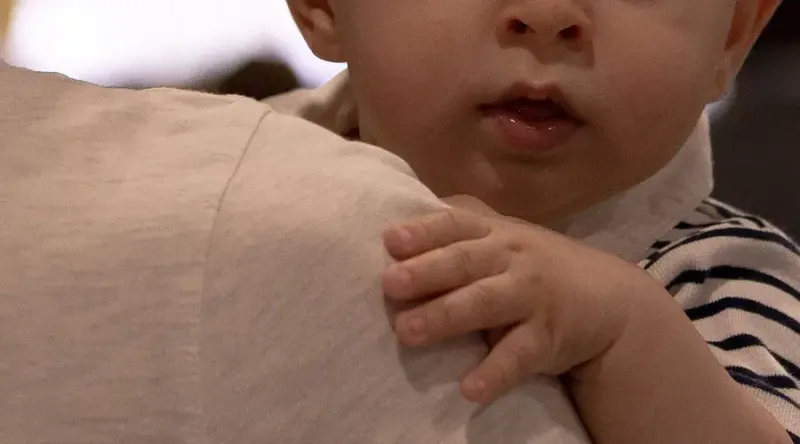
A three-year-old boy was killed by gang members who opened fire inside a church in Fresnillo in the Mexican state of Zacatecas.
Their intended target was a young man they were pursuing who fled into the church.
The boy was attending Mass with his mother and was killed in the hail of bullets unleashed by the gunmen.
“We are saddened and alarmed by the killing of a three-year-old boy inside the church of Our Lady of Guadalupe in Fresnillo, Zacatecas, where armed men entered following a man whom they wounded. Our condolences to the family of this little boy,” the Mexican Bishops’ Conference said in a May 20 statement.
The local press reported that two armed men entered the church and let loose a burst of fire at a young man they were chasing, who died later from his wounds in a hospital May 20.
The three-year-old boy named Caleb died instantly when struck by the bullets.
In their statement, the Mexican bishops said that “this shows that all limits of violence and human respect are being exceeded.”
“We once again call on everyone to lay down their arms and put an end to all forms of violence, because all of us can be builders of peace. No one has the right to attack the life of his brother and there is nothing that justifies such violence,” the bishops stressed.
In their message, the prelates also remembered Fr. José Guadalupe Rivas, who was beaten to death May 17.
“We send our most heartfelt condolences to the family of Father José Guadalupe and to the family of the other murdered brother, as well as to the Archbishop of Tijuana, Don Francisco Moreno Barrón, and to his entire Church,” they said.
The bishops called on the faithful to continue “praying for our authorities so that they find the best paths for pacification and security that we all need and desire.”
“Let us pray for the criminals so they repent and change their lives. Let us pray for everyone so that we become peace builders.” the bishops concluded.
If you value the news and views Catholic World Report provides, please consider donating to support our efforts. Your contribution will help us continue to make CWR available to all readers worldwide for free, without a subscription. Thank you for your generosity!
Click here for more information on donating to CWR. Click here to sign up for our newsletter.
Christina Wheatley, a cancer survivor, in front of St. John the Evangelist Catholic Church in Indianapolis, where a welcome Mass was held July 16, 2024, to kick off the National Eucharistic Congress. / Credit: Zelda Caldwell/CNA
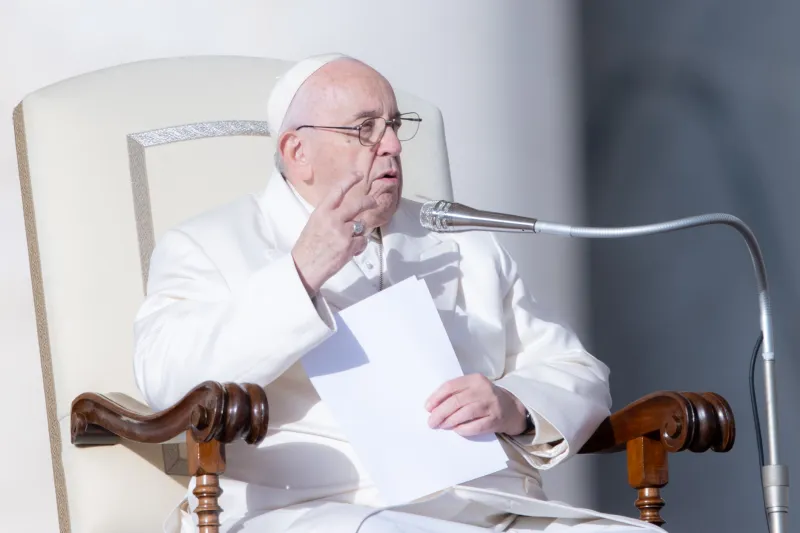
Pope Francis speaking at the general audience on St. Peter’s Square at the Vatican, Nov. 30, 2022 / Daniel Ibáñez / CNA
CNA Newsroom, Dec 6, 2022 / 08:00 am (CNA).
Pope Francis issued a decree on Tuesday aimed at improving the financial accountability of funds, foundations, and other legal entities inside the Vatican.
In the future, these entities — also known as juridical persons — will be controlled by the bodies such as the Secretariat for the Economy and not just supervised by their respective institutions.
The motu proprio is complemented by a law covering entities in the Vatican City State. Both were published Dec. 6 and come into force on Dec. 8.
Pope Francis noted in his apostolic letter that foundations and other affected entities “are instrumental in the realization of the ends proper to the curial institutions at the service of the ministry of the Successor of Peter.”
It was therefore necessary, he added, “that they be subject not only to the supervision of the curial institutions from which they depend, but also to the control and surveillance of the economic bodies of the Roman Curia.”
Already existing instrumental juridical persons will have to comply with the provisions of the motu proprio within three months.
The scope of the law is limited, according to Vatican News: It does not extend to “curial institutions and offices of the Roman Curia, institutions connected with the Holy See, the Governorate of Vatican City State, and entities professionally engaged in activities of a financial nature.”
The news follows the announcement on Nov. 30 that Pope Francis has appointed Maximino Caballero Ledo, 62, to lead the Secretariat for the Economy following the resignation of Jesuit Father Juan Antonio Guerrero. The Spanish layman has been secretary general, the second-ranking position, in the economy office since August 2020.
Pope Francis established the Secretariat for Economy in 2014 as part of his financial reform of the Vatican. It oversees the financial aspects of both the Roman Curia and the Vatican City State administration, including a review of financial reports.
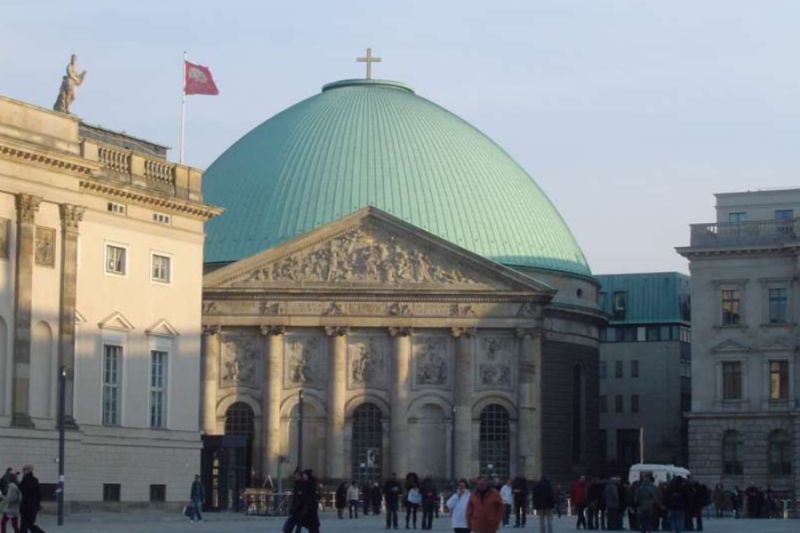
St. Hedwig’s Cathedral in Berlin, Germany. / Cedric BLN via Wikimedia (Public domain).
CNA Newsroom, Jun 19, 2023 / 16:40 pm (CNA).
Ahead of a crucial meeting on the German Synodal Way, one diocese has signaled its opposition to plans for turning the controversial event into a permanent Synodal Council — a new controlling body of the Church in Germany.
The official for the Synodal Way in the Diocese of Regensburg, cathedral chapter Josef Kreiml, warned that the preparatory work for a German Synodal Council contradicts a clear instruction from the Vatican, reported CNA Deutsch, CNA’s German-language news partner.
The prelate also said that the concept of synodality underlying the Synodal Way isn’t in line with either canon law or the ideas of Pope Francis.
The bishops of Germany’s 27 dioceses are expected to make landmark decisions at their meeting in Berlin on June 19-20 regarding the establishment and funding of the so-called Synodal Committee, which is to then establish a permanent German Synodal Council by 2026.
Some bishops had reportedly considered blocking the move by not providing funds for the body, which could prevent a permanent superstructure overseeing the Church in Germany modeled on the German Synodal Way.
The German Synodal Way was a multi-year process initiated by Cardinal Reinhard Marx and co-organized by the German Bishops’ Conference and the Central Committee of German Catholics (ZdK), a lay body financed by the German bishops. Its official purpose was to discuss four main issues: the way power is exercised in the church, sexual morality, the priesthood, and the role of women.
The process was criticized by many cardinals and bishops from around the world, as well as by Pope Francis, who warned of disunity and schism in his 2019 letter to German Catholics.
The Vatican has issued a statement saying that the Synodal Way does not have the authority to oblige bishops and the faithful to accept new forms of governance and new orientations in doctrine and morals.
Citing these statements, Kreiml said that the Synodal Way had greatly interfered with the forms of ecclesial governance and had disregarded the general law of the Church, its sacramental constitution, and the proper duties of the bishops.
He urged the German bishops to respect the unity of the Church and to follow papal guidance on synodality.
Pope Francis and other Church leaders have expressed serious concerns about plans to create a permanent synodal council for the German Church.
Such a body would function “as a consultative and decision-making body on essential developments in the Church and society,” according to a Synodal Way proposal.
More importantly, it would “make fundamental decisions of supra-diocesan significance on pastoral planning, questions of the future, and budgetary matters of the Church that are not decided at the diocesan level.”
Warning of a threat of a new schism from Germany, the Vatican already intervened in July 2022 against a German synodal council.
In January 2023, the Vatican asserted “that neither the Synodal Way, nor any body established by it, nor any bishops’ conference has the competence to establish the ‘synodal council’ at the national, diocesan, or parish level.”
A Soviet-style council in Berlin?
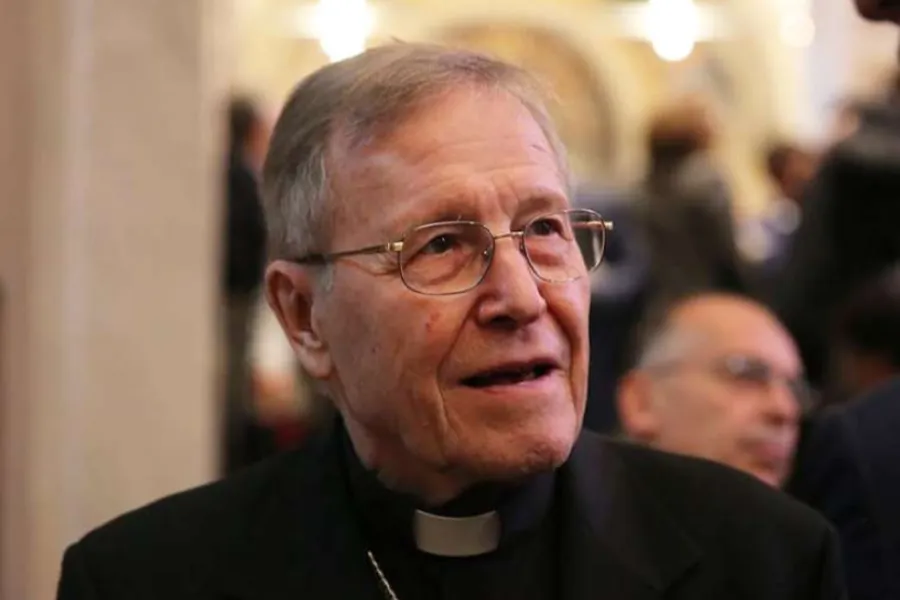
In June 2022, Cardinal Walter Kasper, a theologian considered close to Pope Francis, said there could be no Synodal Council, given Church history and theology.
“Synods cannot be institutionally made permanent. The tradition of the Church does not know a synodal Church government,” he said. “A synodal supreme council, as is now envisaged, has no basis in the entire history of the constitution. It would not be a renewal but an unheard-of innovation.”
Cardinal Walter Kasper. . CNA/Bohumil Petrik.
The president emeritus of the Pontifical Council for Promoting Christian Unity, who was bishop of the Diocese of Rottenburg-Stuttgart from 1989 to 1999, said the German process had invited comparisons to communist structures in the Soviet Union. “It was a political scientist, not a theologian, who recently expressed this notion somewhat strongly, referring to such a Synodal Council as a Supreme Soviet,” Kasper said.
The cardinal continued: “‘Soviet’ is an old Russian word that means exactly what we call a ‘Rat,’ a council in German. Such a Supreme Soviet in the Church would obviously not be a good idea. Such a council system is not a Christian idea, but an idea coming from quite a different spirit or un-spirit.”
The German theologian and prelate also warned this “would choke off the freedom of the Spirit, which blows where and when it wants, and destroy the structure that Christ wanted for his Church.”
Further concerns were raised by a professor of theology from the University of Vienna in June.
The dogmatist Jan-Heiner Tück warned that a German Synodal Council would transfer leadership authority “from sacramentally ordained persons to bodies, a conversion of power that shows a clear closeness to synodal practices in the Protestant Church in Germany.”




Leave a Reply