




Washington, D.C. Newsroom, May 19, 2022 / 18:40 pm (CNA).
A social media-savvy layman, who uses the title “Brother” and wears a habit, will not obey his bishop’s orders to cease presenting himself as a religious brother or member of a religious community.
Nor will Martin Navarro — whose “Br. Martin” Twitter account has more than 11,000 followers — acquiesce to Bishop James Johnston’s demands to stop fundraising in the Diocese of Kansas City-St. Joseph and cease building an unauthorized chapel.
“We’re following the rules, we’re following the guidelines, as well as being honest as who we are and what our intentions are,” Navarro said in a YouTube video posted May 17.
As to his practice of wearing a habit, he said, “it’s a free country, so to speak; you can wear whatever you want.”
Navarro, 31, has asked Johnston to formally recognize a Traditional Latin Mass religious group Navarro started called the Oblates of St. Augustine.
Johnston denied the request. He also ordered the group to cease operating in the diocese.
The bishop issued the demands in a letter dated May 6 addressed to Navarro. Navarro made the letter public in the same YouTube video from May 17.
“I have not given nor will give approval or permission to explore, found, or establish the community about which you have previously inquired,” Johnston stated in the letter.
“I further direct that you do not use the religious title of ‘Brother Martin’ at any time nor dress in a religious habit, since in justice and truth, your canonical status is not one of membership within a religious community, such continued usage is both disingenuous and dishonest,” he added.
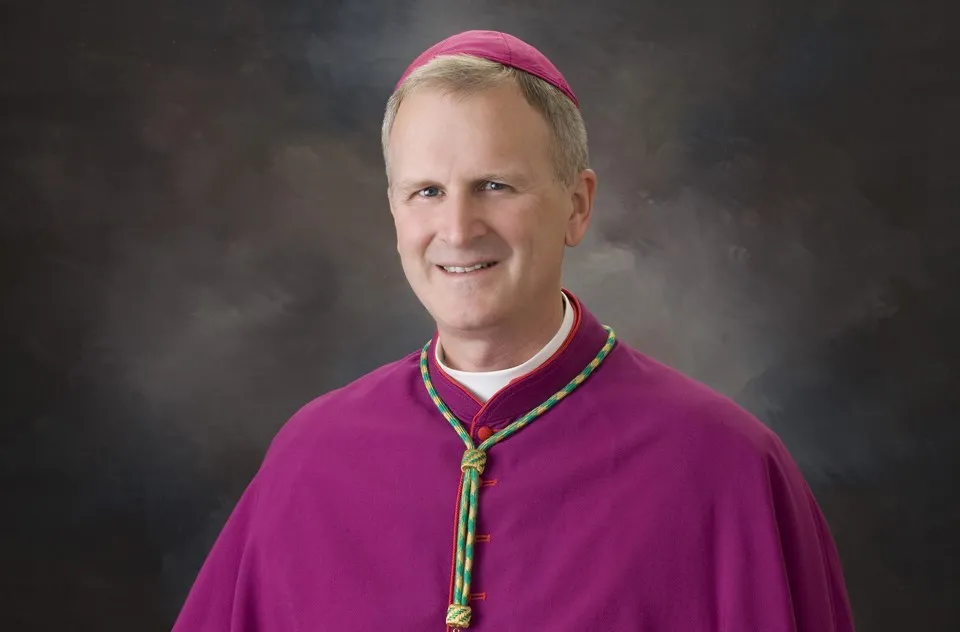
Johnston reiterated his demands “in order to emphasize the seriousness of my warning and prohibitions” at the end of the letter.
“I reiterate what I have made eminently clear above: do not call yourself ‘Brother,’ do not continue to present yourself within the Diocese of Kansas City-St. Joseph in any manner or means, including by wearing a religious habit, as a Brother or as a member of a religious community, do not ask for any funds or alms within the Diocese of Kansas City-St. Joseph whether in person or on the Internet or other social media formats, and do not utilize an unapproved chapel within the Diocese of Kansas City St. Joseph,” he stated.
“Your request of me regarding your proposed formation of Oblates of Saint Augustine is, therefore, denied.”
Church law at issue
Navarro told CNA on May 18 that he will not comply with Johnston’s orders.
The Oblates of St. Augustine community he leads is based in Weston, Missouri, a small town about a 40-minute drive north of Kansas City. It’s unclear how many men are in the group. Speaking to CNA, Navarro would only say that since founding the Oblates in 2020, “I’ve never been alone.”
The Oblates’ website describes the group as a “community of Traditional Roman Catholic men, faithful to the Traditional Roman Rite, the Holy Rule of St. Augustine, and the traditional formulations of the Catholic religion.” The group says it is devoted to the Traditional Latin Mass and breviary.
Chapel pic.twitter.com/5vXnQ1ilxM
— Br. Martin (@BVMConsolatrix) April 29, 2022
Navarro said the group is currently living on property leased to them by Mike Parrott, the host of a YouTube channel called Restoring the Faith Media. The group’s chapel in a converted garage already is under construction on the property, and nearing completion. Navarro told CNA the group has raised more than $161,000 for the monastery project. A separate funding drive accepts donations for the group members’ living expenses.
Navarro’s “Br. Martin” Twitter account often tweets comments concerning an ongoing dispute between Parrot and the Church Militant media outlet which began over Parrot’s fundraising efforts on behalf of Father James Jackson, a priest of the Priestly Fraternity of St. Peter who is facing federal child pornography charges in Rhode Island.
In his letter, Johnston cited several canons, as well as Pope Francis’ 2020 motu proprio Authenticum charismatis, to support his authority over the group’s activities in his diocese.
Johnston warned that “failure to observe these provisions … could result in further disciplinary actions. Accordingly, this letter itself stands as due canonical warning of the same.”
Navarro, for his part, says Johnston is misinterpreting church law, and using it “to intimidate us from praying.”
Asked to respond to Navarro’s intention to defy Johnston, Ashlie Hand, communications director for the Kansas City-St. Joseph Diocese, issued a statement to CNA Thursday night.
“Bishop Johnston has communicated appropriate guidance and next steps with Mr. Navarro regarding his request to establish the Oblates of St. Augustine in the Diocese of Kansas City-St. Joseph,” Hand said. “Bishop Johnston intends any further communication to be private.”
If you value the news and views Catholic World Report provides, please consider donating to support our efforts. Your contribution will help us continue to make CWR available to all readers worldwide for free, without a subscription. Thank you for your generosity!
Click here for more information on donating to CWR. Click here to sign up for our newsletter.



“Who am I to judge?”
Hey, at least Navarro isn’t identifying as a sister, eh?
The bishop has dutifully passed his judgement in regards Mr Navarro’s actions. As the bishops states Navarro is “being disengenuous and dishonest.” Also, let Navarro wear a policman’s or fireman’s outfit and act as one and see what happens.
I suppose this young man thinks that the Church has failed him and so he must set about to correct her? Is that what is going on here?
“We’re following the rules, we’re following the guidelines,” he asserts. Really? And he adds, “it’s a free country, so to speak.” The appeal to “a free country” is both disingenuous and irrelevant. The country probably doesn’t give a tinker’s dam.
Holy Mother Church, however, does care, even if She has strange ways of showing it at times.
And that “so to speak” speaks volumes. It is Navarro speaking for (to put it bluntly) the father of lies. “I will not serve,” he says in Milton’s account. That is, I will not serve another, certainly not one who has the status of authority given, delegated to him–and not simply assumed.
It is just one more instance of the arrogance of an overweening autonomy at work. In time, perhaps he will learn better.
Note: The role of the so-called social media in phenomena like this is only too predictable. Imagine: without it, Mr. Martin would likely never have even thought to exercise his pretentions.
How many religious congregations and monastic communities can be regarded as living authentic religious life? More the frat house and sorority life at best, more likely assisted living facility. All with the legacy of an erroneous “spirit of the council.”
Having absolutely no knowledge of Brother Martin or the Oblates of Saint Augustine it must be said that there are not a few aware and faithful Roman Catholics who have serious reservations regarding who exactly in the Church is accurately regarded as disingenuous and dishonest — the shepherds or the sheep?
Sheep deliberately deprived of accurate catechesis and scattered, what could that verdict be?
Regardless of what wrong are going on in the Church, doing what this man is doing is not the right way. In effect, he is trying to start another branch of the Catholic Church within the Church. One that suits his views. He’s no better than all the other breakaways who got disillusioned with the Catholic Church so decided they could do better. They never do, of course. There are approximately 40,000 different Christian denominations, all started by somone who thought they could do better. It will fail, like they all do.
James: There are lots of faithful religious communities. You’re not looking in the right places…start here:
http://www.religiouslife.com
“Bishop Johnston intends any further communication to be private.”
That is as it should be, and so methinks that we can depend on Navarro to keep this whole matter as public as possible, because he knows he has no real legs to stand on. This being so – he knows he must depend on people who don’t really know what’s going on to keep this going.
FYI – I oppose the suppression – a strong term but one which I am using – of the Traditional Latin Mass, which I find profoundly moving both spiritually and musically, not being a fan of ‘glad tambourines’.
Yea let’s get the Trads!
From the Wikipedia article titled “Clerical collar”:
Catholicism
In the Catholic Church, the clerical collar is worn by all ranks of clergy, thus: bishops, priests, and deacons, and often by seminarians as well as with their cassock during liturgical celebrations.
Bishops, superiors, and popes only have authority over you if you give it to them. And given their constant abuse of authority and corruption they have no authority. This isn’t the Papal States in the Middle Ages. “Sorry Bishop. I don’t really care what you think. Have a nice day.” Granted, that was Luther’s attitude, but Frankie loves Luther. You reap what you sow.
You are mistaking the ability to use force with authority. They have authority from Christ whether they use it well or not, or can bring force to bear or not.
A few things…it seems to me that a young man starting a religious community out of the blue seems to be the height of arrogance. It’s as though he’s saying that there are no recognized communities or Orders in the entire Church that meets his standard of holiness. He is barely old enough to be ordained let alone be the founder and superior of a religious community.
Secondly, initiatives like these seem to be just a high level of medieval cosplay. What exactly makes this guy a traditional Augustinian? Does he have an Augustinian formation or did he just read some books? One can’t just wake up one day and say “Hey, I’m an Augustinian now.”
Lastly, it seems like he just showed up in the diocese of the Bishop (wearing a cassock and presenting himself as a religious when he is not) and then demanded some sort of official recognition. The Bishop is right to be wary and to not grant his approval. The Bishop has no idea who this guy is, and yet this guy presumes ecclesiastical approval. Moreover, he makes public his private communication with the Bishop and casts himself as a martyr. Lots of red flags. The Bishop is right.
Sounds like Francis, the Saint not the pope.
Padre: At every stage of St. Francis’ life, he submitted himself and his Order to the judgement of the Church.
“What exactly makes this guy a traditional Augustinian? Does he have an Augustinian formation or did he just read some books?”
Andrew, why don’t you contact him through the website of the Oblates and ask him? Maybe he was originally formed in another Augustinian community. And if he simply doesn’t join an existing community maybe that is because there is not an existing community in the Church which adheres both to Augustinian spirituality and traditional liturgy. As to starting a community out of the blue, usually a religious order begins informally with men (or women) coming together to live a communal life of prayer and then if it seems to thrive, formal approbation from Church authorities is requested and formal constitutions can be approved. That seems to be all [Br.] Martin is asking for at this stage. That said, he definitely needs to get off social media, since it is hard to imagine a religious brother – traditional or otherwise – being on Twitter. One aspect of this story that seems to be overlooked, is Pope Francis’s handcuffing of bishops and taking away their authority to approve new religious institutes on the diocesan level without approval from Rome. Yet another of the hypocrisies of the current pontificate: always talking about synodality and the authority of bishops, but in reality limiting their legitimate prerogatives. It is and should be up to Bishop Johnston whether he wants to give formal approval to the Oblates of St. Augustine; the outrageous thing is that Francis won’t let the bishop do it, even if he wants to.
Peter: I don’t need to ask him anything as his bishop has rendered his decision.
As for starting a community, he can do that informally (as you say) without the unauthorized use of habits, religious titles etc. He can also get a job and suspend the fundraising which seems to be done under the pretence that he has a properly established religious community (which he does not). From there he can start quietly living his life of prayer and then humbly approach the Bishop. What one does NOT do is show up in a diocese. Wear a habit, call yourself Brother (when you are not), say your an Oblate of St. Augustine and then start fund raising and holding vocation weekends and demand recognition from the Bishop before approval. He’s not asking, but demanding and now that the Bishop has answered in the negative, this guy is throwing a public tantrum.
Again, this is just medieval/church cosplay and the religious fantasies of some guy. Sadly, the bishop’s response will probably just fuel his “remnant of the true Church/persecution” delusions. I’m really sick of Trads that act like this.
He has already started founding the community informally, it’s called a de facto private association of the faithful. It doesn’t require the Bishops permission. It’s just a canonical term for a group of Catholics who come together to live under a common rule.
He didn’t just show up out of nowhere and decide to be a monk. He spent a number of years in other communities but wants to found a new group around the Old Mass and Breviary.
He also does not wear a cassock and collar currently, he stopped doing so at the request of the Bishop months ago. The reporter who wrote this story is misrepresenting him by using an outdated screenshot. They currently wear something that resembles a habit but technically is not a habit. What do you want him to wear? Jeans and a t-shirt?
There is nothing out of the ordinary about what he is doing. It’s just that the Bishop is opposed to working with him to recognize founding a community.
If the National Catholic Reporter — widely subscribed to across the spectrum of the clerical world — can mask itself as Catholic, why should this community not describe itself as it pleases.
Should we need ask ourselves who exactly is responsible for the erosion of accurate Roman Catholic nomenclature?
The ecclesiastical machine has done this to themselves and intentionally. In that context the good bishop stands on quicksand. The episcopate and the current pontificate have undermined themselves. They should not attempt to exercise an authority they have deliberately debased — it only magnifies their impotence.
James: Thanks for that hilarious example of circular reasoning and non sequiturs. Great satire of Trad arguments. Bravo! Lol.
If he is a priest, he is dead WRONG. It wouldn’t be the first time I see an american priest disobeying a bishop, going against God and priestly hierarchy; remember Fr Corapi?
This guy is more interested in his twitter audience, is more interested about promoting himself!!! Simple as!!!
Regardless of what wrong are going on in the Church, doing what this man is doing is not the right way. In effect, he is trying to start another branch of the Catholic Church within the Church. One that suits his views. He’s no better than all the other breakaways who got disillusioned with the Catholic Church so decided they could do better. They never do, of course. There are approximately 40,000 different Christian denominations, all started by somone who thought they could do better. It will fail, like they all do.
Another sad example of someone who thinks he is above the Catholic Church law. I guess you can call yourself anything you want but that doesn’t make it true. If he wants to be a brother so much why doesn’t he go through the correct process? He thinks he knows more than the collective wisdom of the Holy Catholic Church. He does not. He is disobedience personified. Shame on those 11,000 people following him. He is leading them astray and they are allowing themselves to be led astray. He appears to be acting outside of the Church. What is seems to be is that he is setting up his own personal Catholic Church. So, in effect, just a layperson who thinks he is smarter than the collective Catholic Church. He is just exercising a willful stance, going against direction from a Bishop.
This poor soul is looking for purpose in his life. I wonder if this began with the lockdown and the rush to virtual Mass, and this is his solution? Currently it seems almost comical, if not for the underlying deception and potential scandal. I hope the poor soul does not sink deeper into his self deception. If anyone reading this is within convenient access, please reach out to him over breakfast or coffee and find out what’s bugging him and offer him sound council and prayer.