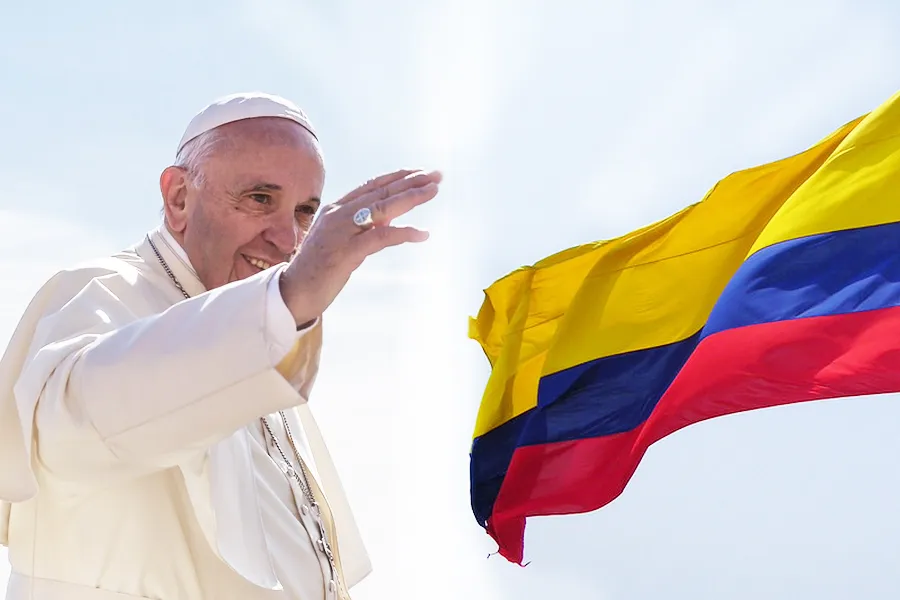
Rome, Italy, Jul 28, 2017 / 03:02 am (CNA/EWTN News).- During his six-day visit to Colombia in September, Pope Francis will beatify martyrs Bishop Jesús Emilio Jaramillo Monsalve and Fr. Pedro María Ramírez Ramos, who provide a potent testimony as the country heals from decades of conflict.
Bishop Jaramillo was killed by Colombian Marxist guerrillas forces in 1989, while Fr. Ramirez was murdered at the start of the Colombian Civil War in 1948.
The two were recognized as martyrs by the Vatican earlier this year, and will be beatified during the Pope’s Sept. 6-12 visit to Colombia, which he is making largely to encourage efforts for peace and reconciliation after more than 50 years of violent conflict that has left some 200,000 people dead.
Given the nature of their deaths, the two can be seen as belonging to a new wave of “modern martyrs” Pope Francis has often referred to, killed by oppressive regimes of their time such as Nazism, communism and brutal dictatorships.
Born in Santo Domingo, Colombia, in 1916, Bishop Jamillo was one of the many thousands of victims of the 52-year-long civil war between the government and guerrilla rebels.
After intensive seminary studies in philosophy, humanities and theology, in 1940 he was ordained a priest with the Xaverian Missionaries of Yarumal at the age of 24. Just four years later, in 1944, he received his doctorate in theology.
Immediately after his ordination Jamillo was sent to serve in the Sabanalarga municipality in the northern most tip of Colombia. Part of the Barranquilla Archdiocese, the area was known at the time to be hostile, and the people had very primitive religious knowledge.
Although the assignment only lasted four months, it cemented in the future martyr a love for both the priesthood and his vocation as a missionary.
In a letter to his rector at the time, Fr. Aníbal Muñoz Duque, Jamillo said “I think that now my spirit is more capable of appreciating the greatness of my missionary vocation, I feel like Christ; I feel in the depths of my being the great love for my sheep.”
After finishing the assignment, Jamillo was then appointed at a professor at the Order’s seminary, where he quickly became known for his clarity, spiritual depth and love for the priesthood. During this time, he also served as a spiritual director at the seminary and worked at the Women’s Prison in Bogotá.
He was named director of novices at the age of 30, and in the year 1950 was named Second Assistant to the Secretary General of the Order and Rector of the seminary. He was easily recognized by those around him for his smile, good humor and pastoral advice.
In 1959 Jamillo was elected Superior General of the Order, guiding them through the years of the Second Vatican Council and the many changes that ensued.
Eight years into his 10 year mandate, he asked permission to step down as Superior General, and began working for the bishops conference as and adviser to the National Council of the Laity.
Not long after, in 1970, Bl. Pope Paul VI named him Apostolic Vicar of Arauca, and he was ordained a bishop in 1971. Just 13 years later, the vicariate was elevated to a diocese, and Jamillo became the first residential bishop of the area.
He quickly gained a reputation as a selfless servant who was close to his people, and launched several pastoral projects aimed at helping the local population.
Jamillo became an outspoken critic of the violence that was being committed by the National Liberation Army (ELN) at the time, however, he was also unafraid to call out what he referred to as a climate of fear among the people that often prompted them to retaliate against the guerrillas.
It was his public criticism of violence that led to his kidnapping Oct. 2, 1989, as he was making a pastoral visit to local parishes in Fortul. According to his biography, he celebrated Mass and administered some Sacraments before setting out for the city on foot when he and his delegation were stopped by armed militants dressed as peasants.
They asked for the bishop, telling him they were members of the ELN and that he was being kidnapped in order to “send a message” to the national government. One of the priests traveling with Jamillo, Fr. Helmer Muñoz, realized what was happening and refused to leave the bishop’s side.
The two were driven for several hours before stopping in a remote location. After praying together and absolving each others’ sins, Jamillo ordered Fr. Muñoz to leave out of obedience when the captors demanded that he go. As he was walking away, Muñoz heard the the bishops’ last known words, when he said: “I will speak to whoever you want me to, but please, don’t do anything to my son.”
Despite reassurances from the captors that Bishop Jamillo would not be hurt, when Fr. Muñoz returned to the spot the following morning he found the bishop’s body. Jamillo was lying on his back in the form of a cross, having been shot in the head twice; his episcopal ring was gone, and his pectoral cross had been broken.
He was buried shortly after and dubbed by the faithful of Arauca as “prophet and martyr of peace,” which is engraved on his tombstone.
The murder of Fr. Pedro María Ramírez Ramos also came at another contentious point in Colombia’s history, when the country was facing divisions after the death of left-wing presidential candidate Jorge Eliecer Gaitan.
Born in La Plata, Colombia Oct. 23, 1899, Ramirez was just 12-years-old when his brother, Luis Antonio, invited him to join the seminary. He was officially enrolled in the seminary of Mayor de Garzon in 1915, but left in 1920. However, he entered the seminary again in 1928, this time in Ibague.
Ramírez was ordained a priest just three years later on June 21, 1931. He then served as pastor in various cities until 1946, when he was assigned to Armero just as political conflict in the country began to intensify.
After Gaitan’s death, tensions between liberals and conservatives reached a fever pitch, eventually leading to Colombia’s 10-year civil war, which lasted from 1948-1958 and is commonly referred to as “La Violencia,” or “the Violence.” It was out of this conflict that many of the left-leaning guerrilla groups who have fought against the government for the past 50 years rose.
Amid the chaos of the war, many liberal party groups in Armero protested Gaitan’s death by taking up arms, widely accusing the Church of joining forces with the conservative party; accusations they backed with the Church’s alleged support for conservatives and their frequent appeals to nonviolence.
It was in this atmosphere that an angry mob, alight with anti-religious sentiments, stormed Fr. Ramirez’s parish and a nearby convent April 9, 1949, in an attempt to arrest him.
They started throwing stones and eventually broke into the curial house and went to the chapel, where Fr. Ramirez was praying. He managed to escape with the help of one of the nuns.
The next morning, Ramirez continued his schedule as normal, celebrating Mass and visiting a wounded man in prison. Despite numerous pleas from parishioners and even the city’s mayor to leave town, Ramirez refused, insisting that he would not leave the sisters or the Blessed Sacrament alone.
After returning from the prison, the priest created an escape plan for the sisters, and had them consume all the consecrated hosts, leaving just one for himself. He then stayed in the convent to pen his last will and testament before the mob returned.
In the letter with his testament, Ramirez wrote that “I want to die for Christ and for his faith.” He thanked the bishop for allowing him to become a priest for the people of Armero, “for whom I want to spill my blood.”
“To my family, I will go ahead so that they follow the example of dying for Christ. With special affection, I will look at them from heaven,” he wrote.
Later that afternoon, as the mob returned, he consumed the last host and left his stole and serving vestments with a statue of Our Lady so they would not be desecrated before going out to meet the crowd.
The mob took Fr. Ramirez and beat him with sticks and their fists before bashing his head with a machete. As he fell to the ground, the priest shouted “Father, forgive them! All for Christ!” He was then decapitated, however, his body was later recovered and preserved from further desecration.
Pope Francis has often said that there are more martyrs now than in the early Church, and has praised them as sources of life and strength for the faith.
In an April 22, 2017, liturgy honoring the “new martyrs” of the Church, the Pope noted how in many communities around the world Christians are “objects of persecution.” However, he also noted that it is in difficult moments that people frequently call for “heroes.”
The Church today also needs the heroic witness of martyrs and saints, he said, explaining that this includes “the saints of everyday life,” who move forward with coherency, but also those who “have the courage to accept the grace of being witnesses until the end, until death.”
“All of them are the living blood of the Church. They are the witnesses who carry the Church forward,” he said. By demonstrating with their lives that Jesus is alive and risen, they also “attest with the coherency of their lives and with the strength of the Holy Spirit that they have received this gift.”
 […]
[…]




The fact of a missed opportunity:
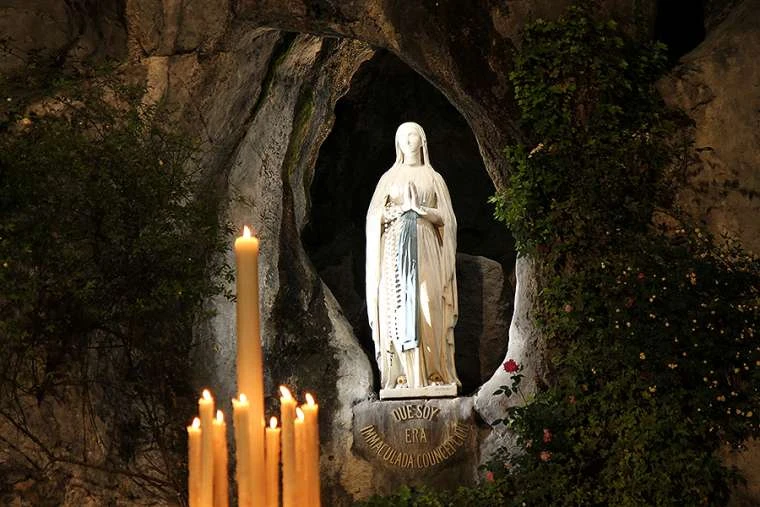
The Church misses a very important pro-life witness regarding Lourdes. By identifying herself as the Immaculate Conception, Our Lady was announcing to the world, just four decades before the bloody twentieth century, that God’s plan for each life in this world clearly begins at our conception. Of course, we can’t expect many of our anti-wisdom prelates to have picked up on this. They’ve only had 164 years to think about it.
Been to Lourdes twice. Was honored to have carried the statue at the nine P.M. procession. Naturally, being somewhat expert in electrical matters, I inspected the wiring on the lighting system to make sure all the connections were in good condition when we returned it to the holding room. It was clear that everyone treats it with TLC.
Francesca presents an endearing essay on an endearing saint. What I beg to add is a revelatory reality of Bernadette’s death. Written by an ethnic German Franz Werfel, published 1941 following Nazi Germany’s annexation of Czechoslovakia’s Sudetenland and the pretext of absorption and dissolution of the Czech State.
Werfel gives account in his biography of Bernadette’s illness, a bone cancer in her leg that caused serious pain throughout her short life at the convent she gave her life to in Christ for love of Christ. She kept it hidden through the years, Werfel’s account makes note of accusations [unknowing of her terminal illness] of laziness.
Bernadette’s suffering and death, silent while unwittingly accused. Bernadette’s witness to her love for Christ is the reflexion in us of the depth of that love for us, the key to transformation of a world at present suffocating in it’s own self absorption. An heroic love of divine goodness manifest in a young woman, that reveals our true humanness, the means for transformation of a chaotic, disordered, violent world.
A note on Franz Werfel, Born in Prague of German Jewish parentage. Werfel was a novelist and a humanist. He wrote on the Turkish genocide of Armenians and was denounced by the Nazis. He escaped with his wife to France. When Germany invaded France he fled with his wife to Lourdes [in Vichy France granted semi autonomy by the Germans] where they were given refuge by the shrines religious orders. After his arrival in the US he fulfilled a promise in thankfulness to write the story of Bernadette Soubirous and Our Blessed Mother.
As with Edward Baker, above (and so many others), part of my family also visited Lourdes on a private healing pilgrimage, once in May 1999, and then Nevers where we viewed Bernadette’s crypt, blindingly ablaze in a shaft of the afternoon sun. Said a nun in residence, later, “oh yes, Bernadette was really showing off today!”
Due to our circumstances and the deserted condition of the Nevers grounds during our visit, we were volunteered a private tour by this nun. My wife, Kristi, was in remission and doing very well, but was a long-time cancer victim; and in August 2001 passed into the company of Bernadette and her other favorite saints (and about whom, my first book: “KRISTI: So Thin is the Veil,” Crossroads, 2006).
During the tour we were escorted even into the upstairs and intact infirmary where Bernadette spent her last days and hours. And, in the yard, we were shown a life-size statue of Mary, placed in celebrating of the much-needed discovery of well water on the property: “Our Lady of the Waters.”
Bernadette remarked that she found this informal and inviting statue to be truer to reality than the more familiar statue positioned in the Grotto at Lourdes. Here’s a link and photo: https://jasonbermender.wordpress.com/2017/02/11/bernadettes-our-lady-of-the-waters/