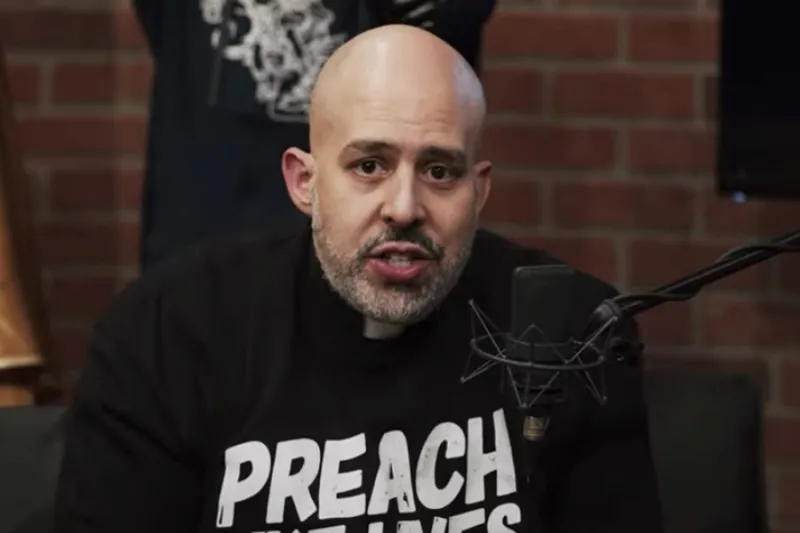
In a video promoting the launch, Espaillat, who also goes by Father J, said that the podcast would include discussions on faith, music, sports, fashion, and pop culture.
“We’re going to talk about Pop Smoke. We’re going to talk about Kanye. We’re going to talk about Kim Kardashian. We’re going to talk about everything under the sun, and Cardi B,” Espaillat said.

Bishop-elect Joseph A. Espaillat takes part in the podcast and YouTube series ‘Sainthood in the City.’. Screenshot from Centro Católico Carismático YouTube channel.
A featured speaker at Steubenville Youth Conferences, Espaillat says that he loves ministering the sacraments, playing softball and basketball, writing poetry and rapping.
He was ordained in 2003 and has served as the pastor of St. Anthony of Padua parish in the South Bronx since 2015.
Espaillat attended Cathedral Preparatory School in Manhattan before studying at Fordham University, where he received a Bachelor of Arts degree in philosophy in 1998.
While in St. Joseph’s Seminary in Dunwoodie, New York, Espaillat earned a Master of Divinity degree in Theology and a Master of Arts degree in Theology, specializing in Church history.
He has served as a director of youth ministry for the Archdiocese of New York, a pastor at St. Peter’s parish in Yonkers, and as a parochial vicar at Our Lady Queen of Martyrs in Manhattan.
Bonnici, 56, has served as a priest of the Archdiocese of New York for 30 years.
He holds a doctorate from the Pontifical John Paul II Institute in Washington (1995) and a licentiate degree from the Pontifical John Paul II Institute (1992) in Rome, where he also studied at the Pontifical North American College and the Gregorian University (1987-1990) before his ordination.
We thank Pope Francis and rejoice in the appointment of our two new auxiliary bishops, Bishop-elect John Bonnici and Bishop-elect Joseph Espaillat! https://t.co/6xWnfc55ePpic.twitter.com/AFe1HpDmep
Bonnici previously served as director of the archdiocese’s Respect Life Office for six years and as the pastor of St. Columba in Chester from 2008 to 2021.
He was born in New York on Feb. 17, 1965, and earned a Bachelor of Science degrees in biology and philosophy from St. John’s University in Queens, New York in 1987.
Bonnici’s most recent assignment was as pastor of St. Augustine parish and Saints John and Paul parish in Larchmont.
Bonnici and Espaillat’s episcopal ordinations will take place at St. Patrick’s Cathedral on March 1.
The Archdiocese of New York has a total population of 6.2 million, 2.81 million of whom are Catholic. Cardinal Timothy M. Dolan has served as the archbishop of New York since 2009.
“Pope Francis has selected two outstanding priests, both experienced pastors, to serve the people of God of this archdiocese as auxiliary bishops,” Dolan said in a statement on the archdiocese’s website.
“I look forward to working even more closely with Bishop-elect Bonnici and Bishop-elect Espaillat, as they undertake this new role in their priesthood.”
With the addition of Bonnici and Espaillat, there will be a total of five active auxiliary bishops serving the Archdiocese of New York.
The youngest bishop in the world is 40-year-old Bishop Cristian Dumitru Crişan, an auxiliary in Romania, according to Catholic-hierarchy.org.
If you value the news and views Catholic World Report provides, please consider donating to support our efforts. Your contribution will help us continue to make CWR available to all readers worldwide for free, without a subscription. Thank you for your generosity!
Click here for more information on donating to CWR. Click here to sign up for our newsletter.
Pope Francis with Cardinal Arthur Roche, Prefect of the Vatican’s Dicastery of Divine Worship and Discipline of Sacraments, at the consistory in St. Peter’s Basilica, Aug. 27, 2022 / Daniel Ibáñez / CNA
Rome Newsroom, Aug 27, 2022 / 08:31 am (CNA).
Pope Francis created 20 new cardinals for the Catholic Church during a liturgy in St. Peter’s Basilica Saturday.
“Jesus calls us by name; he looks us in the eye and he asks: Can I count on you?” Pope Francis said in a homily addressed to the College of Cardinals and its new members on Aug. 27.
“The Lord,” he said, “wants to bestow on us his own apostolic courage, his zeal for the salvation of every human being, without exception. He wants to share with us his magnanimity, his boundless and unconditional love, for his heart is afire with the mercy of the Father.”
The pope’s reflection followed a reading from the Gospel of Luke, chapter 12, verses 49-50: “In that time, Jesus said to his disciples: ‘I have come to set the earth on fire, and how I wish it were already blazing! There is a baptism with which I must be baptized, and how great is my anguish until it is accomplished!’”
“The words of Jesus, in the very middle of the Gospel of Luke, pierce us like an arrow,” Francis said.
“The Lord calls us once more to follow him along the path of his mission,” he said. “A fiery mission – like that of Elijah – not only for what he came to accomplish but also for how he accomplished it. And to us who in the Church have been chosen from among the people for a ministry of particular service, it is as if Jesus is handing us a lighted torch and telling us: ‘Take this; as the Father has sent me so I now send you.’”
The pope ended his homily mentioning that one cardinal-elect, Richard Kuuia Baawobr of Wa (Ghana), was not present. Francis asked for prayers for the African prelate, explaining Baawobr had been taken ill.
At the beginning of the consistory, Pope Francis pronounced the opening prayer of the ceremony in Latin.
During the ceremony, the new cardinals made a profession of faith by reciting the Creed. They then pronounced an oath of fidelity and obedience to the pope and his successors.
Each cardinal then approached Pope Francis, kneeling before him to receive the red birretta, the cardinal’s ring, and a document naming the titular church he has been assigned.
Pope Francis embraced each new cardinal, saying to him: “Pax Domini sit semper tecum,” which is Latin for “the peace of the Lord be with you always.” Each cardinal responded: “Amen.”
The new cardinals also exchanged a sign of peace with a number of the members of the College of Cardinals, representative of the whole college.
While placing the red biretta on the head of each cardinal, the pope recited these words: “To the glory of almighty God and the honor of the Apostolic See, receive the scarlet biretta as a sign of the dignity of the cardinalate, signifying your readiness to act with courage, even to the shedding of your blood, for the increase of the Christian faith, for the peace and tranquility of the people of God and for the freedom and growth of the Holy Roman Church.”
As he gave each new cardinal the ring, Francis said: “Receive this ring from the hand of Peter and know that, with the love of the Prince of the Apostles, your love for the Church is strengthened.”
In his homily, the pope said: “The Lord wants to bestow on us his own apostolic courage, his zeal for the salvation of every human being, without exception. He wants to share with us his magnanimity, his boundless and unconditional love, for his heart is afire with the mercy of the Father.”
He also recalled another kind of fire, that of charcoal. “This fire,” he said, “burns in a particular way in the prayer of adoration, when we silently stand before the Eucharist and bask in the humble, discreet and hidden presence of the Lord. Like that charcoal fire, his presence becomes warmth and nourishment for our daily life.”
“A Cardinal loves the Church, always with that same spiritual fire, whether dealing with great questions or handling everyday problems, with the powerful of this world or those ordinary people who are great in God’s eyes,” he said.
The pope named three men as examples for the cardinals to follow: Saint Charles de Foucauld, Cardinal Agostino Casaroli, and Cardinal Van Thuân.
The consistory to create cardinals also included a greeting and thank you to Pope Francis, expressed by Cardinal Arthur Roche, prefect of the liturgy dicastery, on behalf of all the new cardinals.
Cardinal Arthur Roche speaking on behalf of the new cardinals in St. Peter’s Basilica, Aug. 27. 2022. Daniel Ibáñez / CNA
“All of us, coming from different parts of the world, with our personal stories and different life situations, carry out our ministry in the vineyard of the Lord. As diocesan and religious priests, we are at the service of preaching the Gospel in many different ways and in different cultures, but always united in the one faith and the one Church,” Roche said.
“Now, in manifesting your trust in us, you call us to this new service, in an even closer collaboration with your ministry, within the broad horizon of the universal Church,” he continued. “God knows the dust of which we are all made, and we know well that without Him we are capable of falling short.”
Roche quoted Saint Gregory the Great, who once wrote to a bishop: “We are all weak, but he is weakest of all who ignores his own weakness.”
“However, we draw strength from you, Holy Father,” he said, “from your witness, your spirit of service and your call to the entire Church to follow the Lord with greater fidelity; living the joy of the Gospel with discernment, courage and, above all, with an openness of heart that manifests itself in welcoming everyone, especially those who suffer the injustice of poverty that marginalizes, the suffering of pain that seeks a response of meaning, the violence of wars that turn brothers into enemies. We share with you the desire and commitment for communion in the Church.”
At the end of the consistory to create cardinals, Pope Francis convened a consistory for the cardinals to give their approval to the canonizations of Blessed Artemide Zatti and Giovanni Battista Scalabrini.
The new cardinals are:
— Cardinal Arthur Roche, 72, prefect of the Congregation for Divine Worship and former Bishop of Leeds (England);
— Lazarus You Heung-sik, 70, prefect of the Congregation for Clergy and former Bishop of Daejeon (South Korea);
— Jean-Marc Noël Aveline, 63, Archbishop of Marseille, the first French diocesan bishop to get the honor during Pope Francis’ pontificate;
— Peter Ebere Okpaleke, 59, Bishop of Ekwulobia in the central region of Nigeria, who was created bishop in 2012 by Benedict XVI;
— Leonardo Ulrich Steiner, 77, Archbishop of Manaus, in Brazil’s Amazon region, a Franciscan who played a leading role during the Amazon Synod and as Vice President of the recently created Amazonian Bishops’ Conference;
— Filipe Neri António Sebastião do Rosário Ferrão, 69, Archbishop of Goa (India), appointed bishop by St. John Paul II in 1993;
— Robert McElroy, 68, Bishop of San Diego (United States), whose diocese is suffragan to the Archdiocese of Los Angeles, led by the President of the USCCB, Archbishop José Gomez;
— Virgilio do Carmo Da Silva, 68, a Salesian, since 2019 the Archbishop of Dili (East Timor);
— Oscar Cantoni, 71, Bishop of Como (Italy), appointed in January 2005 by St. John Paul II, who is suffragan to Milan;
— Archbishop Fernando Vérgez Alzaga, L.C., 77, president of the Governorate of the Vatican City State and of the Pontifical Commission for the Vatican City State; the Spaniard is the first Legionary of Christ to become a cardinal;
— Anthony Poola, 60, Archbishop of Hyderabad (India), a bishop since 2008 and the first dalit to become a cardinal;
–Paulo Cezar Costa, 54, Archbishop of Brasilia (Brazil), the fourth archbishop of the Brazilian capital to become a cardinal;
— Richard Kuuia Baawobr, 62, Bishop of Wa (Ghana), former Superior General of the White Fathers, and bishop since 2016;
— William Goh Seng Chye, 65, Archbishop of Singapore since 2013;
— Adalberto Martinez Flores, 71, Archbishop of Asunción (Paraguay) and the first Paraguayan cardinal;
— Giorgio Marengo, 47, Italian Missionary of the Consolata and Apostolic Prefect of Ulan Bator in Mongolia, the youngest cardinal in recent history, along with Karol Wojtyla, who also was created a cardinal at 47, during the consistory of June 26, 1967.
Furthermore, Pope Francis appointed the following prelates over the age of 80, who are therefore excluded from attending a future conclave.
Jorge Enrique Jiménez Carvajal, 80, Archbishop Emeritus of Cartagena (Colombia); Arrigo Miglio, 80, Archbishop Emeritus of Cagliari (Italy); Fr. Gianfranco Ghirlanda, a Jesuit and former rector of the Pontifical Gregorian University, who extensively collaborated in the drafting of the Apostolic Constitution Praedicate Evangelium; and Fortunato Frezza, 80, (Italy) currently a Canon at the Basilica of St. Peter, who collaborated for several years at the Secretariat General for the Synod of the Bishops.
Pope Francis had originally also nominated Ghent Bishop Luc Van Looy, 80, who later declined to accept the post because of criticism of his response to clergy abuse cases.
View of a recreation of an El Chipote prison cell during a photography exhibition of the victims of state repression in Nicaragua and their families, at the Hall of Former Presidents of the Costa Rican Congress in San Jose, on Nov. 5, 2021. / Cr… […]
Leave a Reply
