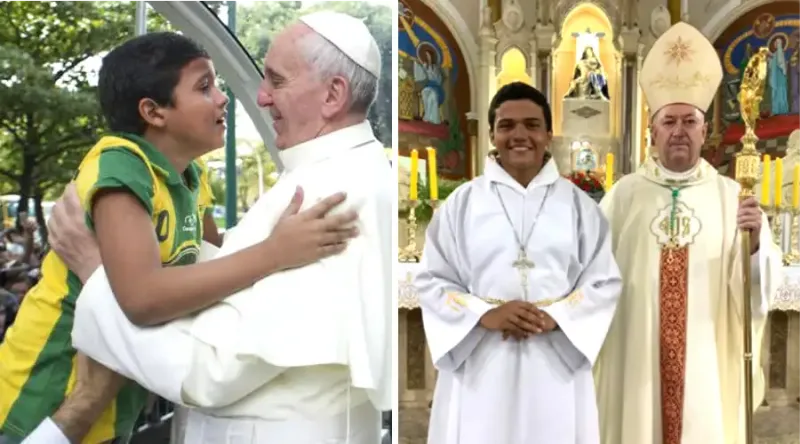
Nathan de Brito and Pope Francis at World Youth Day 2013 (L) Nathan de Brito and Bishop Joaquim Wladimir Lopes Dias en 2021 (R). Facebook de Mons. Joaquim Wladimir Lopes Dias / Bishop Joaquim Wladimir Lopes Dias via Facebook.
Lorena, Brazil, Jan 5, 2022 / 18:45 pm (CNA).
During World Youth Day in Rio de Janeiro, in 2013, a boy made his way through the crowd to hug Pope Francis tearfully. That boy, now a young man, is discerning religious life.
The news was released Jan. 3 by the Bishop of Lorena, Joaquim Wladimir Lopes Dias, who in a Facebook post shared the photo of Pope Francis hugging Nathan de Brito, then nine years old, and another photo showing him now as a young man dressed as a postulant of the Order of Friars Minor in Rondonópolis.
Many faithful, especially in Brazil, remember the image of Nathan de Brito hugging the Holy Father.
Recordings show Nathan going after the passing popemobile and managing to get security to pick him up and take him to the vehicle. The little boy is then seen clinging to and hugging the Pope several times with tears streaming down his face as he resisted efforts to pull him away from the pope.
After Pope Francis gave him a blessing, one of the security guards manages to pull the boy away from the vehicle and comfort him as he leads him to where his family was standing. On the way back to his family, the boy is seen covering his face and crying with emotion.
In his Jan. 3 post, Bishop Lopes shared a photo of himself in front of the altar in a church, and next to Nathan de Brito, now a smiling young man wearing a white robe and a cross on his chest.
The photos are accompanied by a brief text, where the prelate indicates that the young man in the photo is Nathan and that “today he is visiting Lorena where he lived for a few years.”
Bishop Lopes also revealed that Nathan “received a pectoral cross from the Pope, with permission to wear it” and concluded by announcing that “currently, he is a postulant of the Order of Friars Minor in Rondonópolis in Mato Grosso state. Many blessings!”
In addition to recalling Nathan’s presence at WYD, the prelate wrote that three years later, in 2016, Nathan participated in the Brazilian Bishops Conference’s Vocation Month.
The photo showing Nathan’s emotional embrace of Pope Francis was used as a symbol for that Vocation Month, which Nathan said later in a 2018 interview “was a surprise.”
“I only realized that it was a campaign when my diocesan bishop, at a Mass where I was serving as an acolyte, commented to me saying that he had seen me on the campaign theme poster. I thought it was something going on within the Bishops’ Conference itself,” the young man explained.
In that same interview, Nathan revealed that his “dream” was to be a priest, and that in addition to his First Communion, his encounter with Pope Francis was one of the milestones of his vocation story.
“The special moment that marked my vocation story was my First Eucharist. From that day onwards, unworthy as I am, I became a living tabernacle of Jesus in the Eucharist. Another very powerful moment for me was the unexpected meeting with Pope Francis at WYD Rio 2013.″
If you value the news and views Catholic World Report provides, please consider donating to support our efforts. Your contribution will help us continue to make CWR available to all readers worldwide for free, without a subscription. Thank you for your generosity!
Click here for more information on donating to CWR. Click here to sign up for our newsletter.
Guayaquil, Ecuador, Jun 24, 2019 / 09:01 pm (CNA).- Tens of thousands took to the streets of Guayaquil, Ecuador on June 22 in support of life, marriage, conscience protections, and parental rights.
Organizers said more than 100,000 people attended the march, which had as its theme, “Respect the Constitution, the family and life.”
The demonstrators demanded the nullification of a ruling by the Constitutional Court of Ecuador which opens the door to redefining marriage. They also voiced their opposition to attempts to legalize abortion, medical marijuana, and sex change operations on minors without parental consent.
The march was organized by several groups defending life and the family, including the Guayaquil Family Network, I’m the One to Educate My Children, Ecuador for the Family, the Young People’s Front of Ecuador, Don’t Mess with my Children, Lawyers for Life, and the National Front for the Family.
In a statement, the organizers charged that a recent ruling from the Constitutional Court, which paves the way for the redefinition of marriage, violates Article 67 of the Constitution, which says, “Marriage is the union between man and woman, to be based on the free consent of the contracting persons and with equal rights, obligations, and legal capacity.”
“The sovereign authority, that is, the Ecuadoran people, is defending its rights and fighting so they don’t keep passing laws attacking the life, health and security of the family, and attacking children, the most vulnerable of beings,” they said.
They also warned that the National Assembly of Ecuador is debating a measure that would legalize abortion in cases of incest, rape, and fetal deformity.
Abortion is currently only legal in the country in cases of the rape of a woman with mental disabilities or when the mother’s life is determined to be at risk.
In addition, leaders of the march argued against a proposal to legalize the cultivation and consumption of medical marijuana, saying that it “puts children and adolescents in real risk of addiction in a State that has not been able control the consumption of other drugs.”
Other proposals that organizers objected to include a surrogacy measure, sex change operations on minors without parental consent, same-sex adoption, and requiring doctors to perform abortions.
The organizers of the march said that they are gathering signatures “to continue fighting until the nullification of these laws is accomplished through a referendum. The marches will continue in the coming days in other cities.”
Another march will be held in Quito, Ecuador’s capital, on June 29.
Rodrigo Iván Cortés, president of the National Front for the Family, described Claudia Sheinbaum’s victory as “very bad news for life, family, and freedoms.” / Credit: EWTN Noticias/Screenshot
ACI Prensa Staff, Jun 5, 2024 / 18:50 pm (CNA).
Various pro-life, pro-family, and lay leaders of the Catholic Church in Mexico have reacted with concern to the election of Claudia Sheinbaum as president of the country.
Rodrigo Iván Cortés, president of the National Front for the Family, described Sheinbaum’s victory as “very bad news for life, family, and freedoms.”
For the pro-family leader, Sheinbaum represents continuity with the same progressive agenda of the outgoing administration of President Andrés Manuel López Obrador. Citing the growing legalization of abortion and use of gender ideology throughout the country, Cortés explained that “the López Obrador regime culminated in a culture of death, of ideology, not only of gender confusion but also of socialist populist indoctrination.”
However, in an interview with “EWTN Noticias,” EWTN’s Spanish-language news program, Cortés emphasized that just as people didn’t vote for López Obrador because of his position on abortion, gender ideology, or for freedoms to be canceled, people didn’t vote for Sheinbaum for those same reasons. What happens, he indicated, is that “when they come to power, they implement [that agenda].”
For Juan Dabdoub, president of the Mexican Family Council (ConFamilia), there are “two important factors” that would explain Sheinbaum’s victory in the presidential elections.
The first, he told ACI Prensa, CNA’s Spanish-language news partner, is that in Mexico there is “a poor political culture, which makes a large majority of the people manipulable.”
A second factor, Dabdoub noted, is that “Mexican Catholicism has failed in something extremely important that Pope St. John Paul II already pointed out: ‘A faith that does not create culture is a useless faith.’”
In a Jan. 16, 1982, speech, John Paul II said: “A faith that does not become culture is a faith that is not fully accepted, not entirely thought out, not faithfully lived.”
For the president of ConFamilia, “Mexico has stopped being a country of practicing Catholics and has become one of simply baptized people; and when a Catholic doesn’t live his faith in the outside world, that is, outside his home and his parish, those who dominate the world take control.”
Dabdoub considered Sheinbaum’s victory to be “a brutal threat” to the defense of life, family, and freedoms, since she has “a radical progressive agenda.”
‘Formation and serious work are needed’
For Father Hugo Valdemar, who for 15 years headed the communications office of the Primatial Archdiocese of Mexico when Cardinal Norberto Rivera led the archdiocese, “Catholics must learn that social media are not enough to really influence; serious formation and work are needed, otherwise everything remains up in the air.”
“The big problem is that we haven’t been seriously forming the laity, and nothing is being done to do so,” he told ACI Prensa. However, he noted that with a Sheinbaum administration, “the Church is not in danger. I don’t see an adverse climate, much less persecutory, and Christian values have been violated for a long time.”
What’s next in the battle for life and family?
Pilar Rebollo, director of the Steps for Life platform, pointed out that Sheinbaum’s election “means much more work” for pro-lifers: “It requires us to be united, it requires us to be coordinated,” anticipating possible “frontal attacks on what we know as our values that are foundational.”
Rebollo also emphasized the importance of serving underserved and vulnerable populations, which, she considered, were key to Sheinbaum’s victory. This, she said, must be done “not out of a desire for numbers but zeal for souls, a desire to [heal] wounds, zeal for humanity, to see Christ in others.”
It should be noted that all three candidates for president — Sheinbaum, Xóchitl Gálvez, and Jorge Álvarez Máynez — backed the legalization of abortion and the LGBTQ policy agenda, so Mexican voters had no real alternative to vote for a pro-life and pro-family candidate.
Sheinbaum is the first person of Jewish ancestry to be elected to Mexico’s presidency. In February of this year, she visited Pope Francis at the Vatican, where she asked him to bless a rose wrought in silver by a Mexican artisan. She later presented it to the rector of the Basilica Shrine of Our Lady of Guadalupe in Mexico City.
Jason Poblete of the Global Liberty Alliance anticipates that Claudia Sheinbaum will govern under the shadow of the current president and his leftist party. Credit: EWTN News Nightly/Screenshot
During her campaign, Sheinbaum was seen wearing a skirt bearing the image of the revered Virgin of Guadalupe. According to Jason Poblete of the Global Liberty Alliance, Sheinbaum also wore a rosary around her neck at a public event. He and others suggested that this was an act of demagoguery intended to appeal to Catholics, who comprise approximately 78% of the country’s population.
Sheinbaum, 61, holds a doctorate in physics specializing in energy and taught at Mexico’s National Autonomous University. Her political militancy began during her student years, joining a group that became the founding youth movement of the socialist Party of Democratic Revolution. She later joined the ruling Morena party. She has been described as a climate activist, having been part of a Nobel Prize-winning commission advising the United Nations on climate change.
Sheinbaum’s tenure as Mexico City mayor was marked by progressive initiatives. For example, the World Economic Forum, led by Klaus Schwab, noted that as mayor she ended public school policy requiring gender-appropriate uniforms for children. Sheinbaum said: “The era when girls had to wear a skirt and boys had to wear trousers has been left behind; I think that’s passed into history,” and added: “Boys can wear skirts if they want and girls can wear pants if they want.”
While she did not raise the issue during her campaign, Sheinbaum’s Morena party is a firm supporter of abortion. The newly-elected congress will be seated in September, one month before Sheinbaum’s inauguration, thus allowing incumbent president López Obrador an opportunity to push through his legislative initiatives.
Poblete told “EWTN News Nightly” that the 2024 election may have led to a Morena majority in Mexico’s Congress, which has vowed to amend the constitution in order for Mexican Supreme Court justices to be elected by popular ballot, thereby confirming partisan control of the heretofore independent judiciary, which would rule on issues such as abortion and matters of gender ideology. He fears that Sheinbaum will govern under the shadow of the current president and his leftist party.
This story was first published by ACI Prensa, CNA’s Spanish-language news partner. It has been translated and adapted by CNA.
Argentine President Javier Milei is pictured here during an audience with Pope Francis on Feb. 12, 2024. / Credit: Vatican Media via Vatican Pool/Getty Images
ACI Prensa Staff, Mar 9, 2024 / 06:00 am (CNA).
The president of Argentina, Javier Mi… […]
Leave a Reply