Pope Francis will beatify the “smiling pope” John Paul I on Sept. 4, 2022.
Vatican News, the website overseen by the Vatican’s Dicastery for Communication, said on Dec. 23 that the pope who reigned for only 33 days would be beatified in St. Peter’s Basilica.
It added that the Congregation for the Causes of Saints shared the ceremony’s date with Cardinal Beniamino Stella, postulator of the cause of canonization, and Bishop Renato Marangoni of Belluno-Feltre, the Italian diocese where the cause opened on Nov. 23, 2003, and closed on Nov. 9, 2017, with the proclamation of John Paul I’s heroic virtues.
Pope Francis recognized a miracle obtained through the intercession of his papal predecessor in October.
John Paul I was elected pope on Aug. 26, 1978, following the death of Paul VI. A priority of his short pontificate was carrying forward the work of the Second Vatican Council.
He died unexpectedly on Sept. 28, 1978, at the age of 65, and was succeeded by Pope John Paul II.
Even before he was elected pope, Albino Luciani was known for his humility, his emphasis on spiritual poverty, and his dedication to teaching the faith in an understandable manner.
The miracle attributed to John Paul I’s intercession is the 2011 healing of a girl in the Archdiocese of Buenos Aires, Argentina, from a severe form of encephalopathy, a disease affecting the brain.
In an April 2020 article in L’Osservatore Romano, Vatican Secretary of State Cardinal Pietro Parolin wrote that “Pope John Paul I was and remains a reference point in the history of the universal Church, the importance of which — as St. John Paul II pointed out — is inversely proportional to the duration of his very short pontificate.”
In 2008, on the 30th anniversary of John Paul I’s death, Benedict XVI reflected on St. Paul’s Letter to the Philippians, in which the apostle writes: “Do nothing out of selfishness or out of vainglory; rather, humbly regard others as more important than yourselves.”
Benedict said that the biblical text brought to mind John Paul I, who chose the same episcopal motto as St. Charles Borromeo: Humilitas.
John Paul I’s simplicity, according to Benedict, “was a means of solid and fruitful instruction, which, thanks to the gift of an excellent memory and vast culture, was enriched by numerous citations of Church and secular authors.”
Writing in Avvenire, the official newspaper of the Italian bishops’ conference, on Dec. 23, vice postulator Stefania Falasca noted that the causes of six of the nine 20th-century popes have opened. Four of them have concluded in canonization: those of Pius X, John XXIII, Paul VI and John Paul II.
The cause of Pope Pius XII was opened on Nov. 18, 1965, by Paul VI during the last session of the Second Vatican Council. Benedict XVI declared the wartime pope Venerable on Dec. 19, 2009.
If you value the news and views Catholic World Report provides, please consider donating to support our efforts. Your contribution will help us continue to make CWR available to all readers worldwide for free, without a subscription. Thank you for your generosity!
Click here for more information on donating to CWR. Click here to sign up for our newsletter.
Bishop Michael Pfeifer, who was Bishop of San Angelo from 1985 to 2013. / Courtesy photo.
Denver Newsroom, Apr 29, 2022 / 16:55 pm (CNA).
An emeritus Texas bishop has called on his fellow bishops to take action after President Biden’s proposed … […]
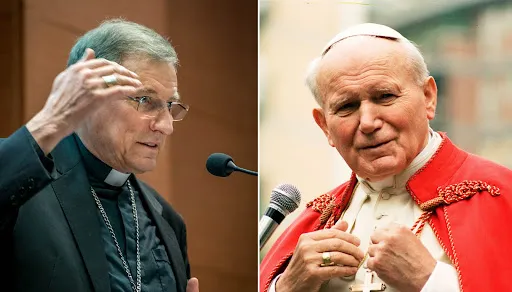
Archbishop Zbigņevs Stankevičs of Riga, Latvia (left), speaking during a Catholic conference in Warsaw in May 2022 on the natural law legacy of John Paul II (right.) / Photos by Lisa Johnston and L’Osservatore Romano
Warsaw, Poland, Jun 9, 2022 / 09:17 am (CNA).
Constant cooperation and dialogue among Catholic, Lutherans, Orthodox, and other Christian denominations have been crucial to protect life and family in the Baltic nation of Latvia, Archbishop Zbigņevs Stankevičs of Riga, Latvia, said during a recent Catholic conference in Warsaw.
In his speech, Stankevičs shared his personal ecumenical experience in Latvia as an example of how the concept of natural law proposed by St. John Paul II can serve as the basis for ecumenical cooperation in defending human values.
The metropolitan archbishop, based in Latvia’s capital, is no stranger to ecumenical work and thought. In 2001, he became the first bishop consecrated in a Lutheran church since the split from Protestantism in the 1500s. The unusual move, which occurred in the church of Evangelical Lutheran Cathedral in Riga, formerly the Catholic Cathedral of St. Mary, signaled the beginning of Stankevičs’ cooperation with the Lutheran church in Latvia, a cooperation that would ultimately become a partnership in the cause of life and the family. Since 2012, the archbishop has served on the Pontifical Council for Promoting Christian Unity.
“I would like to present this ecumenical cooperation in three experiences in my country: the abortion debate, the civil unions discussion, and the so-called Istanbul convention,” Stankevičs began.
Entering the abortion debate
Ordained as a priest in 1996, Stankevičs struggled to find proper consultation for Catholic couples on natural family planning. It was then that he decided to create a small center that provided natural family planning under the motto “let us protect the miracle [of fertility].”
This involvement in the world of natural family planning would lead him into the heart of the abortion debate in Latvian society, and, ultimately, to the conclusion that moral discussions in the public square benefit from a basis in natural law, something emphasized in the teachings of John Paul II.
“I knew that theological arguments would not work for a secular audience, so I wanted to show that Catholic arguments are not opposed to legal, scientific, and universal arguments, but rather are in harmony with them,” Stankevičs said.
“[A] few years later our parliament introduced the discussion to legalize abortion. No one was doing anything so I decided to do something. I consulted some experts and presented a proposal that was published in the most important secular newspaper in Latvia,” the archbishop said.
Stankevičs’ article, “Why I was Lucky,” used both biological and theological arguments to defend human life. He noted that his own mother, when pregnant with him, was under pressure to get an abortion; “but she was a believer, a Catholic, so she refused the pressure.”
After the Latvian parliament legalized abortion in 2002, the different Christian confessions decided to start working together to protect the right to life and the family.
In Latvia, Catholics comprise 25% of the population, Lutherans 34.2%, and Russian Orthodox 17%, with other smaller, mostly Christian denominations making up the remainder.
“We started to work together by the initiative of a businessman in Riga, a non-believer who wanted to promote awareness about the humanity of the unborn,” the archbishop recalled.
“Bringing all Christians together in a truly ecumenical effort ended up bearing good fruits because we worked together in promoting a culture of life: From more than 7,000 abortions per year in 2002, we were able to bring it down to 2,000 by 2020,” he said.
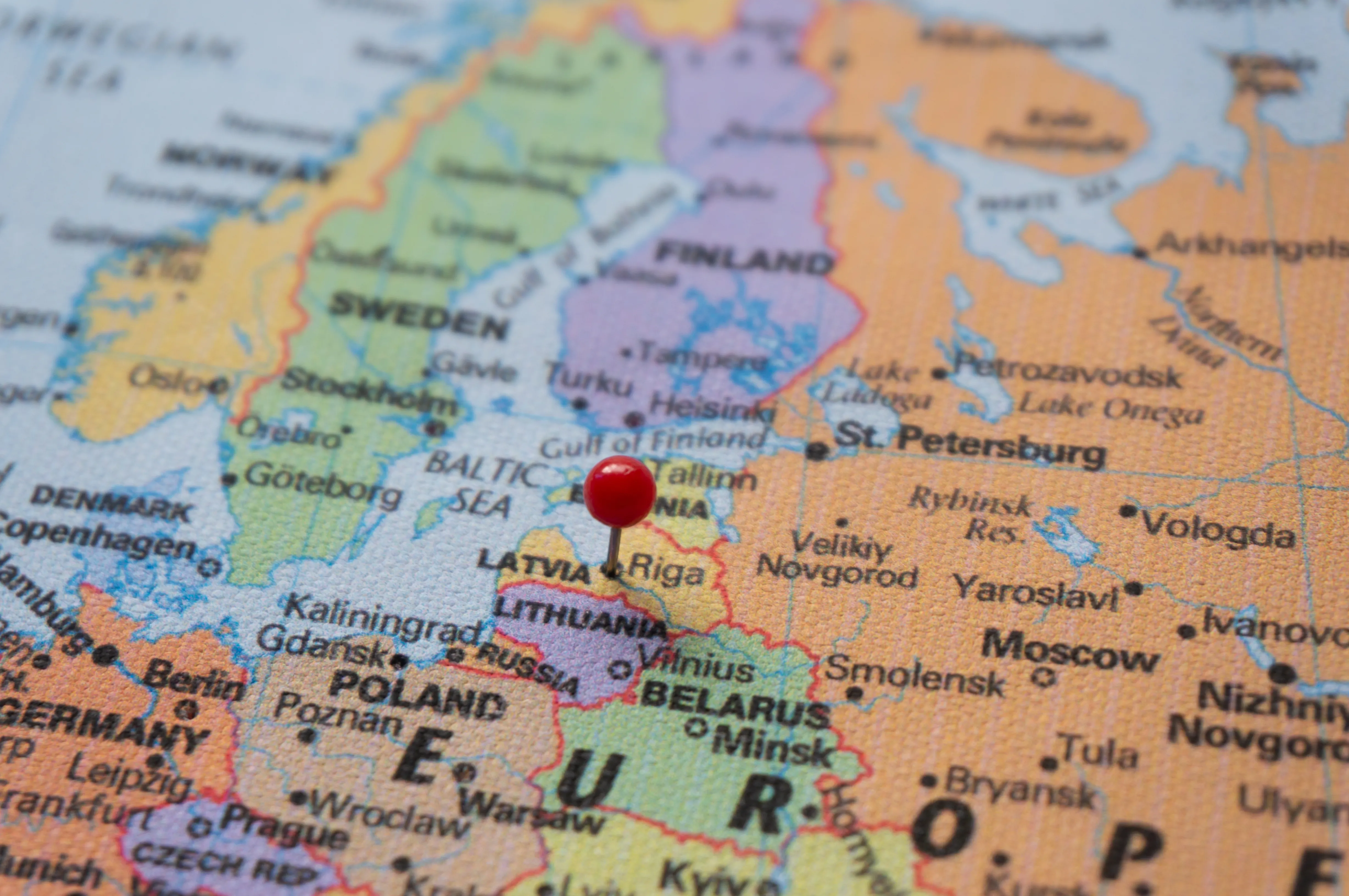
Map of Riga, the capital of Latvia. Shutterstock
Ecumenical defense of marriage, family
Regarding the legislation on civil unions, another area where Stankevičs has rallied ecumenical groups around natural law defense of marriage, the archbishop said that he has seen the tension surrounding LGBT issues mount in Latvian society as increased pressure is brought to bear to legalize same-sex unions.
Invited to a debate on a popular Latvian television show called “One vs. One” after Pope Francis’ remark “who am I to judge?” was widely interpreted in Latvian society as approving homosexual unions, Stankevičs “had the opportunity to explain the teachings of the Catholic Church and what was the real meaning of the Holy Father’s words.”
After that episode, in dialogue with other Christian leaders, Stankevičs proposed a law aimed at reducing political tensions in the country without jeopardizing the traditional concept of the family.
The legislation proposed by the ecumenical group of Christians would have created binding regulations aimed at protecting any kind of common household; “for example, two old persons living together to help one another, or one old and one young person who decide to live together.”
“The law would benefit any household, including homosexual couples, but would not affect the concept of [the] natural family,” Stankevičs explained. “Unfortunately the media manipulated my proposal, and the Agency France Presse presented me internationally as if I was in favor of gay marriage.”
In 2020, the Constitutional Court in Latvia decided a case in favor of legalizing homosexual couples and ordered the parliament to pass legislation according to this decision.
In response, the Latvian Men’s Association started a campaign to introduce an amendment to the Latvian constitution, to clarify the concept of family. The Latvian constitution in 2005 proclaimed that marriage is only between a man and a woman, but left a legal void regarding the definition of family, which the court wanted to interpret to include homosexual unions.
The Latvian bishops’ conference supported the amendment presented by the Men’s Association, “but most importantly,” Stankevičs explained, “we put together an ecumenical statement signed by the leaders of 10 different Christian denominations supporting the idea that the family should be based on the marriage between a man and a woman. The president of the Latvian Jewish community, a good friend, also joined the statement.”
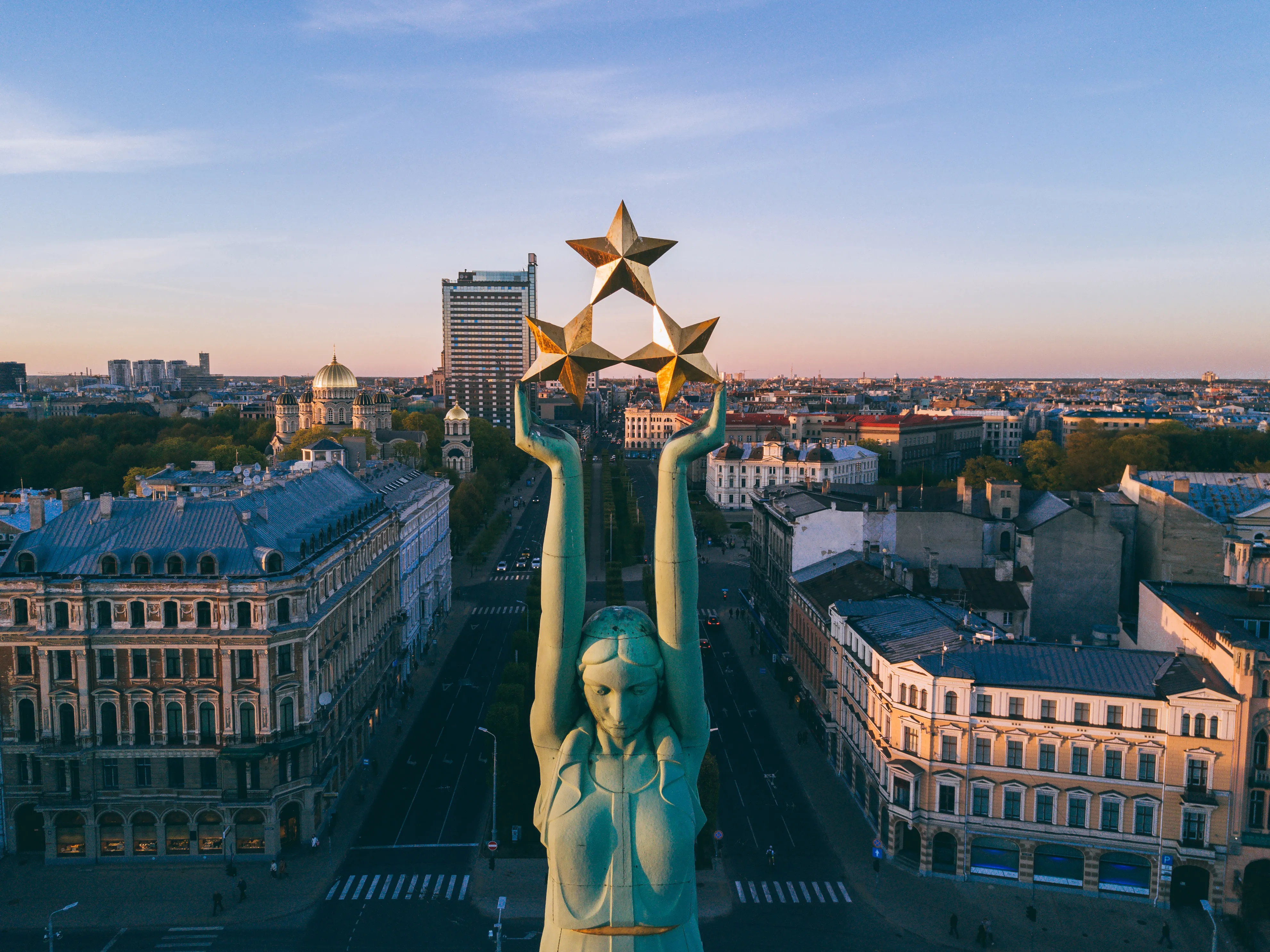
The Freedom Monument in Riga, Latvia, honors soldiers who died during the Latvian War of Independence (1918-1920). Shutterstock
According to Stankevičs, something strange happened next. “The Minister of Justice created a committee to discuss the demand of the constitutional court, and it included several Christian representatives, including three from the Catholic Church, which worked for a year.” But ignoring all the discussions and proposals, the Minister of Justice ended up sending a proposal to parliament that was a full recognition of homosexual couples as marriage.
The response was also ecumenical: Christian leaders sent a letter encouraging the parliament to ignore the government’s proposal.
According to Stankevičs, the proposal has already passed one round of votes “and it is very likely that it will be approved in a second round of votes, with the support of the New Conservative party. But we Christians continue to work together.”
Preventing gender ideology
The third field of ecumenical cooperation mentioned by Stankevičs concerned the Istanbul Convention, a European treaty which the Latvian government signed but ultimately did not ratify.
The treaty was introduced as an international legal instrument that recognizes violence against women as a violation of human rights and a form of discrimination against women.
The convention claims to cover various forms of gender-based violence against women, but Christian communities in Latvia have criticized the heavy use of gender ideology in both the framing and the language of the document.
The word “gender,” for instance, is defined as “the socially constructed roles, behaviors, activities, and attributes that a given society considers appropriate for women and men,” a definition that allows gender to be defined independent of biological sex and therefore opens the document to the question of whether it really is aimed at the protection of women.
Christian communities also question the biased nature of the committee designated to enforce the convention.
The governments of Slovakia and Bulgaria refused to ratify the convention, while Poland, Lithuania, and Croatia expressed reservations about the convention though it was ultimately ratified in those countries, a move the government of Poland is attempting to reverse.
“When we found out that the Latvian parliament was going to ratify it, I went to the parliament and presented the common Christian position,” Stankevičs explained. As a consequence of that visit, the Latvian parliament decided not to ratify the convention, Stankevičs said, crediting the appeal to the unity provided by the common Christian position argued via natural law.
“In conclusion,” the archbishop said, “I can say that in Latvia we continue to defend the true nature of life and family. But if we Catholics would act alone, we would not have the impact that we have as one Christian majority. That unity is the reason why the government takes us seriously.”
Archbishop Samuel Aquila carries the Eucharist out of the Cathedral Basilica of the Immaculate Conception in Denver on June 9, 2024. / Credit: Kate Quiñones/CNA
CNA Staff, Jun 16, 2024 / 07:30 am (CNA).
A new study has found that 69% of Mass-go… […]
17 Comments
Yet another steroid fueled popularity contest promoting fraudulence…
Bergoglio is on a warpath to make a handful of recent popes saints. I wouldn’t doubt if he’s going to nominate himself as a saint before he passes…yet, Venerable Archbishop Fulton Sheen’s canonization is on a shelf collecting dust…
Let’s make this a lot simpler. It is obvious and undeniable that every pope before Vatican II was a reactionary sinner who is rightfully consigned to the outer darkness and thence forth eternally ignored while every after Vatican II pope is a glorious “Santo Subito” because of course The Council. Once a new pope is elected, he will automatically be called “Saint” in to avoid the tedious and pointless delay and expense in having to wait until he dies and some rigamarole has to be done in the Saint-making sausage factory to beautify and canonize.
What did he actually do that was saintly? Smile for the cameras? John Paul I accomplished precisely zero as pope except being made pope by the same lobbies that made Roncalli as John XXIII and Montini as Paul VI. If he is made a saint, we should all be made saints automatically and thus dispense with the Church, the sacraments, grace, and even Christ Himself.
I, for one, do believe that the Holy Spirit, who works in mysterious ways, does lead the Cardinals to vote for a person that is needed by the Church at the time.
And you know this how? Because he had a cute and innocently-looking smile? Because we should feel sorry for him because he was robbed of years as Pope? Please give us an explication of what you’re aware of regarding his holiness?
A – its chief theologian Cardinal Kasper, promoted by sycophants of the Pontiff Francis such as “Eminence” Cupich, writes and teaches that the faithful “probably don’t need to believe” in the miracle accounts attributed to Jesus as testified by the apostles and evangelists in the New Testament, for example those in this list including the calming of the sea, the Transfiguration, the raising of the widow’s son, the daughter of Jairus and Lazarus, and especially the bodily resurrection of Jesus, which “appearances” were not “objectively TANGIBLE events…it is a mistake to interpret what happened as…a miraculous event…[which] “knocked them over” …. This would lead to the grotesque conclusion that those who first preached faith…were dispensed from faith by having seen…. [the appearances] “were actual encounters with Christ present in the spirit.” (Kasper, Jesus the Christ, the denial of the bodily resurrection being on p. 139 of the 1976 edition).
B – While the contemporary Catholic Church absolves the faithful from believing miracle accounts attested in the Gospels by mere evangelists and apostles, yet the faithful can nevertheless be assured that the “miracles” certified by the Church of Pachamama are all to be believed.
Not a very convincing testimony, your Eminences and Excellencies.
One more comment; I thought to be declared a ‘saint’ in the Church, there would have to be ‘2’ miracles attributed to this person. On here, apparently there was only ‘one’ attributed to JPI. These awards to sainthood seem to be flying off the shelf since Frank took over the ‘holy Chair of Peter…’
Pope John Paul II was shot while he was going to view the Shroud of Turin. When John Paul I died, there had been a three-part series on the Shroud of Turin featured in the Kansas City Star. I remember well how this unfolded. Above the headline banner, in red print, was the announcement of the featured articles each of the three days. Having an interest in the Shroud, and having seen the first article, I was anxious to read the second one. I purchased the newspaper the second day, and the headline that morning announced the death of Pope John Paul I. There, above that headline were two images in red of the crucified Christ, with the notice of the second installment of the series on the Shroud presented in red lettering between them. Rather strange.
Just because you’re not a canonized Saint doesn’t mean you’re a lesser saint. Popes and religious have hordes who labor on promoting their sainthood. Lay people, especially obscure saintly people, don’t have such tireless and savvy advocates. That’s okay because in heaven a saint is a saint. Just strive to be a saint.
I heard rumors that Pope John Paul I was poisoned due to him wanting to investigate corruption in the Vatican Bank. IF true, he would be saintly and likely a martyr, although most of these averments come from unverified sources in the Vatican rumor mill, without any proof to substantiate them thus far.







Yet another steroid fueled popularity contest promoting fraudulence…
Bergoglio is on a warpath to make a handful of recent popes saints. I wouldn’t doubt if he’s going to nominate himself as a saint before he passes…yet, Venerable Archbishop Fulton Sheen’s canonization is on a shelf collecting dust…
Let’s make this a lot simpler. It is obvious and undeniable that every pope before Vatican II was a reactionary sinner who is rightfully consigned to the outer darkness and thence forth eternally ignored while every after Vatican II pope is a glorious “Santo Subito” because of course The Council. Once a new pope is elected, he will automatically be called “Saint” in to avoid the tedious and pointless delay and expense in having to wait until he dies and some rigamarole has to be done in the Saint-making sausage factory to beautify and canonize.
Let’s start now and not waste any time: “St. Francis the Great.”
This is good news. John Paul 1, was indeed a saintly man.
What did he actually do that was saintly? Smile for the cameras? John Paul I accomplished precisely zero as pope except being made pope by the same lobbies that made Roncalli as John XXIII and Montini as Paul VI. If he is made a saint, we should all be made saints automatically and thus dispense with the Church, the sacraments, grace, and even Christ Himself.
I, for one, do believe that the Holy Spirit, who works in mysterious ways, does lead the Cardinals to vote for a person that is needed by the Church at the time.
And you know this how? Because he had a cute and innocently-looking smile? Because we should feel sorry for him because he was robbed of years as Pope? Please give us an explication of what you’re aware of regarding his holiness?
Was it the fact of his just being another ordained man saying shallow silly things about the wisdom of Humane Vitae that made him “saintly?”
“saying shallow silly things” says the person who does so regularly.
Be man enough to be specific.
Problem for Team Francis:
A – its chief theologian Cardinal Kasper, promoted by sycophants of the Pontiff Francis such as “Eminence” Cupich, writes and teaches that the faithful “probably don’t need to believe” in the miracle accounts attributed to Jesus as testified by the apostles and evangelists in the New Testament, for example those in this list including the calming of the sea, the Transfiguration, the raising of the widow’s son, the daughter of Jairus and Lazarus, and especially the bodily resurrection of Jesus, which “appearances” were not “objectively TANGIBLE events…it is a mistake to interpret what happened as…a miraculous event…[which] “knocked them over” …. This would lead to the grotesque conclusion that those who first preached faith…were dispensed from faith by having seen…. [the appearances] “were actual encounters with Christ present in the spirit.” (Kasper, Jesus the Christ, the denial of the bodily resurrection being on p. 139 of the 1976 edition).
B – While the contemporary Catholic Church absolves the faithful from believing miracle accounts attested in the Gospels by mere evangelists and apostles, yet the faithful can nevertheless be assured that the “miracles” certified by the Church of Pachamama are all to be believed.
Not a very convincing testimony, your Eminences and Excellencies.
One more comment; I thought to be declared a ‘saint’ in the Church, there would have to be ‘2’ miracles attributed to this person. On here, apparently there was only ‘one’ attributed to JPI. These awards to sainthood seem to be flying off the shelf since Frank took over the ‘holy Chair of Peter…’
Pope John Paul II was shot while he was going to view the Shroud of Turin. When John Paul I died, there had been a three-part series on the Shroud of Turin featured in the Kansas City Star. I remember well how this unfolded. Above the headline banner, in red print, was the announcement of the featured articles each of the three days. Having an interest in the Shroud, and having seen the first article, I was anxious to read the second one. I purchased the newspaper the second day, and the headline that morning announced the death of Pope John Paul I. There, above that headline were two images in red of the crucified Christ, with the notice of the second installment of the series on the Shroud presented in red lettering between them. Rather strange.
Just because you’re not a canonized Saint doesn’t mean you’re a lesser saint. Popes and religious have hordes who labor on promoting their sainthood. Lay people, especially obscure saintly people, don’t have such tireless and savvy advocates. That’s okay because in heaven a saint is a saint. Just strive to be a saint.
Yawn.
I heard rumors that Pope John Paul I was poisoned due to him wanting to investigate corruption in the Vatican Bank. IF true, he would be saintly and likely a martyr, although most of these averments come from unverified sources in the Vatican rumor mill, without any proof to substantiate them thus far.