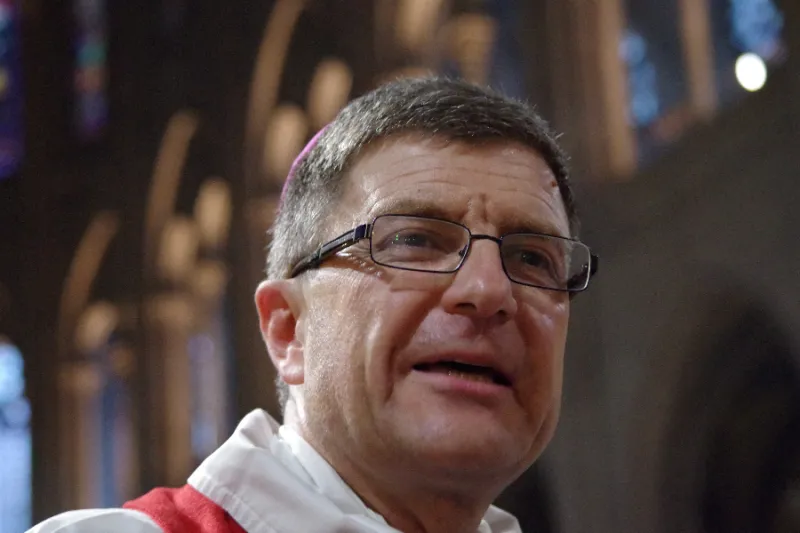
Archbishop Éric de Moulins-Beaufort, pictured in 2015. / Olivier LPB via Wikimedia Commons (CC BY-SA 4.0).
Paris, France, Oct 12, 2021 / 13:00 pm (CNA).
The president of the French bishops’ conference discussed the “clumsy wording” of his recent comments about the confessional seal with the country’s interior minister on Tuesday.
In a statement after the meeting at the interior ministry’s headquarters in Paris on Oct. 12, the bishops’ conference said that Archbishop Éric de Moulins-Beaufort and Gérald Darmanin reflected on an interview that the archbishop gave after the publication of a watershed report on clerical abuse in France.
In the interview with France Info, Moulins-Beaufort was pressed on whether the confessional seal took precedence over French laws.
“The seal of confession imposes itself on us and in this, it is stronger than the laws of the Republic,” he said.
France has a mandatory reporting law, with sanctions for failing to stop or report a crime.
“Archbishop Éric de Moulins-Beaufort was able to discuss with Gérald Darmanin the clumsy wording of his answer on France Info last Wednesday morning,” the bishops’ conference statement said.
“The state has the task of organizing social life and regulating public order. For us Christians, faith appeals to the conscience of each person, it calls to seek the good without respite, which cannot be done without respecting the laws of the country.”
The final report of the Independent Commission on Sexual Abuse in the Church (CIASE), issued on Oct. 5, estimated that 216,000 children were abused by priests, deacons, monks, or nuns from 1950 to 2020.
The independent commission, established by the French bishops in November 2018, spent 30 months investigating abuse within the Catholic Church led by Jean-Marc Sauvé, a senior civil servant.
Among the report’s 45 recommendations was a request for the Church to reconsider the seal of confession in relation to abuse.
The bishops’ conference statement quoted Moulins-Beaufort as saying: “I ask forgiveness of the victims and all those who may have been hurt or shocked by the fact that the debate sparked by my remarks on France Info about confession took precedence over the reception of the content of the CIASE report and the consideration of the victims.”
The Vatican has strongly defended the confessional seal in response to mandatory reporting laws introduced around the world.
In June 2019, the Apostolic Penitentiary issued a note reaffirming the inviolability of the sacramental seal.
The bishops’ conference statement noted that Darmanin, who is responsible for France’s religious affairs, initiated the meeting. It said that the two men discussed the CIASE report, which it described as “remarkable.”
It noted that the French bishops’ conference (CEF) and the Conference of Religious in France (CORREF) had asked Pope Francis to grant Sauvé and his colleagues an audience.
“The extent of sexual violence and aggression against minors revealed by the CIASE report requires the Church to re-read its practices in light of this reality. Work is therefore needed to reconcile the nature of confession with the need to protect children,” the statement said.
The French bishops will address the CIASE report and its recommendations at their plenary assembly on Nov. 3-8.
“Along with the bishops of France, Archbishop Eric de Moulins-Beaufort invites parishes, movements, and communities to read this report, to share it and to work on it, as it seems essential that all welcome the numerous testimonies of victims that it contains and draw the necessary conclusions,” the bishops’ conference statement said.
“The reality of sexual violence and aggression against minors within the Church and in society calls women and men of goodwill, believers or not, to work together in the service of the protection of the youngest, of the reception and accompaniment of the victims.”
“Faced with these facts, Archbishop Éric de Moulins-Beaufort reiterates his shame and dismay, but also his determination to carry out the necessary reforms so that the Church in France may deserve the trust of all.”
If you value the news and views Catholic World Report provides, please consider donating to support our efforts. Your contribution will help us continue to make CWR available to all readers worldwide for free, without a subscription. Thank you for your generosity!
Click here for more information on donating to CWR. Click here to sign up for our newsletter.
Rome, Italy, May 25, 2018 / 10:29 am (CNA/EWTN News).- For the first time in five years, seminarians and student priests from the North American College in Rome will hit the soccer field to battle it out for the winning title in the city’s holies… […]
Sisterhood of Saint Mary with bishops from the Anglican Church of North America’s Diocese of the Living Word. / Courtesy of Becket.
Washington D.C., Nov 1, 2021 / 15:56 pm (CNA).
Foes of mandatory coverage of abortion in New York State insurance law will have another hearing after the U.S. Supreme Court ordered a New York state court to reconsider their decision. The law’s narrow religious exemption wrongly disqualifies many religious groups which object to providing abortion, critics said.
A group of Anglican nuns is among the objectors.
“We believe that every person is made in the image of God,” said Mother Miriam of the Sisterhood of Saint Mary, an Anglican body. “That’s why we believe in the sanctity of human life, and why we seek to serve those of all faiths—or no faith at all—in our community. We’re grateful that the Supreme Court has taken action in our case and hopeful that, this time around, the New York Court of Appeals will preserve our ability to serve and encourage our neighbors.”
The Sisterhood of Saint Mary, also known as the Sisters of the Community of St. Mary, is aligned with the Anglican Church in North America. It was founded in 1865 and claims to be the oldest Anglican religious order in the United States.
The Anglican sisters are part of a coalition of religious groups challenging the New York State mandate requiring employers to cover abortions in their health plans. They are represented by attorneys from the religious freedom legal group Becket and the law firm Jones Day.
Eric Baxter, vice president and senior counsel at Becket, alluded to the Little Sisters of the Poor who fought a years-long court battle to secure relief from a federal mandate to cover contraceptive drugs, including drugs that can cause abortions.
“New York clearly learned nothing from the federal government’s own attempts to force nuns to pay for contraceptives and is now needlessly threatening charities because they believe in the dignity and humanity of every human person,” Baxter said Nov. 1.
“Punishing faith groups for ministering to their local communities is cruel and counterproductive,” he said. “We are thankful that the Supreme Court won’t allow the New York Court of Appeals’ bad ruling to be the last word on the right of religious ministries to serve New Yorkers of all faiths.”
On Nov. 1, the Supreme Court vacated the state appellate court’s judgment in the case Diocese of Albany v. Lacewell. The lower court must now reconsider the decision in light of Fulton v. Philadelphia, a case in which the Supreme Court unanimously ruled that the City of Philadelphia violated a Catholic foster care agency’s free exercise of religion by requiring it to certify same-sex couples as foster parents.
Becket said the religious exemption is “so narrow that Jesus himself would not qualify for it.” Only religious groups that primarily serve and employ people of their own religion are exempt.
The Anglican nuns’ sponsorship of a 4-H club and their agricultural outreach ministry program that allows local youth to lease their goats would disqualify them for the exemption, the legal group said.
The Sisters of the Community of St. Mary, Eastern Province have two houses: one in Greenwich, New York, and one in Luwinga, Malawi. They claim a Benedictine ethos, seeking to “draw near to Jesus Christ through a disciplined life of prayer set within a simple agrarian lifestyle and active ministry in their local communities,” their website says.
For over 150 years, the sisters’ province was linked to the Episcopal Church. In 2021 they affiliated with the Anglican Church in North America after controversies in the Episcopal Church, including the disciplining of an Episcopal Bishop of Albany who refused to bless same-sex couples.
The 2017 mandate from the superintendent of the New York State Department of Financial Services required that employers cover “medically necessary” abortions in their employee health insurance plans. The stated justification was that the state’s insurance law bars limits on or exclusion of coverage based on medical condition or treatment, the New York Times reports.
At minimum, medically necessary abortions would include abortions of pregnancies conceived in rape or incest or those in which the unborn child is malformed. However, the superintendent said that the determination of medical necessity is made by a patient’s health care provider, in consultation with the patient.
“The mandate thus appears to cover abortions of babies afflicted with Down Syndrome and other maladies,” said the petitioners’ brief.
The coalition of petitioners against the New York mandate also includes the Catholic dioceses of Albany and Ogdensburg; their Catholic Charities affiliates, as well as Catholic Charities, Diocese of Brooklyn; and the Carmelite Sisters for the Aged and Infirm. The First Bible Baptist Church of Hilton, New York is also a petitioner.
If the groups do not comply with the mandate, they could face fines of millions of dollars per year. Their petition to the Supreme Court argues that the state is making religious organizations choose between violating their core beliefs, being financially crushed, or closing down services.
Attorneys for the state of New York argued that the mandate’s exception mirrors language used in other contexts. They argued that there is no evidence that health insurance plans that cover abortions cost more money.
“The record thus contains no evidence that by purchasing policies that include the subject coverage, a purchaser funds, even indirectly, medically necessary abortion services,” they argued, according to USA Today.
For his part, Roman Catholic Bishop Edward B. Scharfenberger of Albany said he was “confident” that the regulation will be “completely overturned as incompatible with our country’s First Amendment guarantee of religious liberty.”
“We are gratified and grateful that the Supreme Court has recognized the serious constitutional concerns over New York State’s heavy-handed abortion mandate on religious employers,” he said.
Some Supreme Court justices appeared more favorable towards giving the case a national platform. Justices Clarence Thomas, Samuel Alito, and Neil Gorsuch would have granted the petition for an appeal to the U.S. Supreme Court.
While religious freedom was for decades an unquestioned American principle, various controversies over health care mandates and LGBT rights claims have made it an area of dispute.
As CNA has previously reported, multiple wealthy donors have poured millions of dollars into a patronage network that aims to limit religious freedom protections that conflict with their vision of LGBT rights and abortion access. Some of these donors, such as the Arcus Foundation, have also backed religious groups that reject Christian teaching on abortion and sexual ethics.
The Covid-19 pandemic has also resulted in religious freedom debates and legal challenges about congregations and individuals who refuse to comply with pandemic mitigation measures and vaccine mandates.
An artist’s rendering of the affordable apartment complex soon to be built by Our Lady Queen of Angels Housing alliance in Los Angeles. / Courtesy of Our Lady Queen of Angels Housing alliance
St. Louis, Mo., Aug 26, 2024 / 06:30 am (CNA).
Los Angeles is one of the most expensive cities in the United States, with an average home price almost touching a million dollars in 2024 — a landscape that crowds out not only the poor, but also young families with children. The high cost of housing is one of the primary reasons why tens of thousands of people live on the streets of LA, and most of those who are housed are “rent burdened,” which means they spend more than 30% of their income just keeping a roof over their heads.
In the face of such challenges, the Archdiocese of Los Angeles recently announced it will provide land for a new housing development dedicated to serving community college students and young people exiting the foster care system.
Amy Anderson, executive director of Our Lady Queen of Angels Housing alliance and a former chief of housing for the City of Los Angeles, told EWTN News that a group of Catholic lay leaders from the business and philanthropic community reached out to the archdiocese with a vision for creating an independent, nonprofit affordable housing development organization.
“Our vision is to really collaborate with the archdiocese and [use] the resources potentially available from the archdiocese to create homes that are affordable to a wide range of populations and incomes,” Anderson told “EWTN News Nightly” anchor Tracy Sabol.
She said they hope to break ground on the project, known as the Willowbrook development, “about a year from now.”
“The archdiocese is a fantastic partner. They are providing the land for our first development, which is already in process, and we’re working really closely with them to identify additional opportunities.”
The proposed building, which will be located steps from Los Angeles Community College, will feature 74 affordable housing units, as well as “on-site supportive services” for young people transitioning out of foster care — a population that often ends up experiencing homelessness.
The land, located at 4665 Willow Brook Ave just a few miles from the Hollywood Sign, currently hosts a Catholic Charities building, which will move its operations to another site to make way for the apartments.
“Through Catholic Charities and our ministries on Skid Row [an LA street where many unhoused people live] and elsewhere, we have been working for many years to provide shelter and services for our homeless brothers and sisters,” Archbishop Jose Gomez said in a statement to LAist.
“With this new initiative we see exciting possibilities to make more affordable housing available, especially for families and young people.”
Making land work for mission
The Catholic Church is often cited as the largest non-governmental owner of land in the entire world, with an estimated 177 million acres owned by Catholic entities.
Maddy Johnson, program manager for the Church Properties Initiative at the University of Notre Dame’s Fitzgerald Institute for Real Estate (FIRE), noted that the Church as a large landowner is not a new phenomenon, but there is a need today to adapt to modern challenges like regulations, zoning, and the importance of caring for the natural environment.
Many Catholic dioceses and religious orders have properties in their possession that aren’t fulfilling their original purpose, including disused natural land and parking lots, as well as shuttered convents and schools. Sometimes, Johnson said, a diocese or religious order doesn’t even realize the full extent of what they own.
“How can the Church make good strategic decisions, strategic and mission-aligned decisions, if it doesn’t know what properties it’s responsible for?” she said.
The Church of St. Agatha and St. James in Philadelphia, with The Chestnut in the foreground, a housing unit developed on property ground-leased from the church. Courtesy of Maddy Johnson/Church Properties Initiative
Since real estate management is not the Church’s core competency, FIRE aims to “provide a space for peer learning” to educate and equip Church leaders to make better use of their properties in service of the Church’s mission.
To this end, they offer an undergraduate minor at Notre Dame that aims to teach students how to help the Church make strategic real estate decisions that align with the Church’s mission. The Institute also organizes a quarterly networking call with diocesan real estate directors, as well as an annual conference to allow Catholic leaders to convene, share best practices, and learn from each other.
Fr. Patrick Reidy, C.S.C., a professor at Notre Dame Law School and faculty co-director of the Church Properties Initiative, conducts a workshop for diocesan leaders on Notre Dame’s campus in summer 2023. Courtesy of David J. Murphy/Church Properties Initiative
In many cases, Catholic entities that have worked with FIRE have been able to repurpose properties in a way that not only provides income for the church, but also fills a need in the community.
Johnson said the Church is called to respond to the modern problems society faces — one of which is a lack of housing options, especially for the poor.
“Throughout its history, there have been so many different iterations of how the Church expresses its mission…through education, healthcare — those are the ones that we’ve gotten really used to,” Johnson said.
“In our day and age, could it be the need for affordable housing?…that’s a charitable human need in the area that’s not being met.”
Unlocking potential in California
Queen of Angels Housing’s first development, which has been in the works for several years, is being made possible now by a newly-passed state law in California that aims to make it easier for churches to repurpose their land into housing.
California’s SB 4, the Affordable Housing on Faith Lands Act, was signed into law in October 2023. It streamlines some of the trickiest parts of the process of turning church-owned land into housing — the parts most people don’t really think about. These can include permitting and zoning restrictions, which restrict the types of buildings that can be built in a given area and can be difficult and time-consuming to overcome. SB 4 even includes a provision allowing for denser housing on church-owned property than the zoning ordinances would normally allow.
Yes in God’s Backyard
The law coming to fruition in California is part of a larger movement informally dubbed “Yes in God’s Backyard,” or YIGBY — a riff on the term “Not in My Backyard” (NIMBY), a phenomenon whereby neighbors take issue with and oppose new developments.
Several Catholic real estate professionals with ties to California expressed excitement about the possibilities that SB 4 has created in the Golden State.
Steve Cameron, a Catholic real estate developer in Orange County, told CNA that he is currently working with the Diocese of Orange, which abuts the LA archdiocese, to inventory properties that could be repurposed for residential use.
He said their focus is on building apartment buildings and townhomes, primarily for rental rather than for sale, in an attempt to address the severe housing shortage and high costs in Southern California.
Unlike some dioceses, the Orange diocese has an electronic GIS (geographic information system) database showing all the properties it owns. Prepared by a civil engineering firm, the database includes details such as parcel numbers, acreage, title information, and demographic reports, which facilitate the planning and development process.
“Strategically, what we’re doing is we’re inventorying all of the property that the diocese and the parishes own, and trying to understand where there might be underutilized property that would make sense to develop some residential use,” Cameron said.
Cameron said he can’t yet share details about the housing projects they’re working on, but said they are looking to the Archdiocese of Los Angeles and the Queen of Angels housing project as a model for how to take advantage of the new incentives created by SB 4.
“I think it’s great, and it’s exciting that they’re taking the lead and that they are able to find an opportunistic way to repurpose an underutilized property to meet the housing shortage in California,” he said.
“[We] look at them as a role model for what we’re trying to accomplish here in the Diocese of Orange.”
Holy Name Cathedral in Chicago with One Chicago Square in the background, a residential tower constructed on the former cathedral parking lot, which was sold in 2019. Courtesy of Maddy Johnson/Church Properties Initiative
John Meyer, a former president of the California-based Napa Institute who now works in real estate with J2 Development, emphasized the importance of viewing the Church’s vast real estate holdings as an asset rather than a liability.
Meyer said he is currently working with two Catholic entities on the East Coast on ground lease projects, one of which will fund the construction of a new Catholic Student Center at a university. He told CNA he often advises Catholic entities to lease the land they own rather than selling it, allowing the church to maintain ownership of the property while generating income.
Naturally, he noted, any real estate project the Church undertakes ought to align with the Church’s mission of spreading the Gospel, and not merely be a means of making money.
“Any time we look at the Church’s real estate decisions, it’s got to be intertwined with mission and values,” he said.
“We’re not just developing for the sake of developing. What we want to do is we want to create value for the Church, and we also want to create value for the community. So working closely with the municipality to make sure that needs are met, and to be a good neighbor, is important.”
He said Church leaders should strongly consider taking advantage of incentives in various states such as California for projects like affordable housing, which align with the Church’s mission and provide both social and financial benefits.
“Priests and bishops aren’t ordained to do these things, and sometimes they have people in their diocese that have these abilities, and sometimes they don’t,” Meyer said.
“This [new law] in California has created an incentive that we can take advantage of, so we need to take advantage of that incentive…it’s allowing us to unlock potential value in land while at the same time serving a social good that’s part of the mission of the Church.”
Leave a Reply
