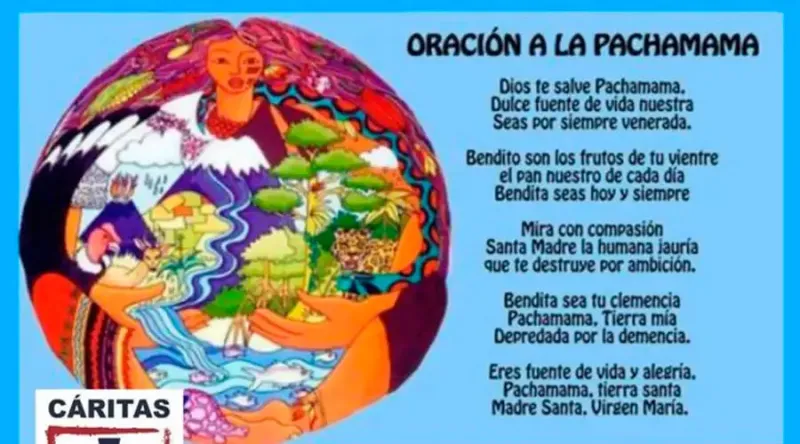
The Prayer to Pachamama posted by Caritas Venado Tuerto.
Venado Tuerto, Argentina, Aug 5, 2021 / 17:49 pm (CNA).
The Diocese of Venado Tuerto’s Caritas branch apologized Tuesday for having posted on its social media a prayer to Pachamama, an Andean deity.
“The pachamama is a symbol of fertility, of the earth and the sacredness of life. It is a myth full of spiritual meaning (that) can be used to advantage,” said the now-deleted Aug. 1 post.
“Some religious festivals have a sacred meaning and are occasions for gathering and fraternity. These are the new paths for the Church and for the achievement of an integral ecology. Holy Father Francis. #somoscaritasarag #caritasvt #equipomagrevenadotueto,” the post said.
The prayer read: “Hail Pachamama, sweet source of our life, may you be forever venerated. Blessed are the fruits of your womb, our daily bread, may you be blessed now and forever. Look with compassion, Holy Mother, upon the human pack that destroys you out of ambition. Blessed be your clemency Pachamama. My land preyed upon by madness. You are the source of life and joy. Pachamama, holy land, Holy Mother, Virgin Mary.”
Pachamama Day is celebrated annually on Aug. 1 in Quechua and Aymara communities in the Andes mountains of Argentina, Bolivia, Colombia, Chile, Ecuador, and Peru in honor of the Andean deity.
The posting of the prayer drew massive pushback on social media, leading to its deletion.
Cáritas Venado Tuerto posted Aug. 3 on Facebook: “We want to apologize to those who felt offended by our post about Pachamama, the intention was to communicate our communion with Francis who in the Apostolic Exhortation Querida Amazonia says to us: ‘It is possible to take up an indigenous symbol in some way, without necessarily considering it as idolatry. A myth charged with spiritual meaning can be used to advantage and not always considered a pagan error. Some religious festivals have a sacred meaning and are occasions for gathering and fraternity, albeit in need of a gradual process of purification or maturation. A missionary of souls will try to discover the legitimate needs and concerns that seek an outlet in at times imperfect, partial or mistaken religious expressions …’ (79). ‘Such a spirituality will certainly be centered on the one God and Lord, while at the same time in contact with the daily needs of people who strive for a dignified life…’ (80)”
The prayer to Pachamama existed before the Amazon synod, held at the Vatican in October 2019.
During the synod carved wooden figures of a pregnant woman were on display in related churches and events. Those figures, referred to by Pope Francis and others as “Pachamama”, were said by some to depict an Andean fertility goddess, while Vatican spokesmen characterized them more vaguely as symbols of “life.”
Two such “Pachamama” figures were eventually taken from a church near the Vatican and thrown into the Tiber, and were later recovered.
Pope Francis issued an apology asking forgiveness from those who were offended by the Pachamama statues being thrown into the Tiber, and said that they had been displayed in the church “without idolatrous intentions.”
Pachamama Day is celebrated annually on Aug. 1 in Quechua and Aymara communities in the Andes mountains of Argentina, Bolivia, Colombia, Chile, Ecuador, and Peru in honor the Andean deity.
If you value the news and views Catholic World Report provides, please consider donating to support our efforts. Your contribution will help us continue to make CWR available to all readers worldwide for free, without a subscription. Thank you for your generosity!
Click here for more information on donating to CWR. Click here to sign up for our newsletter.
A defining theme of Pope Francis’ papacy has been his urging of humanity to better care for the natural environment, which he has done most prominently in his landmark 2015 encyclical Laudato Si’ and numerous subsequent writings and speeches.
The pope’s emphasis on this topic — especially his foray into climate science via his recent encyclical Laudate Deum — has variously drawn both praise and consternation from Catholics in the United States, about half of whom do not share Pope Francis’ views on climate change, according to surveys.
In Laudate Deum, which was released in October as a continuation to Laudato Si’, Francis wrote that the effects of climate change “are here and increasingly evident,” warning of “immensely grave consequences for everyone” if drastic efforts are not made to reduce emissions. In the face of this, the Holy Father criticized those who “have chosen to deride [the] facts” about climate science, stating bluntly that it is “no longer possible to doubt the human — ‘anthropic’ — origin of climate change.”
The pope in the encyclical laid out his belief that there must be a “necessary transition towards clean energy sources, such as wind and solar energy, and the abandonment of fossil fuels.” This follows a call from Pope Francis in 2021 to the global community calling for the world to “achieve net zero carbon emissions as soon as possible.”
He further lamented what he called “certain dismissive and scarcely reasonable opinions [on climate change] that I encounter, even within the Catholic Church.”
In light of the new encyclical — which extensively cites the U.N.’s Intergovernmental Panel on Climate Change (IPCC) — Pope Francis was invited to speak at this week’s United Nations Climate Change Conference, known as COP28. Though the 86-year-old pope was forced to cancel his trip due to health issues, the Vatican has indicated that he aims to participate in COP28 this weekend in some fashion. It announced today that Vatican Secretary of State Cardinal Pietro Parolin will represent the pope at the conference.
While various Catholic groups have welcomed the pope’s latest encyclical, some Catholics have reacted with persistent doubts, questioning whether the pope’s policy prescriptions would actually produce the desired effects.
How do Americans feel about climate change?
According to a major survey conducted by Yale University, 72% of Americans believed in 2021 — the latest available data year — that “global warming is happening,” and 57% believe that global warming is caused by human activity.
More recent polling from the Pew Research Center, conducted in June, similarly suggests that two-thirds of U.S. adults overall say the country should prioritize developing renewable energy sources, such as wind and solar, over the expansion of the production of oil, coal, and natural gas. That same survey found that just 3 in 10 adults (31%) say the U.S. should completely phase out oil, coal, and natural gas. The Yale study found that 77% of U.S. adults support at least the funding of research into renewable energy sources.
Broken down by party affiliation, Pew found that a large majority of Democratic and Democratic-leaning independents — 90% — favor alternative energy sources, while just under half, 42%, of Republicans and Republican-leaning adults think the same. Within the Republican cohort, however, 67% of Republicans under age 30 prioritize the development of alternative energy sources, compared with the 75% of Republicans ages 65 and older who prioritize the expansion of oil, coal, and natural gas.
In terms of the expansion of alternative energy sources, two-thirds of Americans think the federal government should encourage domestic production of wind and solar power, Pew reported. Just 7% say the government should discourage this, while 26% think it should neither encourage nor discourage it.
How do America’s Catholics feel about climate change?
Surveys suggest that Catholics in the United States are slightly more likely than the U.S. population as a whole to be skeptical of climate change, despite the pope’s emphatic words in 2015 and since.
A separate Pew study suggests that 44% of U.S. Catholics say the Earth is warming mostly due to human activity, a view in line with Pope Francis’ stance. About 3 in 10 (29%) said the Earth is warming mostly due to natural patterns, while 13% said they believe there is no solid evidence the planet is getting warmer.
According to the same study, 71% of Hispanic Catholics see climate change as an extremely or very serious problem, compared with 49% of white, non-Hispanic Catholics. (There were not enough Black or Asian Catholics in the 2022 survey to analyze separately, Pew said.)
One 2015 study from Yale did suggest that soon after Laudato Si’ was released, U.S. Catholics were overall more likely to believe in climate change than before. That same study found no change, however, in the number of Americans overall who believe human activity is causing global warming.
Pope Francis’ climate priorities
Beyond his groundbreaking writings, Pope Francis has taken many actions during his pontificate to make his own — admittedly small — country, Vatican City, more sustainable, including the recent announcement of a large order of electric vehicles, construction of its own network of charging stations, a reforestation program, and the continued importation of energy coming exclusively from renewable sources.
Francis has often lamented what he sees as a tepid response from developed countries in implementing measures to curb climate change. In Laudate Deum, he urged that new multinational agreements on climate change — speaking in this case specifically about the COP28 conference — be “drastic, intense, and count on the commitment of all,” stating that “a broad change in the irresponsible lifestyle connected with the Western model would have a significant long-term impact.”
The pope lamented what he sees as the fact that when new projects related to green energy are proposed, the potential for economic growth, employment, and human promotion are thought of first rather than moral considerations such as the effects on the world’s poorest.
“It is often heard also that efforts to mitigate climate change by reducing the use of fossil fuels and developing cleaner energy sources will lead to a reduction in the number of jobs,” the pope noted.
“What is happening is that millions of people are losing their jobs due to different effects of climate change: rising sea levels, droughts, and other phenomena affecting the planet have left many people adrift. Conversely, the transition to renewable forms of energy, properly managed, as well as efforts to adapt to the damage caused by climate change, are capable of generating countless jobs in different sectors.”
‘Leave God’s creation better than we found it’
Dr. Kevin Roberts, president of the Washington, D.C.-based Heritage Foundation think tank, told CNA that he has noticed a theme of frustration and confusion among many Catholics regarding the Holy Father’s emphasis on climate change.
A self-described outdoorsman and former president of Wyoming Catholic College, Roberts spoke highly to CNA of certain aspects of Laudato Si’, particularly the pope’s insights into what he called “human ecology,” which refers to the acceptance of each person’s human body as a vital part of “accepting the entire world as a gift from the Father and our common home.”
Dr. Kevin Roberts, president of the Heritage Foundation. Courtesy of Heritage Foundation.
“I like to think [Pope Francis] personally wrote that, because I could see him saying that,” Roberts said of the passage, which appears in paragraph 155 of the encyclical. Roberts said he even makes a point to meditate on that “beautiful and moving” passage during a retreat that he does annually.
That portion of Laudato Si’ notwithstanding, Roberts said he strongly believes that it detracts from other important issues, such as direct ministry to the poor, when Pope Francis elevates care for God’s natural creation as “seemingly more important than other issues to us as Catholics.” He also said he disagrees with Pope Francis’ policy prescriptions, such as a complete phasing out of fossil fuels, contained in Laudate Deum.
“We of course want to pray for him. We’re open to the teaching that he is providing. But we also have to remember as Catholics that sometimes popes are wrong. And on this issue, it is a prudential matter. It is not a matter of morality, particularly when he’s getting into the scientific policy recommendations,” Roberts said.
Roberts said the Heritage Foundation’s research and advocacy has focused not on high-level, multinational agreements and conferences to tackle the issues posed by climate change but rather on smaller-scale, more community-based efforts. He said this policy position is, in part, due to the historical deference such multinational conglomerates of nations have given to China, the world’s largest emitter of greenhouse gases overall.
He said agreements within the U.S. itself, with businesses and all levels of government working together, have produced the best results so far when it comes to improving the environment. He also pointed to examples of constructive action that don’t involve billions of dollars, such as families making the choice to spend more time outdoors or engaging in local activities that contribute to environmental conservation and community life, such as anti-litter campaigns and community gardening. The overarching goal, he said, should be to “leave God’s creation better than we found it.”
Roberts — who said he personally believes humans likely have “very little effect” on the climate — said he was discouraged to read other portions of Laudato Si’, as well as Laudate Deum, that to him read as though they had come “straight out of the U.N.” Despite his criticisms, Roberts urged his fellow Catholics to continue to pray for the Holy Father and to listen to the pope’s moral insights.
“I just think that the proposed solutions are actually more anti-human and worse than the purported effects of climate change,” he added.
‘A far more complex issue’
Greg Sindelar, a Catholic who serves as CEO of the Texas Public Policy Foundation (TPPF), a conservative think tank that studies the energy industry, similarly expressed concerns to CNA about the potential impact of certain climate change mitigation policies on human flourishing.
Like Roberts, Sindelar spoke highly of certain aspects of the pope’s message while expressing reservations about some of the U.N.-esque solutions proposed in Laudate Deum.
“I think the pope is right about our duty as Catholics to be stewards and to care for the environment. But I think what we have to understand — what we have to balance this with — is that it cannot come at the expense of depriving people of affordable and reliable energy,” Sindelar said in an interview with CNA.
“There’s ways to be environmentally friendly without sacrificing the access that we all need to reliable and affordable energy.”
Greg Sindelar is CEO of the Texas Public Policy Foundation, a think tank in America’s leading energy-producing state. Courtesy of Texas Public Policy Foundation
Sindelar said TPPF primarily promotes cheap, reliable access to energy as a means of promoting human flourishing. The free-market-focused group is skeptical of top-down governmental intervention, both in the form of regulation and incentives or disincentives in certain areas of the energy sector.
When asked what he thinks his fellow Catholics largely think about the issue, Sindelar said many of the Catholics he hears from express the view that government policies and interventions rarely produce effective solutions and could potentially hinder access to energy for those in need.
“I think it’s a far more complex issue than just saying we need to cut emissions, and we need to transfer away from fossil fuels, and all these other things. What we need to do is figure out and ensure ways that we are providing affordable and reliable electricity to all citizens of the world,” he reiterated.
“When the pope speaks, when the Vatican speaks, it carries a lot of weight with Catholics around the world, [and] not just with Catholics … and I totally agree with him that we need to be thinking about the most marginalized and the poorest amongst us,” Sindelar continued.
“[But] by going down these policy prescription paths that he’s recommending, we’re actually going to reduce their ability to have access to that,” he asserted.
Sindelar, while disagreeing with Pope Francis’ call for an “abandonment of fossil fuels,” said he appreciates the fact that Pope Francis has spoken out about the issue of care for creation and has initiated so much public discussion.
“I think there is room for differing views and opinions on the right ways to do that,” he said.
Effective mitigation efforts
Susan Varlamoff, a retired biologist and parishioner at St. John Neumann Catholic Church in the Atlanta area, is among those Catholics who are committed to Pope Francis’ call to care for creation and to mitigate the effects of climate change. To that end, Varlamoff in 2016 created a peer-reviewed action plan for the Archdiocese of Atlanta to help Catholics put the principles contained in Laudato Si’ into action, mainly through smaller, more personal actions that people can take to reduce their energy usage.
Retired biologist Susan Varlamoff. Photo courtesy of Susan Varlamoff
The Atlanta Archdiocese’s efforts have since garnered recognition and praise, Varlamoff said, with at least 35 archdioceses now involved in an inter-diocesan network formed to exchange sustainability ideas based on the latest version of the plan from Atlanta.
“It’s fascinating to see what everybody is doing, and it’s basically based on their talents and imaginations,” Varlamoff said, noting that a large number of young people have gotten involved with their efforts.
As a scientist, Varlamoff told CNA it is clear to her that Pope Francis knows what he’s talking about when he lays out the dangers posed by inaction in the face of climate change.
“He understands the science, and he’s deeply concerned … he’s got remarkable influence as a moral leader,” she said.
“Part of what our religion asks us to do is to care for one another. We have to care for creation if we’re going to care for one another, because the earth is our natural resource system, our life support, and we cannot care for one another if we don’t have that life support.”
Responding to criticisms about the financial costs associated with certain green initiatives, Varlamoff noted that small-scale sustainable actions can actually save money. She offered the example of parishes in the Atlanta area that have drastically reduced their electric bills by installing solar panels.
“[But,] it’s not just about saving money. It’s also about reducing fossil fuels and greenhouse gas emissions, and protecting the natural resources for future generations,” she said.
Moreover, Varlamoff said, the moral imperative to improve the natural environment for future generations is worth the investment. “When [Catholics] give money, for example, for a social justice issue like Walking with Moms in Need or special needs, the payback is improving lives. We’re improving the environment here,” she emphasized.
Pope Francis waves to pilgrims during his March 28, 2018 general audience in St. Peter’s Square. / Daniel Ibáñez/CNA.
Vatican City, Apr 21, 2021 / 09:00 am (CNA).
Pope Francis has sent four ventilators to hospitals in Colombia after the South American country recorded its highest daily death rate since the start of the coronavirus pandemic.
According to the Colombian health ministry, the country reported 420 deaths from COVID-19 in 24 hours April 20. More than 68,700 people have died from COVID-19 in Colombia since February 2020. The country has a population of 50 million people.
The donated ventilators from Pope Francis were also accompanied by boxes of personal protective equipment. The Colombian bishops’ conference said that the apostolic nuncio sent the medical equipment to hospitals in Quibdó, western Colombia.
The equipment was flown into the city with the help of the Colombian Air Force and the Military Ordinariate of Colombia.
Bishop Juan Carlos Barreto Barreto of Quibdó wrote in a note: “This gesture highlights the continuous solicitude of Pope Francis for Colombia in many areas and expresses his concern for all the Churches.”
During the coronavirus outbreak, Pope Francis has donated ventilators and other medical equipment to countries such as Brazil, Spain, and Romania.
In South America, fears are growing over the spread of the P.1 variant of COVID-19, also known as the Brazil variant, which recent research suggests is much more transmissible.
In March, Peru’s health minister said that 40% of cases in the capital city of Lima were caused by the Brazil variant. Cases of the new variant have also been detected in Uruguay, Paraguay, Bolivia, Venezuela, and Argentina.
Washington D.C., Aug 3, 2022 / 19:00 pm (CNA).
The mother of 12-year-old Archie Battersbee said that the family is “at the end” of their efforts to keep their son on life support after the Europea… […]
4 Comments
We read from Apostolic Exhortation Querida Amazonia ‘,,,Such a spirituality will certainly be centered on the one God and Lord, while at the same time in contact with the daily needs of people who strive for a dignified life…’ (80)
A nuanced and possibly good point is made, interculturally, but then again, the real issue is not to be marginalized as simply that of one’s “intentions,” or of others being “offended.” Isn’t the issue one of at least appearing to displace the historical Incarnation—-which is the divinely revealed assurance of truly “a dignified life?”
One parallel to our syncretic times is the 17th- and 18th-century Rites Controversy in China, where the Dominicans were more persuasive than the Jesuits on the nature of ancestor veneration/worship. St. Paul gives an objective clue about pagan trappings and the call for Christians to avoid giving scandal (1 Corinthians 8:4-13). Instead of Pachamama, why not the dignity of Our Lady of Guadalupe?
St. Paul, in his letter to the Romans, made this revelation about discerning the signs of the times:
“Ever since the creation of the world [God’s] invisible nature, namely, his eternal power and deity, has been clearly perceived in the things that have been made. So they are without excuse; for although they knew God they did not honor him as God or give thanks to him, but they became futile in their thinking and their senseless minds were darkened. Claiming to be wise, they became fools, and exchanged the glory of the immortal God for images resembling mortal man or birds or animals or reptiles.
Therefore God gave them up in the lusts of their hearts to impurity, to the dishonoring of their bodies among themselves, because they exchanged the truth about God for a lie and worshiped and served the creature rather than the Creator….
For this reason God gave them up to dishonorable passions. Their women exchanged natural relations for unnatural, and the men likewise gave up natural relations with women and were consumed with passion for one another, men committing shameless acts with men….”
There are ample signs in the Church today that there is an aggressive cult of abusive homosexual Archbishops/Cardinals like McCarrick and abusive coverup Archbishops/Cardinals like Danneels, and Cupich and Joseph Tobin and McElroy etc etc etc, holding the Church hostage by promoting to power men of the homosexual cohort to (that is, men who actively promote homosexual behavior or who live “double lives” in active homosexual behavior) to power everywhere in the Church, as General Secretaries of conferences (“His Excellency” Burrill), seminary formation directors (“Rev.” Park the suddenly resigned director of the North American College in Rome, being sued by US seminarians in the state of New York, after US Bishops governing the NAC persisted in refusing him justice), “special” representatives (“Rev.” Martin) and Papal gatekeepers (“Rev.” Battista Ricca), and governors of financial and real estate holdings (“His” Excellency Zanchetta of Argentina).
Thus, the sudden appearance of signs in “the-new-openly-ruled-Church-of-the-Pontiff-Francis,” that the Pontiff Francis himself will orchestrate idolatry, and the men surrounding him everywhere live and/or promote sexual immorality as a norm of their cult.
The double sign of sexual immorality and idolatry are revealed before our very eyes.
2084 God makes himself known by recalling his all-powerful loving, and liberating action in the history of the one he addresses: “I brought you out of the land of Egypt, out of the house of bondage.” The first word contains the first commandment of the Law: “You shall fear the LORD your God; you shall serve him. . . . You shall not go after other gods.” God’s first call and just demand is that man accept him and worship him.
2085 The one and true God first reveals his glory to Israel.6 The revelation of the vocation and truth of man is linked to the revelation of God. Man’s vocation is to make God manifest by acting in conformity with his creation “in the image and likeness of God”:
There will never be another God, Trypho, and there has been no other since the world began . . . than he who made and ordered the universe. We do not think that our God is different from yours. He is the same who brought your fathers out of Egypt “by his powerful hand and his outstretched arm.” We do not place our hope in some other god, for there is none, but in the same God as you do: the God of Abraham, Isaac and Jacob.
2086 “The first commandment embraces faith, hope, and charity. When we say ‘God’ we confess a constant, unchangeable being, always the same, faithful and just, without any evil. It follows that we must necessarily accept his words and have complete faith in him and acknowledge his authority. He is almighty, merciful, and infinitely beneficent. Who could not place all hope in him? Who could not love him when contemplating the treasures of goodness and love he has poured out on us? Hence the formula God employs in the Scripture at the beginning and end of his commandments: ‘I am the LORD.'”-Catechism of the Catholic Church
The worship of Demon Idols is forbidden by God, and all those who condone, approve and partake in it will answer to Him.
Those clerics, Argentine, Vatican, Mexican [Spanish priest accused of Pachamama monstrance Guadalajara] who have warm feelings for ancient cultural worship as benevolent delude themselves. What they achieve is a rebirth of what Catholicism during the Spanish conquest thankfully ended. Although today we have a revival, Nat Geographic among institutions that present an admiration of this past. Archeologists expressing understanding that Mayans would sacrifice their people, their children to the gods to ensure plentiful crop yields. “Beautiful beyond exaggeration, is how one Spanish chronicler described Tanta Carhua. Carhua was a 10-year old Inca child whose father offered her to the Inca Emperor as a Capacocha sacrifice. She was taken by priests to Cuzco where she met the Inca Emperor. Tanta Carhua was then taken to a high Andean mountain, placed in a shaft-tomb and walled in alive” (Author Liesl Clark Nova). Human sacrifice was practiced by Aztecs and Mayans. Little is known of that practice among Incas. Incas inhabited the Andes and celebrated the goddess of the Andes recently celebrated at the Vatican as culturally and anthropologically germaine. How ironic isn’t it that the oft criticized edicts give by Joshua for the ban on Jericho, God to Saul regards the Amalekites to annihilate the populace, edicts germaine to the times its significance now totally lost even to the point of resurrecting the evil the idolatry practiced by these inhabitants of ancient Israel portends [when becoming permissive in relations with Canaanites Jews began immolating their own children to Baal]. It’s not an exaggeration to consider the Pachamamma enshrinement ceremony prelates and natives dancing singing into Saint Peter’s Basilica into the sanctuary where the sacrifice of the Mass is held is not at least a type of installation of the abomination of desolation. This is where refocus of Catholicism from personal morals to ecology is taking us.
We read from Apostolic Exhortation Querida Amazonia ‘,,,Such a spirituality will certainly be centered on the one God and Lord, while at the same time in contact with the daily needs of people who strive for a dignified life…’ (80)
A nuanced and possibly good point is made, interculturally, but then again, the real issue is not to be marginalized as simply that of one’s “intentions,” or of others being “offended.” Isn’t the issue one of at least appearing to displace the historical Incarnation—-which is the divinely revealed assurance of truly “a dignified life?”
One parallel to our syncretic times is the 17th- and 18th-century Rites Controversy in China, where the Dominicans were more persuasive than the Jesuits on the nature of ancestor veneration/worship. St. Paul gives an objective clue about pagan trappings and the call for Christians to avoid giving scandal (1 Corinthians 8:4-13). Instead of Pachamama, why not the dignity of Our Lady of Guadalupe?
As always, we live in interesting times.
St. Paul, in his letter to the Romans, made this revelation about discerning the signs of the times:
“Ever since the creation of the world [God’s] invisible nature, namely, his eternal power and deity, has been clearly perceived in the things that have been made. So they are without excuse; for although they knew God they did not honor him as God or give thanks to him, but they became futile in their thinking and their senseless minds were darkened. Claiming to be wise, they became fools, and exchanged the glory of the immortal God for images resembling mortal man or birds or animals or reptiles.
Therefore God gave them up in the lusts of their hearts to impurity, to the dishonoring of their bodies among themselves, because they exchanged the truth about God for a lie and worshiped and served the creature rather than the Creator….
For this reason God gave them up to dishonorable passions. Their women exchanged natural relations for unnatural, and the men likewise gave up natural relations with women and were consumed with passion for one another, men committing shameless acts with men….”
There are ample signs in the Church today that there is an aggressive cult of abusive homosexual Archbishops/Cardinals like McCarrick and abusive coverup Archbishops/Cardinals like Danneels, and Cupich and Joseph Tobin and McElroy etc etc etc, holding the Church hostage by promoting to power men of the homosexual cohort to (that is, men who actively promote homosexual behavior or who live “double lives” in active homosexual behavior) to power everywhere in the Church, as General Secretaries of conferences (“His Excellency” Burrill), seminary formation directors (“Rev.” Park the suddenly resigned director of the North American College in Rome, being sued by US seminarians in the state of New York, after US Bishops governing the NAC persisted in refusing him justice), “special” representatives (“Rev.” Martin) and Papal gatekeepers (“Rev.” Battista Ricca), and governors of financial and real estate holdings (“His” Excellency Zanchetta of Argentina).
Thus, the sudden appearance of signs in “the-new-openly-ruled-Church-of-the-Pontiff-Francis,” that the Pontiff Francis himself will orchestrate idolatry, and the men surrounding him everywhere live and/or promote sexual immorality as a norm of their cult.
The double sign of sexual immorality and idolatry are revealed before our very eyes.
2084 God makes himself known by recalling his all-powerful loving, and liberating action in the history of the one he addresses: “I brought you out of the land of Egypt, out of the house of bondage.” The first word contains the first commandment of the Law: “You shall fear the LORD your God; you shall serve him. . . . You shall not go after other gods.” God’s first call and just demand is that man accept him and worship him.
2085 The one and true God first reveals his glory to Israel.6 The revelation of the vocation and truth of man is linked to the revelation of God. Man’s vocation is to make God manifest by acting in conformity with his creation “in the image and likeness of God”:
There will never be another God, Trypho, and there has been no other since the world began . . . than he who made and ordered the universe. We do not think that our God is different from yours. He is the same who brought your fathers out of Egypt “by his powerful hand and his outstretched arm.” We do not place our hope in some other god, for there is none, but in the same God as you do: the God of Abraham, Isaac and Jacob.
2086 “The first commandment embraces faith, hope, and charity. When we say ‘God’ we confess a constant, unchangeable being, always the same, faithful and just, without any evil. It follows that we must necessarily accept his words and have complete faith in him and acknowledge his authority. He is almighty, merciful, and infinitely beneficent. Who could not place all hope in him? Who could not love him when contemplating the treasures of goodness and love he has poured out on us? Hence the formula God employs in the Scripture at the beginning and end of his commandments: ‘I am the LORD.'”-Catechism of the Catholic Church
The worship of Demon Idols is forbidden by God, and all those who condone, approve and partake in it will answer to Him.
Those clerics, Argentine, Vatican, Mexican [Spanish priest accused of Pachamama monstrance Guadalajara] who have warm feelings for ancient cultural worship as benevolent delude themselves. What they achieve is a rebirth of what Catholicism during the Spanish conquest thankfully ended. Although today we have a revival, Nat Geographic among institutions that present an admiration of this past. Archeologists expressing understanding that Mayans would sacrifice their people, their children to the gods to ensure plentiful crop yields. “Beautiful beyond exaggeration, is how one Spanish chronicler described Tanta Carhua. Carhua was a 10-year old Inca child whose father offered her to the Inca Emperor as a Capacocha sacrifice. She was taken by priests to Cuzco where she met the Inca Emperor. Tanta Carhua was then taken to a high Andean mountain, placed in a shaft-tomb and walled in alive” (Author Liesl Clark Nova). Human sacrifice was practiced by Aztecs and Mayans. Little is known of that practice among Incas. Incas inhabited the Andes and celebrated the goddess of the Andes recently celebrated at the Vatican as culturally and anthropologically germaine. How ironic isn’t it that the oft criticized edicts give by Joshua for the ban on Jericho, God to Saul regards the Amalekites to annihilate the populace, edicts germaine to the times its significance now totally lost even to the point of resurrecting the evil the idolatry practiced by these inhabitants of ancient Israel portends [when becoming permissive in relations with Canaanites Jews began immolating their own children to Baal]. It’s not an exaggeration to consider the Pachamamma enshrinement ceremony prelates and natives dancing singing into Saint Peter’s Basilica into the sanctuary where the sacrifice of the Mass is held is not at least a type of installation of the abomination of desolation. This is where refocus of Catholicism from personal morals to ecology is taking us.
