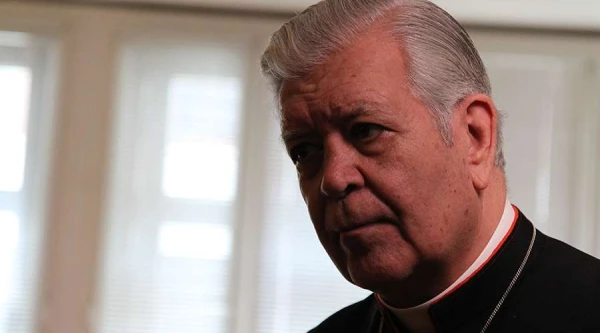
CNA Staff, Apr 29, 2020 / 04:30 pm (CNA).- Venezuela’s prolonged social, political and economic crisis has only been compounded by the coronavirus pandemic, the archbishop emeritus of Caracas, Cardinal Jorge Urosa Savino, charged Tuesday.
Even before the coronavirus pandemic, Venezuela has been marred by violence and social upheaval under the socialist administration of Nicolas Maduro, with severe shortages of food and medicine, high unemployment, power outages, and hyperinflation. Some 4.5 million Venezuelans have emigrated since 2015.
In response to the threat of the virus, the government imposed a nationwide stay at home order March 17. According to government statistics, to date there have been 329 cases of COVID-19 with ten deaths. The country is ill prepared to handle the crisis, with chronic shortages of medical supplies, and many doctors have left the country.
“The national reality is terrible,” and the government has no answers, Urosa said in an April 28 statement to ACI Prensa, CNA’s Spanish-language news partner.
While the cardinal acknowledged the lockdown has prevented the spread of the virus, he pointed out that “the quarantine has hurt a great many people because the economic, social and logistical conditions in the country weren’t taken into account,” including “the extremely serious problem of the gasoline shortage for transport, especially for food.”
In some cases, crops are rotting in farmers’ fields due to lack of fuel to transport them to market.
Especially hard hit, the cardinal said, are “informal” workers who are paid off the books, and who are now “barely surviving,” and only with “the help of family members, social organizations and the Church.”
On April 25, Venezuelan vice president Delcy Rodríguez announced state intervention and oversight of several food supply companies in order to control the prices of 27 products for 180 days.
Urosa criticized the intervention, calling it “an extremely serious mistake, since it will probably result in greater shortages. Price controls are acceptable, but intervening in efficient businesses is not. The government can’t even manage to supply gasoline.” “The state-run petroleum industry has collapsed, and now Venezuelans’ food is in danger!”
“The current government doesn’t have any answers for such elementary things such as the extremely serious problem of the gasoline shortage” and runaway inflation. “In the last 40 days, the dollar has doubled in value, which is undoubtedly the fundamental cause of the spike in prices,” the cardinal said.
Urosa decried political persecution, which “has gotten worse since March because amid the quarantine, the government has ramped up the repression. During these weeks the government has jailed, even without due process, many political activists, especially from the inner circle of Juan Guaidó, president of the National Assembly and leader of the Venezuelan opposition.”
Guaidó declared himself the nation’s interim leader Jan. 23 last year following Maduro’s inauguration for a second term. Maduro won a May 2018 presidential election, which was boycotted by the opposition and has been rejected by much of the international community. The United States was swift to recognize Guaidó as interim president, eventually followed by over 60 countries. Both the National Assembly and the Venezuelan bishops’ conference declared Maduro’s reelection to be invalid.
With the military firmly in support of Maduro, however, opposition protests calling for his resignation have failed to oust the leader.
On March 30, Guaidó charged that the Maduro regime had unleashed a new wave of harassment against his close collaborators. Andrea Bianchi, the wife of close associate Rafael Rico, was kidnapped, beaten and then left naked on a highway. Two others, Rómulo García and Víctor Silio were also picked up and later charged with possession of marijuana and a handgun.
The NGO Venezuelan Program for Education-Action in Human Rights reported that during the state of emergency, 34 people have been arbitrarily arrested and attacks against politicians, journalists and healthcare workers have increased.
“The bishops have always strongly criticized the political repression by the government and once again I call for the release of all political prisoners. They are even in greater physical danger because of the pandemic situation we’re going through,” Urosa stressed.
On March 26, “the Trump administration unsealed sweeping indictments against Venezuelan President Nicolás Maduro and members of his inner circle on narcoterrorism charges, a dramatic escalation in the U.S. campaign to force the authoritarian socialist from power,” even offering “a $15 million reward for information leading to his capture or conviction,” the Washington Post reported. time.
In response, the Maduro regime activated a plan against the Venezuelan opposition called “Operation Bolivarian Fury.”
The archbishop emeritus denounced these recent “threats of violence by the government against Venezuelans. Maduro himself has spoken of a supposed ‘Bolivarian fury’ as a threat against members of the Venezuelan opposition in case of international problems. That’s illegal, unconstitutional and unacceptable from every point of view. That threat of violence is intolerable.”
The cardinal said the government has used the quarantine simply as an opportunity to strengthen its social and political control.
On April 25, the Maduro regime placed shipping containers on the Caracas-La Guaira highway to prevent demonstrators from other cities who have been protesting the shortages of food, water and electricity in other cities from getting to the capital.
“Why restrict the right to free transit?” the cardinal asked.
The Maduro regime also blocked the highway in February 2019 to prevent humanitarian aid from entering the country from Colombia.
Guaidó charged April 24 on Twitter that “a dictatorship of corrupt and incapable people has brought us to a crisis where farmers are losing their crops while families are starving to death in the barrios. They turned the richest country in the region into a hell. They’ll leave here, the sacrifice has been enough already.”
As signs of hope, Urosa pointed to ongoing work of Caritas Venezuela and the creative ways the clergy has reached out to the faithful through social media. “Our message is one of encouragement, trust in God, solidarity and hope in this dark hour,” he said.
Catholics “have an unshakeable faith in God who is love,” who had died and risen and “has shown us the merciful face of God.” “We’ll come out of this,” the archbishop said, “the suffering we are experiencing has united us closer to God and opens to us the gates of heaven.”
The archbishop encouraged Venezuelans to always stand in solidarity with each other and “to be the face of God to those in need. God is love and is with us. Let us join ourselves to him and the Blessed Virgin Mary, Mother of Mercy in this painful hour.”
A version of this story was first published by ACI Prensa, CNA’s Spanish-language news partner. It has been adapted by CNA.
 […]
[…]


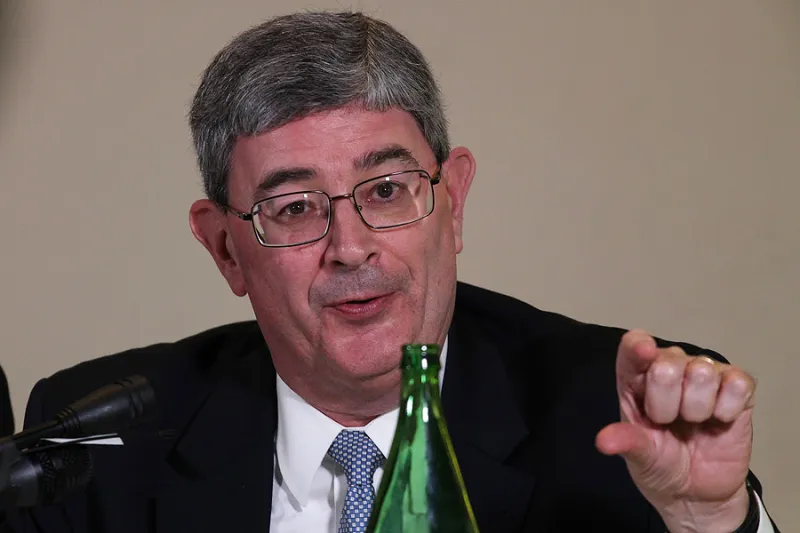

Although Traditionis custodes, the defense of tradition that eliminates tradition will have some effect on the next papal election, it may not be as George Weigel purports, that “This has not gone over well throughout the world Church, and that fact will have a marked effect on the next papal election.” Yes it has not gone over well with many. But not all. Presently according to Vaticanista Sandro Magister the papabile candidates are distancing themselves from His Holiness. And many of the top candidates are appointees made cardinals by Francis. And as logic follows most are of the same mindset. Why the distance? Because it’s a matter of self image and positioning oneself for the prize, rather than loyalty. Sure, it may seem cynical, however it is really a matter of realism. I haven’t looked at Edward Pentin’s list of candidates and likely will not unless an article appears that feature’s Pentin’s book. Needless to say but I’ll say it, I hope this time the electors desist from illegal canvassing [an allegation perhaps proved by admission of Austen Ivereigh in his 1st edition of the Great Reformer that he immediately discontinued and redacted in his 2nd edition when he realized his gaff], that the election is impeccably honest, canonical, and, not to imply the last election wasn’t that the electors follow the inspiration of the Holy Spirit. That the best man may win.
As you surely recall, here so far, at least, is CWR commentary from Ross Douthat on Pentin’s (editor, with prudently anonymous contributors) then-forthcoming “The Next Pope” (2020, a thorough 691 pages). A side-by-side and very detailed and unusually attractive work. Well worth the read, especially by all of the members of the next conclave. https://www.catholicworldreport.com/?s=the+next+pope+pentin
In alphabetical order, the nineteen profiles are on: Bagnasco, Burke, Duka, Eijk, Erdo, Muller, Napier, O’Malley, Ouellet, Parolin, Piadcenza, Rahjith, Ravasi, Sarah, Schonborn, Scola, Tagle, Turkson, and Zuppi.