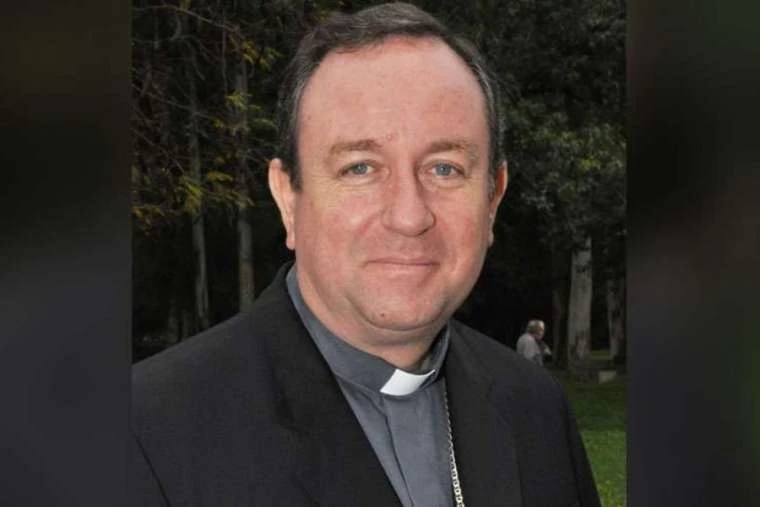
Bishop Gustavo Zanchetta is no longer working as an assessor at the Vatican’s Administration of the Patrimony of the Holy See (APSA).
According to a source working at APSA, the Argentine bishop finished his service at the Vatican’s central reserve bank around 10 or more days ago.
The source did not know where Zanchetta is now, but speculated that he may be in Argentina, where he is facing charges of sexual and financial misconduct.
CNA requested comment from the Holy See press office but, at the time of publication, had not received a response.
Zanchetta, the 57-year-old former bishop of Orán, Argentina, has been accused of “aggravated continuous sexual abuse” of two adult-aged seminarians, as well as fraud and mismanagement of funds. He denies the charges.
The accused bishop was suspended from his role as an assessor at APSA amid a canonical investigation, announced in January 2019.
In June 2020, the Vatican confirmed that Zanchetta had returned to work at APSA while “remaining available to the Argentine judicial authorities.”
APSA oversees the Vatican’s real estate holdings and other sovereign assets.
Zanchetta was one of Pope Francis’ first episcopal appointments in Argentina, where he led the Diocese of Orán from July 2013 to 2017.
After being allowed to resign as Bishop of Orán for “health reasons” in 2017, Zanchetta was appointed by Pope Francis to the specially created position of assessor at APSA.
Argentine media have since reported that the bishop was first accused of sexually inappropriate behavior as early as 2015.
According to a report from El Tribuno, one of Zanchetta’s secretaries alerted authorities after accidentally finding sexually explicit images sent and received on Zanchetta’s cell phone in 2015. The complaint said that some of the images depicted “young people” having sex, in addition to lewd images of Zanchetta himself.
Pope Francis summoned Zanchetta to Rome for five days in October 2015. The bishop claimed his phone and computer had been hacked, and that the accusations were motivated by ill-feeling towards the pope. Francis reportedly accepted the bishop’s explanation that his cell phone had been hacked, and took no further action.
The Vatican has repeatedly denied having prior knowledge of sexual abuse allegations against Zanchetta before his December 2017 appointment to a Vatican office.
After Zanchetta was charged with assaulting two seminarians in June 2019, Orán’s Economic Crime Unit raided offices in the chancery in November 2019. The raid was carried out to investigate Zanchetta’s alleged fraud against the state, according to the newspaper El Oranense.
In addition to accusations of mismanaging Church funds donated by the faithful in the diocese, public records show that Zanchetta received more than 1 million Argentine pesos (around $10,500) from Salta Province to restore a rectory and for lectures at the seminary, which reportedly never occurred.
Spanish priest Fr. Javier Belda Iniesta, who was seen alongside Zanchetta during his trial in Argentina, confirmed in November 2019 that the bishop was still living in Casa Santa Marta, where he had resided for two years, in Vatican City.
According to the Spanish newspaper La Verdad, Belda Iniesta was dismissed from his position as dean of the faculty of humanities and religious sciences at the Catholic University of St. Anthony of Murcia (UCAM) in May after it was discovered that he was unable to provide proof of two degrees listed on his curriculum vitae.
According to media reports, Zanchetta was granted Vatican citizenship in 2018.
If you value the news and views Catholic World Report provides, please consider donating to support our efforts. Your contribution will help us continue to make CWR available to all readers worldwide for free, without a subscription. Thank you for your generosity!
Click here for more information on donating to CWR. Click here to sign up for our newsletter.
Metropolitan Job, the Eastern Orthodox bishop of Pisidia and the permanent representative of the Ecumenical Patriarchate to the World Council of Churches, speaks to delegates of the Synod on Synodality on Oct. 9, 2023, at the Vatican’s Paul VI Hall. He is attending the Synod on Synodality as a fraternal delegate. / Credit: Screenshot of Vatican Media livestream
Rome Newsroom, Oct 9, 2023 / 11:12 am (CNA).
Speaking to the Synod on Synodality on Monday, an Eastern Orthodox bishop said the definition of synodality of the October assembly “differs greatly” from the Orthodox understanding.
Metropolitan Job of Pisidia referenced the first ecumenical council, the Council of Nicea in 325, and quoted from the Apostolic Canons, a fourth-century Christian text on the government and discipline of the early Christian Church.
Drawing from this text, he said, “a synod is a deliberative meeting of bishops, not a consultative clergy-laity assembly.”
“In light of this, we could say that the understanding of synodality in the Orthodox Church differs greatly from the definition of synodality given by your present assembly of the Synod of Bishops,” he added. The current synod now underway at the Vatican is the first of its kind to include laypeople as full voting members.
Metropolitan Job, the Eastern Orthodox bishop of Pisidia and the permanent representative of the Ecumenical Patriarchate to the World Council of Churches, is attending the Synod on Synodality as a fraternal delegate.
Fraternal delegates are non-Catholic representatives of Christian Churches. They participate in the synod assembly without the right to vote.
Job was one of four participants to give short speeches during the general congregation held on the morning of Oct. 9.
The metropolitan said he was grateful to be representing the Orthodox Church at the Synod of Bishops and to be able “to bear witness to the practice of synodality in the Orthodox Church.”
He quoted Apostolic Canon 34, reading that: “The bishops of the people of a province or region [ethnos] must recognize the one who is first [protos] amongst them, and consider him to be their head [kephale], and not do anything important without his consent [gnome]; each bishop may only do what concerns his own diocese [paroikia] and its dependent territories. But the first [protos] cannot do anything without the consent of all. For in this way concord [homonoia] will prevail, and God will be praised through the Lord in the Holy Spirit.”
The Eastern Orthodox bishop then said the following four points, “in light of this text”:
“A synod is a deliberative meeting of bishops, not a consultative clergy-laity assembly.”
“There cannot be a synod without a primate/protos, and there cannot be a primate/protos without a synod.”
“The primate/protos is part of the synod; he does not have superior authority to the synod, nor is he excluded from it.”
“The concord/homonoia which is expressed through the synodal consensus reflects the Trinitarian mystery of the divine life.”
“It is through this practice of synodality, as described by the Apostolic Canons and the canons of the First Ecumenical Council, that the Orthodox Church has been administered over the centuries until the present day, although the frequency and constitution of the synods may vary from one local autocephalous Church to another,” he said.
Job went on to admit that there have been “certain historical circumstances” in which the Orthodox Church has diverged from this formula, including the involvement of the laity in synodal decision-making on several specific occasions, which he listed.
Another exception, he said, is in the Church of Cyprus, where laity are involved in the first stage of the election of bishops.
“Nevertheless, the case of the Church of Cyprus constitutes an exceptional case in contemporary Orthodoxy, where, otherwise, the practice of synodality implies exclusively an assembly of bishops,” he said, noting that during a synod of the Orthodox Church in Crete in 2016, the 62 advisers made up of clergy, monks, and laity did not have the right to speak or vote.
Job’s presentation and those by the three other participants followed a speech by Cardinal Jean-Claude Hollerich introducing the synod’s next round of discussions.
The morning also included a spiritual reflection from Father Timothy Radcliffe, OP, and a theological reflection from British theologian Anna Rowlands.
An artist’s rendering of the affordable apartment complex soon to be built by Our Lady Queen of Angels Housing alliance in Los Angeles. / Courtesy of Our Lady Queen of Angels Housing alliance
St. Louis, Mo., Aug 26, 2024 / 06:30 am (CNA).
Los Angeles is one of the most expensive cities in the United States, with an average home price almost touching a million dollars in 2024 — a landscape that crowds out not only the poor, but also young families with children. The high cost of housing is one of the primary reasons why tens of thousands of people live on the streets of LA, and most of those who are housed are “rent burdened,” which means they spend more than 30% of their income just keeping a roof over their heads.
In the face of such challenges, the Archdiocese of Los Angeles recently announced it will provide land for a new housing development dedicated to serving community college students and young people exiting the foster care system.
Amy Anderson, executive director of Our Lady Queen of Angels Housing alliance and a former chief of housing for the City of Los Angeles, told EWTN News that a group of Catholic lay leaders from the business and philanthropic community reached out to the archdiocese with a vision for creating an independent, nonprofit affordable housing development organization.
“Our vision is to really collaborate with the archdiocese and [use] the resources potentially available from the archdiocese to create homes that are affordable to a wide range of populations and incomes,” Anderson told “EWTN News Nightly” anchor Tracy Sabol.
She said they hope to break ground on the project, known as the Willowbrook development, “about a year from now.”
“The archdiocese is a fantastic partner. They are providing the land for our first development, which is already in process, and we’re working really closely with them to identify additional opportunities.”
The proposed building, which will be located steps from Los Angeles Community College, will feature 74 affordable housing units, as well as “on-site supportive services” for young people transitioning out of foster care — a population that often ends up experiencing homelessness.
The land, located at 4665 Willow Brook Ave just a few miles from the Hollywood Sign, currently hosts a Catholic Charities building, which will move its operations to another site to make way for the apartments.
“Through Catholic Charities and our ministries on Skid Row [an LA street where many unhoused people live] and elsewhere, we have been working for many years to provide shelter and services for our homeless brothers and sisters,” Archbishop Jose Gomez said in a statement to LAist.
“With this new initiative we see exciting possibilities to make more affordable housing available, especially for families and young people.”
Making land work for mission
The Catholic Church is often cited as the largest non-governmental owner of land in the entire world, with an estimated 177 million acres owned by Catholic entities.
Maddy Johnson, program manager for the Church Properties Initiative at the University of Notre Dame’s Fitzgerald Institute for Real Estate (FIRE), noted that the Church as a large landowner is not a new phenomenon, but there is a need today to adapt to modern challenges like regulations, zoning, and the importance of caring for the natural environment.
Many Catholic dioceses and religious orders have properties in their possession that aren’t fulfilling their original purpose, including disused natural land and parking lots, as well as shuttered convents and schools. Sometimes, Johnson said, a diocese or religious order doesn’t even realize the full extent of what they own.
“How can the Church make good strategic decisions, strategic and mission-aligned decisions, if it doesn’t know what properties it’s responsible for?” she said.
The Church of St. Agatha and St. James in Philadelphia, with The Chestnut in the foreground, a housing unit developed on property ground-leased from the church. Courtesy of Maddy Johnson/Church Properties Initiative
Since real estate management is not the Church’s core competency, FIRE aims to “provide a space for peer learning” to educate and equip Church leaders to make better use of their properties in service of the Church’s mission.
To this end, they offer an undergraduate minor at Notre Dame that aims to teach students how to help the Church make strategic real estate decisions that align with the Church’s mission. The Institute also organizes a quarterly networking call with diocesan real estate directors, as well as an annual conference to allow Catholic leaders to convene, share best practices, and learn from each other.
Fr. Patrick Reidy, C.S.C., a professor at Notre Dame Law School and faculty co-director of the Church Properties Initiative, conducts a workshop for diocesan leaders on Notre Dame’s campus in summer 2023. Courtesy of David J. Murphy/Church Properties Initiative
In many cases, Catholic entities that have worked with FIRE have been able to repurpose properties in a way that not only provides income for the church, but also fills a need in the community.
Johnson said the Church is called to respond to the modern problems society faces — one of which is a lack of housing options, especially for the poor.
“Throughout its history, there have been so many different iterations of how the Church expresses its mission…through education, healthcare — those are the ones that we’ve gotten really used to,” Johnson said.
“In our day and age, could it be the need for affordable housing?…that’s a charitable human need in the area that’s not being met.”
Unlocking potential in California
Queen of Angels Housing’s first development, which has been in the works for several years, is being made possible now by a newly-passed state law in California that aims to make it easier for churches to repurpose their land into housing.
California’s SB 4, the Affordable Housing on Faith Lands Act, was signed into law in October 2023. It streamlines some of the trickiest parts of the process of turning church-owned land into housing — the parts most people don’t really think about. These can include permitting and zoning restrictions, which restrict the types of buildings that can be built in a given area and can be difficult and time-consuming to overcome. SB 4 even includes a provision allowing for denser housing on church-owned property than the zoning ordinances would normally allow.
Yes in God’s Backyard
The law coming to fruition in California is part of a larger movement informally dubbed “Yes in God’s Backyard,” or YIGBY — a riff on the term “Not in My Backyard” (NIMBY), a phenomenon whereby neighbors take issue with and oppose new developments.
Several Catholic real estate professionals with ties to California expressed excitement about the possibilities that SB 4 has created in the Golden State.
Steve Cameron, a Catholic real estate developer in Orange County, told CNA that he is currently working with the Diocese of Orange, which abuts the LA archdiocese, to inventory properties that could be repurposed for residential use.
He said their focus is on building apartment buildings and townhomes, primarily for rental rather than for sale, in an attempt to address the severe housing shortage and high costs in Southern California.
Unlike some dioceses, the Orange diocese has an electronic GIS (geographic information system) database showing all the properties it owns. Prepared by a civil engineering firm, the database includes details such as parcel numbers, acreage, title information, and demographic reports, which facilitate the planning and development process.
“Strategically, what we’re doing is we’re inventorying all of the property that the diocese and the parishes own, and trying to understand where there might be underutilized property that would make sense to develop some residential use,” Cameron said.
Cameron said he can’t yet share details about the housing projects they’re working on, but said they are looking to the Archdiocese of Los Angeles and the Queen of Angels housing project as a model for how to take advantage of the new incentives created by SB 4.
“I think it’s great, and it’s exciting that they’re taking the lead and that they are able to find an opportunistic way to repurpose an underutilized property to meet the housing shortage in California,” he said.
“[We] look at them as a role model for what we’re trying to accomplish here in the Diocese of Orange.”
Holy Name Cathedral in Chicago with One Chicago Square in the background, a residential tower constructed on the former cathedral parking lot, which was sold in 2019. Courtesy of Maddy Johnson/Church Properties Initiative
John Meyer, a former president of the California-based Napa Institute who now works in real estate with J2 Development, emphasized the importance of viewing the Church’s vast real estate holdings as an asset rather than a liability.
Meyer said he is currently working with two Catholic entities on the East Coast on ground lease projects, one of which will fund the construction of a new Catholic Student Center at a university. He told CNA he often advises Catholic entities to lease the land they own rather than selling it, allowing the church to maintain ownership of the property while generating income.
Naturally, he noted, any real estate project the Church undertakes ought to align with the Church’s mission of spreading the Gospel, and not merely be a means of making money.
“Any time we look at the Church’s real estate decisions, it’s got to be intertwined with mission and values,” he said.
“We’re not just developing for the sake of developing. What we want to do is we want to create value for the Church, and we also want to create value for the community. So working closely with the municipality to make sure that needs are met, and to be a good neighbor, is important.”
He said Church leaders should strongly consider taking advantage of incentives in various states such as California for projects like affordable housing, which align with the Church’s mission and provide both social and financial benefits.
“Priests and bishops aren’t ordained to do these things, and sometimes they have people in their diocese that have these abilities, and sometimes they don’t,” Meyer said.
“This [new law] in California has created an incentive that we can take advantage of, so we need to take advantage of that incentive…it’s allowing us to unlock potential value in land while at the same time serving a social good that’s part of the mission of the Church.”
Leave a Reply