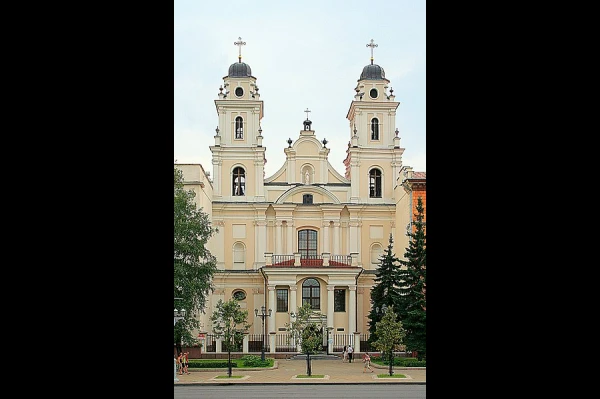
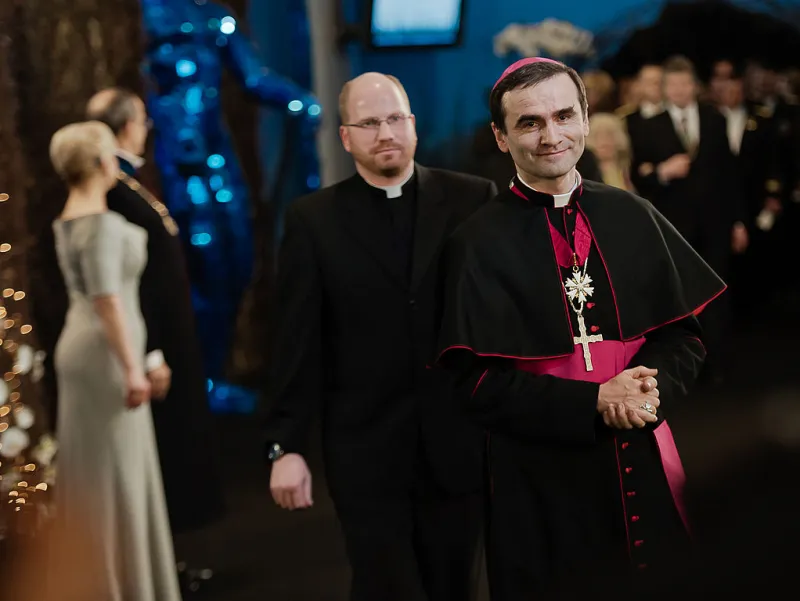
Bishop Philippe Jourdan, Apostolic Administrator of Estonia. Credit: Rene Riisalu via Wikimedia (CC BY-SA 3.0)
Tallinn, Estonia, Jun 15, 2021 / 17:01 pm (CNA).
The only bishop in Estonia is making history.
Bishop Philippe Jourdan leads the Catholic Church in Estonia, which is considered the least religious country in Europe. Nestled between Russia and Latvia, the small country boasts a population of just over 1 million. Of that, an estimated 6,000 citizens – roughly 0.6% of the population – identify as Catholic.
That’s because religion almost disappeared from Estonia while under Soviet rule in the 1940s. Still, Catholic leaders are anticipating change for Estonia – change sparked by Pope Francis’ visit to the country in 2018. Bishop Jourdan, the apostolic administrator of Estonia, emphasized the importance of the papal visit.
Pope Francis has a “special talent to touch the heart also of people who are very far away,” he told EWTN News In Depth on June 11.
“For many people – for the average Estonian – now let’s say that the Catholic Church, especially the pope, is something nearer,” he said.
Bishop Jourdan is a part of the country’s change and hope for the Church in Estonia. Born in Dax, France, he expressed interest in both science and the faith growing up. That led him to study civil engineering as a college student. Faith and science, he said, complement one another.
“I was never afraid to confront science with the light of faith or faith with the light of science,” he said. “Science now strengthens, really, our faith because it helps us to discover, to be more amazed in front of the reality.”
But even as he studied science, he encountered a “feeling of having a vocation, a supernatural vocation” and the “internal conviction that God is asking something else from me.”
It was a conviction that he followed. After graduating, he was offered a job at IBM. He turned it down.
“They were very surprised that somebody is saying ‘no,’” he remembered. “After that, I went to Rome to study.”
He was ordained a priest of Opus Dei in 1988, and, in the 1990s he went to Estonia. The apostolic nuncio there requested his help because of his proficiency in both English and Russian.
Before long, he attracted the attention of the Vatican. In 2005 he was appointed apostolic administrator of Estonia, and consecrated a bishop.
“I must say that I’m very lucky because God protected me in many, many ways,” Bishop Jourdan said. He also felt a “sense of responsibility,” expressing that the “Holy Spirit helps you for what you are chosen to do.”
He was chosen, he said, to build bridges.
When he celebrated his first Mass after ordination, he remembered his fellow priests telling him, “Philippe, before you were [a] builder of bridges, bridges between earth and earth.” But now, they said, he would be a builder “between earth and heaven.”
If you value the news and views Catholic World Report provides, please consider donating to support our efforts. Your contribution will help us continue to make CWR available to all readers worldwide for free, without a subscription. Thank you for your generosity!
Click here for more information on donating to CWR. Click here to sign up for our newsletter.
London, England, Sep 14, 2017 / 12:01 am (CNA/EWTN News).- It’s a tough time for Catholics in public life, and not just in the United States.
Last week, Sen. Dianne Feinstein (D-Calif.) grilled Catholic lawyer Amy Coney Barrett on her religious views during a hearing for her nomination as a federal circuit court judge, in a line of questioning that “smacks of the worst sort of anti-Catholic bigotry,” theologian Dr. Chad Pecknold told CNA Sept. 6.
Across the pond, a Catholic member of Parliament in the U.K. faced his own round of hostile questions, during an interview on the morning show Good Morning Britain.
After a brief question about immigration and Brexit, hosts Piers Morgan and Susanna Reid vigorously interrogated Conservative MP Jacob Rees-Mogg on his views on same-sex marriage and abortion, both of which are legal in the U.K. The MP is seen by some as a potential Conservative Party leader and even a possible future prime minister.
When repeatedly asked about his views on same-sex marriage, Rees-Mogg responded that he supports the teaching of the Catholic Church, and that the teaching is “completely clear.”
Continually grilled about both this issue and then about abortion, Rees-Mogg noted that while he opposes same-sex marriage and abortion on moral grounds, he equally follows the teaching of the Church not to judge others. He also noted that the laws of the land will not change due to his religious beliefs, because liberal Democrats comprise Parliament’s majority.
“None of these issues are party-political, they are issues that are decided by Parliament on free votes,” Rees-Mogg said. “They are not determined by the Prime Minister, there’s no question of these laws being changed. There would not be a majority in the House of Commons for that.”
Morgan then asks Rees-Mogg if the people could accept a leader with Catholic religious views.
“I think the Conservatives are much more tolerant of religious faith, and so they should be,” Rees-Mogg said.
“It’s all very well to say we live in a multicultural country, until you’re a Christian, until you hold the traditional views of the Catholic Church,” he added. “And that seems to be fundamentally wrong. People are entitled to hold these views, but also the Democratic majority is entitled to have the laws of the land as they are, which do not go with the teaching of the Catholic Church and will not go with the teaching of the Catholic Church.”
Numerous Catholic leaders applauded the British MP’s public witness to his faith.
“Well done Jacob Rees-Mogg! Thank you so much for standing up for Catholics and clearly yet gently proclaiming the teaching of Christ,” tweeted Bishop Philip Egan of Portsmouth.
Luke Coppen, editor of the Catholic Herald, told CNA in e-mail comments that this is not the first time Catholic politicians in the UK have experience such antagonism.
“Hostility towards Catholicism is nothing new in Britain. Indeed, it is nothing now compared to what it was in the Elizabethan era,” during which it was illegal – and often fatal – to be Catholic, Coppen noted.
Rather than being frightened by the friction that faith and politics sometimes bring, faithful Catholics should continue to serve in the public sphere, Coppen said.
“They are an example to us: we should always seek to serve the wider society because our faith obliges us to,” he said.
Some have even compared Rees-Mogg’s witness to that of St. Thomas More, who opposed King Henry VIII’s remarriage after failing to secure a decree of nullity, and his ploy to break from Rome and become the leader of the Church of England. His faithfulness to the Church cost him his life, and St. Thomas More is often invoked as a patron saint of religious freedom.
“In this week’s magazine we have a headline describing Rees-Mogg as ‘the Thomas More of breakfast television,’” Coppen said.
“That’s tongue in cheek, of course, because he was very brave. But he’s unlikely to be executed,” he noted, though Catholics in public life “may no longer receive invitations to certain dinner parties.”
Bishop Mark Davies of Shrewsbury also praised Rees-Mogg’s remarks, and also encouraged Catholics to continue to be active, faithful participants in the public sphere.
“…beyond the immediate furore I am sure public figures like Jacob Rees-Mogg will ultimately be respected for their courage and integrity,” he told CNA.
“I am sure we need to see greater Christian witness in political life rather than a withdrawal of faithful Catholics from the public square and from the public debates of our time. The challenge faced by Christians today allows us to see more clearly why Saint Thomas More was made a patron saint for statesmen.”
Michelangelo’s The Creation of Eve, from the Sistine Chapel ceiling, c. 1510. / null
Denver, Colo., Nov 15, 2022 / 09:00 am (CNA).
Michelangelo’s artistic masterpiece in the Sistine Chapel broke new ground in portraying the dynamic creative acts of God, but his work also depicts the combined importance of men and women through all of sacred history, art historian Elizabeth Lev has said.
“The spirit of artistic adventure led the artist to experiment with a completely new vision of creation,” Lev said Nov. 12. “He took a book that had been painted, sculpted, mosaiced, and illuminated over and over again in the history of art and created something completely new.”
She spoke at the closing keynote Saturday evening at the fall conference of the University of Notre Dame’s de Nicola Center for Ethics and Culture. Lev teaches at the Rome campus of Duquesne University and the Pontifical University of St. Thomas Aquinas. Her speech, “Creation, Complementarity, & St. John Paul II in Michelangelo’s Sistine Ceiling,” focused on one of the key artistic treasures of Vatican City.
The 16th-century Florentine artist Michelangelo was commissioned by Pope Julius II to paint the Sistine Chapel’s ceiling and the upper section of its walls. This was the artist’s focus from 1508 to 1512. He later finished the Last Judgment above the chapel altar from 1535 to 1541.
The ceiling frescoes show the creation of the heavens and the earth, the creation of Adam and Eve, their expulsion from the Garden of Eden, the great flood, and the rebirth of humankind through Noah.
Lev cited St. John Paul II’s description of Michelangelo’s work in his poem “Meditations on the Book of Genesis at the Threshold of the Sistine Chapel.”
“It is the book of the origins — Genesis,” the pope said. “Here, in this chapel, Michelangelo penned it, not with words, but with the richness of piled-up colors. We enter in order to read it again, going from wonder to wonder.”
Lev reflected on the first three panels depicting the creation of the world. These show “the mighty dynamic figure of God the Father at work.”
“It’s not what God creates, it’s that God creates,” she said. Michelangelo broke ground in portraying God as “physically engaged in creation.” For Lev, this offers “a preview of the Incarnation.”
Turning to Michelangelo’s famous depiction of the Creation of Adam, Lev noted that the artist depicts “just God and the creature formed in his likeness.” Adam is shown as “somewhat listless” in contrast with God’s energy. Adam is “sentient and awake but he has no will or strength or purpose to rise,” she said. “He looks completely passive and dependent despite that incredibly beautiful form.”
“It’s God who reaches towards man,” she continued. For Lev, the outstretched finger of God makes the viewer “almost lean forward in his seat waiting for that final Act of Creation, the divine spark, the Breath of Life that will release that latent energy and allow Adam to take his place as the greatest of creations.”
“This is the joy in humanity that permeates the Renaissance,” Lev said.
Michelangelo’s The Fall and Expulsion from Paradise from the Vatican’s Sistine Chapel (1508-12).
There is academic debate over a female figure shown in the Creation of Adam. As God the Father stretches out one arm to Adam, his other arm curls around a female figure. Some have identified this figure as Wisdom, some as Mary.
Lev suggested it is best to identify this figure as Eve, both because the figure provides visual balance to Adam and because her gaze “connects her more intimately with Adam.”
The creation of Eve from Adam, depicted next on the chapel ceiling, shows Eve emerging from Adam’s side with her hands clasped in prayer, an image of the Church and the personification of Mary, the “Second Eve.”
Lev cited St. John Paul II’s 1999 homily inaugurating the newly restored Sistine Chapel, after centuries of grime and soot were removed. The pope called the chapel the “sanctuary of the theology of the human body,” alluding to his catecheses offered from 1979 to 1984. The pope suggested that Michelangelo allowed himself to be guided by the Book of Genesis’ depiction of mankind in Eden: “the man and his wife were both naked and they felt no shame.”
Before the fall, Lev commented, Michelangelo depicted Adam and Eve in the state of grace as “two of his most beautiful figures.”
“They are filled with dynamism. They’re buoyant. They’re luminous,” Lev said, adding that their bodies “suggest immortality.” After the fall, however, both of their bodies “lose their luminosity” and appear heavier, like a burden. Adam’s shoulder seems to force Eve into the background, “subjugating her.”
For Lev, the artistic depiction of the genealogy of Jesus Christ also deserves attention. The portrayal of the ancestors of Jesus Christ shows “a genealogy of men and women struggling from generation to generation.” These figures seem “more approachable” and “much more similar to candid family photographs.” Even though 22 women in Jesus’ genealogy are not named, Michelangelo pairs them with their husbands.
Lev noted that Michelangelo broke with artistic convention both by including mothers and by showing them as busy, everyday women “tending to toddlers, toilettes, and tasks.” His style of painting them with “incredible immediacy” adds observations of human nature: Eleazar’s wife holds the purse strings and the key to the house, and her husband looks “startled” as she surveys their son. Other depictions are “tender and intimate,” like the portrayal of the wife of Manasseh, who cradles a swaddled son while rocking an infant’s cradle.
Here, Lev drew on John Paul II’s 1995 “Letter to Women.” He wrote that womanhood and manhood are complementary at the physical, psychological, and even ontological level.
“It is only through the duality of the masculine and the feminine that the human finds full recognition,” the pope said. “To this unity of the two, God has entrusted not only the work of procreation and family life but the creation of history itself.”
Lev noted that the passing of generations “necessarily emphasizes the begetting of children.” This means that the complementarity of the sexes is essential for a population to form and for creation to continue.
In Michelangelo’s portrayal of the Last Judgment, the artist still looks back to creation but also breaks new ground. He placed Mary next to Christ, as “a foil to Christ’s sternness.”
“She is the picture of mercy gazing down towards the elect, placed by the wound in Christ’s side whence the Church sprang,” Lev said. “Mary is transfigured into the Bride of Christ, for whom he gave his life and to whom he cannot say no. She is the conduit to Christ, as Eve was the link between God and man in the creation of woman.”
For Lev, the Sistine Chapel shows the “incredible gift of creation” from the beginning of the world down through the generations, “through which all of us today are a part of that continuation of creation.”
Leave a Reply