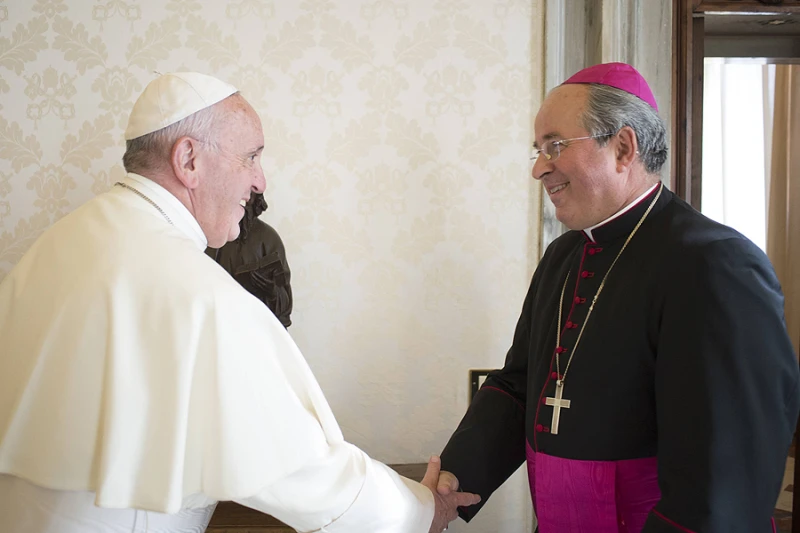
Pope Francis and Archbishop Ivan Jurkovic at Vatican City, Nov. 13, 2015. / Vatican Media
Vatican City, Jun 5, 2021 / 05:30 am (CNA).
Pope Francis on Saturday appointed a new apostolic nuncio to Canada.
The pope named Archbishop Ivan Jurkovič on June 5 to the position that had remained vacant since the previous nuncio, Archbishop Luigi Bonazzi, was posted to Albania in December 2020.
Jurkovič has served as the Permanent Observer of the Holy See to the United Nations and Other International Organizations in Geneva since 2016.
The 68-year-old Slovenian archbishop has also acted as the Holy See’s representative to the World Trade Organization and the International Organization for Migration.
The appointment comes amid a firestorm in Canada following the discovery of unmarked Indigenous graves at a former Church-run residential school in Kamloops, British Columbia.
The remains of 215 children at the site of the former Kamloops Indian Residential School were located in mid-May through the use of ground-penetrating radar. The children were buried in unmarked graves and it is unclear how they died.
The school was the largest institution of its kind and was run by the Church between 1890 and 1969.
The country’s Truth and Reconciliation Commission, which ran from 2008 to 2015, estimated that 4,000 to 6,000 students died as a result of neglect or abuse in the country’s residential schools.
Among its 94 recommendations was a call for the pope “to issue an apology to Survivors, their families, and communities for the Roman Catholic Church’s role in the spiritual, cultural, emotional, physical, and sexual abuse of First Nations, Inuit, and Métis children in Catholic-run residential schools.”
Prime Minister Justin Trudeau raised the possibility of an apology during a meeting with Pope Francis at the Vatican in 2017.
Following the discovery in Kamloops, the Canadian government urged the pope to issue a formal apology for the Church’s role in the residential school system.
Jurkovič was born in Kočevje, southern Slovenia, on June 10, 1952. He was ordained a priest of the Archdiocese of Ljubljana in 1977, at the age of 25.
After training for the diplomatic service of the Holy See, he served in South Korea, Colombia, and Russia. In 2001, Pope John Paul II named him apostolic nuncio to Belarus.
From 2004 to 2011, Jurkovič served as apostolic nuncio to Ukraine and was then appointed apostolic nuncio to the Russian Federation, as well as Uzbekistan.
In 2016, Pope Francis appointed him to the permanent observer role in Geneva, where he spoke on behalf of the Holy See on a welter of issues, including Islamophobia, COVID-19 vaccines, and coronavirus lockdowns.
He is fluent in Slovenian, Italian, English, Spanish, French, German, and Russian.
Archbishop Bonazzi, Jurkovič’s predecessor in Canada, served as apostolic nuncio from 2013 to 2020. Pope Francis named him nuncio to Albania on Dec. 10.
The Apostolic Nunciature in Canada is based in the capital, Ottawa. The 2011 National Household Survey reported that around 13 million Canadians are baptized Catholics.
If you value the news and views Catholic World Report provides, please consider donating to support our efforts. Your contribution will help us continue to make CWR available to all readers worldwide for free, without a subscription. Thank you for your generosity!
Click here for more information on donating to CWR. Click here to sign up for our newsletter.
Vatican City, Feb 7, 2018 / 05:24 am (CNA/EWTN News).- After a massive earthquake and a string of aftershocks in Taiwan killed at least seven and injured hundreds more, Pope Francis Wednesday sent a telegram assuring of his prayer for the victims and those engaged in rescue efforts.
Signed by Vatican Secretary of State Cardinal Pietro Parolin and addressed to Bishop Philip Huang Chao-ming of Hwalien, the Feb. 7 telegram expressed the Pope’s solidarity “with all those affected by the earthquakes in Taiwan these past days.”
Francis, the telegram said, “offers the assurance of his prayers for those who have lost their lives and for those who have been injured.”
“As he encourages the civil authorities and emergency personnel engaged in rescue efforts, His Holiness willingly invokes upon all the Taiwanese people the divine blessings of strength and peace.”
The Pope’s telegram was sent after a 6.4 magnitude earthquake struck the East China Sea just 13 miles north of the Taiwanese city of Hwalien late Feb. 6.
Tremors were felt as far north as the capital city of Taipei, which sits roughly 74 miles from Hwalien. At least 15 aftershocks followed, measuring as high as 4.8, and could still be felt Wednesday morning.
According to CNN, at least seven people have been killed and some 258 injured, with dozens still missing. Extensive damage was done to city structures such as buildings and bridges, with many either collapsing or being held up by makeshift beams.
As aftershocks continued to rock the island Wednesday morning, some 600 military personnel and more than 750 firefighters were deployed to comb through rubble to look for survivors and help with rescue efforts.
Father Paul Sullins, PhD, is a senior research associate at the Ruth Institute and a retired professor of sociology at the Catholic University of America in Washington, D.C. / Credit: The Ruth Institute
Vatican City flag waiving over St. Peter’s dome – Bohumil Petrik / CNA
Rome Newsroom, May 20, 2021 / 05:30 am (CNA).
The Vatican’s Council for the Economy faces a “huge task” in its efforts to quickly bring up the Holy See’s accounting and financial transparency to international standards, according to one of its lay members.
“We are very much focused on getting those basic standards in place and making sure the information that is in front of the pope when he makes decisions is thorough, complete, and fair. And we’re not in that situation yet,” Council for the Economy member Ruth Kelly told EWTN News.
Kelly, who was Education Secretary under British Prime Minister Tony Blair and later worked for HSBC Global Asset Management, is one of seven lay people on the Vatican council overseeing the administrative and financial structures and activities of the Roman Curia, institutions of the Holy See, and Vatican City State.
The lay members work together with eight cardinals to set the budget for the Holy See’s entities and raise the level of financial transparency — something which Kelly said can pose unique challenges.
“For example, the historic legacy is very, very difficult to tackle if you take the example of, say … a place of residence through tradition in a particular part of the Vatican, or Rome, or somewhere in the world. It may be the case that no one has ever had it valued, or really thought about who legally owned it, because through customs and tradition it was obvious to what use it should be put,” she said.
“The Holy See cannot yet account for all of the investment properties that it owns specifically around Rome and in Italy. And there’s a huge task to go through to make sure it identifies properly the ownership of each — whether it’s owned by a diocese, whether it’s owned by the Vatican, whether it’s owned by a parish, or somebody else — and then to valuate it to make sure that it’s properly accounted for in the balance sheets.”
“So that’s one real area where the Holy See needs to be moved quickly up to date.”
Ruth Kelly, pictured in 2006. / skuds via Flickr (CC BY-SA 2.0).
The Council for the Economy is also currently implementing an investment policy for the Vatican and “a huge training program” in financial standards for those who work in its departments and dicasteries, according to Kelly.
“I’m actually very encouraged by the steps that I’ve seen, even though there’s so much to do and so far to go,” she said.
Pope Francis established the Council for the Economy in 2014 as part of his program of financial reform. Kelly was appointed to the council for a six-year term last August along with five other women with backgrounds in banking, finance, asset management, and international law.
“There’s a real recognition that it’s now very important at the heart of the Church to have lay experts involved in overseeing the Vatican accounts and policies and so forth. And that is important, not just in its own sake, but also for the credibility of the process,” Kelly said.
“The ambition is to have international accounting standards applied in full across the Holy See,” she said. “That’s not a position which we have arrived at yet, but it is one to which we aspire.”
Kelly spoke at the webinar series, “Inspiring Trust: Church Communications and Organizational Vulnerability,” offered by the Pontifical University of the Holy Cross in Rome. The university is entrusted to Opus Dei, with which Kelly is associated.
“To be brutally honest about it, from my perspective of the council’s perspectives … it’s not clear how funds have been flowing and how they’ve been managed because the transparency hasn’t been there,” she said.
Kelly is adamant that “once that transparency is there, and international standards are applied, then you can start talking altogether differently about the Vatican’s role and its responsibility and how it manages money, and so forth.”
“If someone’s going to put money into the Peter’s Pence account, they need to know that that money is being well spent. And at the moment, you can’t say definitely that we can show that, but we’re well on the way I think to be able to do that before too long,” she said.
The Council of the Economy was very focused on cost restraint in setting this year’s budget, asking Vatican departments to come up with reductions in their spending, Kelly explained.
The Vatican’s budget, which already operated on a deficit, took another hit in 2020 and the beginning of 2021, when the Vatican Museums, a major source of income, was forced to close for months.
For the Holy See, the coronavirus crisis also meant collapsing market investments, uncertain income from real estate investments, and diminished contributions from the Church around the world.
“The Holy See suffered, along with every other organization, or many other organizations, in the pandemic, and that’s not surprising. And the question really for the council is how much of that is temporary and how much of that will bounce back,” she said.
“And it is the case that fundraising has been severely dented through the COVID crisis, not surprisingly, as it has been felt right throughout the Church,” she said.
“So, you know, it is one of the areas in our minds, as we think about how to restore the reputation and how to create a strong reputation for how the Holy See manages finances.”
Kelly is confident that there is a strong willingness among both the lay members and the cardinals on the council to “make an impact quickly.”
“We do expect results, very significant results, before the six years run out at the end of the council’s current term,” she said.
German Cardinal Reinhard Marx has overseen the council since its creation in 2014. Other cardinals currently on the council include Joseph Tobin of Newark; Anders Arborelius of Stockholm; Péter Erdő of Esztergom-Budapest; Odilo Scherer of São Paulo; Gérald Lacroix of Quebec; Giuseppe Petrocchi of L’Aquila; and Cardinal Daniel DiNardo of Galveston-Houston.
Among the lay members are German law professor Charlotte Kreuter-Kirchhof; Maria Kolak, president of the National Association of German Cooperative Banks; Alberto Minali, the former chief investment officer of the asset management group Eurizon; Leslie Ferrar, who was treasurer to Britain’s Prince Charles; elevator manufacturer Zardoya Otis; and Eva Castillo Sanz, who sits on the board of directors of the Spanish bank Bankia.
Kelly said: “One of the things that’s on my mind to really explore as we go forward is how the whole whistleblowing setup works in the Vatican. Because I think part of an open culture is not only financial transparency but the ability of people to raise issues in private, perhaps without being identified or only identified if they so wish.”
“Now I do know that whistleblowing happens, but I’m not yet sure that that works well enough within the Holy See, and the Vatican.”
“There is a huge way to go, but I do think the will is there at the very top to see change happen,” she said.
ALSO DISEASE and ACCIDENT
estimated that 4,000 to 6,000 students died as a result of neglect or abuse
READ THE REPORT for more accurate facts
