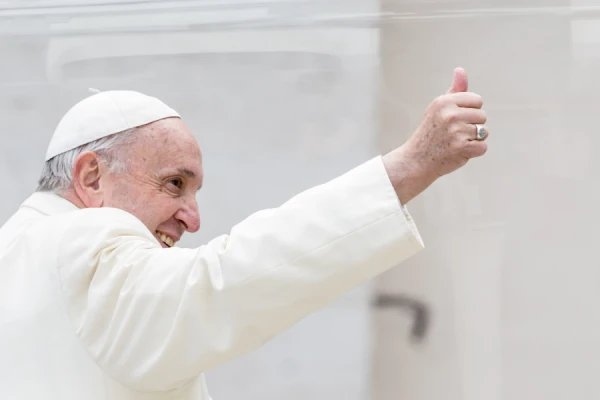
Pope Francis gives a thumbs-up at the general audience in St. Peter’s Square on March 21, 2018. Credit: Daniel Ibáñez/CNA.
Rome Newsroom, Jan 20, 2021 / 01:00 pm (CNA).- Pope Francis met on Wednesday with players of the northern Italian soccer club Spezia after they eliminated the fourth-seeded A.S. Roma from the country’s annual cup competition.
“First of all, congratulations, because yesterday you were good. Congratulations!” the pope told them at an audience in the Vatican’s Apostolic Palace on Jan. 20.
Spezia Calcio, a professional soccer club based in the town of La Spezia, joined the top Italian league Serie A for the first time in its history in 2020.
The 13th-seeded Spezia’s 4-2 win on Tuesday in the Coppa Italia against Roma — one of Rome’s two big clubs — puts them in next week’s quarter-finals, where they will play against Napoli.
Pope Francis said, “in Argentina, we dance the tango,” pointing out that the music is based on “two-by-four,” or two-quarter time.
Referring to their result against Roma, he added: “Today you are 4 to 2, and that’s good. Congratulations and keep going!”
“And thank you for this visit,” he said, “because I like to see the effort of young men and women in sport, because sport is a wonder, sport ‘brings out’ all the best that we have inside. Continue with this, because it leads you to a great nobility. Thank you for your witness.”
Complimenti e coraggio!
Con queste parole, @Pontifex_it ha accolto lo #SpeziaCalcio al gran completo, ricevuto questa mattina in udienza privata nelle stanze vaticane
Pope Francis is a well-known soccer fan. His favorite team is San Lorenzo de Almagro in his native Argentina.
In a 2015 interview, Francis said that in 1946 he went to many of San Lorenzo’s games.
Speaking to the Argentine online sports news site TyC Sports, Francis also revealed that he played soccer as a child, but he said he was a “patadura” — someone who is not good at kicking the ball — and preferred to play basketball.
In 2008, as archbishop of Buenos Aires, he offered Mass for players at the team’s facilities to mark San Lorenzo’s 100th anniversary.
In 2016, Pope Francis spoke at the opening ceremony of a Vatican conference on sports.
He said: “Sport is a human activity of great value, able to enrich people’s lives. As far as the Catholic Church is concerned, she is working in the world of sport to bring the joy of the Gospel, the inclusive and unconditional love of God for all human beings.”
If you value the news and views Catholic World Report provides, please consider donating to support our efforts. Your contribution will help us continue to make CWR available to all readers worldwide for free, without a subscription. Thank you for your generosity!
Click here for more information on donating to CWR. Click here to sign up for our newsletter.

Pope Francis meets religious sisters at a general audience on Jan. 19, 2022. / Vatican Media
Vatican City, Feb 1, 2022 / 09:30 am (CNA).
Pope Francis told religious sisters’ to fight back when they are treated unfairly or “reduced to servitude”… […]
Kazakh artist Dosbol Kasymov works on the icon “Mother of the Great Steppe” in advance of Pope Francis’ Sept. 13-15 trip to Kazakhstan. / Alexey Gotovsky/CNA
Rome Newsroom, Sep 6, 2022 / 09:03 am (CNA).
A Kazakh artist is creating possibly the first-ever painting of Mary and the Child Jesus as native Kazakhs; it will be displayed in Kazakhstan’s only Marian shrine.
It is hoped that the icon, in the form of a triptych, will be blessed by Pope Francis during his Sept. 13-15 visit to the Central Asian country, where more than 70% of the population is Muslim.
The artist, Dosbol Kasymov, told EWTN News in Almaty, Kazakhstan, on Aug. 5 that his inspiration for the image came from his culture’s love and reverence for mothers.
Mother is “a common image,” uniting mankind, Kasymov said. “We are all born, we all came into this world thanks to our mothers.”
Titled “The Mother of the Great Steppe,” the large icon was commissioned by Archbishop Tomasz Peta, the head of Kazakhstan’s Catholic diocese, Maria Santissima in Astana.
The Kazakh Steppe is a treeless, semi-desert grassland covering the northern part of the country, south of the Ural Mountains.
Peta told EWTN News last month that the image of the Kazakh Mary and Jesus is intended for Kazakhstan’s only Marian shrine, Mary Queen of Peace, in the town of Ozernoe, about 68 miles southeast of Nur-Sultan.
The painting depicts the Virgin Mary as a Kazakh woman dressed in traditional clothing. In her arms, she holds her baby son, the Child Jesus, held in the robe of an adult man, a sign of his future death and the Roman tunic he will wear on his way to the cross.
Kazakh artist Dosbol Kasymov spoke to EWTN News about his icon “Mother of the Great Steppe” in advance of Pope Francis’ Sept. 13–15 trip to Kazakhstan. Alexey Gotovsky/CNA.
EWTN News spoke to the artist ahead of Pope Francis’ visit to Kazakhstan, while the painting was still a work in progress. Kasymov spoke about some of the traditional Kazakh symbols he incorporated into the icon.
“The Kazakh ornaments, like all the ornaments in the world, have their own symbols. The nimbus, it’s made in the form of a star. On one side is a flower, on the other side is a star, and on the other side is a part of the Kazakh carpet ‘Tuskeiz,’” he explained.
Kasymov said the Child Jesus’ halo is in the form of a shanyrak, the emblem of Kazakhstan and a common cultural symbol based on the shape of a cross.
Ethnic Kazakhs are predominantly Sunni Muslims, the most commonly practiced religion in the country. According to a 2009 national census, the second most practiced religion is Russian Orthodox Christianity, at more than 20%. The country, which has approximately 250,000 Latin-rite Catholics, according to 2008 statistics, is also home to many immigrants.
The nationally-acclaimed painter said he hopes his work will be received by the people of Kazakhstan “with love, with warmth, because, above all, it is the image of the mother.”
“Here is my personal opinion: I think that Kazakhs are very tolerant, they easily accept any culture,” he said.
A detail of the palette of artist Dosbol Kasymov in his studio in Almaty, Kazakhstan. Alexey Gotovsky/CNA
The finished icon is expected to include a panel on each side depicting an ethnically Kazakh angel playing traditional musical instruments.
After the image is blessed in Nur-Sultan by Pope Francis, who will visit the city for the VII Congress of Leaders of World and Traditional Religions, it will be placed in a new prayer chapel at the Mary Queen of Peace Shrine in Ozernoe.
Peta said the new chapel would be built in the shape of a yurt, the traditional round tent used by nomadic groups in Central Asia. The shrine is also getting a new pilgrim welcome center dedicated to St. John Paul II.
The new chapel “is for all people, regardless of faith and nationality; this yurt will be a meeting place with Mary, and through Mary, with Jesus,” Peta said.
Mary Queen of Peace Shrine in Ozernoe, Kazakhstan. Alexey Gotovsky/CNA
Kasymov said he faced a difficult decision when Peta asked him to create an icon of Mary and the Child Jesus, given that he himself is not Christian, nor even particularly religious.
“When the offer came in to write this work, of course I had my doubts,” he said. “But then I talked to my relatives, brothers, friends and they said, ‘Of course you should write it, it’s our common culture.’”
“The Mother of the Great Steppe” in progress in the studio of artist Dosbol Kasymov on Aug. 5, 2022. Alexey Gotovsky/CNA
Kasymov said he is also interested to see how his depiction of Our Lady of the Steppe interacts with the many European images of the Blessed Virgin Mary.
“I want to praise our beauty, too, and I want the beauty of our women, the beauty of our mothers to be understandable,” he said.
He explained that Mary is shown looking away because “Kazakhs consider it not quite right or polite for a woman to look directly into the face of her interlocutor.”
“We say in Kazakh, ‘Tygylyp Karama,’ do not stare straight ahead,” he said. “A woman should not look at the spectator directly, she looks a little into the distance. It’s a trait of modesty and part of etiquette.”
The Virgin Mary’s gaze can also be interpreted to mean that she is thinking about the future, that “she senses what is going to happen to her son,” he said.
A detail on the painting of “Mother of the Great Steppe” by Dosbol Kasymov. Alexey Gotovsky/CNA
The Christ Child, who is looking the other way from his mother, “has a mixture of feelings,” the artist noted. “It is as if on the one hand, he does not want to separate from his mother, but on the other hand … somewhere in his depths, in his young subconsciousness, there is also an understanding that he has a path, as each of us has our own path.”
Sports and games – life in full flow. Long live sports.