


Vatican City, Dec 9, 2020 / 09:00 am (CNA).- The Council for Inclusive Capitalism launched a partnership with the Vatican on Tuesday, saying that it would be “under the moral guidance” of Pope Francis.
The council consists of global companies and organizations which share a mission to “harness the private sector to create a more inclusive, sustainable and trusted economic system,” according to its website.
Members include the Ford Foundation, Johnson & Johnson, Mastercard, Bank of America, the Rockefeller Foundation, and Merck.
According to a press release from the council, the partnership with the Vatican “signifies the urgency of joining moral and market imperatives to reform capitalism into a powerful force for the good of humanity.”
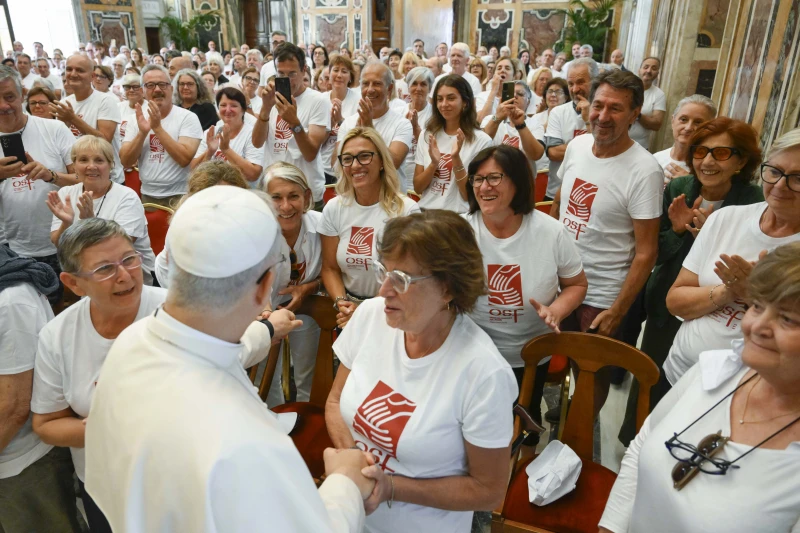
Pope Francis met with members of the organization at the Vatican last year. With the new partnership, the 27 leading members, called “guardians,” will continue to meet annually with Pope Francis and Cardinal Peter Turkson, prefect of the Dicastery for Promoting Integral Human Development.
Francis encouraged the council last year to renew existing economic models to be fair, trustworthy, and capable of extending opportunities to all.
“An inclusive capitalism that leaves no one behind, that discards none of our brothers or sisters, is a noble aspiration,” Pope Francis said Nov. 11, 2019.
Members of the Council for Inclusive Capitalism make public commitments to “advance inclusive capitalism” in their own companies and outside them, through grants promoting various issues, including environmental sustainability and gender equality.
The Vatican partnership puts the group “under the moral guidance” of Pope Francis and Cardinal Turkson, a press release states.
Lynn Forester de Rothschild, founder of the council and managing partner of Inclusive Capital Partners, said “capitalism has created enormous global prosperity, but it has also left too many people behind, led to degradation of our planet, and is not widely trusted in society.”
“This Council will follow the warning from Pope Francis to listen to ‘the cry of the earth and the cry of the poor’ and answer society’s demands for a more equitable and sustainable model of growth.”
On its website, the council sets out the “guiding principles” for its activities.
“We consider that Inclusive Capitalism is fundamentally about creating long-term value for all stakeholders – businesses, investors, employees, customers, governments, communities, and the planet,” it states.
To do this, it continues, members are “guided by an approach” that provides “equality of opportunity for all people … equitable outcomes for those who have the same opportunities and seize them in the same way; fairness across generations so that one generation does not overburden the planet or realize near-term benefits that incur long-term costs at the cost of future generations; and fairness to those in society whose circumstances prevent them from full participation in the economy.”
The pope warned the business leaders last year that “an economic system detached from ethical concerns” leads to a “throw away” culture of consumption and waste.
“When we recognize the moral dimension of economic life, which is one of the many aspects of Catholic social doctrine that must be integrally respected, we are able to act with fraternal charity, desiring, seeking and protecting the good of others and their integral development,” he explained.
“As my predecessor St. Paul VI reminded us, authentic development cannot be restricted to economic growth alone, but must foster the growth of each person and of the whole person,” Francis said. “This means more than balancing budgets, improving infrastructures or offering a wider variety of consumer goods.”
“What is needed is a fundamental renewal of hearts and minds so that the human person may always be placed at the centre of social, cultural and economic life.”
If you value the news and views Catholic World Report provides, please consider donating to support our efforts. Your contribution will help us continue to make CWR available to all readers worldwide for free, without a subscription. Thank you for your generosity!
Click here for more information on donating to CWR. Click here to sign up for our newsletter.

Very intriguing: “Members include the Ford Foundation, Johnson & Johnson, Mastercard, Bank of America, the Rockefeller Foundation, and Merck.” As a former board member of the Ford Foundation, the late and ornamental FR. THEODORE HESBURGH sought to leaven the office culture while at the same time abstaining/remaining silent on white-collar votes/crimes entangled with, for example, the global abortion culture.
But, now and instead, the very credible Cardinal Turkson’s Integral Human Development surely retains a clarifying distinction between the “human ecology” (e.g., the sanctity of each human life, the family, etc.) and the overlapping dynamics and vulnerabilities of both economies and the “natural ecology” (CA, nn. 37-40; unlike some airbrush versions of “integral ecology”).
One WONDERS about Bank of American, for example, which in 2015 was among some 400 American corporations who in 2015 filed amicus briefs in support of oxymoronic gay “marriage”—for demonstrably specious economic reasons, and inevitably paving the way for today’s anti-family gender theory. Other biggies—other members of the partnership?—also included AT&T and Verizon, Dow Chemical, General Electric, Coca-Cola and Pepsi, Google, Apple, Facebook and Microsoft, and the San Francisco Giants.
So, while an “inclusive capitalism” partnership is a surprising and encouraging bridge across borders, in the long run how is this term to be defined and, shall we say, salted?
Yes, this time (unlike Hesburgh), for the Vatican there is no formal/fully complicit boardroom status…But with past silences still in mind, will the indispensable (not “throwaway”) clarity of Veritatis Splendor now find its way into a more leavened conversation (?): “…the commandment of love of God and neighbor does not have in its dynamic any higher limit, but it does have a lower limit, beneath which the commandment is BROKEN” (n. 52). Catholic Social Teaching is the negation of ideology, even a more inclusive one, and is based instead on “moral theology” (Centesimus Annus, CA, n. 55).
Domestically, the contorted Hesburgh model of engagement (and the allied Land O’ Lakes Declaration!) has been tried and found wanting. Now, internationally, how to truly engage and to engage truly?
Well this sounds NWO. I also notice that the pope hears the cries of the earth and the cries of the poor but not the cries of the faithful who long for orthodoxy
Correction: Fr. Hesburgh was a board member of the Rockefeller Foundation (not Ford Foundation)–e.g, elected chairman in 1977.
How Interesting!
Every member of globalist Council for Inclusive Capitalism,including Global-Warming-Pope Francis-Hessburgh, has a knee-jerk vitriolic hatred of President Trump, the most vigorously Pro-Life President in American History!
hmmmmmm
How Interesting!
Every member of globalist Council for Inclusive Capitalism, including Global-Warming-Pope Francis-Hesburgh, has a knee-jerk vitriolic hatred of President Trump, the most vigorously Pro-Life President in American History!
hmmmmmm