

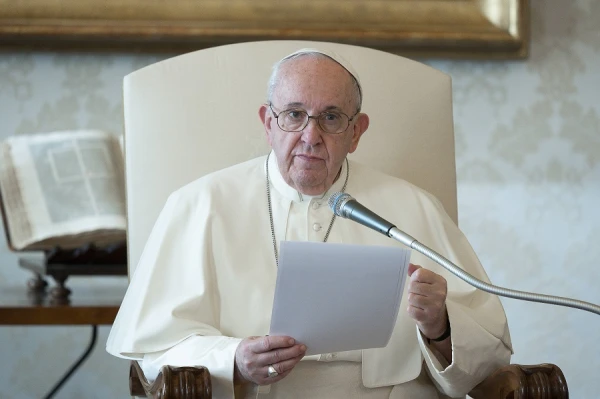
Vatican City, Nov 21, 2020 / 02:25 pm (CNA).- In a video message Saturday, Pope Francis encouraged young economists and entrepreneurs from around the world to bring Jesus to their cities, and to work not only for the poor, but with the poor.
Addressing participants of the Economy of Francesco online event, the pope said Nov. 21 that changing the world is about much more than “social assistance” or “welfare:” “we are speaking of a conversion and transformation of our priorities and of the place of others in our policies and in the social order.”
“Let us, then, not think for [the poor], but with them. Let us learn from them how to propose economic models that will benefit everyone…” he said.
He told young adults it is not enough to meet the essential needs of their brothers and sisters. “We need to accept structurally that the poor have sufficient dignity to sit at our meetings, participate in our discussions and bring bread to their own tables,” he said.
The Economy of Francesco, sponsored by the Vatican Dicastery for Promoting Integral Development, was a Nov. 19-21 virtual event that aimed to form 2,000 young economists and entrepreneurs from around the world to “build a more just, fraternal, inclusive and sustainable economy today and in the future.”
To do this, Pope Francis said in his video message, “calls for more than empty words: ‘the poor’ and ‘the excluded’ are real people. Instead of viewing them from a merely technical or functional standpoint, it is time to let them become protagonists in their own lives and in the fabric of society as a whole. Let us not think for them, but with them.”
Noting the unpredictability of the future, the pope urged young adults to “not be afraid to get involved and touch the soul of your cities with the gaze of Jesus.”
“Do not fear to enter courageously the conflicts and crossroads of history in order to anoint them with the fragrance of the Beatitudes,” he continued. “Do not fear, for no one is saved alone.”
They can accomplish much in their local communities, he said, warning them not to look for shortcuts. “No shortcuts! Be a leaven! Roll up your sleeves!” he emphasized.
Francis said: “Once the present health crisis has passed, the worst reaction would be to fall even more deeply into feverish consumerism and forms of selfish self-protection.”
“Remember,” he continued, “we never emerge from a crisis unaffected: either we end up better or worse. Let us foster what is good, make the most of this moment and place ourselves at the service of the common good. God grant that in the end there will no longer be ‘others,’ but that we adopt a style of life where we can speak only of ‘us.’ Of a great ‘us.’ Not of a petty ‘us’ and then of ‘others.’ That will not do.”
Quoting St. Pope Paul VI, Francis said “development cannot be restricted to economic growth alone. To be authentic, it must be well-rounded; it must foster the development of each person and of the whole person… We cannot allow economics to be separated from human realities, nor development from the civilization in which it takes place. What counts for us is man, each individual man and woman, each human group, and humanity as a whole.”
The pope called the future “an exciting time that summons us to acknowledge the urgency and the beauty of the challenges lying before us.”
“A time that reminds us that we are not condemned to economic models whose immediate interest is limited to profit and promoting favourable public policies, unconcerned with their human, social and environmental cost,” he stated.
If you value the news and views Catholic World Report provides, please consider donating to support our efforts. Your contribution will help us continue to make CWR available to all readers worldwide for free, without a subscription. Thank you for your generosity!
Click here for more information on donating to CWR. Click here to sign up for our newsletter.


China will eat you.
This.
China already ate US, and is taking really huge bites in the past weeks. That US reality those that are suppose to be looking out the countries best interest, are too busy selling us out.. for their own gain.
Its the drum role of, is President Biden going to start looking our for the people, as Kennedy tried. Or continue to sell US out?
President biden sold out 47 years ago buddy. Put your head between you legs and kiss your a.. goodbye. You speak as if buden just entered politics. He has been selling the country out since the 70s. Wake up
I agree with his sentiment but someone forgot to mention the 500 giga tonne gorilla in the room – The hegemony of the United States of America whose sole goal is to rape the planet for anything and everything it can buy or sell. Good luck trying to convey your message of minimalism to that obese, excessive ignorant island.
“Rape the planet”, really? Do you drive a vehicle, do you own clothes, do you eat food, do you have a house, do you have a phone, do you’s can continue. Give up all of what you and your family consumes in the name of not raping the planet.
Right. Except that the United States isn’t an island, it’s part of a continent called North America. So who’s the ignorant one here?
Nothing better than the guy in the gold plated house lecturing about the poor. He should follow God’s word and sell his riches.
The pope, I trust you understand, does not own the riches of the Vatican, etc. In fact, in fairness to Pope Francis, he probably owns very little. Now, a more worthwhile line of criticism would be to ask, “What competence or expertise does Pope Francis have in economics?” And so forth.
Carl no one said that Pope Francis is an economist.
I do not think you would criticize Jesus for his Sermon on the Mount which called for social justice and looking out for the needy.
Isn’t that what a Pope is supposed to articulate.
Carl no one said that Pope Francis is an economist.(sic)
Yet he himself believes he is one as evidenced by that which he allowed to be published under his name in Evangelii Gaudium and Laudato Si’ as only two examples among many.
A yet more worthwhile line of thinking would be this:
Popes must be Catholic.
Francis is not Catholic.
Thus Francis is not pope.
Well, Francis has Jeffry Sachs to tell him how to use abortion to make sure we have fewer poor people in the world.
I do not think Pope Peter had access to the wealth and splendor that Pope Francis has. Not did our first Pope have body guards.
He probably did not even have rosary beads or a crucifix.
.
And that’s the issue. I personally may own much more than Pope Francis, but I don’t live in anywhere near the comfort. I have no security system, and if I come down with Covid or cancer, no hospital or doctor of note will leap at the chance to cure me.
.
They are not called “Princes” for nothing.
.
I do not begrudge him (them) their comforts, or would not, but they clearly have no clue how wealth is created, how poverty might be lessened.
Remember when Popes used to talk about Jesus and Mary?
You remember the simple tales Tod to you as a child. They are still told to children.
Now you are older you need to navigate the bigger more complex stories.
New world order pope . .give away the wealth of the catholic church first..
You first, Francis
What might be said—perhaps competently—about augmenting daily stock market data/quarterly progress reports with a wider-angle business perspective, sometimes referred to as the TRIPLE BOTTOM LINE: prophet, people, planet? A few (not all) tutors and their discussion points:
At least parts of mankind are demonstrably at risk of a self-inflicted “tragedy of the commons” (from ecologist GARRETT HARDIN, 1968). Today the personal ecological footprint involves a layered web of often distant resource uses—land, water, air, and food chains.
ST. AUGUSTINE connected expansive passions and a finite world: “the passions are more easily mortified finally in those who love God, than satisfied, even for a time, in those who love the world” (in Henry Paolucci, ed., The Political Writings of St. Augustine, 1962).
In his Liechentstein Address (1993), SOLZHENITSYN remarked on technological society and the need for “self-limitation”—“in an economic race, we are poisoning ourselves.”
Two years earlier, ST. POPE JOHN PAUL II also called for “important changes in established lifestyles, in order to limit the waste of environmental and human resources, thus enabling every individual and all the peoples of the earth to have a sufficient share of those resources.” (Centesimus Annus, 1991 n. 54).
What is the possible alliance for shared action among the three monotheistic world RELIGIONS? E.g., Christian and Jewish revelation—“[The LORD made the earth] not creating it to be a waste, but designing it to be lived in” (Isa 45:18). (See Michael A. Barkey, ed., Environmental Stewardship in the Judeo-Christian Tradition: Jewish, Catholic, and Protestant Wisdom on the Environment [Acton Institute for the Study of Religion and Liberty, 2000]. Islam (a natural religion) proclaims—at least for the umma or House of Islam—the reality of the common good and of property as a shared good.)
In Mater et Magistra (1961) ST. POPE JOHN XXIII noticed that nature has only “almost inexhaustible productive capacity” (“almost”, not “inexhaustible” as under Pope Leo XIII in Rerum Novarum). And, likewise, it was with an eye on rising per capita resource consumption, that ST. POPE JOHN PAUL II counseled “above all a change in lifestyle (and) models of production and consumption . . . (and) structures of power . . .” (Centesimus Annus, n. 58).
ST. POPE JOHN PAUL II and Ecumenical PATRIARCH BARTHOLOMEW issued a “Joint Declaration on Articulating a Code of Environmental Ethics” stressing five goals: (1) mindfulness of future generations, (2) the priority of Natural Law and the non-utilitarian use of science and technology [Veritatis Splendor! 1993], (3) stewardship and solidarity beyond exaggerated [!] ownership, (4) a variety of roles and [!] responsibilities, and (5) the need for trust beyond legitimate controversy (Origins, CNS Documentary Service, June 20, 2002).
What would a more reflective and robust market (solidarity and subsidiarity, both, with neither eclipsed by the other) actually look like—beyond (a) the narrow and short-term quantitative fixations prevailing today AND EQUALLY BEYOND (b) POPE FRANCIS’ countervailing and self-acknowledged “rhetorical poetry”?
It would make more sense for the Pope to encourage the poor to learn from economists instead, so they can pull themselves out of poverty.
A lot more. But that’s not Francis’ M.O. MT verbiage is. Reams of it. Worst Pope we’ve ever had.
Johann du Toit,
That sounds about right but it would have to be economists with good track records. Some economists fail as badly as the rest of us to see what’s coming next.
It’s ashame when religious leaders embrace fundamentally flawed and evil dogma and ideology, becoming useful idiots for the tyrants.
Alternative view on papal events: canon212 dot com.
To my concluding QUESTION: “What would a more reflective and robust market (solidarity and subsidiarity, both, with neither eclipsed by the other) actually look like…?”
With some adjustments, maybe the Mid-West DUST BOWL of the 1930s will not be repeated in the desertification of coral reefs (related to our food chains) in the 2030s, and in the less preventable Sub-Sahara?
Maybe Artificial Intelligence (AI) and robotics will not pull the rug out from under of family-wage jobs and FAMILIES (papal prayer intention for this November)?
And, happily, with a perspective of centuries and nod to the better side of INNOVATION (“Technocracy”?), open-pit copper mines already have been at least partly replaced by fiber optics and miniaturized/wireless communication. The short-lived buffalo hunter, beaver pelt and finite-coal mentalities offer additional clues.
And, likewise to be purified, maybe the extermination of miniature (!) UNBORN CHILDREN—the moral crisis of “preeminent” priority (USCCB)—as exploited by the Abortion Industry (another “AI”!), will itself be terminated? This, rather than subsidized by the government (!) and exported overseas by Planned un-Parenthood profiteers.
As for the “rhetorical poetry” of Laudato Si—maybe there can be better rhyme and coherence as to WHETHER we can “reverse” (n. 170) OR only “adapt to” (n. 175) our/or nature’s (?) climate change?
(In either case, between Ice Ages the sea level was 4-6 meters deeper than it is now, while both underdeveloped Bangladesh and overdeveloped New York City have an average elevation of only 10 meters above sea level.) Bishop Barron quotes the mythical Mother Nature of eons and eras past: “I have fed species greater than you; and I have starved species greater than you.” And “my oceans, my soil, my flowing streams, my forests—they all can take you or leave you.”
https://www.catholicworldreport.com/2015/08/11/mother-nature-is-one-unreliable-lady/
Lapsing into planetary superlatives, what is the MORAL DIFFERENCE, if any, between short-term and direct genocide, and the long-term and indirect triage (stock market “economics”?) in marginal geographies of possibly vulnerable and “starved” populations?
Consumerism keeps everyone working.
Oh yes, isn’t needless toil and pursuit of “things” grand?
vs. what? Bored poverty and starvation?
Why hasn’t the Pope clarified his remarks about homosexuality? Please clarify the church’s stance on these sins that cry out to God.
Because he’s a coward and a liar.
The Poor are the real tabernacles where Christ resides. Economists have a lot to learn from the Christ residing in the poor.
I can’t believe this guy even sees the irony of telling his ‘flock’ to eschew the better things in life from…. The Vatican, that broken down old property of renown. Any shanty dwellings in there, Frank?
The pope seems to want a return to the middle ages where most people hated being alive.
I don’t know about that. Some of the Middle Ages sound pretty good to me. Some parts don’t ,but as I understand it they had many more days off work than we do today. Lots & lots of holy days observed back then.