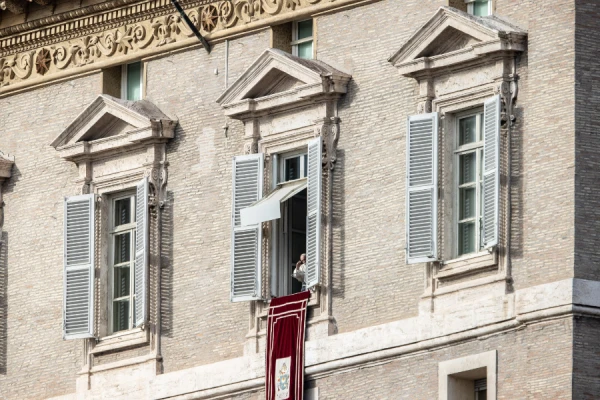
Vatican City, Nov 15, 2020 / 06:20 am (CNA).- Jesus is telling us today to stretch out our hand to the poor, Pope Francis said in his Angelus address Sunday.
Speaking from a window overlooking St. Peter’s Square Nov. 15, the fourth World Day of the Poor, the pope urged Christians to discover Jesus in the needy.
He said: “At times, we think that to be Christian means not to do harm. And not doing harm is good. But not doing good is not good. We must do good, to come out of ourselves and look, look at those who have more need.”
“There is so much hunger, even in the heart of our cities; and many times we enter into that logic of indifference: the poor person is there, and we look the other way. Reach out your hand to the poor person: it is Christ.”
The pope noted that priests and bishops who preach about the poor are sometimes reproached by those who say that they should be speaking about eternal life instead.
“Look, brother and sister, the poor are at the center of the Gospel,” he said, “it is Jesus who taught us to speak to the poor, it is Jesus who came for the poor. Reach out your hand to the poor. You have received many things, and you let your brother, your sister, die of hunger?”
The pope urged pilgrims present in St. Peter’s Square, as well as those following the Angelus through the media, to repeat the theme of this year’s World Day of the Poor in their hearts: “Stretch out your hand to the poor.”
“And Jesus tells us something else: ‘You know, I am the poor person. I am the poor,’” the pope reflected.
In his address, the pope meditated on Sunday’s Gospel reading, Matthew 25:14-30, known as the Parable of the Talents, in which a master entrusts wealth to his servants according to their abilities. He said that the Lord also entrusts us with his gifts according to our capacities.
The pope noted that the first two servants presented the master with a profit, but the third hid his talent. He then tried to justify his risk-averse behavior to his master.
Pope Francis said: “He defends his laziness by accusing his master of being ‘hard.’ This is an attitude that we have too: we defend ourselves, many times, by accusing others. But they are not at fault: the fault is ours; the flaw is ours.”
The pope suggested that the parable applied to every human being, but especially to Christians.
“We have all received from God a ‘patrimony’ as human beings, a human richness, whatever it may be. And as disciples of Christ we have also received the faith, the Gospel, the Holy Spirit, the Sacraments, and so many other things,” he said.
“These gifts need to be used to do good, to do good in this life, in service to God and to our brothers and sisters. And today the Church tells you, she tells us: ‘Use what God has given you and look at the poor. Look: there are so many of them; even in our cities, in the center of our city, there are many. Do good!’”
He said that Christians should learn how to reach out to the poor from the Virgin Mary, who received the gift of Jesus himself and gave Him to the world.
After reciting the Angelus, the pope said that he was praying for the people of the Philippines, struck last week by a devastating typhoon. Typhoon Vamco killed dozens of people and forced tens of thousands to seek shelter in evacuation centers. It was the 21st powerful storm to strike the country in 2020.
“I express my solidarity to the poorest families who have been subjected to these calamities, and my support to those who are trying to aid them,” he said.
Pope Francis also expressed his solidarity with Ivory Coast, which has been engulfed by protests following a disputed presidential election. An estimated 50 people have died as a result of political violence in the West African nation since August.
“I join in prayer to obtain the gift of national harmony from the Lord, and I exhort all sons and daughters of that dear country to cooperate responsibly for reconciliation and peaceful coexistence,” he said.
“I encourage in particular the different political actors to re-establish a climate of mutual trust and dialogue, in the quest for just solutions that protect and promote the common good.”
The pope also appealed for prayers for the victims of a fire at a hospital treating coronavirus patients in Romania. Ten people died and seven were critically injured in the blaze in intensive care ward at Piatra Neamt county hospital on Saturday.
Finally, the pope acknowledged the presence in the square below of a children’s choir from the town of Hösel in the German state of North Rhine-Westphalia.
“Thank you for your songs,” he said. “I wish everyone a happy Sunday. Please, do not forget to pray for me.”
If you value the news and views Catholic World Report provides, please consider donating to support our efforts. Your contribution will help us continue to make CWR available to all readers worldwide for free, without a subscription. Thank you for your generosity!
Click here for more information on donating to CWR. Click here to sign up for our newsletter.

Statuary sits before imagery of the recently canonized saints in St. Peter’s Square at the Vatican, Sunday, Oct. 20, 2024 / Credit: Daniel Ibáñez/CNA
Vatican City, Oct 20, 2024 / 11:00 am (CNA).
Pope Francis canonized 14 new saints on Sunday, including a father of eight and Franciscan friars killed in Syria for refusing to renounce their faith and convert to Islam.
In a Mass in St. Peter’s Square on Oct. 20, the pope declared three nineteenth-century founders of religious orders and the eleven “Martyrs of Damascus” as saints to be venerated by the global Catholic Church, commending their lives of sacrifice, missionary zeal, and service to the Church.
“These new saints lived Jesus’ way: service,” Pope Francis said. “They made themselves servants of their brothers and sisters, creative in doing good, steadfast in difficulties, and generous to the end.”
Pope Francis speaks at a Mass and canonization of 14 new saints in St. Peter’s Square on Sunday, Oct. 20, 2024. Credit: Daniel Ibáñez/CNA
The newly canonized include St. Giuseppe Allamano, a diocesan priest from Italy who founded the Consolata missionary orders, and St. Marie-Léonie Paradis, a Canadian nun from Montreal known for founding an order dedicated to the service of priests.
Also among the saints are St. Elena Guerra, hailed as an “apostle of the Holy Spirit,” and St. Manuel Ruiz López and his seven Franciscan companions, all martyred in Damascus in 1860 for refusing to renounce their Christian faith.
The final three canonized are siblings, Sts. Francis, Mooti, and Raphael Massabki, lay Maronite Catholics martyred in Syria along with the Franciscans.
Thousands of pilgrims prayed the Litany of the Saints together in St. Peter’s Square before Pope Francis declared the 14 as enrolled among the saints “for the honor of the Blessed Trinity, the exaltation of the Catholic faith and the increase of the Christian life, by the authority of our Lord Jesus Christ, and of the Holy Apostles Peter and Paul.”
“We confidently ask for their intercession so that we too can follow Christ, follow him in service and become witnesses of hope for the world,” the pope said.
In his homily, Pope Francis highlighted how service embodied the lives of each of the new saints. “When we learn to serve,” he said, “our every gesture of attention and care, every expression of tenderness, every work of mercy becomes a reflection of God’s love. And so we continue Jesus’ work in the world.”
The Gospel for the Mass was chanted in Greek in addition to Latin in honor of the 11 Martyrs of Damascus.
Pilgrims gather in St. Peter’s Square for a Mass and canonization of 14 new saints on Sunday, Oct. 20, 2024. Credit: Daniel Ibáñez/CNA
Father Marwan Dadas, a Franciscan friar from Jerusalem, was among those who attended the canonization. He said that the testimony of the martyrs from the Franciscan Custody of the Holy Land is especially meaningful to people who are suffering due to the ongoing war and violence in the region today.
“This is a good message to say that even though we have challenges — and it seems we have death continuously — we still have the light of God that is helping us and guiding us through these difficult periods,” Dadas told CNA.
“It’s an important message for me, and I hope it will be the message for all the people of the Holy Land, not only the Holy Land, but for everybody. It is a message from God saying that He is always with us.”
St. Giuseppe Allamano: A missionary heart
One of the most celebrated figures among the new saints is St. Giuseppe Allamano (1851–1926), an Italian diocesan priest who founded the Consolata Missionaries and the Consolata Missionary Sisters. Allamano, though he spent his entire life in Italy, left a global legacy by training missionaries who carried the Gospel to remote corners of Africa, Asia, and South America.
Allamano told the missionaries in the order he founded in northern Italy in 1901 that they needed to be “first saints, then missionaries.”
The medical miracle that led to Allamano’s canonization involved the healing of a man who was attacked by a jaguar in the Amazon rainforest. In 1996, a man named Sorino Yanomami, a member of the indigenous Yanomami tribe in the Amazon, was mauled by a jaguar and left with life-threatening injuries.
As doctors treated his skull fractures, Consolata missionaries prayed in the hospital with a relic of Allamano, seeking his intercession. Miraculously, Yanomami recovered without any long-term damage, according to the Vatican’s Dicastery for the Causes of Saints.
Allamano, whose spiritual director was St. John Bosco, emphasized the importance of holiness in priestly life, telling his priests, “You must not only be holy, but extraordinarily holy.” His influence has endured through the orders he founded, present today in 30 countries across the globe.
St. Marie-Léonie Paradis: “Humble among the humble”
St. Marie-Léonie Paradis (1840–1912), a Canadian religious sister, also took her place among the new saints. She founded the Little Sisters of the Holy Family, an order whose spirituality and charism is the support of priests through both prayer and by taking care of the cooking, cleaning, and laundry in rectories in “humble and joyful service” in imitation of “Christ the Servant.”
During his homily, Pope Francis praised Paradis’ faith and underlined that “those who follow Christ, if they wish to be great, must serve by learning from Him” who made himself “a servant to reach everyone with his love.”
Born in the Acadian region of Quebec, Paradis also spent eight years in New York serving in the St. Vincent de Paul Orphanage in the 1860s and taught French at St. Mary’s Academy in Indiana, before founding her religious order in New Brunswick, Canada.
Paradis’ canonization was supported by the miraculous healing of a newborn in Canada, attributed to her intercession.
St. Elena Guerra: An “apostle of the Holy Spirit”
Among the canonized was St. Elena Guerra (1835–1914), known for her ardent devotion to the Holy Spirit. Guerra, who founded the Oblates of the Holy Spirit, was instrumental in promoting the first-ever novena to the Holy Spirit under Pope Leo XIII in 1895. Her writings and spiritual leadership inspired many, including St. Gemma Galgani, a mystic and saint who was her student.
For much of her 20s, Guerra was bedridden with a serious illness, a challenge that turned out to be transformational for her as she dedicated herself to meditating on Scripture and the writings of the Church Fathers. She felt the call to consecrate herself to God during a pilgrimage to Rome with her father after her recovery and went on to form the religious community dedicated to education.
During her correspondence with Pope Leo XIII, Guerra composed prayers to the Holy Spirit, including a Holy Spirit Chaplet, asking the Lord to “send forth your spirit and renew the world.
“Pentecost is not over,” Guerra wrote. “In fact, it is continually going on in every time and in every place, because the Holy Spirit desired to give himself to all men and all who want him can always receive him, so we do not have to envy the apostles and the first believers; we only have to dispose ourselves like them to receive him well, and he will come to us as he did to them.”
The Martyrs of Damascus: Courageous witnesses of faith
The solemnity of the ceremony was heightened as Pope Francis canonized the Martyrs of Damascus, a group of 11 men killed in 1860 for refusing to renounce their Christian faith and convert to Islam. The martyrs, including eight Franciscan friars and three laymen, were attacked in a church in the Christian quarter of Damascus during a wave of religious violence.
The canonized Franciscan friars include six priests and two professed religious — all missionaries from Spain except for Father Engelbert Kolland, who was from Salzburg, Austria.
Franciscan Father Manuel Ruiz, Father Carmelo Bolta, Father Nicanor Ascanio, Father Nicolás M. Alberca y Torres, Father Pedro Soler, Kolland, Brother Francisco Pinazo Peñalver, and Brother Juan S. Fernández were all declared saints.
The three laymen were brothers — Francis, Abdel Mooti, and Raphael Massabki — known for their deep piety and devotion to the Christian faith. Francis Massabki, the oldest of the brothers, was a father of eight children. Mooti was a father of five who visited the Church of St. Paul daily for prayer and to teach catechism lessons. The youngest brother, Raphael, was single and was known to spend long periods of time praying in the church and helping the friars.
According to witnesses, the brothers were offered the chance to live if they renounced their faith, but they refused. “We are Christians, and we want to live and die as Christians,” Francis Massabki reportedly said. All 11 were brutally killed that night, some beheaded, others stabbed to death.
“They remained faithful servants,” Pope Francis said. “[They] served in martyrdom and in joy.”
A global celebration
The canonization ceremony was attended by pilgrims from around the world, including Catholics from Kenya, Canada, Uganda, Spain, Italy, and the Middle East. More than 1,000 members of the Consolata order traveled to Rome to witness the canonization of their founder.
And bagpipers from Galicia in northern Spain played traditional music at the end of the Mass to honor the Spanish Franciscans canonized among the Damascus martyrs.
Bagpipers play to honor the Spanish Franciscans canonized among the Damascus martyrs at the Vatican on Sunday, Oct. 20, 2024. Credit: Courtney Mares
“I thank all of you who have come to honor the new saints,” Pope Francis said. “I greet the cardinals, the bishops, the consecrated men and women, especially the Friars Minor and the Maronite faithful, the Consolata Missionaries, the Little Sisters of the Holy Family and the Oblates of the Holy Spirit, as well as the other groups of pilgrims who have come from various places.”
Pope Francis led the crowd in the Angelus prayer at the end of the Mass and asked people to pray in particular for the gift of peace for “populations who are suffering as a result of war – tormented Palestine, Israel, Lebanon, tormented Ukraine, Sudan, Myanmar and all the others.”
The pope also greeted a group of Ugandan pilgrims who traveled from Rome to mark the 60th anniversary of the canonization of the Ugandan Martyrs and urged people to pray for missionaries on World Mission Sunday.
“Let us support, with our prayer and our aid, all the missionaries who, often at great sacrifice, bring the shining proclamation of the Gospel to every part of the world,” he said.
“May the Virgin Mary help us to be like her and like the Saints courageous and joyful witnesses of the Gospel.”
Archbishops wear the pallium they received from Pope Francis in St. Peter’s Basilica, June 29, 2014. / Credit: Daniel Ibáñez/CNA
Vatican City, Jun 27, 2025 / 06:00 am (CNA).
Pope Leo XIV on Sunday will bless and bestow the “pallium” — a white w… […]
3 Comments
Making the world Poor, is the USA forte, when we recognize Haiti, the poorest country in the West hemesphere. Elected a Catholic priest by the people, removed by US, promised aid, never delivered. Yemen, poorest nation in East Hemephere, the US attacked, imposed Genocide on today, and exterminates the people by, starvation.
Mexico, the US alows thousands to come to the US and work in the toughest jobs, paid slave wages to enhance the profits of monopolies. Immigrates come to be the main work force of US food production, people of Mexico. Now a wall is built, to prevent more from escaping the corruption of today..
Unjust war, the main production and export of the USA, a Trillion dollar a year industry, the Military Industrial complex, that which Kennedy stood against, and was Martyred for. An insane borrowing of money, to make a few rich, and the majority of the nation, wage and debt slaves. That which every Catholic has a moral obligation to stand against, but that which the “assumed” leaders promote, as an evil vice.
“Mexico, the US alows thousands to come to the US and work in the toughest jobs, paid slave wages to enhance the profits of monopolies. Immigrates come to be the main work force of US food production, people of Mexico. Now a wall is built, to prevent more from escaping the corruption of today..”
Now we’re getting somewhere! So, the U.S. is horrible because it allows Mexicans to come into the country AND the U.S. is evil because it is building a wall to keep illegal aliens from coming into the country. I’d tell you to make up your mind, but you clearly think the U.S. is horrible and evil no matter what it does. Thanks for clarifying.
Making the world Poor, is the USA forte, when we recognize Haiti, the poorest country in the West hemesphere. Elected a Catholic priest by the people, removed by US, promised aid, never delivered. Yemen, poorest nation in East Hemephere, the US attacked, imposed Genocide on today, and exterminates the people by, starvation.
Mexico, the US alows thousands to come to the US and work in the toughest jobs, paid slave wages to enhance the profits of monopolies. Immigrates come to be the main work force of US food production, people of Mexico. Now a wall is built, to prevent more from escaping the corruption of today..
Unjust war, the main production and export of the USA, a Trillion dollar a year industry, the Military Industrial complex, that which Kennedy stood against, and was Martyred for. An insane borrowing of money, to make a few rich, and the majority of the nation, wage and debt slaves. That which every Catholic has a moral obligation to stand against, but that which the “assumed” leaders promote, as an evil vice.
“promised aid, never delivered.”
The U.S. has poured billions of dollars into Haiti. That’s common knowledge.
“Mexico, the US alows thousands to come to the US and work in the toughest jobs, paid slave wages to enhance the profits of monopolies. Immigrates come to be the main work force of US food production, people of Mexico. Now a wall is built, to prevent more from escaping the corruption of today..”
Now we’re getting somewhere! So, the U.S. is horrible because it allows Mexicans to come into the country AND the U.S. is evil because it is building a wall to keep illegal aliens from coming into the country. I’d tell you to make up your mind, but you clearly think the U.S. is horrible and evil no matter what it does. Thanks for clarifying.
Silence sometimes is violence. Doing good adds life to the lifespan of the doer and the receiver.