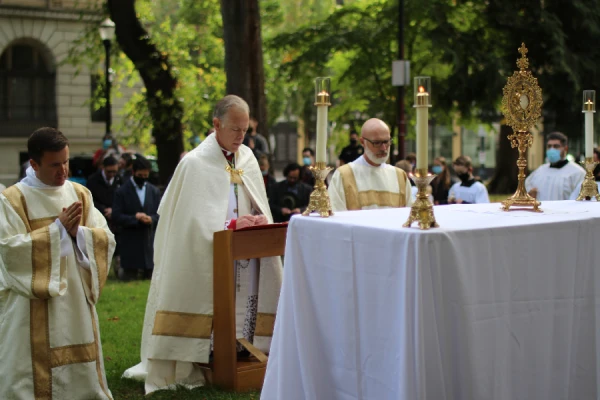
NY Catholic Conference: Science doesn’t support church closures
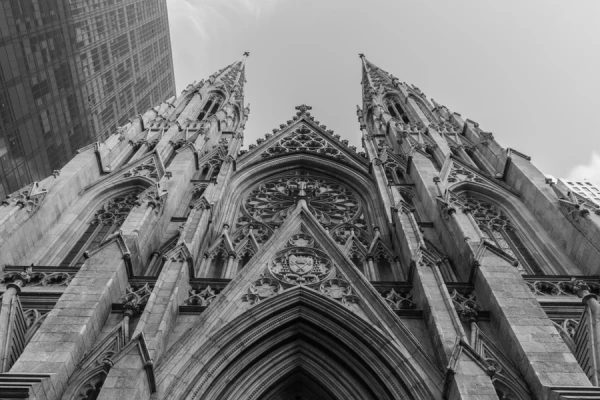
Washington, D.C. Newsroom, Oct 20, 2020 / 04:00 pm (CNA).- New York’s Catholic dioceses continue to push back on new coronavirus restrictions that have shut down more than two dozen churches in the state, despite there being no connection between churches and an outbreak of the virus.
Dennis Poust, director of communications for the New York State Catholic Conference, told CNA Tuesday that the state’s dioceses “are not aware of any outbreaks related to a Catholic Church anywhere in the state, including in the so-called ‘hot zones,’” identified by New York’s Governor Andrew Cuomo.
Cuomo announced at the start of October that there would be new “cluster” designations of “red,” “orange,” and “yellow” for zip codes that are experiencing new cases of the coronavirus.
For houses of worship located in the “red” zip codes, capacity is limited to 10 people, a figure which grows to a maximum of 25 for houses of worship in “orange” zip codes. Public and private schools, as well as “non-essential” businesses located in these “red” and “orange” zip codes were also forced to close due to the new restrictions.
These new regulations mean that about two dozen churches located in the Archdiocese of New York and the Diocese of Brooklyn have been effectively forced to close for the time being. A federal judge rejected a request from the Diocese of Brooklyn for an injunction that would have allowed churches in the diocese to continue operating at 25% capacity.
“Gov. Cuomo talks about following the science,” Poust told CNA. “We say ‘amen.’ We are following all Department of Health and CDC guidelines and keeping our people safe, yet he effectively closed down more than two dozen Catholic churches anyway.”
Poust told CNA that New York’s bishops have been working hard to ensure the safety of all who attend their churches, with much success.
“We have been partners with the administration from Day 1 of the crisis, writing to the governor and pledging our cooperation, offering the use of Catholic facilities for spillover hospital space, whatever we could do,” Poust told CNA on Tuesday.
He noted that the bishops had dispensed the Sunday obligation and canceled Masses prior to the start of Holy Week, and that Catholic schools in New York City had closed before public schools in order to help halt the spread of the virus.
“Fighting this pandemic is a pro-life imperative and we’ve been treating it as one from the start,’ he said. “I’ve been so proud of our parishes.”
Catholics at every level, from bishop to lay parishioners, were involved in discussions for safe reopening, Poust told CNA, calling the efforts taken to ensure liturgies are as safe as possible, including the suspension of the distribution of the chalice at Mass, enforcing masks, and social distancing, a “stunning success.”
But, he said, Cuomo’s recent measures did not reflect the results of this cooperation.
On October 16, the Jewish publication Hamodia shared a recording of a phone call Cuomo had with Jewish leaders. In the call, Cuomo laid blame at the closing of private schools on New York City Mayor Bill de Blasio, and said that it was a “fear-driven response” as “the virus scares people.”
“I’m 100% frank and candid,” said Cuomo. “This is not a highly-nuanced, sophisticated response. This is a fear-driven response.” He said that perhaps a “smarter, more-tailored approach” to the closing of schools, houses of worship, and businesses could be developed once “the anxiety comes down” in the red zip codes.
Poust said that by severely limiting the capacity of houses of worship, Cuomo is “sending a message that churches are not safe anywhere,” something he says “just hasn’t been shown to be true.”
“Can a church or synagogue be a super spreader? Of course, if they aren’t masking and social distancing,” he said. “But with appropriate precautions, the risks are very low and the statistics bear that out.”
With limited exceptions, said Poust, the vast majority of schools and religious congregations have been “exceedingly safe.”
And while Poust said that there was “much to praise” in how Cuomo has handled the coronavirus outbreak–with ”the exception of the early policy regarding nursing homes”–he thinks it is “important to enforce restrictions appropriately, namely on those who are violating the rules and causing spread.”
“The governor knows exactly which congregations have been problematic. It is a small minority that has been unwilling to follow the rules,” he said.
Poust said that isolated incidents of rule breaking do not justify broad action against entire religious communities.
Highlighting criticism by New York state and city officials of some Jewish congregations, he said it is not appropriate to treat the wider Jewish community – or all religious communities – with a broad brush.
“I am confident if it was a Catholic parish violating the law, the state would not have shut down every church, synagogue and mosque in the community. It would have enforced the law against the bad-actor parish,” he said.