CNA Staff, Aug 10, 2020 / 02:48 pm (CNA).- Fr. Liam Ryan, a long-time surfer, was on vacation visiting his best friend in Western Australia when, on the afternoon of July 31, he noticed a fellow surfer in distress.
“I saw him off his board, looking really lost and there was half a board floating there,” Ryan, 33, told The Catholic Leader, the publication of the Archdiocese of Brisbane.
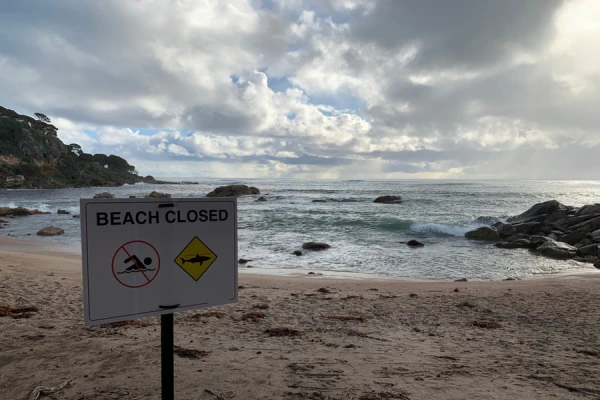
Ryan was surfing at Bunker Bay, about 60 miles southwest of Bunbury.
Ryan said it was ominously quiet before the great white shark, which had bitten Phil Mummert’s board in half, resurfaced to continue its attack.
“And then we saw this huge breach. The shark rolled onto him… and then went back under,” Ryan told The Catholic Leader.
According to Mummert and witnesses, Mummert used half of his broken board to try and beat the shark away, and pummeled the shark’s head with his bare hands, local news station 7News Perth reported.
Ryan later told 7News Perth that the shark, which was approximately 13-16 feet long, was “big enough to make grown men cry.”
“I started screaming ‘help him, help him,’” Ryan told The Catholic Leader.
Fortunately the priest’s calls for help were heard by another nearby surfer, Alex Oliver, who swam towards Mummert and hoisted him on his longboard, which he and Ryan then paddled to shore.
According to The Catholic Leader, Mummert was “bleeding profusely” by the time they reached shore, having sustained deep shark bites in his upper leg.
“As soon as we got into the shallows, someone clamped the wound with his hand to slow the bleeding,” Fr. Ryan said.
Ryan said once Mummert had been airlifted to the hospital, he took a “quiet moment of solitude in the sand dunes.”
“I had a little bit of a cry, and just blessed the Lord,” he told The Catholic Leader. Mummert’s partner Misha Wright told The Catholic Leader that she credits Ryan for saving Mummert’s life.
“Not only did he risk his own life to help save Phil’s, he then sprinted all the way to the end of the beach to tell me what happened and got everyone else out of the water,” she said.
“I honestly don’t know how a person can see a total stranger getting attacked by a four metre great white shark and swim towards to save him so we are beyond grateful to everyone that helped save Phil’s life.”
Mummert was back home and on crutches by Aug. 3, when he was reunited with Ryan, Oliver, and several others who helped save his life.
“Just the definition of heroes, isn’t it? I mean they risked their own lives to come help me out,” Mummert told 7News Perth.
Ryan told The Catholic Leader that he didn’t hesitate to help.
“There’s something deep inside you that wants to help,” he said. “Christianity is built on that principle of someone giving their life for you.”
“You come face to face with what would be one of the greatest fears for a lot of people, a lot of surfers… but what gives you strength in that moment is the grace of God,” he said.
Ryan added that he didn’t want the experience to stop him from surfing and enjoying the water, which has always been one of his favorite ways to relax and enjoy God’s creation. He said he went back to the same beach the next day to offer Morning Prayer and Mass.
“I didn’t want that one event, traumatic as it was, to take away all that surfing has meant to me – all the good surfs and the people I’ve met,” he said.
Ryan was ordained in August 2019 after having attended the Redemptoris Mater Seminary in Perth. Fatal shark attacks in Australian waters are rare, with the country averaging 1.1 deaths from shark attacks per year. This year has already seen an above-average shark attack fatality rate, with 5 deaths so far in 2020.
If you value the news and views Catholic World Report provides, please consider donating to support our efforts. Your contribution will help us continue to make CWR available to all readers worldwide for free, without a subscription. Thank you for your generosity!
Click here for more information on donating to CWR. Click here to sign up for our newsletter.

A man tends to his goats in a village in Kerala, India. / Credit: Shutterstock
CNA Staff, Feb 6, 2024 / 12:00 pm (CNA).
Hundreds of thousands of Indian Catholics are petitioning the government to improve living conditions there.The Syro-Malabar… […]
A reconstruction of an ancient church recently discovered in Armenia. The newly discovered church measures about 100 feet across and is shaped like an octagon with “cruciform annexes oriented east-west and north-south,” according to Achim Lictenberger, who noted the discovery of a similar structure from a slightly later period found in Abchazia (Sebastopol). / Credit: AGAP
Washington, D.C. Newsroom, Oct 24, 2024 / 08:00 am (CNA).
A team of German and Armenian researchers made a groundbreaking discovery last week of an ancient church in Armenia dating back to the fourth century, making it the oldest documented church in Armenia, which is considered the first Christian nation in the world.
In an email correspondence with CNA, co-directors of the project Achim Lichtenberger and Torben Schreiber of the University of Münster and Hayk Gyulamiryan of the Armenian Academy of Sciences explained the significance of the discovery made by the team at the site of the ancient city of Artaxata. The project’s fourth co-director, Mkrtich H. Zardaryan, could not be reached for comment by the time of publication.
Historic roots of Christianity in Armenia
“Being the first country which adopted Christianity at the state level, and where the apostles Thaddeus and Bartholomew preached Christianity in the early first century, this discovery is a very important fact for Armenians,” Gyulamiryan told CNA, further stating that “the findings are among the most important in Armenia in recent decades.”
Lichtenberger also emphasized the site’s particular importance, as the church was discovered near the monastery of Khor Virap, where Gregory the Illuminator had been kept in prison before he converted the Armenian king Tiradates III to Christianity in the fourth century.
The monastery of Khor Virap and Ararat in Armenia. Credit: AGAP
As Gyulamiryan stated, although the roots of Christianity may be traced back to the time of the apostles in Armenia, it was not until 301 that Christianity was proclaimed the official religion of Armenia.
According to tradition, Armenia’s conversion is attributed to St. Gregory the Illuminator, a Christian evangelist and convert from Zoroastrianism who miraculously cured the nation’s pagan king of a peculiar “illness” after no other pagan priest was able to do so.
The widely-adopted story of how Armenia became Christian draws from a mythical history promulgated by the fifth-century author Agathangelos, the Armenian researcher explained.
As the legend goes, the pagan king of Armenia had become fascinated by the beauty of St. Hripsime, a nun who had fled with her abbess and community from persecution in Rome. The king offered to marry and make her queen, but Hripsime refused and was able to ward off the king’s advances through miraculous strength.
After the king ultimately had Hripsime and her community killed, historians claim he was “turned into a wild boar who tore at his own flesh” and could not be cured by any priests of pagan or Zoroastrian temples who attempted the feat.
Eventually, the king’s sister persuaded him to appeal to St. Gregory, whom the king had imprisoned for the past 15 years. Once St. Gregory was released, he cured the king of his “disease” and converted him and the entire royal family to the Christian faith.
Artaxata, where these events are believed to have taken place, is “a major place related to early Christianity in Armenia,” Lichtenberger told CNA.
St. Gregory is revered both in the Orthodox Armenian Apostolic Church and in the Catholic Church traditions. In 2005, Pope John Paul II erected a 19-foot statue of St. Gregory in the north courtyard of St. Peter’s Basilica in Vatican City.
The excavation area of the archeological site where the remains of an ancient church were found in Armenia. Credit: AGAP
The discovery
The newly-discovered church measures about 100 feet across and is shaped like an octagon with “cruciform annexes oriented east-west and north-south,” according to Lichtenberger, who noted the discovery of a similar structure from a slightly later period found in Abchazia (Sebastopol).
Although the Araxata site was previously discovered, Lichtenberger told CNA that the church had been buried underground and gone undiscovered until the team carried out its magnetic prospections and excavations this past spring.
The researchers confirmed in September the age of the church to be from about 350 A.D. using radiocarbon dating techniques on a series of samples taken from a wooden platform belonging to the original construction of the building.
Ahead of the autumn excavations this year, Gyulamiryan told CNA he remembered thinking that the team “should confidently dig up the next chapter of the history of Armenia.”
The massive mortar wall of the recently discovered ancient church believed to be the oldest in Armenia. Credit: AGAP
According to Lichtenberger, the radiocarbon date from the wooden samples corresponded with pottery shards that were also discovered inside the church and with “the overall construction technique of the building using substantial amounts of mortar.”
“In the center of the church we encountered significant amounts of marble decoration that suggest that this part was prominently adorned,” he said. Interestingly, the German researcher noted that the state of the building upon discovery indicated that it had perhaps met a hostile end.
“The building was heavily destroyed (maybe intentionally),” he wrote, “the marble construction smashed, parts of the floor tiles removed, the roof set on fire, and all was buried in a huge collapse of roof tiles and burnt roof beams.”
However, according to Lichtenberger, there are no primary literary sources that correspond to the church, as “literary sources only relate to a seventh-century A.D. church in Artaxata.”
By contrast, while the Armenian literary tradition attests that the oldest church in the country is the Etchmiadzin Cathedral, Lichtenberger noted, “archeological evidence from this place does not date back to the mid-fourth century A.D.”
“This does not mean that Etchmiadzin is younger than the Artaxata church, it only means that the Artaxata church provides earlier archaeological evidence,” he added. “Therefore we assume that the Artaxata church is the oldest archaeologicallyattested church in Armenia.”
The Etchmiadzin Cathedral, which Armenian literary tradition attests is the oldest church in the country. But Achim Lichtenberger says this “does not mean that Etchmiadzin is younger than the Artaxata church, it only means that the Artaxata church provides earlier archaeological evidence. Therefore we assume that the Artaxata church is the oldest archaeologically attested church in Armenia.” Credit: Madalaine Elhabbal
Future of the project
Schreiber shared with CNA in another email chain that analysis of data collected from the site will play a significant role in future archeological measures.
“The interaction of the excavation results, the geophysical survey, and the scientific investigations (natural sciences) will keep us busy in the coming year,” Schreiber said. “However, we are certain that these measures will provide us with a very comprehensive picture of this extraordinary and important find.”
Excavations in the ancient ruins of a church recently discovered in Armenia, the oldest Christian nation in the world. Credit: AGAP
The research team from the University of Münster and the Armenian Academy of Sciences have been at the Artaxata site since 2018 and have also made other noteworthy discoveries, including an unfinished Roman aqueduct, a Hellenistic sanctuary, and the remains of an Urartian settlement, according to Lichhtenberger.
The team of researchers also includes 10 students from the German university along with various internal and external specialists who consulted with the team on different groups of materials at the site, including animal and human bones, plants, or “archaeobotanical” matter, marble, plaster, pottery, and roof tiles — “of which we found a lot,” Lichtenberger said.
“We will continue the work of the Armenian-German Artaxata Project in the future,” he told CNA.
Leave a Reply