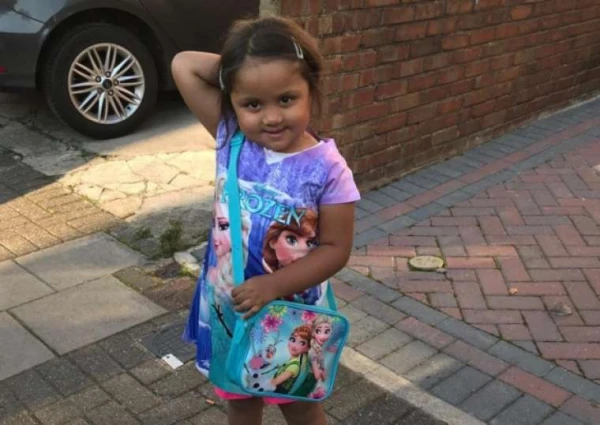
London, England, Oct 3, 2019 / 02:01 pm (CNA).- The High Court of Justice ruled Thursday that the parents of Tafida Raqeeb may take her to Italy for medical treatment. The five-year-old girl has been comatose since February, and UK doctors want to remove her life-sustaining treatment.
Doctors at Royal London Hospital, where Raqeeb is on life support, had barred her parents (Muhhamed Raqeeb and Shalina Begum) from taking her abroad for treatment. Barts Health NHS Trust, which operates the hospital, had asked that the court find that ending Raqeeb’s life-sustaining treatment is in her best interest.
Alistair MacDonald, the High Court judge, wrote in his Oct. 3 ruling that “where a child is not in pain and is not aware of his or her parlous situation, these cases can place the objective best interests test under some stress”.
“Tests must be looked for in subjective or highly value laden ethical, moral or religious factors… which mean different things to different people in a diverse, multicultural, multi-faith society,” stated MacDonald, who before his appointment as a judge practised family law, and is regarded as an expert on children’s rights.
He wrote that continued treatment was “consistent with the religious and cultural tenets by which Tafida was being raised”.
“There is no justification for interfering with the right to receive treatment in another EU member state,” the judge said.
“Transfer for treatment to Italy is the choice of her parents in the exercise of their parental responsibility and having regard to the sanctity of Tafida’s life being of the highest importance, I am satisfied, on a fine balance, that it is in Tafida’s best interests for life-sustaining treatment to continue,” Macdonald found.
The BBC reported that lawyers for Barts Health NHS Trust “said hospital bosses would consider appealing against the ruling.” They have 21 days to do so. The NHS trust said MacDonald’s decision “has clear ramifications that go beyond Tafida,” and could affect other patients being cared for in its hospitals. It stated: “The judge has granted us more time to consider the implications of this judgment for the Trust, other NHS organisations, doctors and patients.”
Two doctors from the Gaslini Children’s Hospital in Genoa examined Raqeeb via video link in July, and they agreed to care for her in Italy, saying they did not believe her to be brain dead. Her family have raised money for her transfer.
A lawyer for the Italian hospital told the court, according to The Evening Standard, that “When you drill down, it is based on differing views of what quality of life Tafida has. Clinicians (in England) don’t think she has a quality of life. Her parents do.”
Raqeeb suffered an arteriovenous malformation which resulted in a burst blood vessel in her brain, and has been in a coma since Feb. 9.
The AVM triggered cardiac and respiratory arrest, as well as a traumatic brain injury. Doctors at the Royal London Hospital say there is no chance she will recover from her coma, and declared any further medical treatment futile.
Raqeeb’s family are Muslim, and have argued that Islamic law “said only God could take the decision to end her life,” the BBC reported.
Begum, a solicitor, has said she wants to “exercise her rights as a parent.”
Muhhamed Raqeeb said he and Begum were thrilled by the High Court’s judgement.
According to The Guardian, Begum said that “We have always had Tafida’s best interests at heart and we have never wanted to come to court to have to argue for our rights to seek continued care in a world-class hospital [the Gaslini] willing to give her the treatment she needs. The entire experience of having to fight for our daughter’s life over the last three months has been exhausting and traumatic for all of her family and we are glad it is now finally over.”
She added that Tafida “is not dying and we are continuously seeing small but important signs that she is gradually improving and we have always been hopeful that she might make something of a recovery if she is just given the time and the right treatment to continue to improve.”
Begum commented, “If it happens to me, I want my life to continue until a time that God actually takes me, not withdraw life support from me.”
David Lock, a barrister for Raqeeb and Begum, said the judgement was an “enormous relief” and that the family “wanted to get on with the transfer” to Gaslini Children’s Hospital.
And Paul Conrathe, a solicitor for the family, said MacDonald’s ruling recognized “that a child’s best interests are not merely medical, but include broader social and religious values. It also recognised the legal right of parents to request life-prolonging treatment in another EU state so that their child can be treated under that system of care and ethics.”
He added, according to The Telegraph, that Raqeeb’s parents “look forward to her receiving outstanding care at the Gaslini hospital in Genoa. They will also feel at peace knowing that Tafida will be cared for under the Italian ethical and legal system.”
Bishop John Sherrington, an auxiliary bishop of Westminster and the English and Welsh bishops’ representative on life issues, welcomed the ruling, which he said “has taken account of the wishes of Tafida’s parents and their innate urge to do all they can to help their daughter in what are truly tragic circumstances. The heart-breaking illness of Tafida Raqeeb and the distress which the illness of a child causes parents touches the hearts of many people.”
“I trust that all the medical professionals will cooperate to continue to give her the best possible care and appropriate treatment. Such international cooperation is essential good practice in the care of tragically difficult lives,” he continued.
In July, Bishop Sherrington had urged that the public be reserved in judgement on Raqeeb’s case, saying that “difficult dilemmas have to be faced. In that process, I hope that all due weight will be given to the wishes of her parents, while also respecting the clinical judgement of the doctors caring for her. Those of us not in possession of all the relevant information might best be reserved in our judgement.”
Katie Gollop, a barrister representing Barts Health NHS Trust, said MacDonald’s ruling could affect other children.
Raqeeb’s case follows similar campaigns by parents with children in NHS care. Charlie Gard, Alfie Evans, and Isaiah Haastrup were all gravely ill children on life-support treatment. The parents of each of those children lost court battles in recent years against hospitals that wanted to end their treatment, and prohibit them from being taken abroad for treatment.
The NHS trust cited both Gard’s and Evans’ cases in its arguments against continuing treatment for Raqeeb and against allowing her to receive treatment elsewhere.
 […]
[…]



Rogatian & Donatian
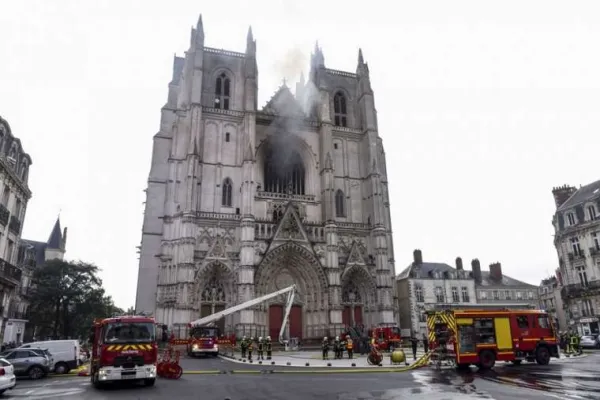
A Nantes’ resident told in one of this videos of the cathedral fire that he heard the bells first. It was unusual for a Saturday morning, so he went out into the street and then he saw a fire in the great rosette of the temple.
On the same day, i.e. on July 18, the third Saturday of the month, the annual Santa Maria Greca festival was held in Corato [https://luisapiccarreta.me/santa-maria-greca]. Before people saw this acheiropoieton (made without hand) image, they first heard the sound of an invisible bell. In Corato, touched by the plague in the year of Our Lord 1656, the Holy Madonna appeared with the Child holding the royal orb. She herself was holding a three-armed papal cross in her right hand. The Most Holy Virgin as Pope? Crowned and not the boy? Because She, as Our Mother Holy CHurch, is the Regent of an underage ruler, both spiritual and secular.
Who is this? This is the fire promised by the Lord Jesus [Lk 12:49]: “I have come to throw fire on the earth, and how much I wish that it should already be kindled.” Actually, the Fire, because it is a person, not an element. I identify him with the promised Paraclete and the great monarch of the end times.
What does the fire in Nantes have to do with it? The cathedral here has the invocation of St. Peter and Paul. I suppose St. Clair, the first bishop of the place, erected the Cathedral of St. Peter, because he had brought the nail from Rome from the crucifixion of the Prince of the Apostles. This is also indicated by the location of the temple in St. Peter’s Square. Paul appeared on the stage of the Church after the apostles had been dispersed and after Peter on the Atlantic Loire. Saint Paul the Apostle is an antitype of the Second Comforter. The coat of arms of the Nantean cathedral chapter – a sword crossed with a key – perfectly illustrates the unity of the spiritual and temporal power entrusted to the Paraclete.
Nantes is famous for the sanctity of the martyrs Donatian and Rogatian. Known as the Nantean Children, they have their basilica here (which was hit by a large fire on June 15, 2015). Their personal history, like that of Peter and Paul, is a kind of prefiguration of the relationship between Jesus Christ and the Paraclete. From the words of the Gospel [John 14:16]: “I will ask the Father, and he will give you another Comforter, that he may be with you forever …” [Latin Vulgate DRBO: “…et ego rogabo Patrem, et alium Paraclitum dabit vobis, ut maneat vobiscum in aeternum…”], it can be deduced that the requester is Rogatian, and the given (requested) is the Donatian. Besides, the Apostle of the Nations himself, before he was baptized, Paul (= Small) was known as Saul (= Asked for, Prayed for). If Rogatian represents Lord Jesus and Peter, then Donatian is the antitype of the Paraclete, Paul, and the great end-time monarch.
The fire entered the cathedral of Nantes, consumed the organ (He likes Roman music) and the stained glass window donated by Anne the Duchess of Brittany. This is the Year of Saint Anne, because July 26 falls on Sunday, the main patroness of Brittany since her apparitions in Santez Anna Wened in 1623-1625. Saint Anne appeared to Ivo Nikolazic with a burning candle (torch) in her hand, heralding the arrival of the promised Fire-Paraclete. A century earlier, in 1510 (probably on May 26), Saint Anne appeared to Małgorzata Błażkowa in Prostynia on the Bug river, Poland. Did the Holy Matron also appear there in connection with the promised Fire? It can be assumed that it is, because the Mother of God’s Mother appeared there on the feast of the Holy Trinity, i.e. the octave of Pentecost.
My variations on the Fire at Nantes are perfectly grounded in the words of the Lord Jesus to Marie Julie Jahenny in June 1882:
“I will make my choice; I will call the true Comforter for my people and for my Church. It is He who will rebuild My temples destroyed by fire and brutal civil war, which, however, will end soon. I cannot name this war that will break out in France other than a civil war. ”
The spiritual guardian (until 1877) of this Breton stigmatic was Félix Fournier, the then bishop of Nantes, the same who in 1873 initiated the construction of the magnificent basilica of the Nantean Children, Donatian and Rogatian.
Santa Maria Greca appeared in Corato – many facts indicate this date – July 15, 1656, feast of the Dispersion of the Apostles. The first Twelve were sent personally by the Lord Jesus. Whom will the Paraclete send, no longer as a Child under the protection of the Holy Regent, but still in the closest relationship with the Virgin Mother of the Church? Whom will He send? He will send the end-time apostles!
July 23, 2020, octave of Our Lady of Mount Carmel; Madonna di Altino, Albino, Bergamo, Lombardy, Italy; commemoration of Saint Bridget and Ezekiel the Prophet
P.S.
Today, i.e. on July 26, French media revealed the name of the arsonist: ‘Emmanuel’, Rwandan, longtime altar boy (rather Catholic), cathedral cleaner and sacristan, volunteer. Thus we got an unexpected confirmation of the line of my interpretation of the fire in Nantes – I suppose Saint Anne the Mother intervened in this matter, this is her Sunday and her Year. All this dramatic event in Nantes, on July 18 22020, can be summed up as the Emmanuel’s Fire!
An associated Polish thread appears here:
Two weeks earlier, on July 4, 2020, at dawn, the roof of Saint Paul’s* Church in Corbeil-Essonnes, belonging to the French-Polish parish, completely burned down. Firefighters participating in the action described this fire as “the small Notre-Dame” compared to the conflagration of the Paris Cathedral on April 15/16, 2019. ‘The Small’ means ‘Paul’ in close relation to ‘Notre-Dame’ in the Polish-French backyard! Interesting, isn’t it?
* https: //pl-pl.facebook.com/stpaulcorbeil/ The main image of the Apostle of the Nations in this temple gives the impression of a two-headed figure, just like the Roman Janus. Saint Paul survived the fire near Paris along with the One of whom he is antitype – the Paraclete.
For the record: The Nantean Cathedral was built on the site of the ancient temple of Janus.