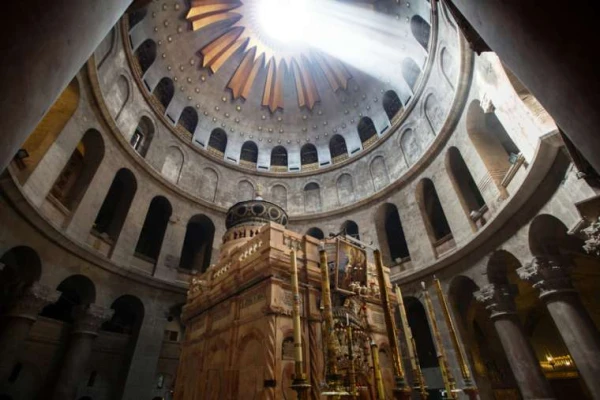
CNA Staff, May 23, 2020 / 02:04 pm (CNA).- The Church of the Holy Sepulchre in Jerusalem is reopening this weekend, after being closed in late March due to the coronavirus pandemic.
A statement from the Custodians of the Holy Sepulchre announced that the site would be open to pilgrims beginning May 24.
“For safety reasons and in order to avoid the risk of a new spread of the COVID-19 infection, at the beginning the number will be limited (to 50 persons) and the Basilica will be accessible only to those who have no fever or symptoms of infection and are wearing suitable face coverings,” they said.
“It will also be necessary to keep a minimal distance of 2 meters between each person and to avoid any act of devotion that might include physical contact such as touching and kissing the stones, icons, vestments and the personnel in the Basilica; as well as abide always by the given instructions.”
The church building, which houses the tomb of Christ and the site of the crucifixion, was first closed to pilgrims and other visitors on Wednesday, March 25. Initially, the closure was only expected to last for one week, but religious and Israeli government officials agreed that due to the ongoing COVID-19 pandemic, the global pilgrimage destination should remain closed.
The Church of the Holy Sepulchre is unique among religious sites as it is partially controlled by several different Christian Churches. The Roman Catholic Church, Greek Orthodox Church, and Armenian Apostolic Church each share control of the building, and other Orthodox Churches also celebrate divine liturgy at the site.
The last time the Church of the Holy Sepulchre was closed for an extended period due to disease was 1349, during an outbreak of the Black Death in Jerusalem.
The church, which was first consecrated in the year 335, has been closed for short periods of time in the subsequent millennia due to war or other disputes. In 2018, to protest a proposed tax increase on churches, the site was closed to the public for about three days before reopening.
Globally, there have been more than 5 million confirmed cases of the novel coronavirus, with more than 340,000 recorded deaths, according to the Johns Hopkins Coronavirus Resource Center.
If you value the news and views Catholic World Report provides, please consider donating to support our efforts. Your contribution will help us continue to make CWR available to all readers worldwide for free, without a subscription. Thank you for your generosity!
Click here for more information on donating to CWR. Click here to sign up for our newsletter.

Deacon Johnny Al-Daoud celebrates his release from captivity in Syria on March 2, 2025, with family and friends. / Credit: St. Michael’s Church – Maskana Parish
ACI MENA, Apr 5, 2025 / 07:00 am (CNA).
On the morning of Sunday, March 2, without any prior notice, Johnny Fouad Dawoud, a deacon in the Syriac Catholic Church for the Archdiocese of Homs, was released from a Syrian prison after a decade of confinement.
ACI MENA, CNA’s Arabic-language news partner, spoke with him after he was reunited with his family to discuss his ordeal of being captured by the Al-Nusra Front, his moments of faith and doubt behind bars, and the light that now shines in his life.
Friends and family gather around Deacon Johnny Fouad Dawoud as he returns home on March 2, 2025, after a decade in captivity. Credit: Photo courtesy of Deacon Johnny Fouad Dawoud
ACI MENA: Tell us first about your upbringing and journey in the Church.
Dawoud: I was born into a religiously committed family, and from childhood, I was passionate about participating in pastoral activities. At the age of 12, I joined the minor and then the major seminary in Lebanon, graduating in 2009 with a degree in theology and philosophy from the University of the Holy Spirit in Kaslik, Lebanon.
I returned to Homs to prepare for my priestly ordination, but as the date for the diaconal ordination approached, I felt unprepared to take on those roles and was not entirely convinced about celibacy. After much reflection and consultation, I decided to be honest with God and myself, and withdrew — a decision that surprised my family and friends, especially my uncle, Cardinal Patriarch Mar Ignatius Moses I Daoud.
[Editor’s note: Dawoud later became a permanent deacon in the Syriac Catholic Church, allowing him to read the Epistles during the liturgy.]
What challenges did you face after that?
I got married and was blessed with a child. However, with the outbreak of the Syrian revolution, I lost my home in the Christian district of Hamidiyah in Old Homs due to clashes. Military service was the biggest challenge; I was moved between several fronts, the last being Abu Dhuhur airport, where we were besieged for months.
The situation was tragic; food supplies ran out, and we were forced to eat grass and leaves. The water was contaminated and not potable, leading to various diseases. In September 2015, the rebels stormed the airport, and only 38 out of 300 survived.
Deacon Johnny Fouad Dawoud gives thanks with his family and friends at Mass after his release from prison in Syria. Credit: Photo courtesy of Deacon Johnny Fouad Dawoud
After you were captured and taken to prison, how did you experience captivity?
We were held hoping for a prisoner exchange, but regime officials did not seriously cooperate with our case. At one point, their negotiators even said, “Kill them; we no longer care about them.” Throughout the 10 years, we were generally treated well and were not subjected to torture or insult, except during the initial investigation period. Yet, our suffering was immense, the hardest part being the complete isolation from the outside world, enough to destroy anyone’s psyche. Living in the unknown as if you were dead causes constant turmoil and devastating frustration.
We fell ill, including with COVID-19, which nearly killed us, and we didn’t even know it had claimed millions outside. Food and water were generally good, though the lack of washing and bathroom water troubled us, but we managed.
After three years of captivity, we were allowed one short call per year (during Ramadan) with our families, thanks to a meeting with Abu Mohammad al-Julani, leader of the Al-Nusra Front.
How did this experience affect your faith?
It’s very difficult for a captive to describe his spiritual experience in prison in a few words.
Muslims were interested in discussing religious issues with me, some of whom I avoided debating due to their blind fanaticism — they knew only words like infidel, polytheist, apostate, atheist, and hypocrite.
However, graduates from Islamic legal institutes and colleges were enjoyable to discuss with, as I had a margin of freedom to speak and defend my faith, which they accepted and understood.
I truly loved witnessing to my faith as if I were living among our saintly fathers and martyrs in times of early persecution. I always lived with Apostle Paul, saying with him: “We are ambassadors for Christ,” indeed being an ambassador for Christ and not just in words, in a place where that was considered heresy.
I prayed a lot, conversing with my Lord at night and calling upon him during the day. But it pains me to say that at the beginning of my captivity, as the years passed and my and my family’s suffering increased, my faith wavered. My trust in God began to shake, and I wondered: Why does my Lord not respond to me? Why is he punishing me? What sins did my family commit to deserve all this suffering?
Deacon Johnny Al-Daoud, pictured with family members, was released from captivity in Syria on March 2, 2025. Credit: St. Michael’s Church – Maskana Parish
What about the moment of your release and your reception in Homs?
On the morning of Sunday, March 2, without any prior knowledge, they called my name, asking me to prepare to leave. I stood outside the prison gate, unbelieving that I was free. I was transferred to the Christian village of Ya’qubiya in Idlib countryside, where Father Louai the Franciscan and the locals warmly received me, leaving a lasting impression on me. There, I contacted the pastor of our Syriac Catholic archdiocese, Bishop Jacob Murad, and my family. My brother Munther, who did not know I had been released, began screaming with joy when I told him, “Prepare dinner, I’ll be home this evening.”
When I arrived at my diocese in Homs, Bishop Jacob, along with priests, my wife, my son, and many relatives and friends, were there to receive me. We entered the church to give thanks to the Lord, and I received holy Communion from his eminence the bishop. After receiving congratulations, I headed to my village, Maskanah (in the Homs countryside), and we entered the village with a grand celebration.
Christians and Muslims, young and old, welcomed me, and crowds from other areas came. When I saw the joy of the people at my liberation, I truly and immediately forgot the suffering of those 10 years.
This story was first published by ACI MENA, CNA’s Arabic-language news partner, and has been translated and adapted by CNA.
Johannesburg, South Africa, Sep 16, 2019 / 09:10 am (CNA).- A wave of deadly attacks targeting African foreign nationals in South Africa has caught the attention of national and regional Church leaders, as affected countries have started repatriating their citizens from South Africa.
“It is with dismay that we take note of the recent upsurge in violence against foreign nationals,” the Southern African Catholic Bishops’ Conference said in a statement earlier this month.
“We are facing a rising tide of hatred and intolerance, no difference to the rising tide of hatred in Nazi Germany,” the bishops added.
“If we do not take urgent action to stop it (xenophobic attacks), there will be nothing left.”
“This is not the work of a few criminal elements,” the bishops said of the recent spate of attacks against Nigerians and other foreign nationals in South Africa. At least 12 people have been killed in recent weeks, and hundreds have been arrested for their part in riots demonstrating against foreigners.
“It is xenophobia, plain and simple,” the bishops said.
We Africans must not lose our characteristic love of humanity, the respect for the sanctity of life and solidarity,” Nigeria’s Bishop Emmanuel Badejo, president of the Pan African Episcopal Committee for Social Communications (CEPACS), said last week.
“Nigeria and South Africa must peacefully resolve this unfortunate incident and stop its aggravation,” Badejo told ACI Africa.
The Zambian bishops’ conference has cautioned Zambians not to retaliate against South Africans in Zambia, urging “all Zambians to restrain themselves from any acts of violence and vengeance against South African nationals and their property or business.”
The Inter-Regional Meeting of the Bishops of Southern Africa has also added their voice to the matter, expressing their disappointment about the situation in one of Africa’s most industrialized nations.
“The deplorable actions that we have witnessed cannot be condoned in any way nor can they be hidden behind words that hide the real terror of xenophobia,” IMBISA said.
“We implore the home nations of those affected, not to raise the stakes by responding in revenge with violence,” the Church leaders of IMBISA added. The organization includes bishops from Angola, Botswana, Mozambique, Namibia, South Africa, Swaziland, and Zimbabwe.
Mozambique, Zimbabwe, and Nigeria are among the African countries that have considered repatriating their citizens from South Africa, with reports indicating hundreds of Nigerians successfully repatriated already.
Amid the attacks in South Africa, South Africa’s High Commission in Abuja, Nigeria, and its mission in Lagos have been closed, as the diplomatic staff feel threatened by the possibility of retaliation.
This is not the first time South Africa has experienced such violence. Xenowatch African Centre for Migration & Society, which has been monitoring xenophobia in the country, reports similar peaks in xenophobic attacks in 2008 and 2015.
Xenophobia in South Africa is often sparked by accusations that migrants take away jobs from South Africans. As a result, foreigners, especially Africans, have been targeted, with reports of some deaths and destruction of property.
A version of this story was first reported by CNA’s partner agency, ACI Africa. It has been adapted by CNA.
Leave a Reply