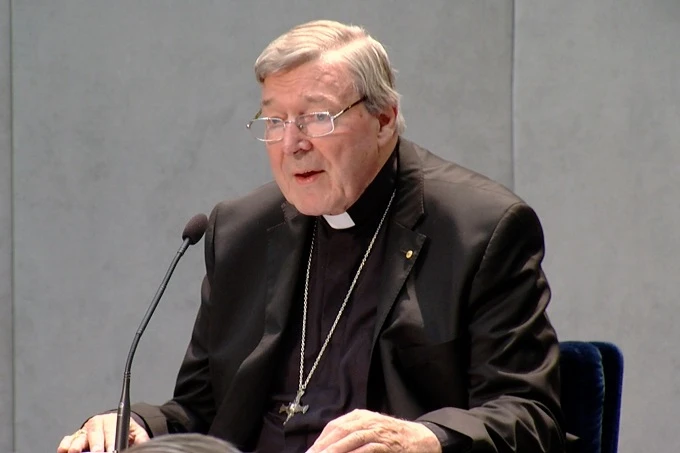
Vatican City, Jun 29, 2017 / 01:34 am (CNA/EWTN News).- After Australian police announced that they have charged him on multiple counts of sexual abuse, Cardinal George Pell has maintained his innocence, saying he will take leave from his responsibilities in the Vatican to clear his name.
In comments to journalists during a June 29 news briefing at the Holy See Press Office, Cardinal Pell said that with the permission of Pope Francis, he will be taking “leave” from his position as the Prefect of the Secretariat of the Economy in order “to clear my name.”
“I am looking forward, finally, to having my day in court. I’m innocent of these charges, they are false,” he said, adding that “the whole idea of sexual abuse is abhorrent to me.”
Throughout the two years he has been fighting the accusations, there have been various media leaks and “relentless character assassination,” he said, insisting he has been “consistent and clear in my total rejection of these allegations.”
Pell said that he has regularly kept Pope Francis informed of the process. In the past week, the two have spoken on “many occasions” about “my need to take leave to clear my name,” he said, voicing his gratitude to the Pope “for giving me this leave to return to Australia.”
The cardinal said he has already spoken with his lawyers and doctors about how and when he will return to Australia to face the charges.
“News of these charges strengthens my resolve, and court proceedings now offer me the opportunity to clear my name and then return here, back to Rome, to work,” he said.
Cardinal Pell’s statement came after the police of Victoria, Australia announced that they are charging him on multiple counts of historical sexual abuse.
The charging of Cardinal Pell, who in 2013 was tapped to oversee the Vatican’s Secretariat for the Economy and is a member of the Council of Cardinals advising Pope Francis, makes him the most senior Vatican official to ever be charged with abuse.
He was ordained in the diocese of Ballarat in 1966, where he served as a priest and later as a consulter to Bishop Ronald Mulkearns, who oversaw the diocese from 1971-1997. Pell was appointed auxiliary bishop for the archdiocese of Melbourne in 1987, and was named archbishop in 1996.
In February 2016, he testified for the third time before Australia’s Royal Commission regarding claims that surfaced in 2015 accusing the cardinal of moving “known pedophile” Gerald Ridsdale, of bribing a victim of the later-defrocked priest, and of ignoring a victim’s complaint.
Established in 2013, the Royal Commission is dedicated to investigating institutional responses to child sexual abuse.
Despite having testified before the commission twice before on the same charges, Pell again offered to give his testimony, which he did via video conference from Rome.
Shortly before the hearing, abuse allegations surfaced accusing the cardinal of multiple counts of child sexual abuse dating as far back as 1961, which he has continued to fervently deny.
In a June 29 communiqué released after Cardinal Pell made his statement to journalists, Vatican spokesman Greg Burke said the Holy See learned with “regret” about the charges filed for “decades-old actions” that have been attributed to the cardinal.
“Having become aware of the charges, Card. Pell, acting in full respect for civil laws, has decided to return to his country to face the charges against him, recognizing the importance of his participation to ensure that the process is carried out fairly, and to foster the search for truth,” the communiqué read.
Echoing Pell’s own statement, Burke affirmed that Pope Francis has granted the cardinal an absence from his duties “so he can defend himself,” and that in his absence, the Secretariat for the Economy will continue to carry out its work.
The secretaries in the department will remain at their posts to carry forward the dicastery’s work “donec aliter provideatur,” meaning “until otherwise provided.”
Pope Francis, Burke said, “has appreciated Cardinal Pell’s honesty during his three years of work in the Roman Curia,” and is grateful for his collaboration and “energetic dedication to the reforms in the economic and administrative sector, as well as his active participation in the Council of Cardinals (C9).”
On behalf of the Holy See, Burke voiced respect for the Australian justice system, which “will have to decide the merits of the questions raised.”
However, at the same time, he said “it is important to recall that Card. Pell has openly and repeatedly condemned as immoral and intolerable the acts of abuse committed against minors” and has cooperated with Australian authorities in the past, specifically with his depositions before the Royal Commission.
Moreover, the cardinal has been supportive of the Pontifical Commission for the Protection of Minors, and as a diocesan bishop in Australia, introduced systems and procedures “both for the protection of minors and to provide assistance to victims of abuse.”
Burke closed noting that Cardinal Pell will no longer be attending public events while facing the charges, and as such would be absent from the day’s today’s Mass for the Feast of Saints Peter and Paul, to be celebrated by Pope Francis and attended by all new metropolitan archbishops appointed during the previous year.
 […]
[…]



Leave a Reply