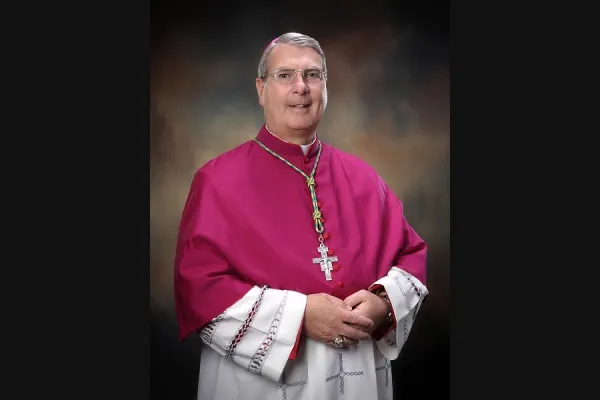
Vatican City, Mar 5, 2020 / 04:09 am (CNA).- Pope Francis Thursday appointed Bishop Gregory Hartmayer of Savannah to be the next archbishop of Atlanta, Georgia.
Hartmayer is a member of the Order of Friars Minor Conventual and has been bishop of Savannah since 2011.
The Archdiocese of Atlanta covers 21,445 square miles in the northern half of Georgia. The archdiocese has over 100 parishes and serves around 1.2 million Catholics.
It is also the metropolitan see of the province of Atlanta, which encompasses the suffragan dioceses of Savannah, Georgia; Charleston, South Carolina; and Raleigh and Charlotte, North Carolina.
This means, according to Pope Francis' 2019 norms Vos estis lux mundi, if a bishop in one of these dioceses were to be accused of sexual abuse or coercion, or of interfering in investigation of such conduct, it would fall to Hartmayer to investigate.
There are currently several 'Vos estis' investigations going on in dioceses in the U.S.
Hartmayer was born in 1951 in Buffalo, New York, one of four children.
He joined the Conventual Franciscan novitiate in Ellicott City, Maryland in 1969 and made his solemn profession in 1973.
He was ordained a priest for the Franciscan order in 1979.
In addition to a bachelor of arts degree in philosophy from St. Hyacinth College and Seminary in Massachusetts, Hartmayer holds three master's degrees: a master of divinity degree from St. Anthony-on-Hudson, in Rensselaer, New York; a master of arts degree in pastoral counseling from Emmanuel College, Boston and a master of education degree from Boston College.
Prior to being named bishop of Savannah, Hartmayer had spent 16 of his 32 years of priesthood in Catholic high school education, with the remaining in parish ministry.
He spent many years in New York and Massachusetts, but in 1995, he moved south to teach at a Catholic high school in Florida, before being asked to serve as pastor of St. Philip Benizi Church in Jonesboro, Georgia.
Hartmayer was appointed bishop of Savannah in 2011.
If you value the news and views Catholic World Report provides, please consider donating to support our efforts. Your contribution will help us continue to make CWR available to all readers worldwide for free, without a subscription. Thank you for your generosity!
Click here for more information on donating to CWR. Click here to sign up for our newsletter.
Pope Francis gives a Regina Coeli address at the Vatican on May 2, 2021 / Daniel Ibáñez/CNA.
Vatican City, Feb 21, 2022 / 12:00 pm (CNA).
According to a canon law expert, the two motu proprios recently promulgated by Pope Francis could signal a… […]
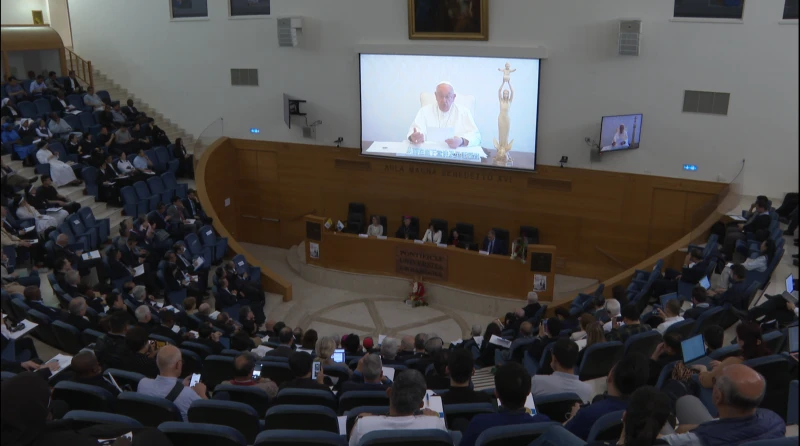
Pope Francis delivers a video message to the conference “100 Years Since the ‘Concilium Sinense’” at the Pontifical Urban University in Rome on Tuesday, May 21, 2024. / Credit: Fabio Gonnella/EWTN
Rome Newsroom, May 21, 2024 / 13:57 pm (CNA).
Pope Francis has praised the Catholic Church’s first council in China 100 years ago as “an authentic synodal journey” that opened the way for the Church in China “to increasingly have a Chinese face.”
In a video message to a conference in Rome on the Catholic Church in China, the pope noted that Chinese Catholics have endured “times of patience and trial” in the past century.
“The Lord in China has safeguarded the faith of the people of God along the way. And the faith of God’s people has been the compass that has shown the way throughout this time,” Pope Francis said in the May 21 address.
Pope Francis delivers a video message to the conference “100 Years Since the ‘Concilium Sinense’” at the Pontifical Urban University in Rome on Tuesday, May 21, 2024. Credit: Fabio Gonnella/EWTN
The pope pointed to a Church council that took place in Shanghai 25 years before the Chinese Communist Revolution as an example of a moment when “the communion between the Holy See and the Church in China manifested its fruits, fruits of good for all the Chinese people.”
The 1924 council, called the Primum Concilium Sinense, brought together 105 Catholic missionaries, bishops, and Chinese Catholics to establish a framework for a native Chinese hierarchy.
“The Fathers gathered in the Concilium Sinense lived an authentically synodal experience and made important decisions together,” Pope Francis said.
“Remembering the Council of Shanghai can also suggest today new paths to the entire Church and open paths to be undertaken with boldness to proclaim and bear witness to the Gospel in the present,” he added.
Among the crowd listening to the pope’s video message were representatives from the People’s Republic of China, including Bishop Shen Bin of Shanghai, who was unilaterally installed by Chinese authorities as bishop of Shanghai in April 2023 without a papal mandate, thereby breaking the terms of the Vatican-China deal. Pope Francis confirmed his appointment in July 2023.
The Holy See first entered into a provisional two-year agreement with Beijing on the appointment of bishops in 2018, which has since been renewed twice and is again up for renewal this fall.
Pope Francis opted not to speak of the Vatican’s diplomatic efforts with Beijing or religious freedom in China in his message but said that Chinese Catholics today “bear witness to their faith through works of mercy and charity, and in their witness they give a real contribution to the harmony of social coexistence.”
A large statue of Our Lady of Sheshan stood on the pope’s desk as he spoke. The pope noted that during the month of May many Chinese Catholics usually go on pilgrimage to the Marian Shrine of Sheshan, located near Shanghai.
“I too ideally climb the hill of Sheshan, and let us all together entrust to Mary, Help of Christians, our brothers and sisters in the faith who are in China, all the Chinese people, and all our poor world, asking for her intercession, so that peace may always win everywhere,” Pope Francis said.
Following the pope’s message, Shen Bin delivered a 15-minute speech in Chinese to the packed auditorium of the Pontifical Urban University on the Janiculum Hill overlooking St. Peter’s Basilica.
The Chinese bishop offered a different interpretation of the 1924 council from the pope in his speech, saying that “the Council of Shanghai did not lead to an immediate and radical change in the Church in China,” adding that by the 1949 Communist Revolution “only 29 of China’s 137 dioceses had Chinese bishops, and only three of 20 archbishops were Chinese.”
“The Catholic Church in China had not really freed itself from foreign powers to become a work led by Chinese Christians and had not yet managed to shed the label of ‘foreign religion,’” he said.
Shen Bin, who has held leadership positions in the Chinese Catholic Patriotic Association established by the Chinese Communist Party and under the control of the United Front Work Department, went on to defend Beijing’s religious freedom record and underlined the need for the Church in China to “follow a path of sinicization.”
“The policy of religious freedom implemented by the Chinese government has no interest in changing the Catholic faith but only hopes that the Catholic clergy and faithful will defend the interests of the Chinese people and free themselves from the control of foreign powers,” Shen Bin said in his speech.
“Today the Chinese people are carrying out the great rebirth of the Chinese nation in a global way with Chinese-style modernization, and the Catholic Church in China must move in the same direction, following a path of sinicization that is in line with Chinese society and culture today,” the Shanghai bishop added.
The conference, titled “100 Years Since the ‘Concilium Sinense’: Between History and the Present,” was held in Chinese and Italian in the Great Hall of the Pontifical Urban University. The Pastoral Commission for China and Agenzia Fides, the information service of the Pontifical Mission Societies, organized the conference, which featured Vatican Secretary of State Cardinal Pietro Parolin and Cardinal Luis Antonio Tagle as speakers.
Speaking to journalists on the sidelines of the conference, Parolin said the Holy See would like to increase and deepen its contacts in China.
“We have been hoping for a long time now to have a stable presence in China, even if initially it may not have the form of a papal representation of an apostolic nunciature,” Parolin said.
Vatican City, Nov 10, 2017 / 05:18 am (CNA/EWTN News).- In a key speech on the global effort to eradicate nuclear arms, Pope Francis called the weapons immoral and said they should be made illegal in war, but he also voiced hope that despite pessimism, things are moving in the right direction.
In a Nov. 10 audience with participants in a Vatican symposium on nuclear disarmament, the Pope said “a healthy realism continues to shine a light of hope on our unruly world,” particularly on the nuclear front.
Pointing to the international treaty passed at the United Nations in July, Francis said this is a concrete sign that progress is being made in the effort to eliminate nuclear arms, and called the treaty “a historic vote,” in which the majority of the international community “determined that nuclear weapons are not only immoral, but must also be considered an illegal means of warfare.”
The employment of nuclear devices, whether intentionally or through accidental detonation, he said, would cause “catastrophic humanitarian and environmental effects.”
Organized by the Pontifical Council for Integral Human Development, the Nov. 10-11 symposium is the first global gathering on this topic since the approval of the Treaty on the Prohibition of Nuclear Weapons at the United Nations July 7.
Until the treaty, nuclear weapons were the only weapons of mass destruction not explicitly banned by any international document. As the Pope pointed out in his speech, chemical weapons, biological weapons, anti-human mines and cluster bombs had all been explicitly prohibited in previous international conventions.
He praised the treaty as also being largely the result of humanitarian initiatives sponsored by the collaboration of civil society, states, international organizations, churches, academies and experts.
Ultimately, to achieve a world without nuclear weapons requires a change of heart, not just laws, he said, saying we must renew our focus on the integral development of the human person as an “indissoluble unity of soul and body, of contemplation and action.”
This approach gives hope that it’s possible, the Pope said, adding that the perspective goes contrary to our own pessimism and the criticisms of those who see the effort to totally eliminate weapons of mass destruction as “idealistic.”
Quoting St. John XXIII’s 1963 encyclical “Pacem in Terris,” Francis said, “unless this process of disarmament be thoroughgoing and complete, and reach men’s very souls, it is impossible to stop the arms race, or to reduce armaments, or – and this is the main thing – ultimately to abolish them entirely.”
Reiterating the many statements he’s made on the topic, Pope Francis said the escalation of the arms race and the expense it requires means money is taken away from what should be the real priorities: “the fight against poverty, the promotion of peace and the undertaking of educational, ecological and healthcare projects.”
As a permanent observer to the United Nations, the Holy See has played an integral role in the negotiations of the treaty banning nuclear weapons. This role has included casting a procedural vote on the treaty earlier this year, which is a right the Holy See doesn’t have for every issue, further underlining the their concern regarding nuclear weapons.
During talks on nuclear weapons at the U.N. headquarters in New York, Pope Francis said the treaty, which was still being negotiated at the time, was inspired by “ethical and moral arguments,” and was an “exercise in hope.”
On that occasion, he voiced his hope that the treaty would be “a decisive step along the road towards a world without nuclear weapons.” And while this is “a significantly complex and long-term goal, it is not beyond our reach.”





Leave a Reply