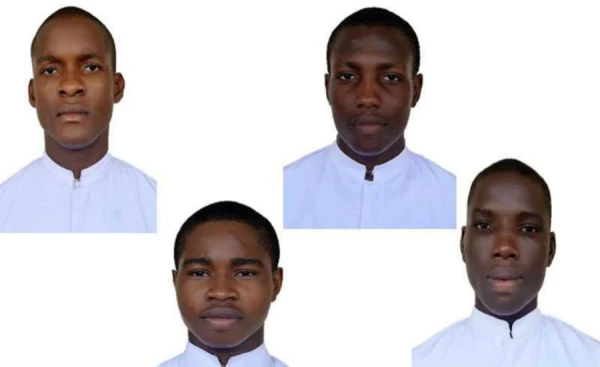
Kaduna, Nigeria, Jan 20, 2020 / 11:30 am (CNA).- A Nigerian seminarian who was abducted this month was freed by his kidnappers after 10 days in captivity. Three seminarians kidnapped with him remain in captivity.
The freed seminarian, who has not yet been identified, is being treated at a Catholic hospital in Kaduna, Nigeria. The extent of his injuries is unclear, but he is being treated in the hospital’s intensive care unit.
“From the time of the abduction, this seminarian was stubborn to the abductors; he could hold on anything he could find, resisting the kidnapping,” a source close to Good Shepherd Major Seminary in Kaduna told ACI Africa, CNA’s African news partner.
“The seminarian was beaten up badly resulting in some fractures of his body parts, yet they took him still,” the source said of the Jan. 8 kidnapping.
The seminarian, still suffering injuries from his abduction, was dumped by kidnappers Jan. 18 on the side of Nigeria’s Kaduna-Abuja highway. He was taken to the hospital after being found by passing motorists.
The seminarian might have been freed and dumped along the road “because the abductors felt the boy could not survive in their hands,” a source told ACI Africa.
The students, Pius Kanwai, 19; Peter Umenukor, 23; Stephen Amos, 23; and Michael Nnadi, 18, were abducted on the night of Jan. 8 in a 30-minute operation that saw the kidnappers, dressed in military uniform and armed with guns, force their way onto the Catholic seminary campus, which is home to 268 seminarians.
Since Jan. 11, the abductors have been making contact with family members of the seminarians to discuss ransoms for their release, a source in Nigeria told ACI Africa Jan. 12.
According to a Sunday news report, Archbishop Matthew Man’oso Ndagoso of Kaduna has cautioned against speculation about the abductors’ demand for ransom for the safe release of the seminarians.
“We have streamlined discussion with the kidnappers, it is only one person that is communicating with them, we can’t disclose any discussion with them,” Archbishop Man’oso told local media. Good Shepherd Seminary is located just off the Abuja-Kaduna-Zaria Express Way. According to AFP, the area is “notorious for criminal gangs kidnapping travelers for ransom.”
The news agency said that schoolgirls and staff from a boarding school also located near the highway were kidnapped in October, and were later released.
Kidnappings of Christians in Nigeria have multiplied in recent months, a situation that has prompted Church leaders to express serious concern about the security of their members and to call on the government to prioritize the security of its citizens.
A version of this story was first published by ACI Africa, CNA’s African news partner. It has been adapted by CNA.
If you value the news and views Catholic World Report provides, please consider donating to support our efforts. Your contribution will help us continue to make CWR available to all readers worldwide for free, without a subscription. Thank you for your generosity!
Click here for more information on donating to CWR. Click here to sign up for our newsletter.

Denver, Colo., Feb 15, 2019 / 05:00 pm (CNA).- Four years after the so-called Islamic State released a propaganda video showing the beheading of 21 abducted Coptic Christians in Libya, aid workers and politicians continue to highlight the dangers facing Christians in the Middle East and across the world.
On Feb. 15, 2015, a video was released showing IS fighters beheading Egyptian workers,as they knelt on a Libyan beach wearing prison-style orange jumpsuits. The Egyptian government and the Coptic Church later confirmed the video’s authenticity.
Edward Clancy, director of outreach for Aid to the Church in Need USA, told CNA that the killing of the Coptic martyrs helped to bring the issue to Christian persecution into focus for the wider Western culture and media, and spurred an outpouring of donations for charitable aid.
“It definitely brought the Christian persecution to the forefront and put it on page one,” Clancy told CNA in an interview Feb. 15.
Soon afterward the video’s release. the Coptic Church announced that the men would be commemorated as martyrs in its Church calendar. In October 2018, authorities found a mass grave believed to contain the bodies of the 21 men.
“Seemingly every day at that time there was a story of something going on, whether it was the fall of Raqqa; the enslavement of women; obviously the killing of the Coptic martyrs. And all of these did bring this [issue] into focus, and people did respond. Obviously it touched a lot of people’s hearts, and because of that they were very generous,” Clancy said.
Aid to the Church in Need has been working to help persecuted Christians since its founding in 1947. Clancy told CNA that while the public martyrdoms brought the dangers facing persecuted Christians to wider attention, Aid to the Church in Need had considered the issue a core concern for some time.
“I wouldn’t say that the videos changed much as far as [ACN’s priorities] go; our commitment to the Christian community there was as high before and after;” Clancy said.
“And that was because we saw the existential threat to the Christian communities by what was going on, by the violence, by the terrorism…The videos strengthened our resolve, I guess, to say we’re not going to let this happen.”
To this day, Clancy said, ancient Christian communities in the Middle East are at risk of disappearing. In Syria alone hundreds of thousands of Christians have been driven from their homes in places like Nineveh, Damascus, Homs, and Aleppo.
Last December, a mass grave of 34 Ethiopian Christians was unearthed. That grave is believed to contain the bodies of Christians killed by IS forces in a propaganda video posted on social media in April 2015, two months after the first video was released.
That video, similar to the first one, appeared to show the Islamic State members shooting and beheading the Ethiopian Christians, who were all wearing orange jumpsuits, on a beach.
Clancy told CNA that ancient Christian communities in the Middle East remain at risk of disappearing. In Syria alone hundreds of thousands of Christians have been driven from their homes in places like Nineveh, Damascus, Homs, and Aleppo.
“We’ve been able to support $55 million in aid over the years in Iraq and probably about $40 million in Syria in different programs to help keep the Christian communities alive,” Clancy said.
“Unfortunately though, even with all of those efforts, there’s been a great decline in the number of Christians. Iraq is down to about 20% of its Christian population as compared to 2000. And Syria’s down probably something like 40% since that time too.”
Clancy highlighted the continued dangers faced by Christians all over the region and the world, and noted the moral imperative on the international community to remember and support them.
“For us here in the United States, in the West, in the sort of ‘safe world,’ we actually take for granted that our faith is part of our lives. There, it’s part of their lives, but it could also be a reason for their death. So we should do our best to pray for them, to be aware of what’s going on and to support them by financial means and also for advocating on their behalf in the public arena.”
Clancy highlighted the recent announcement that the United States would withdraw troops from Syria as a source of fear among some in the Christian community. The move, he said, raised anxiety that terrorist forces might be emboldened by the decision.
“I think we have to be fair enough to say that when there’s a need for [military] protection that we should do it,” he said.
“It’s really all dependent on international governments, on the United States, the West, Europe, to stand up and say we’re not going to allow Christianity to die there. As Catholics, we can’t be afraid to say that, ” Clancy said.
One such advocate in the United States is Arkansas Congressman French Hill, who introduced a resolution Jan. 16 supporting the religious freedom of Coptic Christians in Egypt.
Hill’s resolution called on the Egyptian government to “end the culture of impunity” with which Christians were attacked and to “make examples by arresting, prosecuting, and convicting those responsible for attacks on Christians.”
“We forget that it’s not wrong to say that Christians belong [in the Middle East] and Christians should stay there. That’s what I always ask people to remember,” Clancy said.
Rumbek, South Sudan, Nov 19, 2018 / 02:18 pm (CNA/EWTN News).- Fr. Victor-Luke Odhiambo, a Jesuit from Kenya, was shot and killed in South Sudan by unknown gunmen while at home Thursday morning.
Fr. Odhiambo, who was the principal of Mazzolari Teacher… […]
The Catholic faithful gathered in the Cenacle in Jerusalem for the Mass of the Lord’s Supper that the Franciscan friars celebrated on Holy Thursday, March 28, 2024. The Cenacle is at the center of strong tensions and disputes regarding ownership and rights of access and celebration. An ancient tradition places King David’s tomb here and over the centuries Jews and Muslims have leveraged this to first expel the Franciscans and then to prevent Christian worship, which they deemed sacrilegious. / Credit: Marinella Bandini
Jerusalem, Mar 28, 2024 / 17:15 pm (CNA).
On Holy Thursday, the doors of the Cenacle in Jerusalem were opened to welcome the Franciscans of the Custody of the Holy Land. In this “Upper Room,” called the Cenacle in the Holy Land, Jesus had his Last Supper, washed his apostles’ feet, and instituted the Eucharist.
It was here that the Franciscans celebrated the Mass of the Lord’s Supper, reenacting those same gestures. (At the Basilica of the Holy Sepulcher, however, the celebration is held on Thursday morning due to the Status Quo. Here is Cardinal Pierbattista Pizzaballa’s homily from that Mass.)
Cardinal Pierbattista Pizzaballa, the Latin Patriarch of Jerusalem, kisses the feet of a Franciscan friar during the “Washing of the Feet” ritual at the Mass of the Lord’s Supper celebrated at the Holy Sepulchre on Holy Thursday. The celebration is held on Thursday morning due to the Status Quo. March 28, 2024. Courtesy of the Custody of the Holy Land
The custos of the Holy Land, Father Francesco Patton, presided over the Eucharistic celebration at the Cenacle. In his homily, before washing the feet of six teachers and six students from the Terra Sancta School in Jerusalem, he emphasized the value of the “new commandment” that Jesus gave to his apostles here: “As I have loved you, so you also should love one another” (Jn 13:34).
“To love means to give oneself and to serve,” he said. “In this celebration, we want to nourish ourselves with Jesus because if he is alive within us, then we too will become capable of loving one another as he loved us. And we also want to learn from Jesus not to be served but to serve.”
Some students from the Terra Sancta School in Jerusalem who took part in the “Washing of the Feet” ritual during the Mass of the Lord’s Supper celebrated at the Cenacle in Jerusalem on Holy Thursday, March 28, 2024. Addressing them specifically in his homily, the Custos of the Holy Land emphasized the value of the “new commandment” that Jesus gave to his apostles here: “As I have loved you, so you also should love one another” (John 13:34). Credit: Marinella Bandini
Holy Thursday is the only day, along with Pentecost Sunday, when the Franciscans have the right to gather in the Upper Room to pray. Usually, it is a liturgy of the word, but since 2021 they have celebrated Mass. Outside, Israeli Army personnel ensure security.
The Cenacle is at the center of strong tensions and disputes regarding ownership and rights of access and celebration. An ancient tradition places King David’s tomb here, and over the centuries, Jews and Muslims have leveraged this place to first expel the Franciscans and then to prevent Christian worship, which they deem sacrilegious.
Father Narciso Klimas, historian and archivist of the Custody of the Holy Land, explained to CNA: “The Custody has all the documents confirming our ownership of Mount Zion.” Even today, traces of Christian presence are visible, both in the architecture of the place and in some symbols.
“The presence of the Franciscans at the Cenacle,” Klimas explained, “dates back to 1342, but as early as 1333, the rulers of Naples, Robert of Anjou and Sancha of Majorca, acquired the land and donated it to the friars. This was the first headquarters of the Custody of the Holy Land.” To this day, the official title of the Custos of the Holy Land is “Guardian of Mount Zion and the Holy Sepulchre.”
Father Francesco Patton, custos of the Holy Land, incenses the altar at the beginning of the Mass of the Lord’s Supper that the Franciscan friars celebrated inside the Cenacle in Jerusalem on Holy Thursday, March 28, 2024. This is the only day, along with Pentecost Sunday, that the Franciscans have the right to gather here to pray. Usually, it is a liturgy of the word, but since 2021 they have celebrated Mass. Credit: Marinella Bandini
In 1421, a rabbi submitted a petition to the local emirs, claiming the right for Muslims and Jews to this place due to the presence of King David’s tomb. One hundred years later, Klimas continued, “the Ottomans used this argument to gradually expel the Franciscans, until in 1551 the sultan decreed the total expulsion of the Franciscans from Mount Zion.” The Cenacle first became a mosque and later, in the lower part, also a synagogue.
“Since then,” Klimas recounted, “the Franciscans have never stopped attempting to regain possession of the Cenacle. The friars have always tried to ensure a presence, at least on Holy Thursday and Pentecost, sometimes even with methods that are not exactly orthodox (such as bribing the local guardian).”
Something began to change in the 19th century, during the time of the Ottoman Sultan Abdülmecid. Since then, the Franciscans have had the right to pray at the Cenacle on Holy Thursday and Pentecost. After a failed attempt in the 1930s to regain control of it, the friars managed to purchase adjacent land where they built the convent of San Francesco “ad Coenaculum” (next to the Cenacle).
In 1948, with the founding of the State of Israel, the entire Mount Zion came under Israeli control, and until today, the Israeli state owns the entire complex of the Cenacle. The neighborhood has a strong Jewish religious character and is characterized by the presence of synagogues and rabbinical schools.
The Franciscan friars and the faithful in the Armenian Cathedral of St. James in Jerusalem after the Mass of the Lord’s Supper celebrated at the Cenacle. Here, the friars commemorate the hospitality they received here in the 16th century. After being expelled from the Cenacle, the Franciscans were welcomed by the Armenians for seven years while the convent of St. Saviour was purchased, to this day the headquarters of the Custody of the Holy Land. March 28, 2024. Credit: Marinella Bandini
“Even if the Cenacle cannot return to our hands,” Klimas explained, “we ask at least to celebrate regularly, even with pilgrims, without the need for special permits.”
Negotiations on these matters (taxation and property) have been ongoing for over 25 years between the Holy See and the State of Israel, following the signing of the Fundamental Agreement in 1993 and the agreement recognizing the legal personality of the Catholic Church in Israel in 1997.
Despite the slow pace of diplomatic negotiations, some practical progress can be observed informally. The ability to celebrate Mass on Holy Thursday at the Cenacle is among these developments. Permissions to access the site on other special occasions are usually granted without significant issues as well.
After the Mass at the Cenacle, as tradition dictates, the Franciscans proceeded in a procession to three churches in two other symbolic places: the Armenian churches of St. James and of the Holy Archangels (of the Armenian Apostolic Church), and the Syro-Orthodox Church of St. Mark.
The Franciscan friars and the faithful in the Armenian Church of the Holy Archangels in Jerusalem after the Mass of the Lord’s Supper celebrated at the Cenacle on March 28, 2024. Friars and faithful pray together and receive the blessing from the representative of the Armenian Apostolic Church. Credit: Marinella Bandini
This yearly visit commemorates the hospitality the friars received in the 16th century. After being expelled from the Cenacle, the Franciscans were welcomed by the Armenians for seven years while the convent of St. Saviour was purchased, to this day the headquarters of the Custody of the Holy Land. Friars and faithful prayed together and received the blessing from the representative of the Armenian Apostolic Church.
The Syriac Orthodox Church of St. Mark is said to be built on the house of Mary, the mother of the evangelist Mark. According to Syriac tradition, this is the place where Jesus had the Last Supper. Here as well, those present prayed together and were able to listen to the Lord’s Prayer sung in Aramaic by one of the monks, who then gave a blessing.
The Franciscan friars and the faithful in the Syro-Orthodox church of St. Mark in Jerusalem after the Mass of the Lord’s Supper celebrated at the Cenacle on March 28, 2024. According to Syriac tradition, this is the upper room where Jesus had the Last Supper. Here as well, those present pray together and listen to the Lord’s Prayer sung in Aramaic by one of the monks, who then gives the blessing. Credit: Marinella Bandini
Leave a Reply