Cairo, Egypt, Jan 7, 2020 / 02:30 pm (CNA).- President Abdel Fattah el-Sisi of Egypt attended a Coptic Orthodox Liturgy Monday, praising cooperation between the Christians and Muslims of the country.
“God saw fit for us to live in difficult circumstances…. But as long as we’re together … no one can do anything to us,” the AP reported him saying Jan. 6 at a Liturgy celebrated by Tawadros II, Coptic Orthodox Patriarch of Alexandria, at the Cathedral of the Nativity in Egypt’s new administrative capital, about 40 miles east of Cairo.
The liturgy celebrated Christmas Eve, as Christmas in the Coptic calendar falls Jan. 7 in the Gregorian calendar. Sisi has made a tradition in recent years of attending Liturgy for Christmas Eve among the Copts.
According to the US Commission for International Religious Freedom, Egypt’s religious freedom conditions “generally trended in a more positive direction related to high-level official discourse and actions” in 2018, while “persistent challenges at the community level and a poor, broader human rights situation remained consistent with recent years.”
In the past year, Sisi’s government has seen both a Coptic activist arrested on terrorism-related charges, and the sentencing of 30 men for planning to bomb a church in Alexandria.
USCIRF said in its 2019 report that Sisi has “heightened the inclusion of religious tolerance in public discourse” and has encouraged “the inclusion of churches in plans for new urban developments and calling for wider freedom of belief and worship.”
The commission also said that “the government’s initial effort to combat Islamist violence and ideology has evolved into a more general and severe crackdown on all perceived dissent or criticism toward the country’s leadership.”
Human rights activists in recent years have warned repeatedly that Christians in Egypt are enduring persecution and violence from Muslim groups, and the government has neglected to act.
The country has seen a number of attacks on churches in recent years, motivated in part by a call from the Islamic State.
Sisi has in the past deployed armed forces to help guard important installations and churches across Egypt.
If you value the news and views Catholic World Report provides, please consider donating to support our efforts. Your contribution will help us continue to make CWR available to all readers worldwide for free, without a subscription. Thank you for your generosity!
Click here for more information on donating to CWR. Click here to sign up for our newsletter.
Byblos, Lebanon, Oct 24, 2017 / 03:35 pm (Aid to the Church in Need).- The Church in Lebanon is working to aid the 1.5 million Syrian refugees in Lebanon, the great majority of whom are Muslim, and the Bishop of the Maronite Eparchy of Jbeil recently told Aid to the Church in Need about these efforts.
Bishop Michel Aoun teaches sacramental theology at the Holy Spirit University in Beirut and serves as the liaison for the country’s Catholic patriarchs and bishops with Caritas Lebanon.
He spoke with papal charity Aid to the Church in Need on a recent visit to New York. He spoke in particular on the local Churches’ role in coming to the aid of the 1.5 million Syrian refugees in Lebanon, an influx that has posed enormous challenges for a country whose own population is just 4.5 million.
Please read below the text of Aid to the Church in Need’s interview with Bishop Aoun:
What is the situation at present—are the refugees being integrated somehow?
The refugees are everywhere, along the border with Syria, and in every town and village across the entire country. They are not in refugee camps. These people get some support from international organizations, but they also are seeking work. That is a problem: a Syrian will work for a lot less money than would a Lebanese. As a result, the country is getting poorer. For Caritas it is a special challenge; we are called to help the Syrians, which upsets the Lebanese, who are saying they themselves increasingly need support. Syrian Christians, on the other hand, have local connections, are helped by Churches, etc. The Muslim refugees pose the biggest challenge.
What has been the approach of Caritas in Lebanon?
In conjunction with our partners in Europe and elsewhere, we are allotting at least 30 percent or sometimes even 40 percent of our budget to fund projects in support of vulnerable Lebanese – for example, in supporting schools. That is a good thing. We are also focusing on projects that benefit the Lebanese, as well as the Syrian refugees. In addition, we support Lebanese communities that have a particularly hard time coping, such as those living along the Syrian border; we help them with modest economic development, education, or supply of water, so that local residents are not forced to migrate to the big cities like Beirut. It is important to keep these villages vibrant, so that they simply do not lose all their residents.
With violence abating, to some extent, in Syria, is the refugee crisis in Lebanon easing? Are Syrians – Muslims and Christians – beginning to return home?
That process has not yet begun, much as we want that to happen. Those Muslims who are in Lebanon are opposed to the Assad regime; the majority is Sunni. They await action on the part of the international community so that they can be sure that they will be given protection from being persecuted by the Syrian regime.
There is another issue. These refugees have now spent some four years in Lebanon and have gotten used to a better way of life than the one they left behind. Some are reluctant to leave also because Lebanon offers certain liberties that the dictatorship in Syria, a totalitarian system, would never allow.
Is the additional Sunni presence in Lebanon a threat to Lebanon’s stability?
Lebanon must preserve a certain balance, an equilibrium. Absorbing such a large number of Sunnis could thus pose a threat to that equilibrium. Neither the Shiites nor the Christians of Lebanon could accept that; a solution to the refugee crisis must be found.
Are there tensions in Lebanon between Christians and Muslims?
No, there is a long history of harmony between the two communities, which dates back many decades, up to a century. That culture of living side-by-side is inscribed in the hearts of our people. They work side-by-side and, in Catholic schools, often there are 15 percent or 20 percent, or more, of the students who are Muslim. Muslim parents are eager to have their children taught certain basic values at our schools.
Could Lebanon be a model for the Middle East in this regard?
Yes, St. John Paul II declared that Lebanon, with its conviviality among Christians and Muslims, has a message for the region. Citizens here have the same rights and obligations. It is therefore crucial for the world to help Lebanon preserve this unique state of affairs that shows the world that Christians and Muslims can live together.
Given the upheaval and wars in the region, is Lebanon at risk of losing its privileged position in this regard?
The greatest risk is that Christians will leave Lebanon, also that they do not have many children. That is crucial for maintaining this equilibrium. Christians should not become a small minority. Right now, approximately 38 percent of Lebanese are Christians, with Muslims comprising 62 percent, more or less half Sunnis and half Shiites, not counting the refugees.
What does the Maronite Church in Lebanon want Churches in the West to do?
It would be great if Christians in the West would petition their government so that, for example, the US government take account of the importance of Christians in the Middle East. It seems that sometimes that economic considerations have precedence, as has been the case in Iraq, for example. Western policy should ensure that Christians remain in the Middle East – their presence is vital.
The Lebanese example shows why: Lebanese Muslims are very much influenced by Christians – they are different than Muslims in Syria or Iraq, because they have lived side by side with many Christians and have been exposed to Christian values, including their support for democracy, and tolerance. That is a vital, indispensable gift Christians have to offer the region.
Pope Francis interacted with an energetic crowd of 65,000 young adults and catechists at Martyrs’ Stadium in Kinshasa, Democratic Republic of Congo, on Feb. 2, 2023. / Vatican Media
Rome Newsroom, Feb 2, 2023 / 05:45 am (CNA).
To bring about peace, “prayer is the most powerful weapon there is,” Pope Francis told thousands of young adults and catechism teachers in the Democratic Republic of Congo on Thursday.
The meeting in Martyrs’ Stadium in Kinshasa, the capital city of the DRC, took place on Feb. 2, the third day of the pope’s visit to the central African country. On Feb. 3, Francis will fly to Juba, South Sudan, for the second leg of his peace pilgrimage.
Pope Francis on Thursday interacted with an enthusiastic crowd of about 65,000 young people and adults, some of whom traveled days to be present for the papal visit.
Pope Francis interacted with an energetic crowd of 65,000 young adults and catechists at Martyrs’ Stadium in Kinshasa, Democratic Republic of Congo, on Feb. 2, 2023. Vatican Media
“Yes, prayer conquers fear and enables us to take our future into our hands. Do you believe this?” the pope said. “Do you want to make prayer your secret, as refreshing water for the soul, as the one weapon you carry, as a traveling companion on each day’s journey?”
During the second half of his speech, the pope was repeatedly drowned out by the energetic audience, which broke out in cheering, singing, and dancing despite the hot weather.
Pope Francis interacted with an energetic crowd of 65,000 young adults and catechists at Martyrs’ Stadium in Kinshasa, Democratic Republic of Congo, on Feb. 2, 2023. Vatican Media
In his talk, Francis used the imagery of the hand to speak about the future of the DRC.
“God has placed the gift of life, the future of society and the future of this great country in those hands of yours,” he said.
“Dear brother, dear sister, do your hands not seem small and frail, empty and unsuited to so great a task? It’s true,” he said. “Let me tell you something: your hands all look alike, they all look alike, but none of them is exactly the same. No one has hands just like yours, and that is a sign that you are a unique treasure, an unrepeatable and incomparable treasure.”
He invited those present in the stadium to open and close their hands while meditating on whether they wanted to choose peace or violence.
Pope Francis interacted with an energetic crowd of 65,000 young adults and catechists at Martyrs’ Stadium in Kinshasa, Democratic Republic of Congo, on Feb. 2, 2023. Vatican Media
“Notice how you can squeeze your hand, closing it to make a fist. Or you can open it, to offer it to God and to others,” he said.
“You who dream of a different future: from your hands, tomorrow can be born, tomorrow can be born from your hands, from your hands peace so lacking in this country can at last come about.”
Bishop Donatien Bafuidinsoni Maloko-Mana from the Diocese of Inongo, in western DRC, was at the meeting.
He told EWTN News that people from his diocese traveled in boats on the Congo River for two to four days to arrive in Kinshasa.
Bafuidinsoni said the Congolese people were disappointed last year when the pope’s visit was canceled, but “now that the pope is here it’s a big joy for us all.”
Even those who are following the trip from home “are really happy,” he added. “It’s a message of joy, of peace, and of hope for all.”
Sister Asterie Neema, 29, is from Rutshuru in eastern DRC, where her brother was brutally killed last year. Elias Turk/CNA
Sister Asterie Neema, 29, is from Rutshuru in eastern Congo, where, she told EWTN News, they are under the control of an armed group called M23.
Neema said her older brother was killed in 2022 by unidentified rebels in front of his 12- and 7-year-old children.
In her 29 years of life, she said, her region of the DRC has never seen peace. Neema added that she has forgiven her brother’s killers, but she hopes for peace in her country.
Not everyone in the audience was Catholic. Two young Muslim men also attended the youth gathering with Pope Francis.
Yassine Mumbere, from Butembo in eastern DRC, told EWTN News that he came to the event because all young people were invited. He also studied at a Catholic school.
Muslim Yassine Mumbere, 35, from Butembo in eastern Congo, (R) with his friend (L) at the youth gathering with Pope Francis in Kinshasa, DRC on Feb. 2, 2023. Elias Turk/CNA
The 35-year-old Muslim Scout leader said he hopes the pope’s trip will help bring peace to the DRC’s eastern region.
In his speech, Pope Francis encouraged those present to be careful of the temptation to point fingers at people, or to exclude others because of “regionalism, tribalism, or anything that makes you feel secure in your own group, but at the same time is unconcerned with the life of the community.”
“You know what happens: first, you believe in prejudices about others, then you justify hatred, then violence, and in the end, you find yourself in the middle of a war,” he said.
To create a concrete sign of community, Francis invited the crowd to hold hands with those beside them and to sing a song together: “Imagine yourselves as one Church, a single people, holding hands.”
Pope Francis interacted with an energetic crowd of 65,000 young adults and catechists at Martyrs’ Stadium in Kinshasa, Democratic Republic of Congo, on Feb. 2, 2023. Vatican Media
“Yes, brother and sister, you are indispensable and you are responsible for your Church and for your country,” he said after the song. “You are part of a greater history, one that calls you to take an active role as a builder of communion, a champion of fraternity, an indomitable dreamer of a more united world.”
After Pope Francis spoke against corruption — inviting everyone to shout together, “Go away, corruption!” — the stadium broke out in loud singing and cheering.
The event’s emcee had to invite the crowd to quiet down before the pope could continue speaking.
Francis also drew attention to two Congolese martyrs and their examples of faith: Blessed Isidore Bakanja and Blessed Marie-Clémentine Anuarite.
Statues of Blessed Isidore Bakanja and Blessed Marie-Clémentine Anuarite, young Congolese martyrs beatified by Pope John Paul II, in Martyrs’ Stadium in Kinshasa, DRC, on Feb. 2, 2023. Elias Turk/CNA
Blessed Marie-Clémentine Anuarite, a member of the Sisters of the Holy Family, was killed during the civil war in 1964 at the age of 24. Anuarite was beatified by Pope John Paul II during his visit to the DRC, then known as the Republic of Zaire, in 1985.
Blessed Isidore Bakanja was a Catholic convert at the age of 18. He became a catechist and was devoted to Our Lady of Mount Carmel. He died in 1909, around the age of 21 or 22, after succumbing to an infection caused by a beating and other torture he received at the hands of a European manager for refusing to remove his brown scapular at work. Bakanja was beatified in 1994 by Pope John Paul II.
Statues of the two blesseds were present at the youth meeting, where people in the crowd shouted and held signs asking the pope to make them “santi subito!”
The pope pointed to another example of virtue from the DRC, Floribert Bwana Chui, who was killed in 2007 in Goma.
The 26-year-old man, who worked as a customs manager, was killed for refusing to cooperate with corruption; specifically, he did not allow the passage of expired food products.
A spectator at Martyrs’ Stadium in Kinshasa, DRC, on Feb. 2, 2023, holds a sign with the phrase “santi subito” in reference to two Congolese blesseds. Elias Turk/CNA
“He could easily have turned a blind eye; nobody would have found out, and he might even have gotten ahead as a result,” Francis said. “But, since he was a Christian, he prayed. He thought of others and he chose to be honest, saying no to the filth of corruption.”
“Now I want to tell you something important,” he added. “Listen closely: If someone offers you a bribe, or promises you favors and lots of money, do not fall into the trap. Do not be deceived; do not be sucked into the swamp of evil. Do not be overcome by evil!”
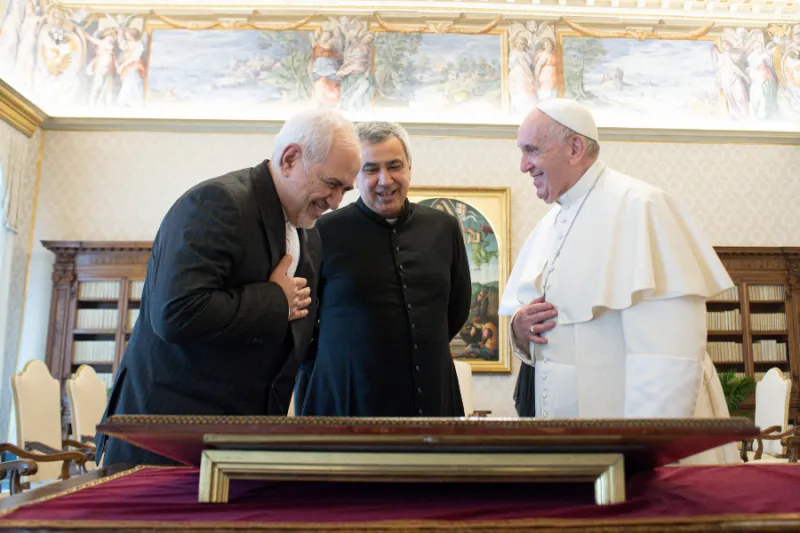
Pope Francis meets with Mohammad Javad Zarif, Iran’s foreign minister, on May 17, 2021. / Vatican Media/CNA.
Vatican City, May 17, 2021 / 10:30 am (CNA).
Pope Francis spoke Monday with Iran’s foreign minister and Turkish President Recep Tayyip Erdoğan amid the ongoing diplomatic efforts to end the violence in the Israel-Gaza conflict.
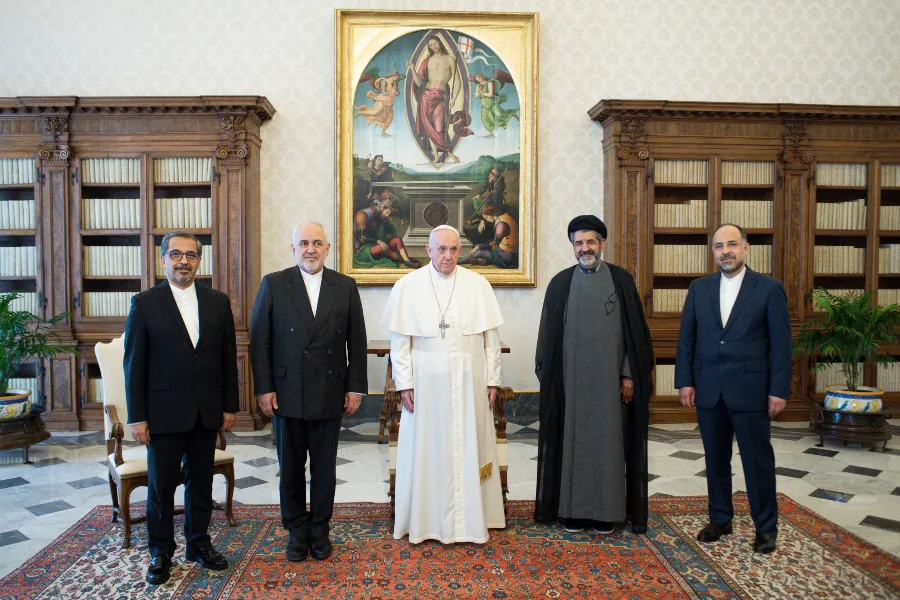
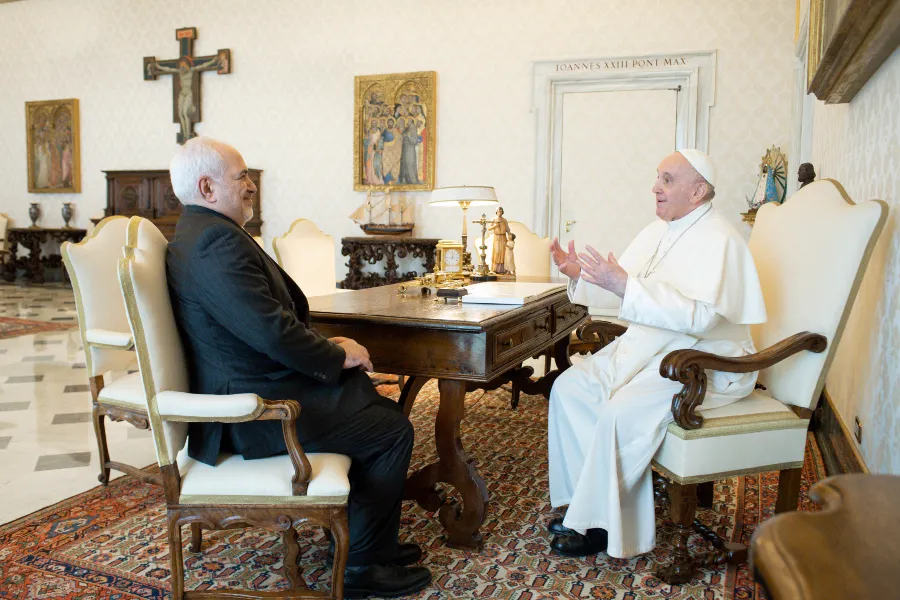
The pope received Mohammad Javad Zarif, Iran’s head diplomat since 2013, for a private audience on May 17 in the Vatican’s Apostolic Palace.
Zarif said that he and the pope “exchanged views” on Palestine, interfaith dialogue, and U.S. sanctions in a post on Twitter.
The Iranian government delegation also met with Vatican Secretary of State Cardinal Pietro Parolin and Archbishop Paul Gallagher, the Secretary for Relations with States.
/ Vatican Media/CNA.
Vatican spokesman Matteo Bruni confirmed that Pope Francis also spoke on the telephone with Turkish President Recep Tayyip Erdoğan on the morning of May 17.
According to a statement from the Turkish president’s office, Erdogan told Pope Francis “that Palestinians would continue to be subjected to massacre as long as the international community did not punish Israel – which is committing humanitarian crimes – with sanctions.”
The Vatican did not comment on the content of the discussions in either the phone call with Erdogan or the meeting with Zarif.
Israel’s Ambassador to Italy responded to the Iranian foreign minister’s visit to Rome with an open letter to Zarif accusing Iran of funding and supporting Hamas.
“Why don’t you recognize Israel’s right to exist? Stop spreading hatred,” Ambassador Dror Eydar wrote.
“The question is: when will the West realize that behind the elegant suits, ties and smiles lies a murderous ideology that seeks to erase all of Western civilization? It is necessary to wake up,” the Israeli ambassador said.
/ Vatican Media/CNA.
Pope Francis appealed for an end to violence in the Israel-Gaza conflict at the end of his Regina Caeli address on May 16.
“In these days, violent armed clashes between the Gaza Strip and Israel have taken hold, and risk degenerating into a spiral of death and destruction. Numerous people have been injured, and many innocents have died,” the pope said.
“Among them there are also children, and this is terrible and unacceptable. Their death is a sign that one does not want to build the future, but wants to destroy it.”
The pope also lamented intercommunal violence involving Jews and Arabs within Israel.
He said: “Furthermore, the crescendo of hatred and violence that is affecting various cities in Israel is a serious wound to fraternity and peaceful coexistence among citizens, which will be difficult to heal if there is not an immediate opening to dialogue.”
“I ask myself: where will hatred and revenge lead? Do we really think we will build peace by destroying the other?”
He appealed for calm in the region, urging local leaders and the international community to help secure peace.
“Let us pray unceasingly that Israelis and Palestinians may find the path of dialogue and forgiveness, to be patient builders of peace and justice, opening up, step by step, to a common hope, to a coexistence among brothers,” Pope Francis said.






The Christmas Season – a time to celebrate the gift of peace.