Juba, South Sudan, Jan 6, 2020 / 02:25 pm (CNA).- Bari ethnic leaders in South Sudan have distanced themselves from critics of the newly-appointed Archbishop of Juba. The archbishop has faced controversy since his December appointment for several reasons, including that he is not a member of the region’s predominant Bari tribe.
“Those indigenous clergy and faithful Bari who have rejected the appointment of the new Archbishop for Juba [do] not reflect the position of the entire Bari Community or their association i.e. the Bari Community Association,” Cornelio Bepo Lado Kenyi, chairman of the Juba-based association, explained in a Dec. 23 statement.
The statement adds that critics of the newly appointed Archbishop Stephen Ameyu “have not been mandated by either the community nor the association.”
The Bari are an ethnic group who are centered in Juba. The Bari Community Association is an umbrella cultural organization representing Bari leadership in South Sudan.
The Bari Community Association issued its statement after letters of protest were sent to the Vatican, protesting the appointment of Ameyu as archbishop. One letter, sent Dec. 12, was signed by three priests and five laymen, who identified themselves as “community elders,” and were widely understood to be presenting themselves as Bari tribal leaders. Their letter gave three reasons for opposing the appointment, charging that government officials and some Juba priests had conspired to promote Ameyu as archbishop for personal interests, and had influenced a Vatican diplomat to that end; that a local priest could have been appointed; and alleging that Ameyu has fathered at least six children.
The letter said that Ameyu “will not be accepted to serve as Archbishop of Juba under any circumstance.”
The letter writers said that they are “a generous and hospitable people … kind hearted and straightforward people who do not tolerate any form of humiliation. We take long to react but once the gloves come off, it becomes difficult to calm things later.”
They maintained that their opposition “should not be misinterpreted as tribalism,” saying they have “no objection in having a bishop from outside the Archdiocese,” and noting that most of their bishops have not been indigenous.
“Therefore, it should be the question of being Bari or none [sic] Bari, but rather appointing a good priest with right qualifications,” they wrote.
In their Dec. 12 letter, the protesters added that they are “not questioning or interfering with the prerogative of the Holy Father to appoint bishops,” but are “only against the manipulation and the buying of the process by politicians and other interest groups.
“We are against a person brought from outside just to promote personal interests while maliciously leaving out the qualified sons of this land,” they wrote. But leaders of the Bari ethnic group said the Dec. 12 letter “sparked a lot of reactions in the social media with many negative references labelling the Bari Community as tribalistic community just because those who appended their signatures to the letter happen to come from the Bari tribe.”
“To be clear, they have neither sought the opinion of the Bari on the subject under reference nor have they (been) delegated to do so,” the Baric Community Association’s Dec. 23 statement said. “No Bari will speak on behalf of the Bari Community except when mandated by its leadership and as guided by the BC Constitution,” the statement added.
On Dec. 19, the Sudanese bishops’ conference issued a statement supporting the appointment of Ameyu.
We “celebrate with Catholics and all the people of Juba and the nation, that there is now a new Catholic Archbishop,” the bishops said.
“We acknowledge the decision of the Holy Father of accepting the resignation of Archbishop Paolino Lukudu, allowing him to take a well-deserved and long overdue rest, and appointing his successor, Most Reverend Stephen Ameyu Mulla as the Archbishop of Juba,” they added.
Neither Church nor Bari leaders have addressed the allegation made by critics that Ameyu has six biological children and ongoing sexual relationships with women.
A date for the installation of Ameyu as Juba’s archbishop has not yet been announced. The outgoing Archbishop Paolino Lukudu remains apostolic administrator of the archdiocese until Ameyu is installed.
If you value the news and views Catholic World Report provides, please consider donating to support our efforts. Your contribution will help us continue to make CWR available to all readers worldwide for free, without a subscription. Thank you for your generosity!
Click here for more information on donating to CWR. Click here to sign up for our newsletter.
Monica Biboso and her employer, Ester Rot, while celebrating Rosh Hashanah (the Jewish New Year) in the dining room of Kibbutz Be’eri in 2022. “I don’t feel like a hero because I saved Ester” during the Oct. 7, 2023, massacre, Biboso told CNA. “I would do anything to save her. I just treated her like my mother. Every child would do the same.” / Credit: Photo courtesy of Monica Biboso
Jerusalem, Oct 7, 2024 / 05:00 am (CNA).
One year has passed since Monica Biboso, a 36-year-old Filipino woman who has worked as a caregiver in Israel for over 10 years, was suddenly awakened by the noise of bombs and gunfire in Kibbutz Be’eri, close to the Gaza border.
In a conversation with CNA, Biboso’s eyes moistened as she recalled that day. Hamas fighters surrounded the house, shattered the windows, and set the home ablaze. She still has nightmares and jumps whenever someone knocks on the door of her room at the David Dead Sea Resort by the Dead Sea, where she has been displaced for the past year.
An outing in Sderot of the caregivers who worked at Kibbutz Be’eri on Sept. 5, 2023. Biboso and her employer were transferred to a hotel on the Dead Sea, along with the surviving residents of Kibbutz Be’eri, after the attack on Oct. 7, 2023. About 10 of Biboso’s colleagues joined them, while two died in the attack and five returned to the Philippines. Credit: Monica Biboso
During the Oct. 7, 2023, massacre in Israel that took the lives of almost 1,200 people, 101 civilians were killed in Be’eri and 30 hostages were taken to Gaza, 11 of whom are still being held in captivity.
Biboso not only survived, but she also managed to protect the elderly lady she was caring for — Ester Rot, who is 81 and has dementia. They were the only two survivors from their neighborhood.
“I have never stopped praying because I have always believed that God was there,” Biboso, a Catholic, told CNA. “All the time, I prayed to God and asked him that if my time had come, he would at least protect my children. But God did not want to call me yet, and I survived.”
Biboso is married to a fellow countryman she met in Israel who had returned to the Philippines just a few days before Oct. 7. The couple has two children, ages 7 and 5, who are growing up in the Philippines under the care of Biboso’s sister.
Monica Biboso with her family in the Philippines in April 2024: her husband, Roberto; her daughter, Sofya; and her son, Clarence. In the first few hours of the Oct. 7, 2023, massacre by Hamas, she managed to stay in touch with them, then her cellphone ran out of power. “When I was able to turn my phone back on, I found video messages from my children, crying, kissing and telling me to take care of myself.” Credit: Photo courtesy of Monica Biboso
In the first few hours of being locked in the house’s safe room, Biboso stayed in touch with her family, her Filipino colleagues in the kibbutz, and Rot’s children, but then her cellphone battery died.
“When I was able to turn my phone back on, I found video messages from my children, crying, kissing, and telling me to take care of myself,” she recalled.
Biboso, who was locked in the shelter with Rot for 16 hours, has been trying to forget the experience, but from the start it was clear it would never be possible.
“All the time, I carry my bag with my documents and important things. I am afraid of losing them again. Every night before going to sleep, I need to check outside and lock the door.”
For the past year, Biboso has been undergoing psychological therapy, which is helping her cope with the memories, fear, anguish, and nightmares — and to talk about what she went through.
“When I heard the sirens, I woke Mrs. Ester up, changed her, and dressed her quickly. I gave her her medicine and something to help her sleep, and we took refuge in the safe room of the house. I understood that the situation was serious, as I could hear the gunshots getting closer and closer,” Biboso recounted to CNA.
The closed caption television cameras that Rot’s children had previously installed in the house showed Hamas militants coming and going until they managed to break into the house.
Screenshot of camera footage from Ester Rot’s home at 10:51 a.m. on Oct. 7, 2023, in Kibbutz Be’eri, where Monica Biboso lived and worked as a caregiver for the elderly woman. Two armed men can be seen in the lower left of the screen near the home. Around 11 a.m., Hamas fighters managed to break into the house by blasting a hole with explosives. Shortly afterward they set fire to the house. Credit: Courtesy of Monica Biboso
“For the entire time I was locked in the shelter, I kept praying and saying to God, ‘Help us, I know it’s impossible to save us, but I know you can save us.’”
Around 11 a.m., the Hamas fighters broke into the house by blasting a hole with explosives.
“Maybe God heard me because they couldn’t open the shelter door. I was holding the handle from the inside. He gave me incredible strength.”
The door to the shelter where Monica Biboso and her employer, Ester Rot, were barricaded for 16 hours during the Hamas attack on Kibbutz Be’eri, Oct. 7, 2023. The photo was taken by Biboso when she had the chance to return and check the situation in January 2024. “For the entire time I was locked in the shelter, I kept praying and saying to God, ‘Help us, I know it’s impossible to save us, but I know you can save us,’” Biboso told CNA. “Maybe God heard me because they couldn’t open the shelter door. I was holding the handle from the inside. He gave me incredible strength.” Credit: Photo courtesy of Monica Biboso
Then they set fire to the house.
“We could barely breathe, it was so hot. We had no water, no food, nothing. I thought we were going to die, but I kept praying.”
When asked how she was able to survive, Biboso said: “God saved me. No one was able to help us. I was weak, I couldn’t breathe, my body was shaking, and I was lying on the floor, but I kept praying. Because of him, I survived. I truly believe that. He was with me the entire time I was in the shelter. I could feel it. Without God, I wouldn’t be here.”
The living room of Ester Rot’s home in Kibbutz Be’eri, where Monica Biboso lived and worked as a caregiver for the elderly woman. The house was completely burned down during the Hamas attack on Oct. 7, 2023. The photo was taken by Biboso when she had the chance to return in January 2024. Credit: Photo courtesy of Monica Biboso
Biboso and Rot spent a day in the hospital, then they were transferred to a hotel on the Dead Sea along with the surviving residents of Kibbutz Be’eri. About 10 of Biboso’s colleagues were among them. (Two others died in the attack and five returned to the Philippines.)
“Together with my husband, we decided it was best for me to stay, at least for the time being. I could never have left Mrs. Ester or allowed her to end up in a nursing home after surviving all this. She is like a mother to me,” said Biboso, who lost her own mother at the age of 16.
“I don’t feel like a hero because I saved Mrs. Ester,” Biboso added. “I would do anything to save her. I just treated her like my mother. Every child would do the same.”
“I knew that if I wanted to have any chance of healing and overcoming this trauma, I could only do it here,” she said. “In Israel, psychologists could help me because they understand the context.”
Ultimately, economic reasons also motivated Biboso to stay. Currently, her salary is the only stable income for her family, whom she was able to reunite with for some weeks in April.
Life at the hotel follows a fairly regular routine. “When we get up, I help Mrs. Ester with breakfast, give her a bath, take her for a walk, and do exercises. After lunch, we rest. When I can’t sleep, I crochet. It helps me relax.” Sometimes the two walk along the sea, take a swim, and spend time with friends.
Four months after Oct. 7, Biboso visited Kibbutz Be’eri together with Rot’s children. “It was very hard. I couldn’t stay there for long.” The house was completely destroyed by the flames.
“All my things were burned, everything was reduced to ashes,” Biboso recounted, “But my rosary didn’t burn. I found it beside my bed. It was a little burnt, but the beads were intact, and the cross was still a cross. My husband gave it to me and I used to pray with it every day before sleeping. I know I’m safe because of it.”
Monica Biboso’s rosary, the only one of her belongings left intact after the home of Ester Rot, the elderly woman she cared for and where she also lived in Kibbutz Be’eri, was set on fire by Hamas fighters during the Oct. 7, 2023, attack. “All my things were reduced to ashes,” Biboso recounted, “but my rosary didn’t burn. My husband gave it to me and I used to pray with it every day before sleeping. I know I’m safe because of it.” Credit: Photo courtesy of Monica Biboso
To this day, every night, Bibosa prays the rosary before bedtime. “In the Philippines, when my mother was alive, every day at 6 o’clock we prayed the rosary together before having dinner. I kept doing it.”
After Oct. 7, a nun living in Tel Aviv called Biboso every day, and they prayed together. “She’s helped me a lot. If I can’t sleep, I call her, and we pray together over the phone.”
“Prayer is a big help to me in healing, lightening the burden on my heart, and freeing my mind from negative thoughts,” Biboso said.
Ester Rot, the elderly woman with whom Monica Biboso works as a caregiver, on the shore of the Dead Sea. After surviving the massacre carried out by Hamas on Oct. 7, 2023, the two were displaced to the David Dead Sea Resort along with the other surviving residents of Kibbutz Be’eri. Credit: Photo courtesy of Monica Biboso
In mid-October, Biboso and Rot are expected to move to Kibbutz Hatzerim, where new housing units have been built for the Be’eri survivors.
“First, you need to have faith in God and be thankful for everything,” Biboso said. “You just need to trust him, and he will make a way to save you. This war will also end because of him. He will find a way to bring good out of it all.”
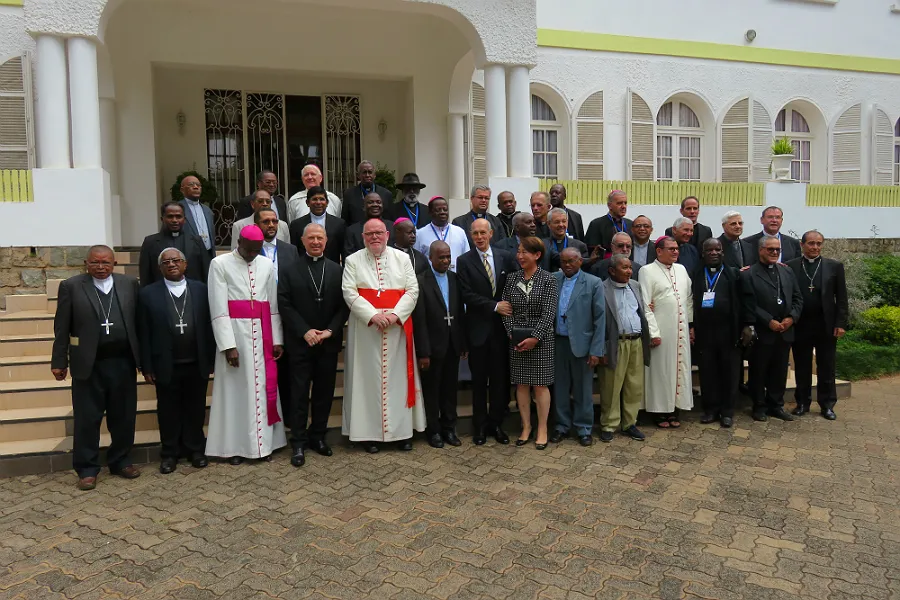
Antananarivo, Madagascar, Jun 5, 2018 / 04:01 pm (CNA/EWTN News).- During a meeting last month between representatives of the bishops of Africa and Germany discussing integral human development, both groups affirmed their need to continue the work of evangelization.
“As Church, both in Africa and in Germany, the Holy Spirit is opening our eyes to the fact that we still have a lot to do in our mission of evangelization,” read a May 27 statement signed by Archbishop Gabriel Mbilingi of Lubango and Cardinal Reinhard Marx of Munich and Freising.
The communique was released following a May 22-27 seminar in Antananarivo, Madagascar, between the German bishops’ conference and the Symposium of Episcopal Conferences of Africa and Madagascar, which are chaired by Cardinal Marx and Archbishop Mbilingi, respectively.
The bishops pointed to poverty, misery, disease, and despair in Africa “caused by human greed and corruption, injustices of all kinds and violence and fratricidal wars,” and in Europe, a “dearth of spiritual values, excessive materialism and consumerism, individualism, little or no of respect for the life and rights of the unborn, of the aged and the infirm.”
“All of these evils .. point to the fact that as Church we still have a lot to do in our evangelization mission,” they affirmed.
In addition to proclaiming the gospel, the bishops said evangelization is “the work of deepening our Christian formation and the formation of consciences of our political and socio-economic leaders, as well as the offering of true witness of our faith in Christ.”
“Evangelization should lead all to understand and develop their lives of relationships with God, with their fellow women and men, and with creation,” they wrote. “This work of building relationship demands that we work with all women and men of good will in order to create a new and better world for all to have the chance to develop their talents to the best of their capabilities, and to bring these to serve every body, living and even yet unborn.”
The May seminar was the eighth such meeting between German and African bishops. The tradition began in 1982, and they occur every four to five years. A statement ahead of the event said that they discuss “mutually agreed issues as part of an effort to promote pastoral solidarity between Germany and the African continent, and also to discuss issues relevant to promoting the growth of the church in the two Conferences. The meetings have contributed to the deepening and intensification of the relationship between the local Churches in Africa and the Church in Germany.”
This year’s theme of integral human development was needed because of secularization and globalization, and was inspired by Catholic social teaching of the last 50 years, said the concluding document. It cited the importance of Bl. Paul VI’s Populorum Progressio, Benedict XVI’s Caritas in veritate, and Pope Francis’ Laudato si’.
They reflected that integral human development “must ensure the total well-being of the person, of every person and of every human society,” and said, “we must renew our missionary zeal working for integral human development as an indispensable part of our mandate.”
The seminar resulted in seven resolutions: a renewed commitment to working for a more just world; the need for development “to respect the ecological limitations of our planet earth”; speaking up “for a more just global order especially regarding international trade”; that “the empowerment of all women worldwide and in all fields of society is a necessary pre-condition for the development of every single person”; that evangelization will be tied to integral human development; to advocate development both domestically aind internationally; and to continue “this dialogue and cooperation and communion between the Church in Africa and in Germany”.
The statement concluded, “We are thankful for the fraternal communion and greater understanding with each other and as representatives of our local Churches.”
“At this meeting in Antananarivo, we have become more aware of the unique wealth and unique opportunities that characterize our Church, universal and global. We are a global community and communion of learning, prayer and solidarity, sent to be witnesses of faith, hope and love to the whole world. By so doing, we are serving the integral development of every person and of the whole human person.”
Alfred Magero, Matthew Njogu, and Edward Chaleh Nkamanyi are three Catholic fathers from Africa who recently shared insights about being a present dad, protecting their families amid threats to the African family, and being a model of family values for their children with ACI Africa, CNA’s news partner in Africa. / Credit: Photos courtesy of ACI Africa
ACI Africa, Jun 17, 2024 / 12:37 pm (CNA).
On the occasion of Father’s Day 2024, a day focused on the celebration of fatherhood, four Catholic men from different African countries recently shared their experiences of impacting the lives of their children.
The Catholic fathers — who hail from Cameroon, Kenya, and Nigeria — talk about the importance of “being present,” of protecting their families amid threats to the African family, and of being a model of family values for their children, who they believe someday will become parents as well.
Tony Nnachetta, 68: Fatherhood is a full-time enterprise
Tony Nnachetta shares a moment with Pope Francis. The married father of four is a parishioner in the Catholic Archdiocese of Onitsha. Credit: Photo courtesy of ACI Africa
Tony Nnachetta is a married father of four who attends the Church of the Assumption Parish in Nigeria’s Archdiocese of Lagos. Nnachettahas been a parishioner there for 40 years, and he was wed there 38 years ago. A member of the Grand Knights of St. Mulumba, he originally hails from the Archdiocese of Onitsha.
I got married to my friend after we dated for four years. I was looking forward to fatherhood and I was mentally prepared for it. Here are the lessons I have learned along my fatherhood journey.
First, being a father means you watch your children grow and become independent. You watch them get to a point in their lives where they can engage in a debate with you and even disagree with you.
Fatherhood is a long process. You would be fortunate to go through the entire process and maybe see your children’s children. I have seen mine achieve excellence in school and even leave home and go across the world as they sought to become independent.
Wherever your children go, what is important for them is what they take away from home — what they take from mommy and daddy. I have always told mine to “remember the child of who you are.” This means that they are not allowed to break the Christian values in our family.
I taught them to always stand for the truth and never to flow with the tide. We have encouraged them to always say what they mean. These days, they have jokingly turned around the statement and they tell me, “Remember the dad of who you are,” and we laugh about it.
You can’t always be there to take the bullet for them, but you can support them through prayers. Our family relies a lot on the intercession of the saints. We call ourselves a family of Jesuits because the school my children went to is under the patronage of St. Ignatius of Loyola.
Fatherhood is a full-time engagement. It is not like you can be a father in the morning and take a break in the evening. You worry about your children even when they are grown and have left your home. They preoccupy you everywhere. You wonder whether they are warm and if they have had their meal. But all this brings a father immense joy.
Young fathers in Africa are overburdened by poverty. Because of poverty they don’t have a way to help their families. Others are scared to enter the marriage institution. Poverty has made young men weak and helpless. Some are leaving their young families and going to faraway places outside the continent to make a living.
Poverty is eroding family values because some fathers do what they do, including stealing, for their children to survive. In doing so, they are setting a bad example for their children …
It is important for our leaders to confront this situation. They must accept that they have let us down.
Matthew Njogu, 75: Tips on being a present dad
Matthew Njogu is the moderator of the Catholic Men Association at St. Austin’s Msongari Parish of Kenya’s Archdiocese of Nairobi. His children are now adults. Credit: Photo courtesy of ACI Africa
Fathers need to be present in the lives of their children. For a long time, it was assumed that it was the mother’s responsibility to take care of the young children; fathers kept off. But being absent in the lives of your children hurts your relationship with them. They end up growing up without you having any impact on their lives.
Unfortunately, some fathers assume that fatherhood ends at providing material things… They don’t pay attention to their children’s growth milestones. And when they eventually try to establish a connection, they find that the children are already all grown without knowing anything about their fathers.
Simple things like dropping your children off at school help you connect with them. While stuck in traffic on the way to school, you can talk about things that will help you understand your child and for him to know you.
Always try as much as possible to have dinner with your children and help them with schoolwork. And always try to make up for the time you don’t spend with them.
Edward Chaleh Nkamanyi, 53: Raising a Christ-like family
Edward Chaleh Nkamanyia runs a medical college in Doula, Cameroon. He is a father of two, though he tells ACI Africa that he is “a father of many” as he takes care of several orphans and other vulnerable children. Credit: Photo courtesy of ACI Africa
Nkamanyi runs a medical college in Doula, Cameroon. He is a father of two children ages 16 and 20. He tells ACI Africa that he is “a father of many,” as he takes care of several orphans and other vulnerable children. Here are his insights into nurturing a Christ-like family.
It is the joy of every responsible young man to be called “daddy” or “papa.” Having a Christ-like family is the greatest gift for a father; a family like that of Joseph, Mary, and Jesus.
My appeal for Catholic fathers is to hold their families firmly, to provide for them, and to protect them from all dangers in the contemporary society, where values are being eroded.
I don’t believe that being a father is a challenging task. God already gave us the innate potential to be fathers. I believe that God can’t give you a role that you can’t perform.
It is unfortunate that many young men are choosing to be absentee fathers. From what I have seen, many children raised by a single parent end up adopting wayward behaviors.
Alfred Magero, 48: Being a present dad in a low-income setting
Alfred Magero belongs to the Catholic Men’s Association group of St. Joseph the Worker Kangemi Catholic Parish of in the Nairobi Archdiocese. The father of three has been married for 29 years. Credit: Photo courtesy of ACI Africa
Magero belongs to the Catholic Men’s Association group of St. Joseph the Worker Kangemi Parish of the Archdiocese of Nairobi. The father of three has been married for 29 years and shares his experience and that of other Catholic dads raising their children in a low-income neighborhood.
I am raising my children to become God-fearing adults. This is not an easy task in the community in which we live, where there is a lot of poverty, drunkenness, and other characteristics typical of a low-income [neighborhood].
Many fathers rarely interact with their children since their main focus is to provide for their families. They leave for work before their children wake up and come back at night when the children have already gone to bed.
The young men and boys we are raising are experiencing a different environment from ours when we were growing up. With the whole world brought to them on the palm of their hand by a simple tap on the phone, this generation is dangerously exposed. They need us, their fathers, to constantly give them direction. They need us to be their role models.
They need us to constantly remind them that they are in Africa and that they should not adopt alien cultures, especially those bound to destroy the family.
As fathers, we must remind our young ones to uphold African values that kept the family unit and the society glued together. Africans knew the importance of loving and caring for each other. Unfortunately, this value is being eroded, and in its place, now we have individualism. Older men in families would educate young men to be responsible adults. Unfortunately, we no longer have this kind of education.
In Europe and by roughly the year 1000 A.D., the Church enforced marriage outside of one’s kinship group, partly to further the diffusion of the new Christian charity above any clan insularity of blood lines.
Now, in South Sudan we see the selection of a bishop from outside the predominant Bari tribe (no tribal objection) complicated by the allegation that he has six biological children plus ongoing sexual relations. About this kind of allegation, one view would recall how bishops behind the Iron Curtain were often subject to setups in efforts to discredit them and divide the Church.
Pope John Paul II was one such target. In 1983, to implicate the new pope in a contrived sexual affair, a women’s forged diary was planted in a priest’s residence and then “discovered” by the Polish secret police (Weigel, The End of the Beginning, 2010, pp. 152-3). Not successful; but a pattern of subversive framing possibly explains the early reluctance/failure of JP II to give credence to emerging allegations in the West of homosexual activity among the clergy.
In Africa the cultural corrosive is polygamy rather than the homosexual lifestyle. Whatever the truth in South Sudan, the Church had better get it right, and more quickly.
“The letter writers said that they are “a generous and hospitable people … kind hearted and straightforward people who do not tolerate any form of humiliation. We take long to react but once the gloves come off, it becomes difficult to calm things later.””
The three priests who signed the letter, at least, appear to have a very shaky grasp of the Faith if they are that intolerant of humiliation and, by extension, humility.







In Europe and by roughly the year 1000 A.D., the Church enforced marriage outside of one’s kinship group, partly to further the diffusion of the new Christian charity above any clan insularity of blood lines.
Now, in South Sudan we see the selection of a bishop from outside the predominant Bari tribe (no tribal objection) complicated by the allegation that he has six biological children plus ongoing sexual relations. About this kind of allegation, one view would recall how bishops behind the Iron Curtain were often subject to setups in efforts to discredit them and divide the Church.
Pope John Paul II was one such target. In 1983, to implicate the new pope in a contrived sexual affair, a women’s forged diary was planted in a priest’s residence and then “discovered” by the Polish secret police (Weigel, The End of the Beginning, 2010, pp. 152-3). Not successful; but a pattern of subversive framing possibly explains the early reluctance/failure of JP II to give credence to emerging allegations in the West of homosexual activity among the clergy.
In Africa the cultural corrosive is polygamy rather than the homosexual lifestyle. Whatever the truth in South Sudan, the Church had better get it right, and more quickly.
“The letter writers said that they are “a generous and hospitable people … kind hearted and straightforward people who do not tolerate any form of humiliation. We take long to react but once the gloves come off, it becomes difficult to calm things later.””
The three priests who signed the letter, at least, appear to have a very shaky grasp of the Faith if they are that intolerant of humiliation and, by extension, humility.