No Picture
News Briefs

Pope Francis: Don’t forget the real meaning of Christmas

December 5, 2019 CNA Daily News 1

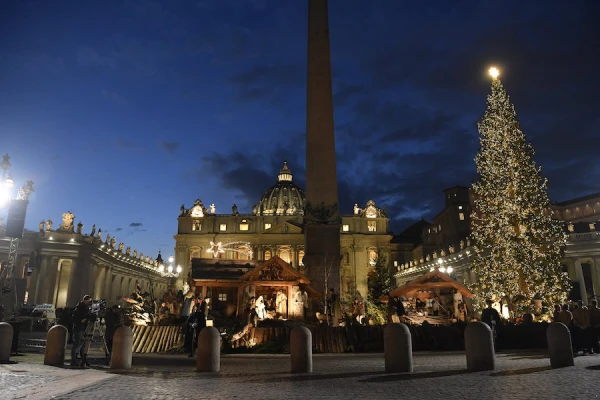
Vatican City, Dec 5, 2019 / 10:40 am (CNA).- Ahead of the Vatican Christmas tree lighting Dec. 5, Pope Francis expressed hope that the nativity scene in St. Peter’s Square will serve as a reminder of what Christmas is truly about.

A nativity scene “is a genuine way of communicating the Gospel, in a world that sometimes seems to be afraid of remembering what Christmas really is, and blots out the Christian signs to only keep those of a banal, commercial imagination,” Pope Francis told an Italian delegation at the Vatican for the Christmas tree lighting ceremony Dec. 5.

This year’s Vatican Christmas tree comes from the northern Italian region of Vicenza, which was greatly damaged by storms in October 2018. The red spruce in St. Peter’s Square is a little over 85 feet tall.

The Christmas tree lighting ceremony also revealed a life-size nativity scene carved out of wood with tree trunks from Vicenza placed in the background in memory of the storm.

“The wooden trunks, coming from the areas hit by the storms, which form the backdrop to the landscape, underline the precariousness in which the Holy Family was found on that night in Bethlehem,” Pope Francis said.

Pope Francis met with delegations from the Italian diocese of Trento, Padua and Vittorio Venetoin at the Vatican’s apostolic palace Dec. 5 before the Christmas tree and nativity scene were presented.

“Today’s meeting offers me the opportunity to renew my encouragement to your people, who last year suffered a devastating natural disaster, with the demolition of entire wooded areas,” Pope Francis told the delegation.

“I was pleased to learn that, replacing the plants removed, 40 fir trees will be replanted to replenish the woods severely damaged by the storm of 2018,” he said.

The Vatican Christmas tree is illuminated by energy-saving Christmas lights from the German multinational OSRAM, to reduce the environmental impact of the display.

Cardinal Giuseppe Bertello and Bishop Fernando Vérgez Alzaga chaired the Vatican Christmas lighting ceremony. The nativity scene and Christmas tree will remain on display in St. Peter’s Square until January 12, 2020, the feast of Christ’s Baptism.

Pope Francis began Advent with a trip to the Italian town of Greccio, where St. Francis of Assisi created the first nativity scene in 1223. In Greccio, Pope Francis signed the apostolic letter, Admirabile signum, on the meaning and importance of nativity scenes.

“All those present experienced a new and indescribable joy in the presence of the Christmas scene. The priest then solemnly celebrated the Eucharist over the manger, showing the bond between the Incarnation of the Son of God and the Eucharist,” Pope Francis wrote in the letter describing the St. Francis’ first nativity.

“As we contemplate the Christmas story, we are invited to set out on a spiritual journey, drawn by the humility of the God who became man in order to encounter every man and woman. We come to realize that so great is his love for us that he became one of us, so that we in turn might become one with him,” Pope Francis said.

[…]

No Picture
News Briefs

‘The key is not to fight, but just to bear witness’: How to preach Advent

December 5, 2019 CNA Daily News 0

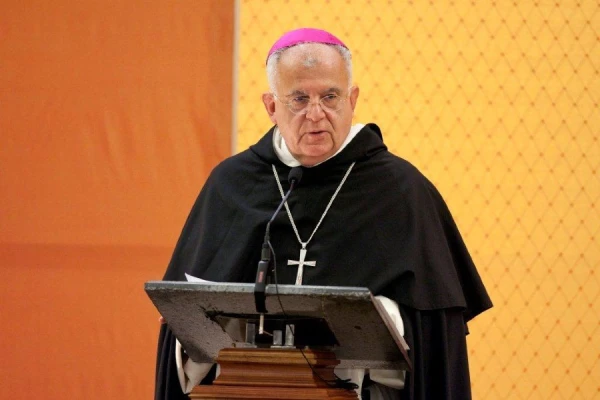
Washington D.C., Dec 5, 2019 / 08:35 am (CNA).- The season of Advent, and the entire cycle of the liturgical year, is vital to remaining rooted in the true mission of the Church, Archbishop Joseph Augustine Di Noia, O.P., adjunct secretary of the Congregation for the Doctrine of the Faith, told CNA. 

Di Noia spoke to CNA Dec. 4 about his newly-released book, “Grace in Season: The Riches of the Gospel in Seventy Sermons” which was published Nov. 15 by Cluny Media. 

“The theme of the book is that the preacher should realize that the liturgical year is a unit that is repeated every single year, and it starts with Advent and finishes with Pentecost,” said Di Noia. The book, a collection of Di Noia’s own sermons, is organized by the liturgical seasons. 

The combined readings–the prayers, the preface, and everything said at Mass– form “a story that you fit into. The liturgy is the key, the entree to it,” he said. By repeating this liturgy in the liturgical year, “we become like Him,” said Di Noia. “That’s the unspoken premise of the book.” 

The liturgical year, he said, is support for the faith similar to a sacramental, and is the “fundamental pattern of Christian spirituality” that is configured to Christ. Preachers, he said, should look to the lectionary and the Sunday readings first and foremost when deciding what they will preach to their homilies. 

“And each season,” he said, “has a particular grace. So Advent is the grace to realize the complete gratuity of grace.”

In the middle of a secularized holiday season, the archbishop said it was important to remain rooted in the true meaning of the time. In the present culture, where the true meaning of Advent as a season of somber preparation is largely discarded, Di Noia said that the best approach to respecting the liturgical season is by hunkering down and living a Christian life in spite of everything. 

“We can’t change the culture,” said Di Noia. “You just have to maintain [a devotion to Advent]. It’s an effort and it requires a certain amount of discipline to concentrate on Advent.” 

“People say, ‘Let’s put Christ back into Christmas.’ I say ‘who took him out?’ Who could take him out?”

Reflecting on the Advent practice of looking towards the second coming of Christ, Di Noia said that it is key to remember why exactly it was that Christ came to earth. 

“Christ did not come for the resolution to [societal] problems,” said Di Noia. “He came to confront the sin in the human heart, directly. He didn’t try to do something superficially.”

Had Christ been born as the son of someone prominent, such as an emperor, that would have undermined his purpose and  “would have confirmed us in our belief that we can deal with sin […] and that there are human ways we can dissolve it.” 

“In the end, without the passion, death, and resurrection of Christ, sin is intractable. It cannot be cured,” he said. 

In his current role at the Congregation for the Doctrine of the Faith, the Vatican department charged with guarding Church discipline in faith and morals, Di Noia is not ordinarily permitted to speak publicly on the nature of his work. But, he told CNA, his day job has not stopped him living out the Dominican charism of teaching and preaching.

The collection of sermons, said Di Noia, “is a way of evangelizing” which was suggested to him by a fellow Dominican friar in Rome.  

The majority of the 70 homilies picked for the book date from after his consecration as a bishop in 2009. Prior to this time, he said he did not typically write down sermons, and instead preferred to form a general idea and preach spontaneously from there. Once he began writing down sermons, he realized he could better craft his preaching and include quotes from the Church Fathers. 

“I’m preaching all the time,” he said, noting that he frequently lectures as well. His work in the CDF he categorized as “pastoral,” while noting the tragic reality that the CDF is now mostly known for dealing with cases of sexual abuse by clerics.

Di Noia is acutely aware of how the abuse crisis has shaken the Church and the faithful, and in particular how it has changed the wider perception of the Church and of Catholics in society. For struggling Catholics, Di Noia offered a reflection on how Christ himself was treated leading up to his crucifixion.

“The profound significance of what the Church experiences in the world is that the suffering is the power of Christ,” he said. Di Noia pointed to a passage from the Gospel of John, where it states “He came to his own and his own received him not.” 

“So that, in other words, the expectation that the message is not going to be palatable is the default position,” he said with a laugh. 

“They key is not to fight, but just to bear witness. It’s very difficult,” he said. 

[…]

No Picture
News Briefs

Burkina Faso bishop: As violence continues, ‘nobody is listening’

December 4, 2019 CNA Daily News 1

Ouahigouya, Burkina Faso, Dec 5, 2019 / 12:09 am (CNA).- Following the death of more than a dozen Christians in a church shooting over the weekend, a Burkina Faso bishop said Western governments have a responsibility to stop the flow of weapons to militants in the region.

“The Western powers should stop those who are committing these crimes, instead of selling them the weapons that they are using to kill the Christians,” Bishop Justin Kientega of Ouahigouya told Aid to the Church in Need.

On Sunday, gunmen in the eastern Burkina Faso town of Hantoukoura attacked a protestant church service, killing 14 people, including several children.

“I condemn the barbaric attack against the Protestant Church of Hantoukoura in the department of Foutouri, which left 14 dead and several wounded. I offer my deepest condolences to the bereaved families and wish a speedy recovery to the wounded,” President Roch Marc Kaboré tweeted late Sunday.

Bishop Kientega said the attack is part of an attempt by radical Islamists to “provoke a conflict between the religions in a country where Christians and Muslims have always lived peaceably side by side.”

According to the Washington Post, militants with connections to al-Qaeda and ISIS regularly attack soldiers and civilians in the region.

“No-one has claimed responsibility for the attack, just as no-one claimed responsibility for the previous ones. So we don’t know whether it is one group or several groups that are involved,” Kientega said.

Escalating violence among armed militant groups in Burkina Faso has drawn international concern, with the United Nations warning earlier this year of an “unprecedented humanitarian emergency” in the country. Nearly half a million people have been forced to flee their homes in the last five years. More than 60 Christians have been murdered in the country this year, Aid to the Church in Need reports.

Last month, Pope Francis called for prayers and urged interreligous dialogue amid ongoing violence by jihadist groups.

Kientega argued that the Western world has been ignoring the plight of Christians in West Africa. He suggested some Western powers “have an interest in seeing the violence continue” in the region.

“There is an ongoing persecution of Christians. For months, we bishops have been denouncing what is happening in Burkina Faso, but nobody is listening to us,” he told Aid to the Church in Need. “Evidently, the West are more concerned with protecting their own interests.”

[…]

No Picture
News Briefs

Open windows for reporting expected to trigger avalanche of new abuse cases

December 4, 2019 CNA Daily News 2

Washington D.C., Dec 4, 2019 / 06:18 pm (CNA).- Open windows for reporting incidents of child sexual abuse regardless of when they occurred could lead to a wave of thousands of new abuse cases against Catholic clergy and billions of dollars in lawsuits, a recent report from the Associated Press estimated.

“A trickle becomes a stream becomes a flood,” James Marsh, a New York lawyer who represents abuse victims, told the AP. “We’re sort of at the flood stage right now.”

In total, eight states have opened “look back” windows, which allow adult victims of sex abuse to come forward with allegations from their childhoods, even if they have passed the statute of limitations. Seven more states have significantly relaxed their statutes of limitations, allowing victims to come forward much later in life than previous laws had allowed.

In August of this year, New York opened up such a window for one year, as part of the Child Victims Act. Prior to this, victims had until the age of 23 to come forward with cases of childhood sexual abuse. After the open look back window closes, victims will now have until the age of 55 to come forward.

New Jersey opened a two-year window for victims Dec. 1. After that window closes, a new law extended the statute of limitations on reporting childhood abuse from 20 years of age to 55.

California’s three-year “look back” window will open Jan. 1, 2020, and victims will be awarded triple in damages if they can prove there was an attempt on the part of the Church to cover up the abuse. Once the window has closed, victims will be able to come forward with childhood abuse cases up until the age of 40, instead of the previous limit of 26 years of age.

According to AP interviews with lawyers and clergy abuse watchdog groups, the number of cases that will come from just those three states could lead to at least 5,000 additional cases of abuse, with lawsuit payouts that “could surpass the $4 billion paid out since the clergy sex abuse first came to light in the 1980s.”

The other states that have opened up look back windows are Arizona, Montana, Hawaii, Vermont, and North Carolina, along with the District of Columbia. Most states have temporary look back windows, though Vermont’s window will never expire, allowing anyone to come forward with an allegation of childhood sexual abuse at any time.

Seven other states have increased the age at which adults may come forward with cases of childhood abuse; in many cases, the increase was by more than a decade.

The relaxed or temporarily eliminated statutes of limitations have victims cheering, lawyers competing for sex abuse clients, and the Church preparing for another onslaught of cases.

“I was sitting in my living room and someone came on TV, ‘If you’ve been molested, act now,’” 57-year-old Ramon Mercado told the AP. “After so many years, I said, ‘Why not?’”

Mercado told the AP that he had been quiet about the abuse he had suffered as a child in the 1970s so as not to upset his mother, who recently died.

Many of the cases being brought forward include priests already on the public “credibly accused” lists that many dioceses have.

But some cases, like Mercado’s, name priests who are dead, and are not already on such lists, complicating the possibility of defense on the part of a diocese.

“Dead people can’t defend themselves,” Mark Chopko, former general counsel to the U.S. Conference of Catholic Bishops, told the AP.

“There is also no one there to be interviewed. If a diocese gets a claim that Father Smith abused somebody in 1947, and there is nothing in Father Smith’s file and there is no one to ask whether there is merit or not, the diocese is stuck,” he added.

Steven Alter, a lawyer who has represented multiple sex abuse victims and is collecting more clients, insisted to the AP that “it’s not a cash grab.”

“They (victims) want to have a voice. They want to help other people and make sure it doesn’t happen again. I haven’t had one person ask me about the money yet,” he said.

The new wave of abuse cases comes after several years of sex abuse scandals that have rocked the Church in the United States, including the allegations against former cardinal Theodore McCarrick and the grand jury report from Pennsylvania detailing decades of abuse cases, which triggered an avalanche of victims to come forward and investigations of clergy sex abuse in dioceses across the country.

The newly relaxed or eliminated statutes of limitations in these 15 states will further strain diocesan finances, with dioceses looking to victim compensation funds or selling valuable real estate as ways to pay victims.

Victim compensation funds are currently being used in several dioceses, including the Archdiocese of New York, every diocese in the states of New Jersey and Colorado, and several dioceses in Pennsylvania and California.

These funds offer to settle with victims outside of court, which means that victims are compensated more quickly, but at a lower amount than what they might have won in court, according to the AP. Compensation funds are formed by donations taken up specifically for that purpose, and are not funded by donations made to Catholic schools, seminaries, or other ministries.

Since setting up its fund in 2016, the Archdiocese of New York has paid “more than $67 million to 338 alleged victims, an average $200,000 each,” the AP reported.

In a 2018 op-ed for the New York Daily News, Dolan said that the use of victim compensation funds “surpasses endless and costly litigation — which can further hurt the victim-survivors; it insures fair and reasonable compensation; and prevents the real possibility — as has happened elsewhere — of bankrupting both public and private organizations, including churches, that provide essential services in education, charity and health care.”

Still, bankruptcy may be in the future for some already financially strained dioceses, which also leads to less compensation for victims than if they were to win at a trial. A Penn State study cited by the AP of 16 dioceses and other religious organizations that had recently filed for bankruptcy were able to settle with sex abuse victims for an average of $288,168 per case.

Paul Mones, a Los Angeles lawyer who has successfully prosecuted millions of dollars worth of sex abuse cases against the Catholic Church, told the AP that if these newly-revealed cases are taken to trial, the amount that the Church will owe in victim compensation could be “astronomical.”

[…]