
No Picture
News Briefs

Economics must prioritize human dignity, pope tells Japanese authorities
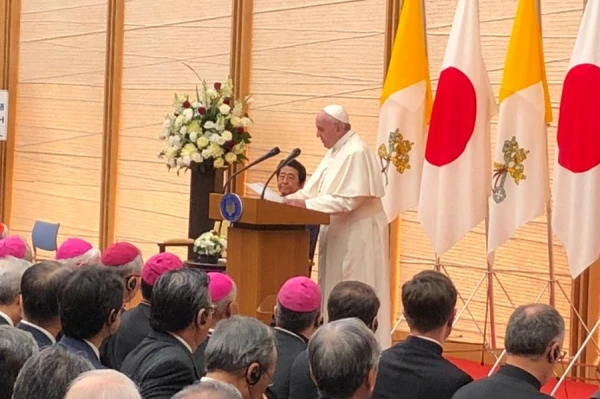
November 25, 2019 CNA Daily News 1

Tokyo, Japan, Nov 25, 2019 / 03:34 am (CNA).- In the measure of a country, concern for human dignity and life is more important than economic strength, Pope Francis told Japanese authorities, civil servants, and diplomats Monday in Tokyo.

“Human dignity, needs to be at the center of all social, economic and political activity,” he said Nov. 25 at the prime minister’s official residence of Kantei.

He also said intergenerational solidarity and concern for the forgotten and excluded should be fostered, pointing in particular to the young, the elderly, and the lonely.

“We know that,” he added, “in the end, the civility of every nation or people is measured not by its economic strength, but by the attention it devotes to those in need and its capacity to be fruitful and promote life.”

In a change from the usual protocol, Pope Francis met with the prime minister and authorities of Japan at almost the end of his trip, rather than the beginning.

He also met with Emperor Naruhito Nov. 25.

The pope’s first full day in Japan was instead spent visiting Nagasaki and Hiroshima, where he spoke against nuclear weapons and honored the Japanese martyrs of the 17th and 18th centuries.

His visit to Japan was the second leg of a six-day trip to Asia, which began in Thailand Nov. 20-23.

Pope Francis urged authorities in Japan to include human ecology in their efforts to protect the environment, including “confronting the growing gap between rich and poor in a global economic system that enables a select few to dwell in opulence while the majority of the world’s population lives in poverty.”

He used the delicacy of Japan’s beautiful cherry blossom to illustrate the fragility of the common home to natural disasters and “to greed, exploitation and devastation at the hands of human beings.”

As a young Jesuit in Argentina, Pope Francis was inspired by the example of the first missionaries to Japan, such as St. Francis Xavier, and wanted to go to the country as a missionary, though he was prevented for health reasons.

“In these days, I have experienced and have come to esteem once more the precious cultural heritage that Japan throughout many centuries of its history has been able to develop and preserve, and the profound religious and moral values that characterize this ancient culture,” he said.

Praising the beauty of the country, he quoted the Jesuit missionary Alessandro Valignano, who wrote in 1579: “Whoever wishes to see what our Lord has bestowed upon man need only come to Japan to see it.”

He praised Japan’s attention to the suffering of the less fortunate, the handicapped, and the disabled.

Pope Francis also said that the purpose of his trip was “to confirm Japanese Catholics in their faith, their charitable outreach to those in need and their service to the country of which they are proud citizens.”

Before the meeting with authorities, Pope Francis celebrated Mass for 50,000 people in the Tokyo Dome. Present at the Mass was ex-death row inmate Iwao Hakamada.

Hakamada, 83, was released from death row after 48 years. A boxer, he had been convicted in 1966 of a quadruple murder but was released in 2014 when new DNA evidence led to a suspension of his sentence. He is currently awaiting retrial by Japan’s supreme court.

Hakamada was baptized in prison on Christmas Eve 1984. The Catholic bishops of Japan invited Hakamada to attend the papal Mass Nov. 25.
 

[…]

No Picture
News Briefs

Pope Francis in Hiroshima: ‘Never again war’

November 24, 2019 CNA Daily News 1

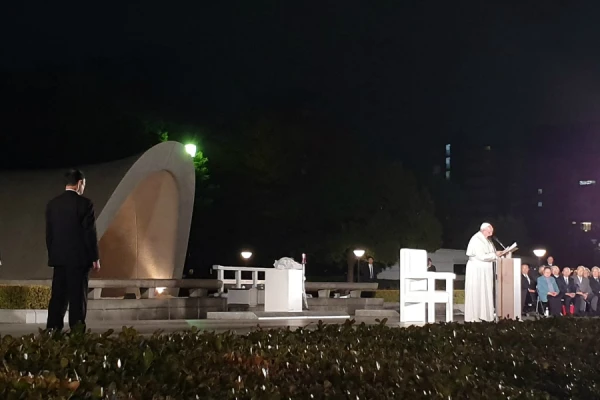
Hiroshima, Japan, Nov 24, 2019 / 05:30 am (CNA).- Pope Francis prayed for peace Sunday at the site of the atomic bomb in Hiroshima, where he called for an end to war and the threat of nuclear weapons.

“How can we propose peace if we constantly invoke the threat of nuclear war as a legitimate recourse for the resolution of conflicts?” Pope Francis said Nov. 24 in Hiroshima’s Peace Memorial Park.

“May the abyss of pain endured here remind us of boundaries that must never be crossed. A true peace can only be an unarmed peace,” the pope said.

On August 6, 1945 American armed forces dropped a uranium atomic bomb dubbed “Little Boy” on Hiroshima, Japan killing an estimated 80,000 people instantly.

More than 90% of Hiroshima’s buildings were destroyed by the blast. By the end of 1945, the death toll rose to 140,000 with people developing intestinal bleeding and leukemia from the residual radiation that followed.

“In a single plea to God and to all men and women of good will, on behalf of all the victims of atomic bombings and experiments, and of all conflicts, let us together cry out: Never again war, never again the clash of arms, never again so much suffering,” Pope Francis said after a moment of silence for the victims of Hiroshima.

“Indeed, if we really want to build a more just and secure society, we must let the weapons fall from our hands,” he said.

Pope Francis quoted Gaudium et Spes, which states that “peace is not merely the absence of war … but must be built of ceaselessly.” He added that the lessons of history show that peace is the fruit of justice, development, solidarity, care for our common home, and promotion of the common good.

“I am convinced that peace is no more than an empty word unless it is founded on truth, built up in justice, animated and perfected by charity, and attained in freedom,” he said.

Within a week of the bombings of Nagasaki and Hiroshima, the Japan announced its unconditional surrender brining World War II to a close on August 15, 1945.

Peace Memorial Park, located on the epicenter of the atomic explosion, opened ten years after the bombing. The Japanese parliament named Hiroshima a “city of peace” in 1949.

“I felt a duty to come here as a pilgrim of peace, to stand in silent prayer, to recall the innocent victims of such violence, and to bear in my heart the prayers and yearnings of the men and women of our time, especially the young, who long for peace, who work for peace and who sacrifice themselves for peace,” Pope Francis said.

“With deep conviction I wish once more to declare that the use of atomic energy for purposes of war is today, more than ever, a crime not only against the dignity of human beings but against any possible future for our common home,” he said.

The pope repeated: “The use of atomic energy for purposes of war is immoral, just as the possession of atomic weapons is immoral, as I said two years ago. We will be judged on this.”

Earlier on Sunday, Pope Francis visited the site of the atomic bombing in Nagasaki where he denounced the ‘unspeakable horror’ of nuclear weapons

“The Catholic Church is irrevocably committed to promoting peace between peoples and nations,” the pope said in Nagasaki.

“Peace and international stability,” he stated, “are incompatible with attempts to build upon the fear of mutual destruction or the threat of total annihilation.”

Twenty survivors of the Hiroshima bombing attended the ceremony. Among them was Kojí Hosokawa, who was less than one mile from the epicenter of the bombing and the only survivor in his building. He is now 91 years old.

“Although there is little time left for me, I believe that passing on the experience of Hiroshima to
the next generation is the final mission assigned to us A-bomb survivors,” she shared at the pope’s peace meeting.

Pope Francis addressed the survivors in Hiroshima: “Here I pay homage to all the victims, and I bow before the strength and dignity of those who, having survived those first moments, for years afterward bore in the flesh immense suffering, and in their spirit seeds of death that drained their vital energy.”

“We cannot allow present and future generations to lose the memory of what happened here,” Pope Francis said.

[…]