

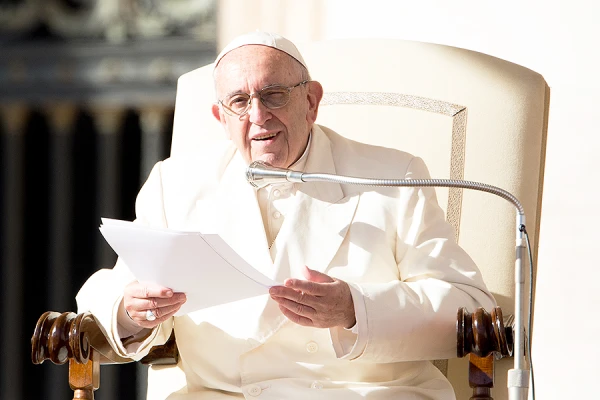
Vatican City, Sep 26, 2019 / 10:25 am (CNA).- In a meeting with Jesuits in Mozambique earlier this month, Pope Francis said that clericalism is a direct result of rigidity and linked to a fixation on sexual morality.
“One dimension of clericalism is the exclusive moral fixation on the sixth commandment,” Pope Francis said according to the Jesuit-run journal La Civilta Cattolica transcript published online Sept. 26.
“We focus on sex and then we do not give weight to social injustice, slander, gossip and lies. The Church today needs a profound conversion in this area,” the pope said.
“Once a Jesuit, a great Jesuit, told me to be careful in giving absolution, because the most serious sins are those that are more angelical: pride, arrogance, dominion… And the least serious are those that are less angelical, such as greed and lust,” he explained.
Pope Francis said: “Clericalism has a direct consequence in rigidity. Have you never seen young priests all stiff in black cassocks and hats in the shape of the planet Saturn on their heads? Behind all the rigid clericalism there are serious problems.”
The pope added that he recently had to intervene in three dioceses due to “problems that expressed themselves in these forms of rigidity that concealed moral problems and imbalances.”
“On the other hand, great shepherds give people a lot of freedom. The good shepherd knows how to lead his flock without enslaving it to rules that deaden people,” he said.
“The shepherd has the ability to go in front of the flock to show the way, stay in the middle of the flock to see what happens within, and also be at the rear of the flock to make sure that no one is left behind,” he said. “Clericalism, on the other hand, demands that the shepherd always stays ahead, sets a course, and punishes with excommunication those who stray from the flock.”
As examples of clericalism, Pope Francis told stories of a priest who refused to bless a woman’s rosary and a Jesuit provincial who wrote a letter with a future date claiming to have discerned a decision for a long time.
“Clericalism is essentially hypocritical,” he said.
During papal trips Pope Francis often stops to meet with Jesuits in the region. On his Sept. 4-10 trip to sub-Saharan Africa, the pope had private meetings with members of the Society of Jesus in both Mozambique and Madagascar.
In a one-hour meeting on Sept. 5 with 24 Jesuits from Mozambique, Zimbabwe, and Portugal, Pope Francis answered questions about apostolate, proselytism, clericalism, xenophobia, and his experience of God as pope.
On this last subject, Pope Francis said: “My relationship with the Lord has not changed, apart from a greater sense of responsibility and a prayer of intercession that has spread to the world and to the whole Church.”
“I commit the same sins as before. My election as pope did not convert me suddenly, so as to make me less sinful than before. I am and I remain a sinner. That’s why I confess every two weeks,” Pope Francis said.
If you value the news and views Catholic World Report provides, please consider donating to support our efforts. Your contribution will help us continue to make CWR available to all readers worldwide for free, without a subscription. Thank you for your generosity!
Click here for more information on donating to CWR. Click here to sign up for our newsletter.


““We focus on sex and then we do not give weight to social injustice, slander, gossip and lies.”
We focus on sex becaust at the moment that is the sin that is being pushed most, with claims tha sexual sin is not evil and that we must be “tolerant.”
“Have you never seen young priests all stiff in black cassocks and hats in the shape of the planet Saturn on their heads? Behind all the rigid clericalism there are serious problems.””
There are a lot fewer problems with them, I suspect, than with the young priests who are schlepping around in lay clothes being just one of the guys. The ones in the cassocks and with the hats are at least remembering that they are priests.
More often than not..one of the GAY guys.
Whats a BILLION babies murdered by abortion to this Pope….just a chance to bash Catholics who take the faith seriously.
As we have come to endure, Pope Francis makes one good point by unmaking another. No, clericalism is NOT a “fixation on sexual morality”…
Instead, clericalism–as the collared form of domination–is rooted in lust. The height of clericalism in all its forms is to appropriate what is not our own.
From St. Paul: “Do you not know that your bodies are temples of the Holy Spirit, who is in you, whom you have received from God? You are not your own” (1 Cor 6:19). And this from St. Augustine who, from early personal experience, surely knew what he was talking about:
“But to return to the word ‘lust’. As lust for revenge is called anger, so lust for money is avarice, lust to win at any price is obstinacy, lust for bragging is vanity. And there are still many other kinds of lust, some with names and some without. For example, it would be difficult to find a specific name for that lust for domination [clericalism!]which plays such havoc with the souls of the ambitious soldiers and comes to light in every civil war” (Book XIV, Ch. 15).
The Church itself is now in civil war–betrayed by the lust of an evasive “clericalism” that would enable and normalize the homosexual subculture even within the Church! There’s also the insight, maybe from a former pope, that while perhaps overrated in itself, sexual failing is nevertheless an open door to all of the other fatal vices, including those now flagged by Pope Francis (“social injustice, slander, gossip, lies”).
“Have you never seen young priests all stiff in black cassocks and hats in the shape of the planet Saturn on their heads? Behind all the rigid clericalism there are serious problems.” Truly, the hatefulness of this man knows no bounds. He sees modesty and virtue, devotion and piety, self-effacement and discipline with a jaundiced and sickly eye!
Francis is preparing the soil for what comes out of the German Synod.
I am very touched by Pope Francis humanity. He is wonderful gift to the church and the word. A true shepherd.
Marxists are always probing for weaknesses in the society they wish to destroy. Extreme poverty is inexcusable but Marxism draws its diabolical strength from envy. Sexual immorality leads to poverty of unwed mothers or abandoned wives and children, AIDS and other STDs and abortion. Sexual immorality has destroyed western civilization.
And yet, so much of the focus on sexual immorality concerns homosexuality rather than adultery or straight up fornication. No woman was ever left an unwed mother due to homosexual activity.
No woman was ever left an unwed mother due to homosexual activity.
You conveniently omitted the caveat “that I know of.”
And yet, so much of the focus on sexual immorality concerns homosexuality rather than adultery or straight up fornication.
80%+ of abuse committed by sexual deviants masquerading as Catholic Priests involves homosexual ephebophilia. The Pontiff might be capable of multitasking – although that remains in doubt – but he needs to first purge the seminaries, consecrated religious and Priesthood of homosexuals before he can have any credibility judging the sinful behavior of adulterers and fornicators.
OMG!
A true shepherd.
A true shepherd wouldn’t cultivate schism.
Pope Francis is The best pope we have had in my lifetime and I was born 15 yrs before the death of Pius XII.
“We focus on sex and then we do not give weight to social injustice, slander, gossip and lies. The Church today needs a profound conversion in this area,” the pope said. Most of the young priests in cassocks coming out of the seminaries unscathed by those clerics that the clericalists won’t remove are in fact well balanced in morality, liturgy, and charity. If things can be said of a priest who does not know his flock, what should be said of a Pope who does not know his priests.
Pope Francis is right, fundamentalism and Catholic fundamentalists spend way too much focus on sexuality and ignore the worst sins going on in the world! it’s time for people to reread what Jesus had to say about what’s really important
Blaise Cupich, is that you?
At least we have a clue as to why PF did nothing about McCarrick, did not respond to the Dubia, protected his abusive friend Bishops in South America, and told the American Bishops to take a hike when they tried to convene to do something about the 2018 summer of shame clerical sexual abuses. He just doesn’t see Greed and Lust as being that bad at all, despite them still being on the list of capital sins.
Based on the Pope’s statements, I guess that he must regard Jesus, Mary, and Joseph, and all the virgin saints as being too sexually rigid. By his non-standards their chastity must be completely unacceptable to the modernist wing of the Church.
The millions of lives lost to abortion and the millions more ruined by the sexual revolution (which includes persons sexually abused by Priests who have betrayed their vow of celibacy) are far more important and a far more immediate threat to the world than climate change or migrants.
“… Have you never seen young priests all stiff in black cassocks and hats in the shape of the planet Saturn on their heads? Behind all the rigid clericalism there are serious problems.”
The Pontiff’s tendency to utter foolish, nonbinding, prudential statements and his well documented apathy and indifference to the heretics polluting the clerical state are legitimate, serious problems not the traditional head gear and clerical attire worn by faithful Priests.
ACTION ITEM! SATURNOS FOR CLERICS!
“We focus on sex and then we do not give weight to social injustice, slander, gossip and lies”. Unless the Pontiff has discovered a new sanctification for the Christian and for all persons historically personal holiness is what initiates authentic compassion for the underprivileged and the environment evidenced in Medieval Catholicism’s initiating hospital care for the poor, monastic advancements in agricultural development, care of animals Francis of Assisi a prime example. The dearth of effective response in the world at present is due precisely to secularist global organizations and their benefactors who persistently foster a political agenda of unprincipled morality in guise of freedom [Catholicism has been verbally attacked by senior UN officials for being against contraception and abortion – although some Catholic agencies have succumbed especially in support of tho Pontiff]. It is reducible to conversion to a secular humanist vision that inhibits convincing response. What viable impact has the ‘brotherhood’ of secular socialists had? George Soros a prime example who had said he is like God. Because Pope Francis follows his bidding in principle. Certainly there is evidence of parallel interests and known monetary support to Church social justice programs and nominal Catholic political candidates. Abortion on the demand focus off traditional family structure acceptance of where you’re at morally. Except if you’re rigid wear a cassock teach the truth on sexual morality – not the gravest yet the most prolific sin the likely major cause for eternal condemnation.