Denver, Colo., Sep 13, 2019 / 04:00 pm (CNA).- A federal jury concluded Thursday that the Knights of Columbus breached a verbal contract with a technology company that hoped to become a “designated vendor” for local councils and other organizations connected to the Catholic fraternal organization. The jury awarded plaintiff UKnight Interactive $500,000, far less than the $100 million its lawsuit petitioned for.
In a statement released Sept. 12, the Knights of Columbus said they were pleased that the jury saw the lawsuit as a “garden variety contract case,” and not the complex case of conspiracy or fraud alleged by the plaintiff.
In the course of litigation, the plaintiff alleged that the Knights of Columbus pad membership numbers, a charge the Knights of Columbus called “baseless.”
“As testimony and evidence during the trial revealed, the plaintiffs sought in this contract case to concoct a narrative about the manner and intent behind the way the Knights track its membership numbers. We defended ourselves vigorously against these false claims because we believe we owe it to the men who volunteer their time as members of this organization and to the many people who give generously to our charities to remove any doubt about the honesty, character and integrity of our organization,” the Knights of Columbus said.
UKnight Interactive first filed suit against the Knights of Columbus in 2017, claiming a verbal contract worth $100 million to UKnight had been broken, and that the fraternal organization used the company’s proprietary website design elements to seek contracts with other technology companies.
The Knights of Columbus denied that claim.
The Knights of Columbus, founded in 1882, are a Catholic fraternal and service organization, offering life insurance and other financial products to members. The organization began, in part, to provide insurance to Catholic immigrant laborers and their families. The Knights of Columbus claim nearly two million members worldwide, and announced in August that the organization gave $185.7 million in charity in 2018.
If you value the news and views Catholic World Report provides, please consider donating to support our efforts. Your contribution will help us continue to make CWR available to all readers worldwide for free, without a subscription. Thank you for your generosity!
Click here for more information on donating to CWR. Click here to sign up for our newsletter.
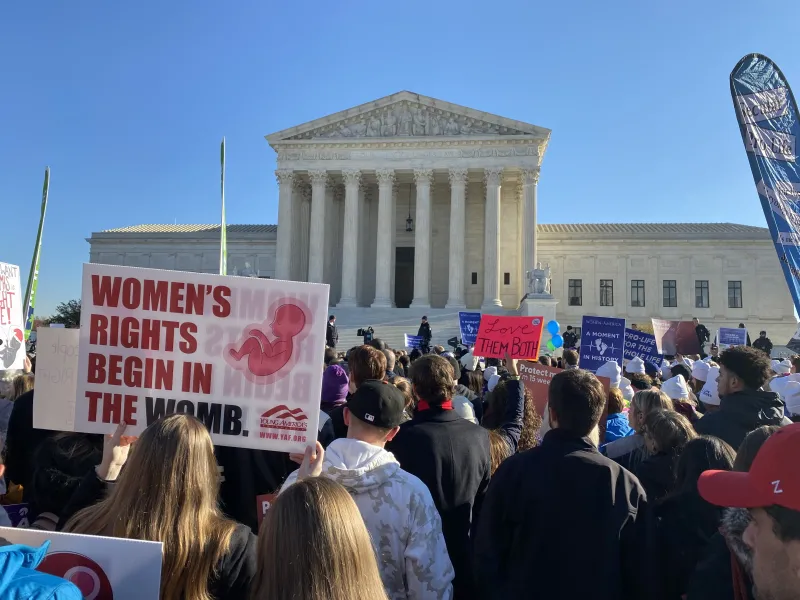
Thousands of pro-life advocates gathered outside the U.S. Supreme Court in Washington, D.C., on Dec. 1, 2021, in conjunction with oral arguments in the Dobbs v. Jackson Women’s Health Organization abortion case. / Katie Yoder/CNA
Denver Newsroom, May 3, 2022 / 16:10 pm (CNA).
Pro-life advocates have condemned the leak of a draft opinion in a U.S. Supreme Court case that would overturn Roe v. Wade, while also looking forward to such a decision being made.
“I hope it is true. I hope the majority of the court did decide to overturn Roe v. Wade. I also thought that it was a tragedy that there was a leak of the draft decision. A leak is not good for the Supreme Court. It was irresponsible and an ethical violation to make such a leak. It compromises the integrity of the court,” Archbishop Joseph Naumann of Kansas City in Kansas told CNA May 3.
Similarly, Dr. Melissa Moschella, an associate professor of philosophy at the Catholic University of America, commented that the leak “was very unethical conduct on the part of some individual at the court,” while adding, “I wasn’t surprised at all about the decision itself. It seemed very clear on the merits that this is the right decision, constitutionally.”
The news organization Politico published May 2 a draft ruling written by Justice Samuel Alito in the case Dobbs v. Jackson Women’s Health Organization. The document calls for the overturning of Roe v. Wade.
A statement from the court the following day said that “Although the document described in yesterday’s reports is authentic, it does not represent a decision by the Court or the final position of any member on the issues in the case.”
Archbishop Naumann said, “I encourage the Court to issue their actual decision as quickly as possible. It appears that leaking the draft decision was an attempt to pressure the court … Leaking a draft decision while the Court is still deliberating is a serious violation of the integrity of the Court and attempts to politicize the work of the Court.”
He added that “I am ecstatic if the Supreme Court has finally acknowledged that there really is no constitutional right to abortion. The Supreme Court, in 1973, made a tremendous error in claiming that there was a right to abortion. The court today is recognizing and acknowledging that the constitution does not address abortion. A right to abortion was not in the minds of those who authored the constitution.”
Moschella observed that “If the court is concerned at all with maintaining its legitimacy and making clear that it is not supposed to be a political actor but is simply supposed to be interpreting and applying the constitution, they should just ignore [the leak] and continue on their course.”
“Caving into political pressure and changing the decision in the face of political pressure after this leak will really delegitimize the court,” she added.
The draft ruling, Moschella said, would return abortion regulation “to democratic processes and probably will help to overcome some of the polarization that has resulted from removing it from democratic deliberation and the ability to make democratic compromises.”
“The pro life movement now needs to focus its attention on lobbying at the state level to get better laws that respect the dignity of the unborn in each state. And also to make sure that states are at the same time enacting legislation that supports women in crisis pregnancies and ensures that they have the resources that they need to have a healthy pregnancy and receive care and support.”
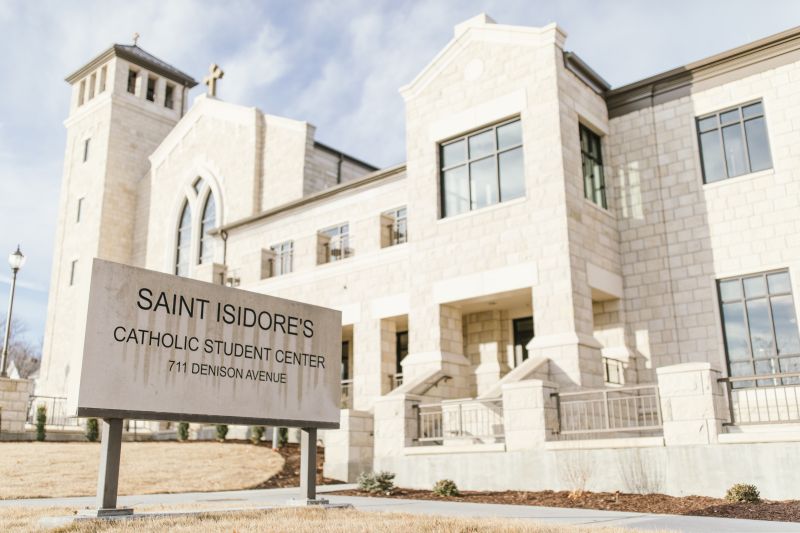
The exterior of the new St. Isidore’s Catholic Student Center at Kansas State University. / Credit: Jacob Bentzinger
CNA Staff, Oct 2, 2023 / 17:15 pm (CNA).
There’s a quote from Jerome Tang, head coach of the Kansas State University (KSU) basketball team, that Father Gale Hammerschmidt likes.
“I didn’t come to rebuild. I came to elevate,” Tang said after taking the team’s helm last year. (His team bowed out of the NCAA Tournament last spring after making it to the Elite Eight.)
Hammerschmidt, chaplain at St. Isidore’s Catholic Student Center at Kansas State, said he thinks “elevation” is an appropriate word for what the Catholic community he leads is doing right now. On Jan. 28, the local bishop dedicated the Catholic center’s brand-new, $20 million church — a project more than two decades in the making.
But now that the new church is open, the real work of bringing the Catholic faith to students on campus can continue. The grand new church presents an opportunity to “elevate everything we do here at St. Isidore’s,” Hammerschmidt told CNA.
“We know that the work is just now beginning. And if we’re going to create a beautiful space, we want to be able to do beautiful things in the space. And nothing is more beautiful than a soul encountering the living God,” the priest told CNA.
Hammerschmidt, a Kansas native and 1995 Kansas State alum, was ordained to the priesthood in 2012 and was assigned to St. Isidore’s in 2017. The Catholic center sits just across the street from the Kansas State campus, which is itself the lifeblood of the small city of Manhattan. There had been discussions about the need for a new church building for several years before he arrived.
“I already knew that there was a need to build a new church. This is something that had been talked about for probably 20 years, honestly, even since right around the time that I was graduating from college,” Hammerschmidt told CNA.
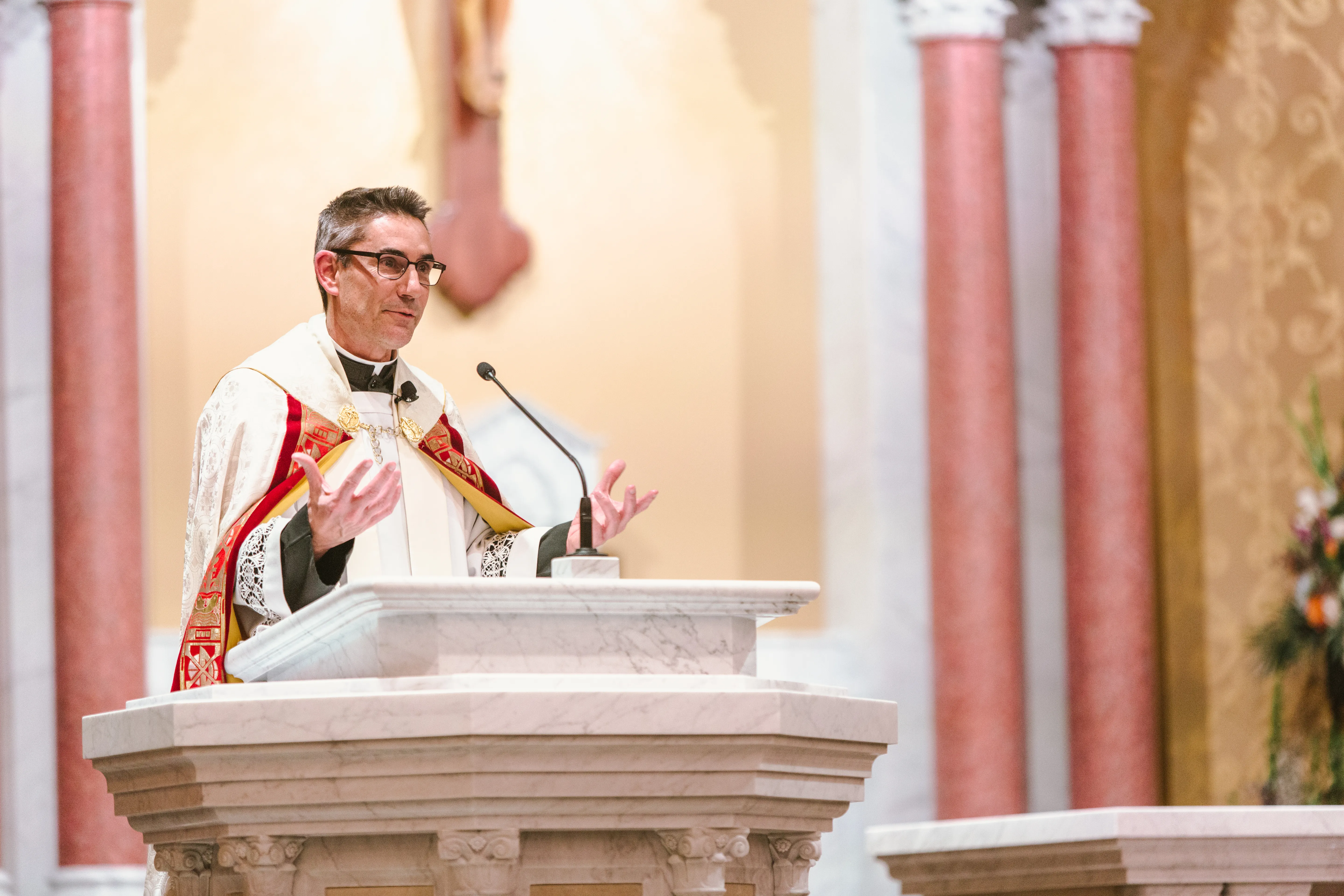
Father Gale Hammerschmidt. Credit: Jacob Bentzinger
Part of the reason was that the population served by St. Isidore’s had outgrown the old space, which sat about 400 and was regularly filled to bursting on Sundays with overflow seating in the student center library.
Grace Gorges, a K-State student studying graphic design, got involved with the Catholic community at the college as soon as she arrived at KSU. From the get-go, “the Masses were always crowded, always overflowing,” she said, adding that the fallout from COVID made things even worse when parts of the sanctuary had to be roped off for distancing purposes.
The campaign to raise money for a new church was dubbed “Home Away from Home.” About $5 million had already been raised before Hammerschmidt’s arrival, and the campaign ultimately raised nearly $20 million for the project, he said. Some 1,500 individual donors contributed to the campaign.
Nebraska-based lead architect Kevin Clark came to Manhattan in 2017 and began asking the community what they wanted their new church to look like. Countless students requested a beautiful interior, “traditional-looking in nature,” the priest said.
“We want this to look like a church that has been standing forever and will stand forever,” he recalled students telling him.
“We wanted to make sure that it was an epic-looking building” with an interior that would raise hearts and minds “to the beauties of heaven,” he said.
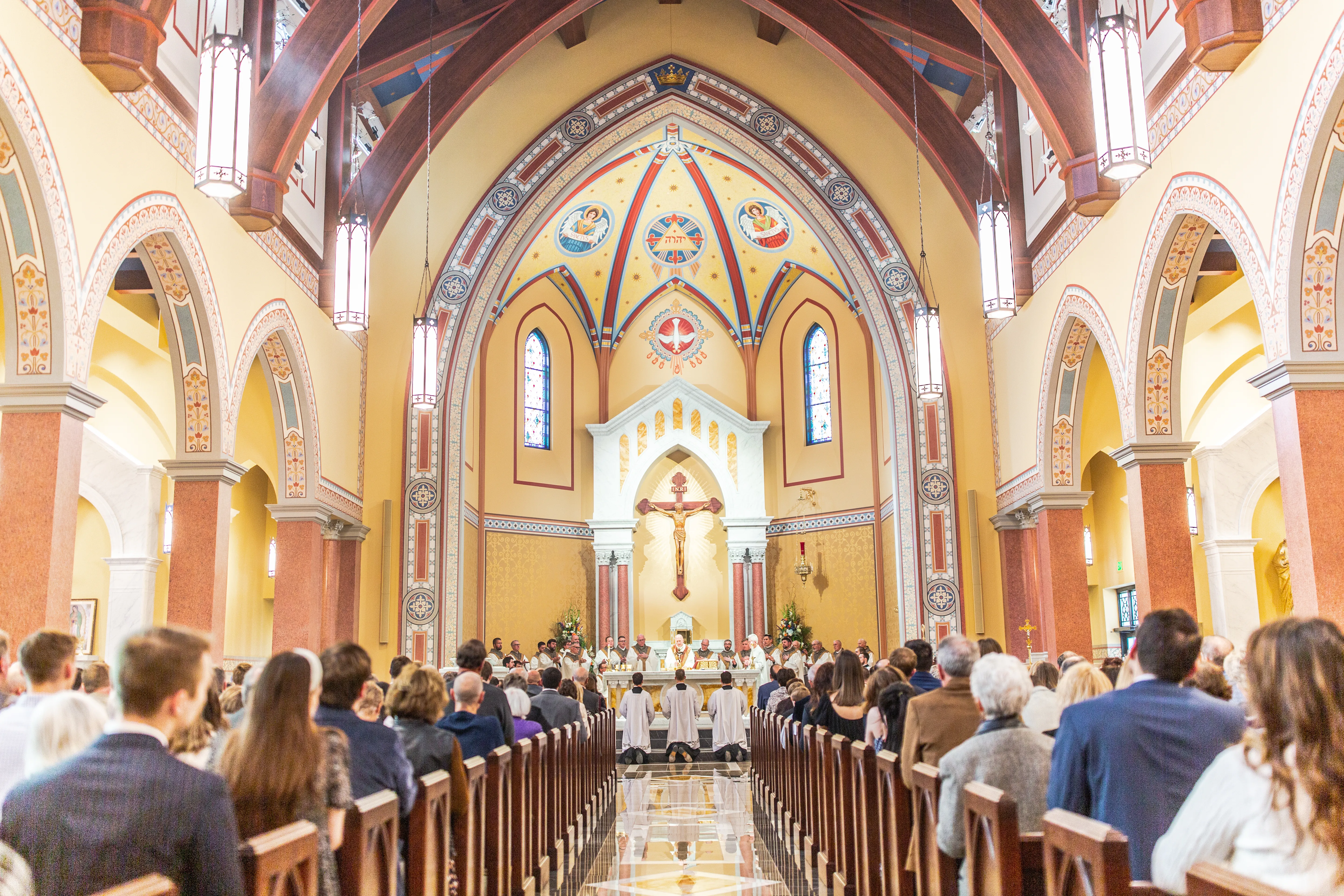
The congregation kneels during the dedication Mass for the new St. Isidore’s Catholic Student Center at Kansas State University. Credit: Jacob Bentzinger
Given her involvement in the community and her interest in beauty and design, Hammerschmidt asked Gorges to serve on the building committee, which meant she would have a say in the church’s aesthetic. Gorges said she was invited to help design the church’s tile flooring. She researched churches online for inspiration and also drew from her personal experience of visiting numerous beautiful sacred spaces on a trip to Italy.
Ridge Pinkston, a fifth-year senior when CNA spoke with him, studying medieval history, was also chosen to be on the building committee. He told CNA that the committee — which included Hammerschmidt, diocesan board member Doug Hinkin, and others — was given almost complete control over the look of the new church.
He said the committee had numerous meetings with the architect to figure out the look of everything in the new church — they spent an entire two-hour meeting designing the look of the altar, for example. He said the building committee “represented the body of owners” to the architect and designers, similar to how when a family builds a house, the architects and contractors consult them on how they want it to look. He said it was a “huge privilege” and a great learning process to be a part of the committee as a student.
Despite his interest in medieval architecture, the churches that Pinkston primarily drew inspiration from were mainly stateside; most are located in the Archdiocese of Denver. They included the medieval revival-style chapel at St. John Vianney Theological Seminary and the Cathedral Basilica of the Immaculate Conception and Holy Ghost Catholic Church, both in downtown Denver.
Ultimately, the architects and designers of St. Isidore’s produced a neo-Gothic interior with pointed arches that dropped many a jaw when it was unveiled. The interior also features numerous instances of vine imagery — an image of Jesus himself, but also a subtle nod to the college’s agricultural heritage. Evergreene Architectural Arts, a renowned design studio in New York, provided the decoration, Hammerschmidt said.
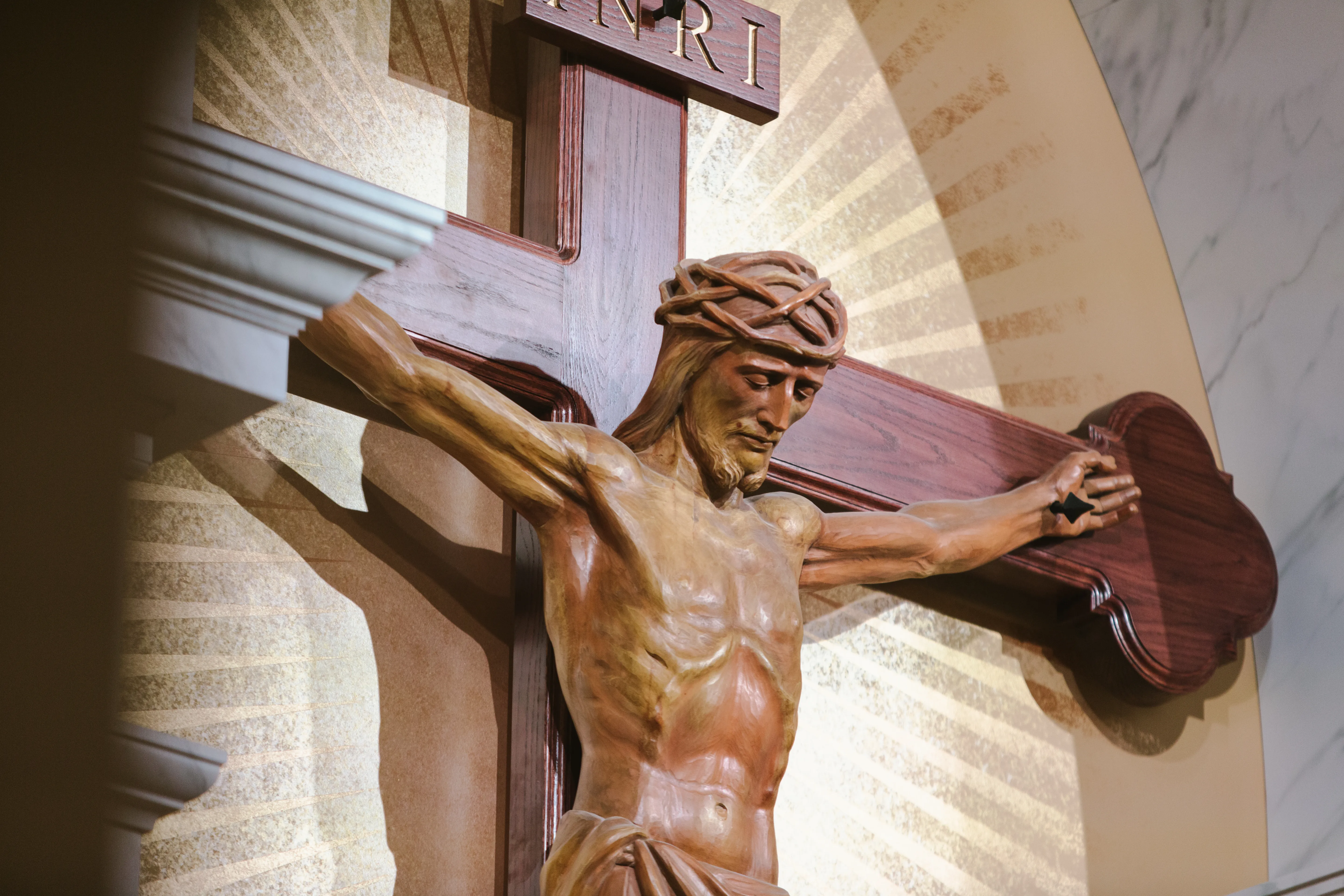
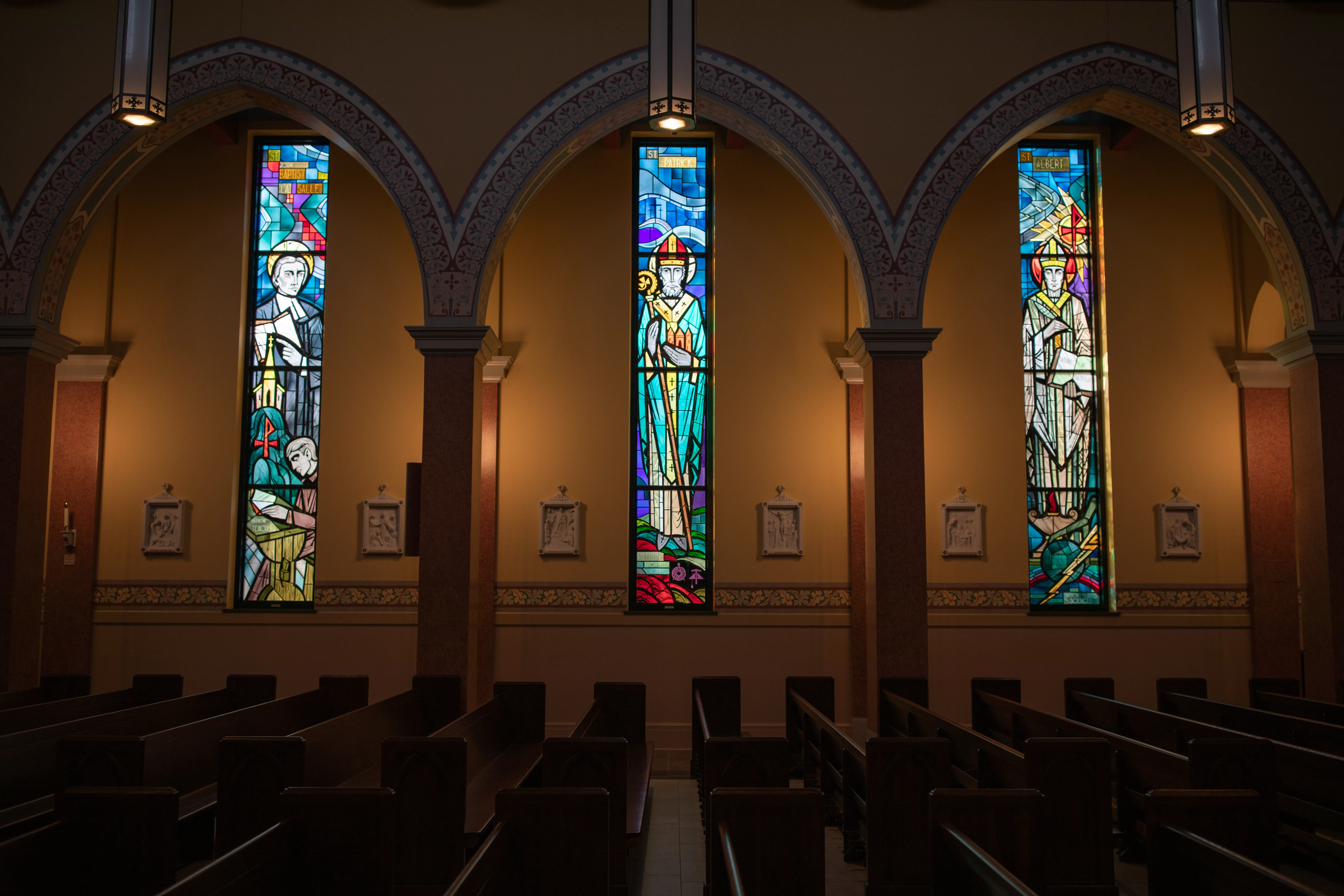
Not everything in the interior is entirely new, however. Hammerschmidt said at the request of students, stained-glass windows depicting the seven patron saints of the seven original colleges at Kansas State (the university was originally Methodist-founded) were saved and incorporated into the new church. Among those saints are the church’s namesake, St. Isidore — an 11th-century Spaniard and patron saint of agricultural workers — as well as the namesake of the student center, St. Robert Bellarmine. A much-loved crucifix that hung over the tabernacle in the old church was also used again in the new church.
The crucifix in the new St. Isidore’s Catholic Student Center. Credit: Jacob Bentzinger
Gorges said she loves the triumphal arch over the altar in the finished church, which draws one’s eyes toward the focal point of the crucifix, and onward to heaven. A beautiful church, she said, is “not the end-all-be-all by any means. But if it’s at all possible, beauty matters. And we should be trying to live that in our daily lives.”
Pinkston said his favorite design element in the new church, apart from the ceiling of the apse, is the new altar itself, which he said really strikes him as being designed in a way that calls to mind a place where sacrifices are made.
“Rightfully, that should be one of the most beautiful features,” he said of the altar.
The designers also took care to design the exterior of the church to match the native limestone buildings of Kansas State, in an effort to make the church an integral part of the campus it serves.
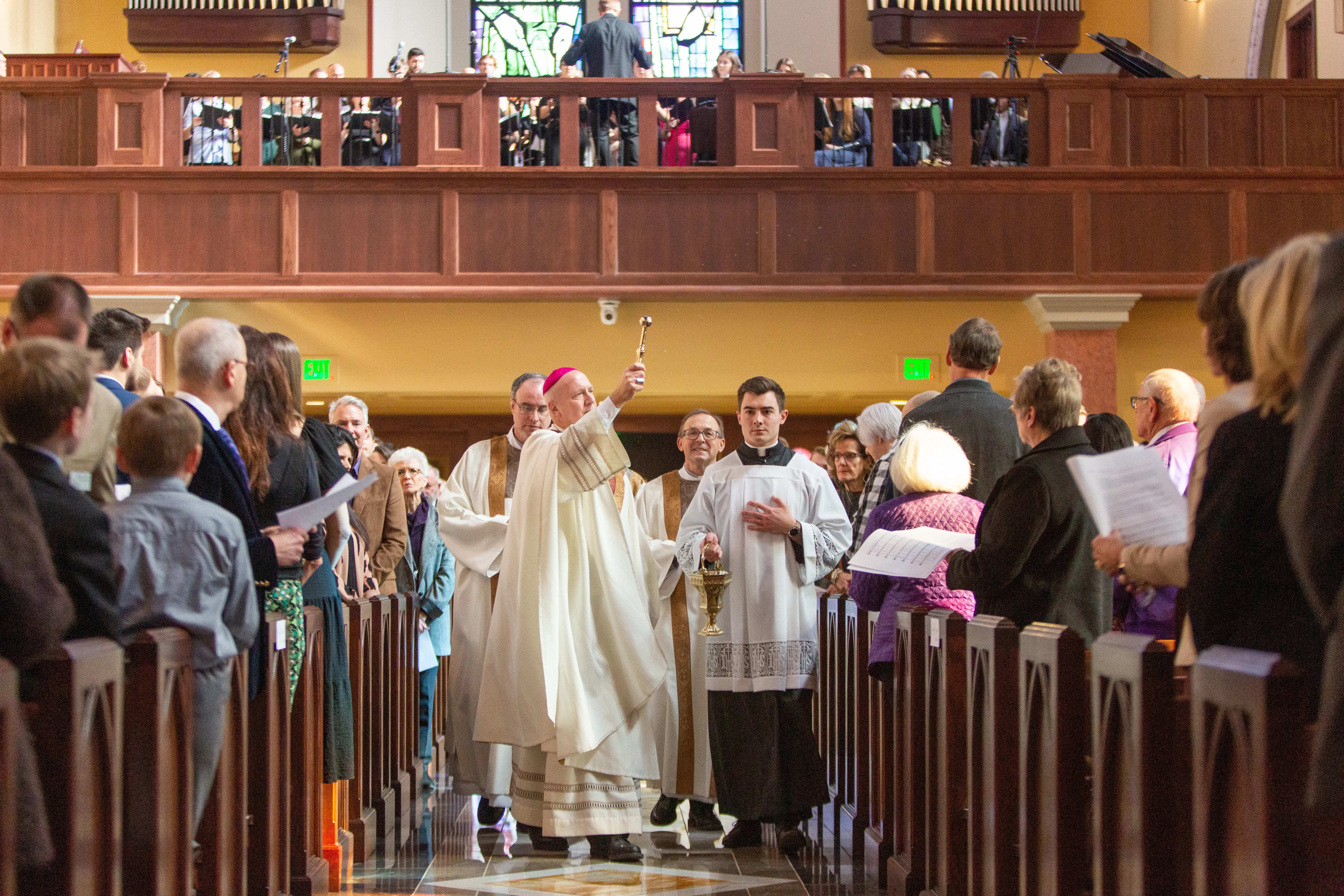
Bishop Gerald Vincke of Salina, Kansas, dedicated the diocese’s newest church on Jan. 28. The 14,000-square-foot structure can accommodate about 700 for Sunday Masses.
Bishop Gerald Vincke of Salina, Kansas, sprinkles holy water during the dedication of the new St. Isidore’s Catholic Student Center on Jan. 28, 2023. Credit: Jacob Bentzinger
Hammerschmidt said daily Masses at St. Isidore’s were already attracting nearly 200 students on a regular basis. A key part of the Catholic center’s success, he said, is the presence of missionaries from the Fellowship of Catholic University Students (FOCUS). FOCUS maintains a presence on college campuses with the goal of winning people to the Catholic faith through authentic friendships and forming others to go out and do the same through Bible studies, small groups, and retreats.
“We also work closely with the high schools in the state of Kansas, especially the Catholic high schools. And we have many strong Catholic high schools in our area. And so we just have students who, the first day they show up in Manhattan, they already know about us,” Hammerschmidt said.
In addition, he said, the Catholic center is in cooperation with the local Diocese of Salina and the nearby Diocese of Wichita, whereby Wichita — which has been blessed in recent years with large vocation numbers — sends a priest to serve as Hammerschmidt’s associate. Large numbers of students come to KSU from Wichita — Gorges among them — who get involved with the Catholic center thanks to strong word of mouth.
“It’s good for them to have one of their own priests looking after them … I think it’s working phenomenally well.”
Stained-glass windows in the new St. Isidore’s Catholic Student Center. Credit: Jacob Bentzinger
Working at St. Isidore’s, Pinkston said he has gotten to know “the regulars” that came to the church before the rebuild, but now with the new church, he said he sees many more people coming in to pray whom he has never seen before. He also said it was inspirational for him to see a friend — a man who is joining the Catholic Church this Easter — weeping openly when he first saw the new church’s interior.
“That was really the first time I’d ever seen him express emotion … That’s definitely a huge blessing to be able to see that happening,” he said.
Hammerschmidt was almost overwhelmed by the support of the many students, alumni, and others who made the new church possible. Months on from the chapel’s opening, the 9:09 p.m. daily Mass is always well attended, with about 300 students attending regularly. As of September, St. Isidore’s has 40 student-led Bible studies with around 400 Bible study participants.
“The outpouring of joy and gratitude has been incredible. The number of people who we will just see walking through the church from out of town is unbelievable,” Hammerschmidt said.
“And then beyond that, we had so many more hundreds of people praying for the project, and we just have been supported unbelievably well.”
Hammerschmidt said he wants the students and community of Kansas State to take ownership of the magnificent new church and to use it for their spiritual benefit.
“We want to let everybody in Manhattan and on K-State’s campus know that we built this church for them,” he said.
“If they just need a place of encounter with God to just come in to be seated, to be immersed in the beauty and the silence and to just let God speak. That’s our hope. For the Catholics, for the non-Catholics, for the students, for nonstudents, just for anyone who needs a place to encounter the living God, this would be the place for them.”
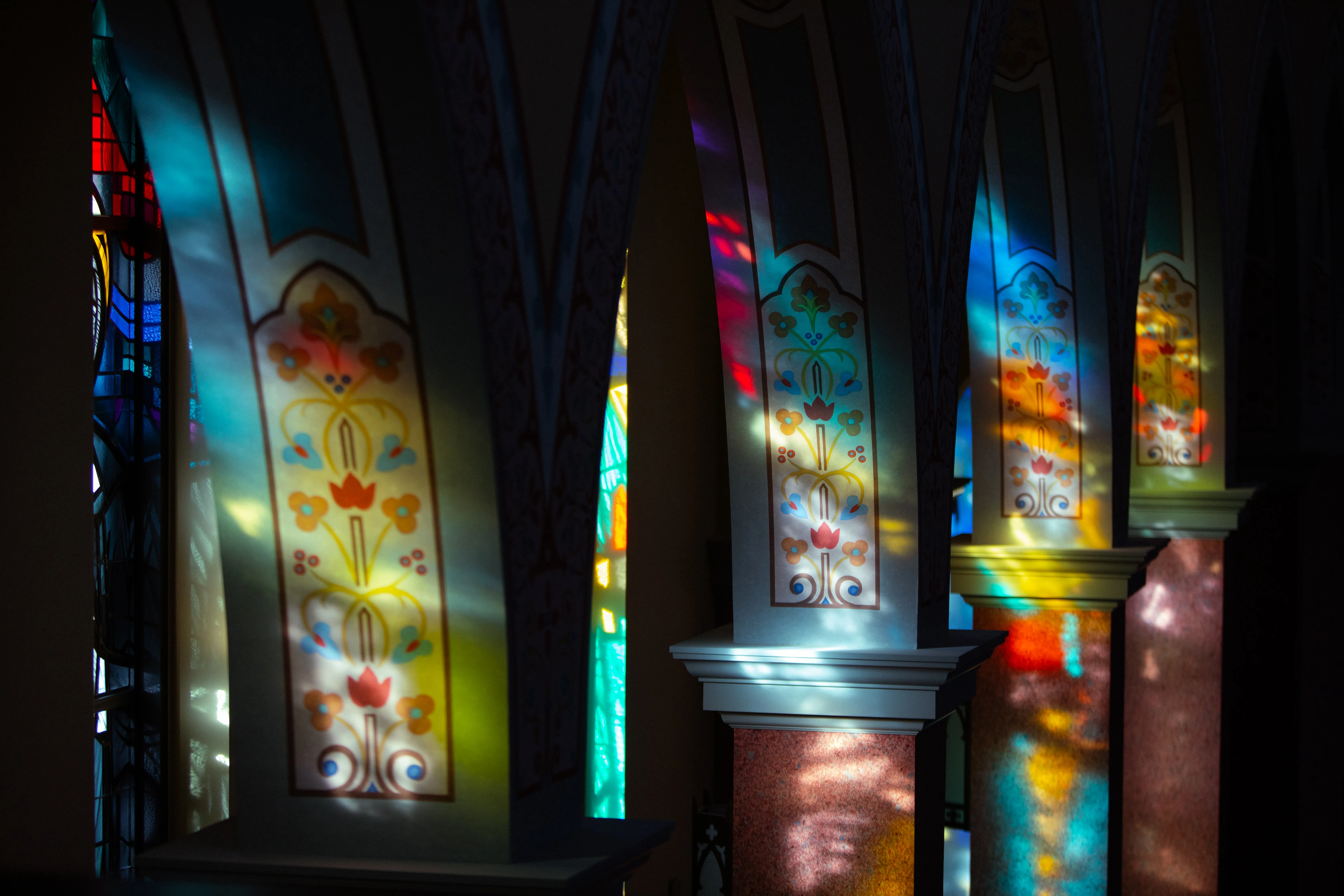
Light from the stained glass in the new St. Isidore’s Catholic Student Center. Jacob Bentzinger
Saint Peter’s Chapel and Native American Museum at Saint Kateri Tekakwitha National Shrine and Historic Site in Fonda, New York. / Photo courtesy of Saint Kateri Tekakwitha National Shrine and Historic Site
Chicago, Ill., Jul 13, 2023 / 12:00 pm (CNA).
Shrines to various saints can be found in every part of the world, including every state in the U.S. Each one is dedicated to faith and prayer, but one shrine in the northeastern United States also has a distinct mission of connecting pilgrims with Native American culture and sharing the fascinating history of Kateri Tekakwitha, the first American Indian to be canonized a saint.
The Saint Kateri Tekakwitha National Shrine and Historic Site in Fonda, New York, honors not only the life of St. Kateri, whose feast day is July 14, but also the life and history of the local Indigenous people to whom she belonged.
“We have cultivated strong ties to both the Catholic Mohawk community and the traditional Mohawk community,” said Melissa Miscevic Bramble, director of operations at the St. Kateri Shrine, in an interview with CNA. “We see it as our mission to educate about her Mohawk culture as well as her Catholic faith.”
Who was St. Kateri?
Called the Lily of the Mohawks, Kateri Tekakwitha was the child of a Mohawk father and a Christian Algonquin mother but was orphaned at age 4 when the rest of her family died of smallpox. Her own early bout with the illness left lasting scars and poor vision.
She went to live with an anti-Christian uncle and aunt, but at age 11 she encountered Jesuit missionaries and recognized their teaching as the beliefs of her beloved mother. Desiring to become a Christian, she began to privately practice Christianity.
Beginning at about age 13, she experienced pressure from her family to marry, but she wanted to give her life to Jesus instead. A priest who knew her recorded her words: “I have deliberated enough. For a long time, my decision on what I will do has been made. I have consecrated myself entirely to Jesus, son of Mary, I have chosen him for husband, and he alone will take me for wife.”
At last, she was baptized at about age 19, and her baptism made public her beliefs, which had been kept private up until then. The event was the catalyst for her ostracism from her village. Some members of her people believed that her beliefs were sorcery, and she was harassed, stoned, and threatened with torture in her home village.
Tekakwitha fled 200 miles to Kahnawake, a Jesuit mission village for Native Amerian converts to Christianity to live together in community. There, she found her mother’s close friend, Anastasia Tegonhatsiongo, who was a clan matron of a Kahnawake longhouse. Anastasia and other Mohawk women took Kateri under their wings and taught her about Christianity, and she lived there happily for several years until her death around age 23 or 24.
Although she never took formal vows, Tekakwitha is considered a consecrated virgin, and the United States Association of Consecrated Virgins took her as its patron. She is also the patron saint of traditional ecology, Indigenous peoples, and care for creation.
A shrine with a special mission
The Saint Kateri Tekakwitha National Shrine and Historic Site has a unique mission of archaeological and historical research related to Kateri Tekakwitha and her people. Welcoming several thousand visitors per year, the shrine ministers not only to Christians but also to all American Indians.
According to its website, the shrine and historic site “promotes healing, encourages environmental stewardship, and facilitates peace for all people by offering the natural, cultural, and spiritual resources at this sacred site.” Describing itself as a sacred place of peace and healing with a Catholic identity, its ministry and site are intended to be ecumenical and welcome people of all faiths.
In keeping with this mission, the shrine’s grounds include an archaeological site, the village of Caughnawaga, which is the only fully excavated Iroquois/Haudenosaunee village in the world. St. Kateri lived in this village, which is on the National Register of Historic Places. Visitors can also visit the Kateri Spring, where Kateri Tekakwitha was baptized.
“The water from the Kateri Spring is considered holy water by the Catholic Church,” Bramble said. “People are welcome to come take the waters, and we regularly get reports of healing. We’ve sent that water all over North America to folks who have requested it.”
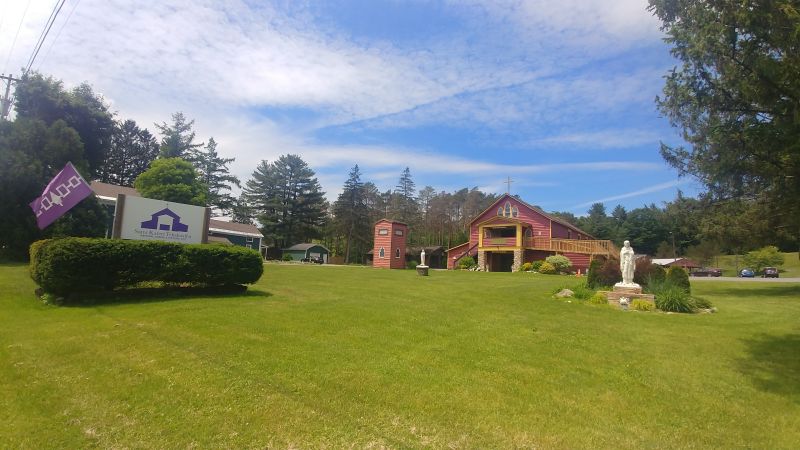
Besides the archaeological site, the main grounds of the shrine include St. Peter’s Chapel, housed in a former Dutch barn built in 1782; museum exhibits of Native American culture and history; St. Maximilian Kolbe Pavilion; a Candle Chapel dedicated to St. Kateri; Grassmann Hall and the Shrine office; a friary; a gift shop; an outdoor sanctuary; and maintenance facilities. The 150-acre property includes hiking trails that are open to the public year-round from sunrise to sunset.
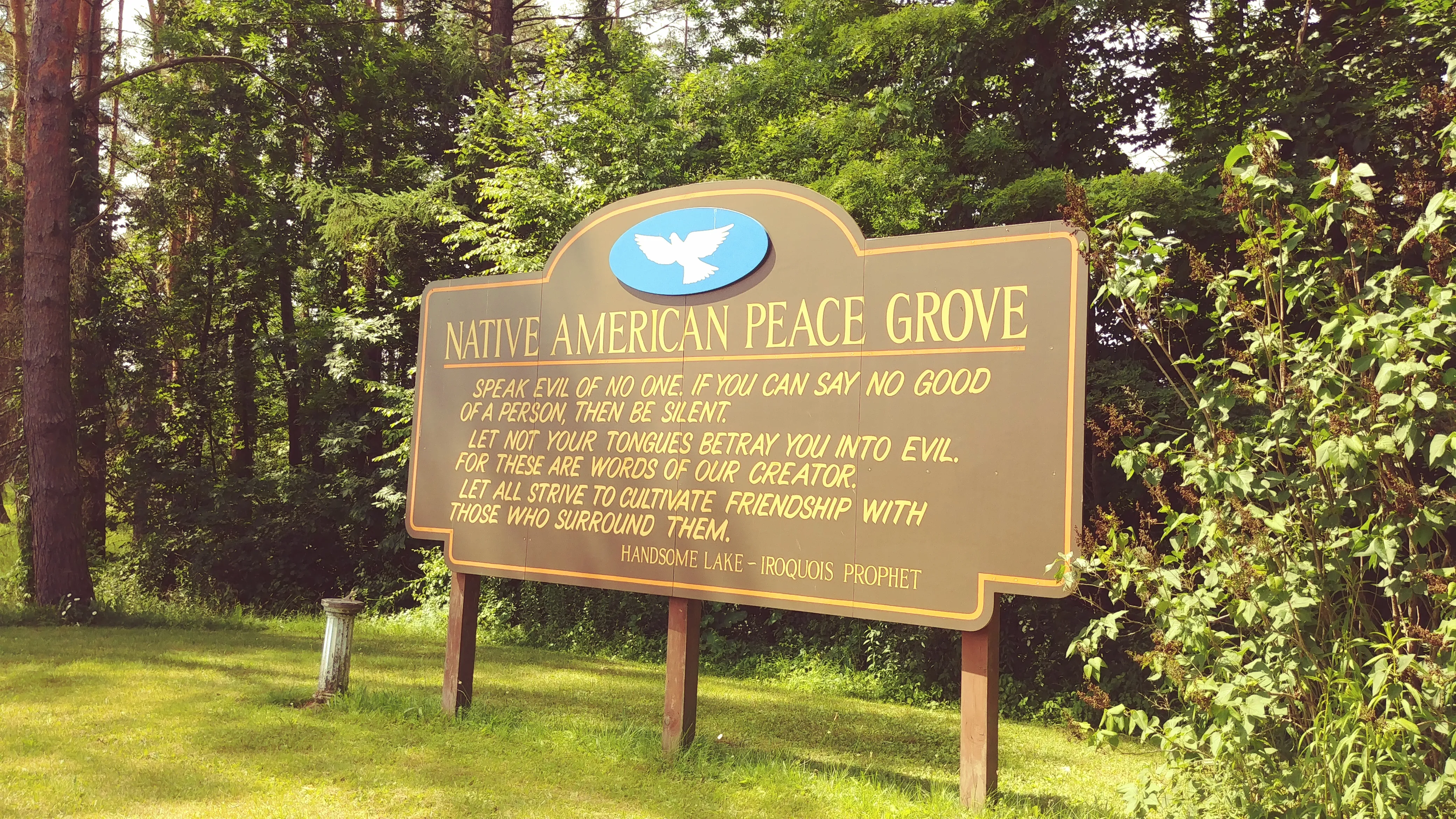
Peace Grove at Saint Kateri Tekakwitha Shrine and Historic Site in Fonda, New York. Photo courtesy of Saint Kateri Tekakwitha Shrine and Historic Site
Outside the Candle Chapel, which is always open for prayer, visitors can participate in a ministry of “Kateri crosses.”
“St. Kateri was known for going into the forest, gathering sticks, binding them into crosses, and then spending hours in prayer in front of crosses she created,” Bramble said. Sticks are gathered from the shrine grounds and visitors are invited to make their own “Kateri crosses” and take them home to use as a prayer aid. Bramble shared that the shrine sends materials for Kateri crosses to those who aren’t able to visit, including recently to a confirmation group.
The feast day weekend
The Saint Kateri Tekakwitha National Shrine has a schedule of special events planned for St. Kateri’s feast day on July 14. Bramble said they anticipate several hundred visitors for the feast day events this year, which include Masses, a healing prayer service, and talks. (A listing of the full schedule can be found here.)
The weekend Masses, which include special blessings and the music of the Akwesasne Mohawk Choir, “incorporate American Indian spiritual practices in keeping with the Catholic Church,” Bramble said. “The Akwesasne Mohawk Choir is made up of descendants of St. Kateri’s community who lived in the area historically.”
Bramble described numerous events each year that partner with the local American Indian community, such as the fun-filled “Three Sisters Festival” in May (celebrating corn, beans, and squash — the “three sisters” that were staples of Native cuisine), healing Masses during Indigenous Peoples’ Week in October, and a recent interfaith prayer service with Mohawk elders.
“There is a reestablished traditional Mohawk community a few miles west of the shrine, and we feel very blessed that we’ve been able to cultivate a very cooperative and mutually respectful relationship with the folks there,” Bramble said.
The Saint Kateri Shrine is also a great place for families. Events often include activities and crafts for children, there is an all-ages scavenger hunt available at the site, and the shrine’s museum is “a phenomenal educational opportunity.”
Bringing together American Indian archaeology and history with the story of St. Kateri, the shrine and its programs shed light on the saint’s story and keep alive the traditions and history of her people.




Leave a Reply