Vatican City, Jul 11, 2019 / 10:35 am (CNA).- The opening of two tombs on Vatican property revealed both graves to be completely empty, providing no answers in the unsolved disappearance of an Italian girl 36 years ago, the Vatican reported Thursday.
“The research has given negative results: no human findings or funerary urns were found,” stated Holy See spokesman Alessandro Gisotti July 11.
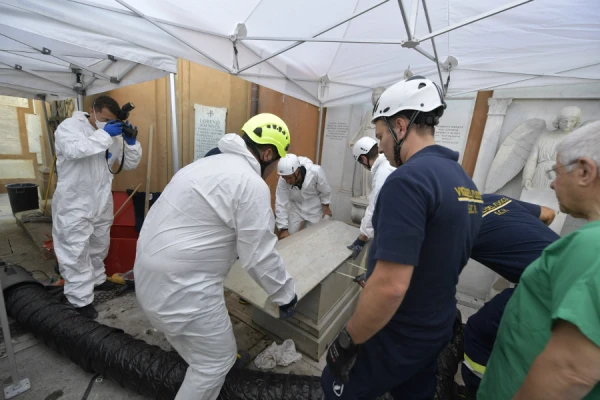
The tombs, located on Vatican extra-territorial property adjacent to Vatican City State, were opened in an attempt to find a clue to the 1983 vanishing of Emanuela Orlandi.
Orlandi was the daughter of an envoy of the Prefecture of the Pontifical House and a citizen of Vatican City State. Her disappearance at age 15 has been the subject of international intrigue, including suspicion about the Vatican’s role, since it occurred.
The Vatican authorized the opening of the graves after a request by Orlandi’s family, which had last year received an anonymous letter suggesting a clue could be found near a large statue of an angel in the Teutonic College cemetery.
The tombs opened were those of Princess Sophie von Hohenlohe, who died in 1836, and Duchess Charlotte Frederica of Mecklenburg-Schwerin, who died in 1840.
Charlotte’s monument bears an inscription indicating it was erected in 1848 by her son, Frederick VII of Denmark.
According to Gisotti, von Hohenlohe’s tomb revealed an empty underground compartment of approximately 13 by 12 feet. The opening of the sarcophagus of Charlotte also revealed no human remains. Relatives of both women were informed of the discovery.
The Vatican’s next step following the discovery, Gisotti explained, will be to look into documentation about structural renovations that took place in the cemetery at the end of the 1800s and in the 1960s and ‘70s.
The opening of the graves was performed by the Vatican construction staff and overseen by a forensic anthropologist and his team, the Vatican gendarmerie, and by the Vatican tribunal’s promoter of justice.
Members of Orlandi’s family, and their lawyer, were also present.
If you value the news and views Catholic World Report provides, please consider donating to support our efforts. Your contribution will help us continue to make CWR available to all readers worldwide for free, without a subscription. Thank you for your generosity!
Click here for more information on donating to CWR. Click here to sign up for our newsletter.
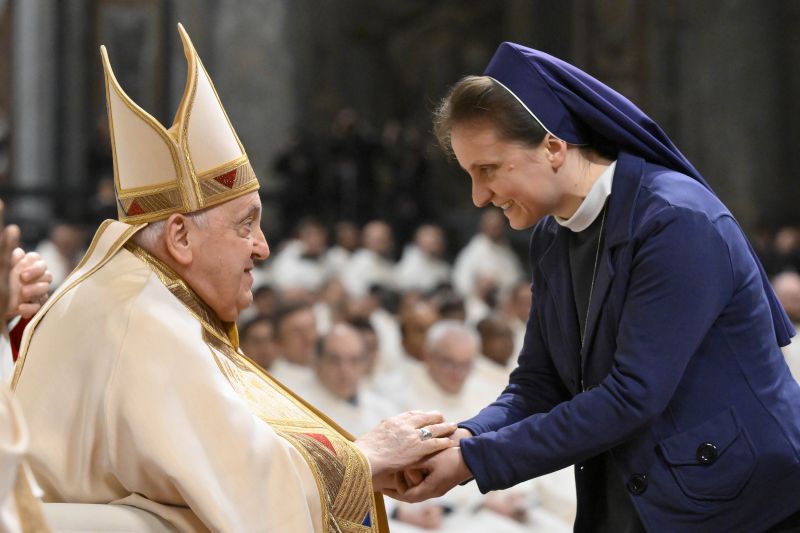
Pope Francis greets a woman religious at a Mass on the World Day of Consecrated Life, the feast of the Presentation of the Lord, on Feb. 2, 2024, in St. Peter’s Basilica at the Vatican. / Credit: Vatican Media
ACI Prensa Staff, May 30, 2024 / 16:30 pm (CNA).
Pope Francis on Thursday addressed a message to participants in a conference on consecrated religious life currently taking place in Brazil.
In his message, he expressed his gratitude for “the immense gift of the vocation to consecrated life which, in its most diverse charisms, enriches ecclesial communion and contributes greatly to the mission of the Church throughout the world.”
The pontiff noted that in many places “the first proclamation of the Gospel is made by consecrated men and women, who take up with great commitment and with the dedication of their lives the mandate of the Lord.”
The Holy Father also said that “the gift of vocation must be safeguarded and cultivated every day, so that it produces good fruits in the life of each religious.”
Pope Francis expressed his joy for the theme chosen for the conference, which is the exhortation that Jesus made to the apostles at the Last Supper: “Remain in my love.”
According to Pope Francis, “to live the divine call well, it is necessary to remain in his love, through constant dialogue with Jesus in daily prayer and fidelity to the vows that so beautifully express our consecration.”
The pope also said that “the consecrated life, if it remains firm in the love of the Lord, sees beauty. It sees that poverty is not a titanic effort but rather a much greater freedom, which gives us God and others as true riches.”
The consecrated life “sees that chastity is not austere sterility but the way to love without possessing. It sees that obedience is not discipline but victory over our unruliness as exemplified by Jesus,” he said, recalling his homily of Feb. 1, 2020, on the occasion of the World Day of Consecrated Life.
Finally, he encouraged the attendees to live the present “sustained by the mysticism of the specific charisms of each religious family and [by being] prophetically committed to the proclamation of the Gospel.”
He also invited them to “look to the future with hope” and not to forget “to pray for me.”
This story was first published by ACI Prensa, CNA’s Spanish-language news partner. It has been translated and adapted by CNA.
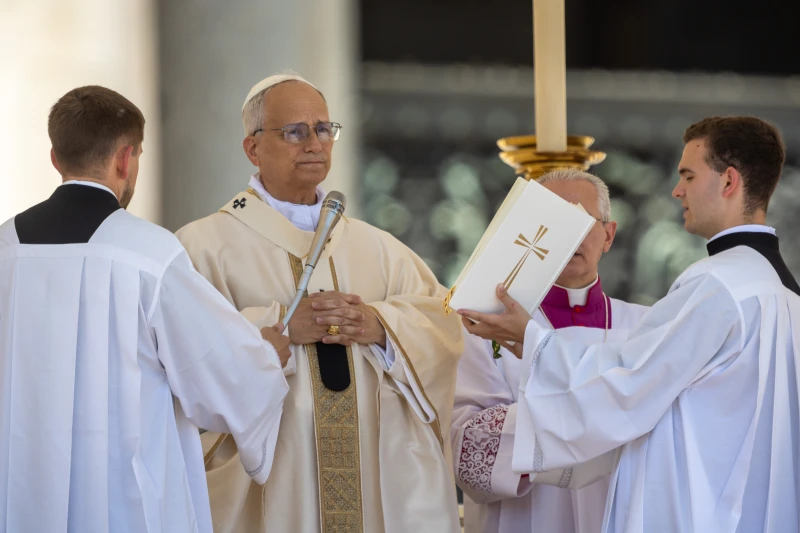
Pope Leo XIV gcelebrates the Holy Mass Holy Mass for Jubilee of Families, Children, Grandparents and the Elderly at St. Peter’s Square on Sunday, June 1, 2025 / Credit: Daniel Ibáñez/CNA
CNA Newsroom, Jun 1, 2025 / 07:18 am (CNA).
Pope Leo XIV gave the following homily on Sunday, June 1, 2025 for the Jubilee of Families, Children, Grandparents, and the Elderly on St. Peter’s Square at the Vatican.
The Gospel we have just heard shows us Jesus, at the Last Supper, praying on our behalf (cf. Jn 17:20). The Word of God, made man, as he nears the end of his earthly life, thinks of us, his brothers and sisters, and becomes a blessing, a prayer of petition and praise to the Father, in the power of the Holy Spirit. As we ourselves, full of wonder and trust, enter into Jesus’ prayer, we become, thanks to his love, part of a great plan that concerns all of humanity.
Christ prays that we may “all be one” (v. 21). This is the greatest good that we can desire, for this universal union brings about among his creatures the eternal communion of love that is God himself: the Father who gives life, the Son who receives it and the Spirit who shares it.
The Lord does not want us, in this unity, to be a nameless and faceless crowd. He wants us to be one: “As you, Father, are in me and I am in you, may they also be in us” (v. 21). The unity for which Jesus prays is thus a communion grounded in the same love with which God loves, which brings life and salvation into the world. As such, it is firstly a gift that Jesus comes to bring. From his human heart, the Son of God prays to the Father in these words: “I in them and you in me, that they may become completely one, so that the world may know that you have sent me and have loved them even as you have loved me” (v. 23).
Let us listen with amazement to these words. Jesus is telling us that God loves us as he loves himself. The Father does not love us any less than he loves his only-begotten Son. In other words, with an infinite love. God does not love less, because he loves first, from the very beginning! Christ himself bears witness to this when he says to the Father: “You loved me before the foundation of the world” (v. 24). And so it is: in his mercy, God has always desired to draw all people to himself. It is his life, bestowed upon us in Christ, that makes us one, uniting us with one another.
Listening to this Gospel today, during the Jubilee of Families, Children, Grandparents and the Elderly, fills us with joy.
Dear friends, we received life before we ever desired it. As Pope Francis said: “all of us are sons and daughters, but none of us chose to be born” (Angelus, 1 January 2025). Not only that. As soon as we were born, we needed others in order to live; left to ourselves, we would not have survived. Someone else saved us by caring for us in body and spirit. All of us are alive today thanks to a relationship, a free and freeing relationship of human kindness and mutual care.
That human kindness is sometimes betrayed. As for example, whenever freedom is invoked not to give life, but to take it away, not to help, but to hurt. Yet even in the face of the evil that opposes and takes life, Jesus continues to pray to the Father for us. His prayer acts as a balm for our wounds; it speaks to us of forgiveness and reconciliation. That prayer makes fully meaningful our experience of love for one another as parents, grandparents, sons and daughters. That is what we want to proclaim to the world: we are here in order to be “one” as the Lord wants us to be “one,” in our families and in those places where we live, work and study. Different, yet one; many, yet one; always, in every situation and at every stage of life.
Dear friends, if we love one another in this way, grounded in Christ, who is “the Alpha and the Omega,” “the beginning and the end” (cf. Rev 22:13), we will be a sign of peace for everyone, in society and the world. Let us not forget: families are the cradle of the future of humanity.
In recent decades, we have received a sign that fills us with joy but also makes us think. It is the fact that several spouses have been beatified and canonized, not separately, but as married couples. I think of Louis and Zélie Martin, the parents of Saint Therese of the Child Jesus; and of Blessed Luigi and Maria Beltrame Quattrocchi, who raised a family in Rome in the last century. And let us not forget the Ulma family from Poland: parents and children, united in love and martyrdom. I said that this is a sign that makes us think. By pointing to them as exemplary witnesses of married life, the Church tells us that today’s world needs the marriage covenant in order to know and accept God’s love and to defeat, thanks to its unifying and reconciling power, the forces that break down relationships and societies.
For this reason, with a heart filled with gratitude and hope, I would remind all married couples that marriage is not an ideal but the measure of true love between a man and a woman: a love that is total, faithful and fruitful (cf. SAINT PAUL VI, Humanae Vitae, 9). This love makes you one flesh and enables you, in the image of God, to bestow the gift of life.
I encourage you, then, to be examples of integrity to your children, acting as you want them to act, educating them in freedom through obedience, always seeing the good in them and finding ways to nurture it. And you, dear children, show gratitude to your parents. To say “thank you” each day for the gift of life and for all that comes with it is the first way to honour your father and your mother (cf. Ex 20:12). Finally, dear grandparents and elderly people, I recommend that you watch over your loved ones with wisdom and compassion, and with the humility and patience that come with age.
In the family, faith is handed on together with life, generation after generation. It is shared like food at the family table and like the love in our hearts. In this way, families become privileged places in which to encounter Jesus, who loves us and desires our good, always.
Let me add one last thing. The prayer of the Son of God, which gives us hope on our journey, also reminds us that one day we will all be uno unum (cf. Saint Augustine, Sermo super Ps. 127): one in the one Saviour, embraced by the eternal love of God. Not only us, but also our fathers, mothers, grandmothers, grandfathers, brothers, sisters and children who have already gone before us into the light of his eternal Pasch, and whose presence we feel here, together with us, in this moment of celebration.
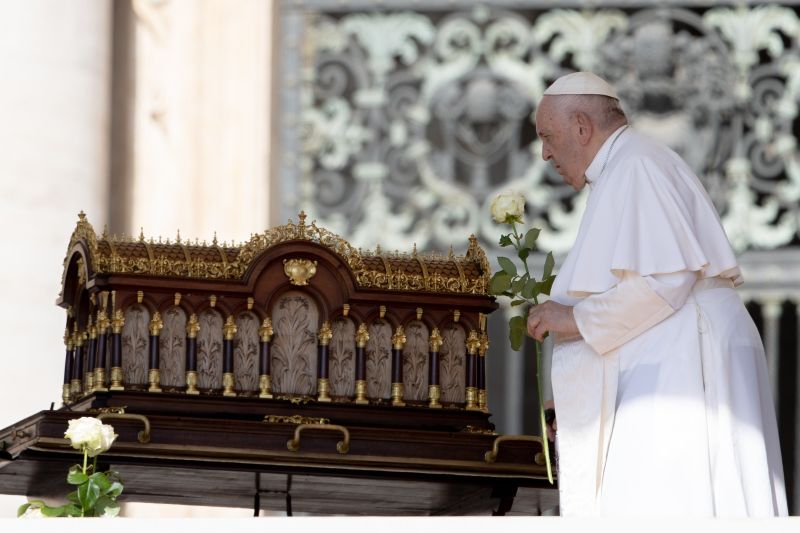
Pope Francis prayed before a relic of St. Therese of Lisieux at the beginning of his general audience in St. Peter’s Square, and shortly before going to the hospital for an abdominal surgery, on June 7, 2023. / Daniel Ibanez/CNA
Vatican City, Jun 7, 2023 / 04:37 am (CNA).
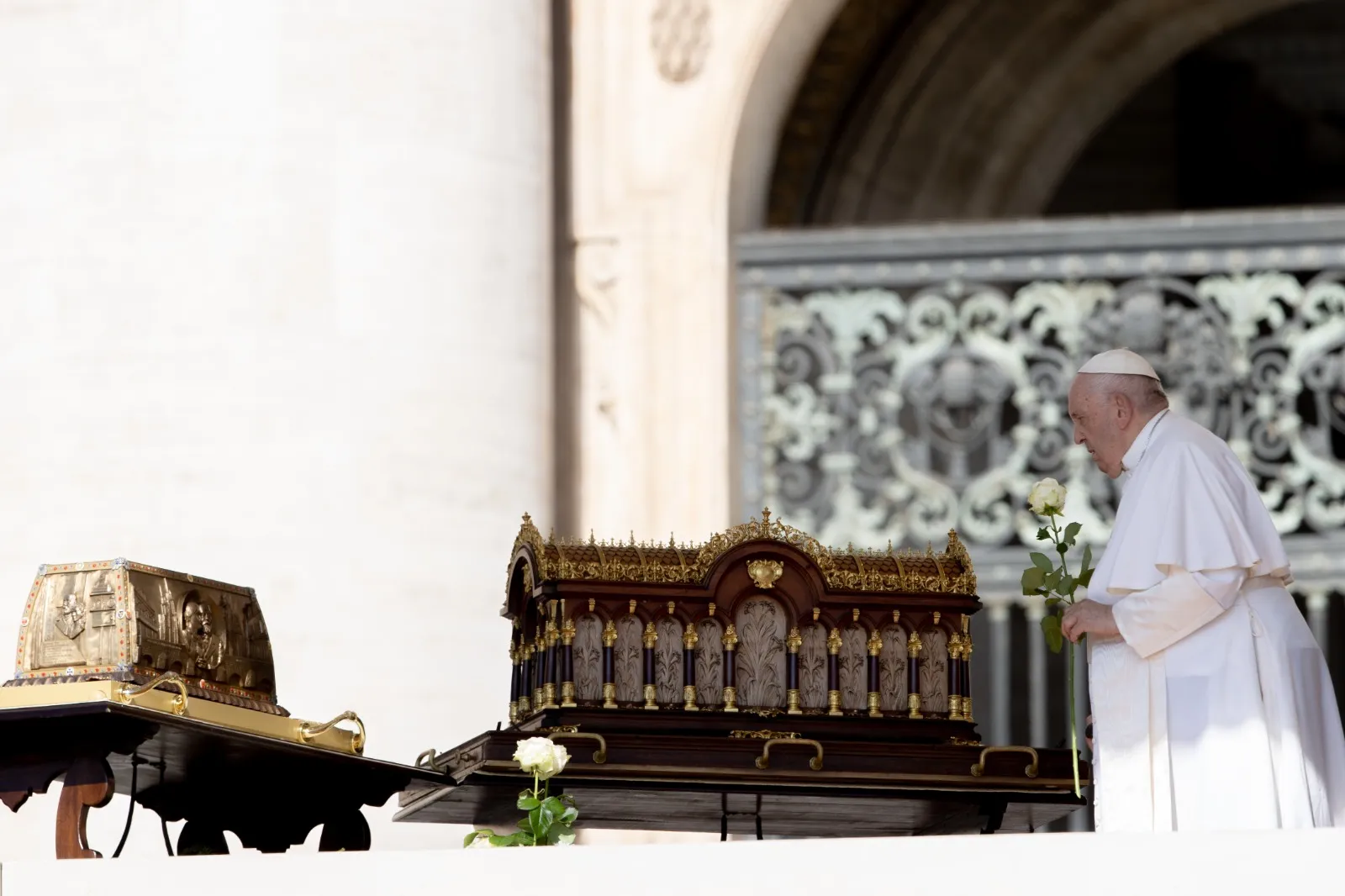
One of Pope Francis’ last gestures before undergoing abdominal surgery on Wednesday was to pray before a relic of St. Therese of Lisieux.
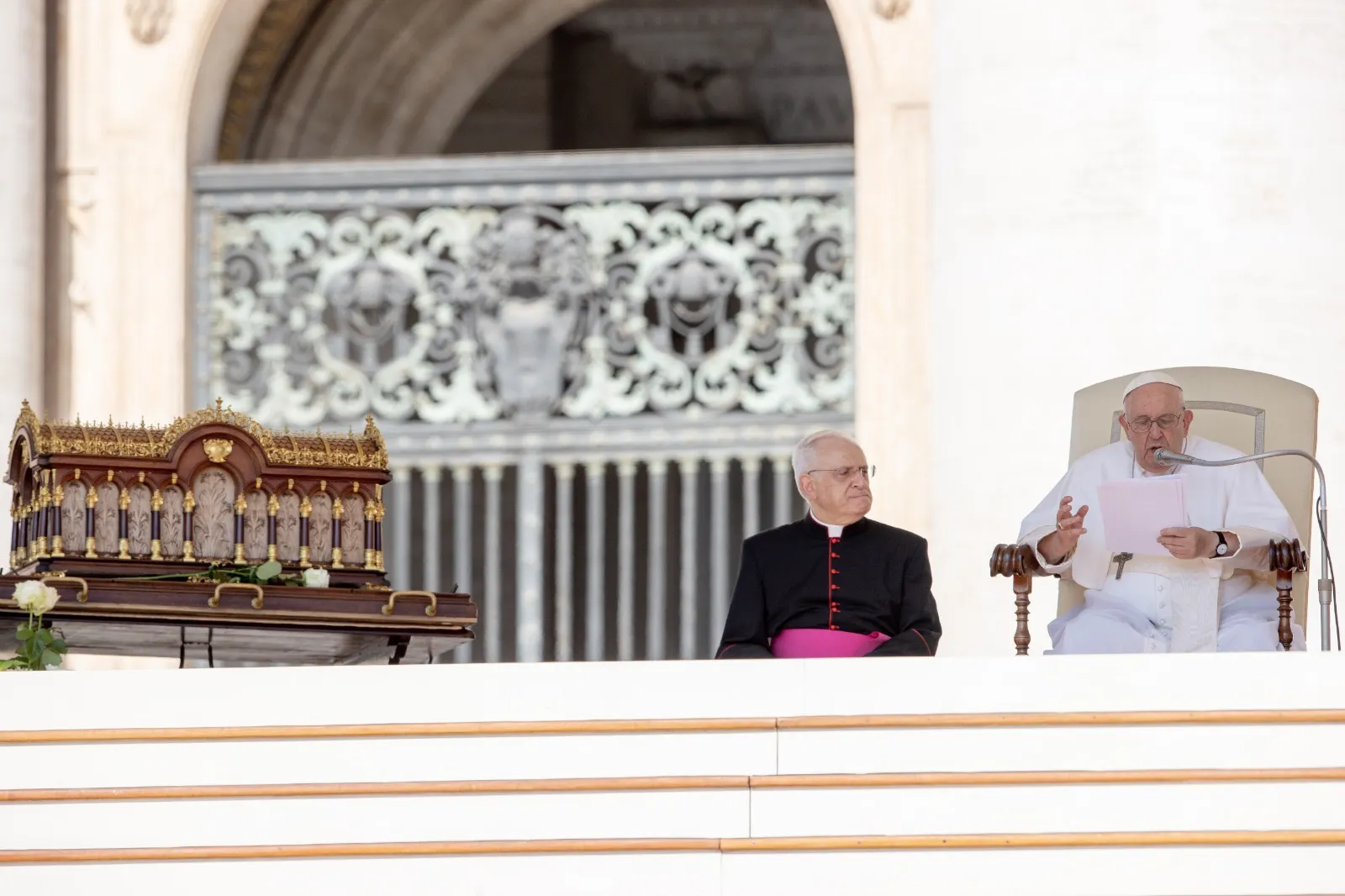
A relic of the French Carmelite nun, also known as St. Therese of the Child Jesus, was present on the platform in front of St. Peter’s Basilica during the pope’s weekly general audience June 7.
Before beginning the audience, Francis venerated the relics of St. Therese in a moment of silent prayer. He also placed a single, white rose on the table in front of the reliquary.
Pope Francis was taken to Rome’s Gemelli Hospital for abdominal surgery under general anesthesia at the end of the morning audience, shortly after 11:00 a.m. Rome time, the Vatican said.
Relics of St. Therese’s parents, Sts. Louis and Zélie Guérin Martin, were also present at the meeting with the public June 7. The relics of all three saints will visit different churches in Rome through June 16.
Relics of St. Therese of Lisieux and her parents, Sts. Louis and Zelie Guerin Martin, were on the platform in front of St. Peter’s Basilica during Pope Francis’ general audience June 7, 2023. The relics made a pilgrimage to Rome June 6-16, 2023. Daniel Ibanez/CNA
Pope Francis said Wednesday he intends to publish an apostolic letter on St. Therese of Lisieux, “patroness of the missions,” to mark the 150th anniversary of her birth.
“She was a Carmelite nun who lived her life according to the way of littleness and weakness: she defined herself as ‘a small grain of sand,’” he said in St. Peter’s Square.
“Having poor health, she died at the age of only 24,” he added. “But though her body was sickly, her heart was vibrant, missionary.”
“Here before us are the relics of St. Therese of the Child Jesus, universal patroness of missions,” he said. “It is good that this happens while we are reflecting on the passion for evangelization, on apostolic zeal. Today, then, let us allow the witness of St. Therese to help us. She was born 150 years ago, and I plan to dedicate an apostolic letter to her on this anniversary.”
🎥HIGHLIGHTS | Before commencing the General Audience in St. Peter’s Square, Pope Francis shared a beautiful moment of prayer before the sacred relics of St. Therese of Lisieux, Doctor of the Church and Patroness of the Missions. As a symbol of his devotion, the Holy Father… pic.twitter.com/lRJeWuSx8n
St. Therese of Lisieux was born on Jan. 2, 1873, in Alençon, France. Her mother died when she was four, leaving her father and older sisters to raise her. She received papal permission to enter the Carmelite Monastery at the young age of 15, where she lived until her death from Tuberculosis at the age of 24.
She was proclaimed a Doctor of the Church by St. Pope John Paul II in 1997 and is the patron saint of missions.
Pope Francis reflected on the saint’s life as part of a series of lessons on evangelical zeal.
“She is patroness of the missions, but she was never sent on mission,” Francis explained in his catechesis. “She recounts in her ‘diary’ that her desire was that of being a missionary, and that she wanted to be one not just for a few years, but for the rest of her life, even until the end of the world.”
St. Therese did this, he said, by becoming a spiritual sister to several missionaries, whom she accompanied through her prayers, letters, and sacrifices from within the monastery walls.
“Without being visible, she interceded for the missions, like an engine that, although hidden, gives a vehicle the power to move forward,” the pope said.
“Missionaries, in fact — of whom Therese is patroness — are not only those who travel long distances, learn new languages, do good works, and are good at proclamation,” he added. “No, a missionary is anyone who lives as an instrument of God’s love where they are.”
Pope Francis spoke about St. Therese of Lisieux, the patroness of missions, during his general audience June 7, 2023. Relics of St. Therese and her parents, Sts. Louis and Zelie Guerin Martin, were present on the platform beside the pope for the audience. Daniel Ibanez/CNA
Pope Francis recounted two episodes from St. Therese’s life that help to explain the source of her zeal and missionary strength.
The first happened during Christmas 1886, when Therese was almost 14 years old.
St. Therese was pampered as the youngest child of the family, he explained. But her father was tired after midnight Mass for Christmas and did not feel like being present when his daughter opened her gifts, so he said he was glad it was the last year she would receive gifts.
“Therese, who was very sensitive and easily moved to tears, was hurt, and went up to her room and cried,” the pope said.
“But she quickly suppressed her tears, went downstairs and, full of joy, she was the one who cheered her father,” he said. “What had happened? On that night, when Jesus had made himself weak out of love, her soul became strong: in just a few moments, she had come out of the prison of her selfishness and self-pity; she began to feel that ‘charity entered her heart’ — so she said — ‘with the need to forget herself’ (cf. Manuscript A, 133-134).”
“From then on, she directed her zeal toward others, that they might find God…”
The second event happened after St. Therese became a Carmelite. Pope Francis said the nun became aware of a hardened criminal, Enrico Pranzini, who was sentenced to death by guillotine for having murdered three people.
Therese had a special zeal for saving sinners, and so “she took him into her heart and did all she could: she prayed in every way for his conversion, so that he, whom, with brotherly compassion she called ‘poor wretched Pranzini,’ might demonstrate a small sign of repentance and make room for God’s mercy,” Francis said.
The day after his execution, she read in the newspaper that before laying his head on the chopping block, Pranzini had, “‘all of a sudden, seized by a sudden inspiration, turned around, grabbed a Crucifix that the priest handed to him and kissed three times the sacred wounds’ of Jesus,” he continued.
“Then his soul,” St. Therese wrote, “went to receive the merciful sentence of the One who declared that in Heaven there will be more joy for a single sinner who repents than for the ninety-nine righteous who have no need of repentance!”
Pope Francis said: “With so many means, methods, and structures available, which sometimes distract from what is essential, the Church needs hearts like Therese’s, hearts that draw people to love and bring people closer to God.”
“Let us today ask this saint, whose relics we have here,” he added, “let us ask this saint for the grace to overcome our selfishness and for the passion to intercede that Jesus might be known and loved.”




Leave a Reply