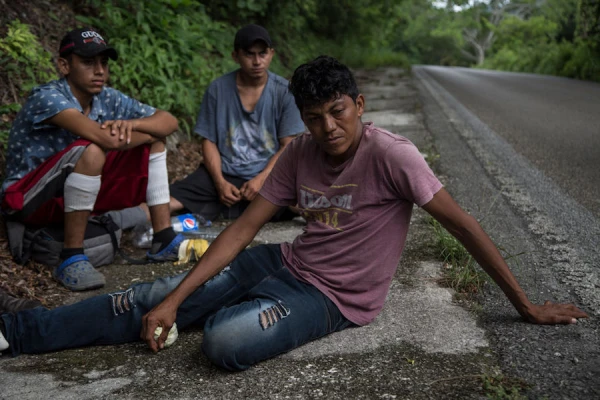
Tucson, Ariz., Jul 11, 2019 / 05:17 pm (CNA).- A Catholic agency in Tucson, Arizona is hoping to transform an unused portion of a juvenile detention center into housing facilities for immigrants seeking asylum.
Since January, Catholic Community Services in Arizona has housed asylum seekers in the local Benedictine Monastery, the third largest shelter for migrants in the United States, according to the Sahuarita Sun. Due to monastery renovations, they must relocate later this month.
Arizona Public Media reported this week that a $100 one-year renewable lease is currently being drawn up for the organization to use a portion of the Pima County's Juvenile Justice Complex.
The county board of supervisors must approve the move during the next board meeting in August.
The justice complex can hold 350 people, but currently houses less than 50. Catholic Community Services is hoping to use the additional 300 beds, plus an attached kitchen and laundry room, in a portion of the facility that is separate from the area still used as a juvenile detention center.
Bishop Edward Weisenburger of Tucson said the justice complex will provide a safer and healthier environment to shelter the migrants, who typically stay no longer than a few days.
“Even though the monastery was a lovely environment, it was not setup in its infrastructure for our needs. The plumbing system especially was a real challenge,” he said, according to Arizona Public Media.
The county would pay for operating costs, and would then request reimbursement from the federal government, which is responsible for the immigrants seeking asylum, the Sahuarita Sun reports.
Some renovations will be necessary, to make the space more comfortable and inviting. Jan Lesher, chief deputy county administrator, stressed that the asylum seekers are not being imprisoned, and the building will be altered to reflect that.
“What we hope to do is make it as seamless as possible for those who live in the community and those asylum seekers passing through,” she told Arizona Public Media.
If you value the news and views Catholic World Report provides, please consider donating to support our efforts. Your contribution will help us continue to make CWR available to all readers worldwide for free, without a subscription. Thank you for your generosity!
Click here for more information on donating to CWR. Click here to sign up for our newsletter.

Washington, D.C. Newsroom, Apr 11, 2025 / 15:52 pm (CNA).
The U.S. Conference of Catholic Bishops (USCCB) and Jubilee USA Network this week sent a letter to President Donald Trump urging him to purs… […]
CNA Staff, Sep 1, 2020 / 10:00 am (CNA).- Former vice president Joe Biden invoked Pope St. John Paul II during a campaign speech on Monday. The Democratic nominee cited the former pope in an address in Pittsburgh, in which he urged voters to embrace hope in the face of civil unrest, but drew criticism from some Catholics for his continued support for expanded abortion access.
“The campaign for the presidency has come down to fear,” said Biden during an appearance in Pittsburgh on Monday, August 31. “But I believe Americans are stronger than that. I believe we’ll be guided by the words of Pope John Paul II, words drawn from the scriptures: ‘Be not afraid. Be not afraid.’”
“Fear never builds the future,” said Biden. “Hope does. And building the future is what America does.”
Biden, who has met with successive popes during his political career, has made his Catholic faith a frequent feature during his campaign for the presidency. During the Democratic National Convention, speakers repeatedly praised Biden for his deep devotion to his religious beliefs, and the former vice president offered anecdotes about being educated by nuns as a child.
Despite this, Biden is running on a platform that would legalize the taxpayer funding of abortions up until birth, has pedged to codify a right to abortion in federal law, and also committed to revoking conscience and religious liberty protections for religous orders concerning the HHS contraceptive mandate.
His choice Monday to reference St. John Paul II came despite the pope’s vocal opposition to pro-choice politicians during his reign.
In the encyclical Evangelium Vitae, the late pope wrote “Laws which legitimize the direct killing of innocent human beings through abortion or euthanasia are in complete opposition to the inviolable right to life proper to every individual; they thus deny the equality of everyone before the law,” and “In the case of an intrinsically unjust law, such as a law permitting abortion or euthanasia, it is therefore never licit to obey it, or to ‘take part in a propaganda campaign in favour of such a law or vote for it.’”
Under St. John Paul II, then-Cardinal Joseph Ratzinger issued a letter in 2004 to then-Cardinal Theodore McCarrick of the Archdiocese of Washington, specifically outlining the policy positions that would render a Catholic politician ineligible for Communion.
“Regarding the grave sin of abortion or euthanasia, when a person’s formal cooperation becomes manifest (understood, in the case of a Catholic politician, as his consistently campaigning and voting for permissive abortion and euthanasia laws), his Pastor should meet with him, instructing him about the Church’s teaching, informing him that he is not to present himself for Holy Communion until he brings to an end the objective situation of sin, and warning him that he will otherwise be denied the Eucharist,” wrote the future Pope Benedict XVI.
If the politician remains in “obstinate persistence” in attempting to receive communion despite abortion advocacy, they are to be denied communion, said Ratzinger.
Biden’s website currently states that “ Biden will work to codify Roe v. Wade, and his Justice Department will do everything in its power to stop the rash of state laws that so blatantly violate Roe v. Wade.”
Biden’s Pittsburgh speech drew criticism from some Catholics, who noted his stated policy positions which contradict both Church teaching and the writing of St. John Paul II.
National Review’s Kathryn Jean Lopez urged Biden to “spare us” the references to the pope until he was willing to accept the “Gospel of life” in a column published on Monday.
“I grieve when I hear Joe Biden talk this way because he should know better,” said Lopez. “Don’t use the Catholic faith to push the abortion agenda that is rotten to the core and part of the reason we are where we are today, so miserable and violent and often making no natural sense,” she said.
“Abortion is the opposite of health care, the opposite of love, the opposite of life.”
Marjorie Dannfelser, president of the Susan B. Anthony List, chair of Pro-Life Voices for Trump and a member of Catholics for Trump, said in a statement on Monday
“Joe Biden may try to appeal to religious Americans, especially Catholics, by quoting scripture and St. John Paul II,” she said. “But this does nothing to change the fact that his extreme pro-abortion policy positions are deeply offensive to Americans of faith and conscience.”
“Claiming to be a devout Catholic while supporting radical, deeply unpopular policies is disingenuous. Pro-life Americans of all faiths will not be fooled.”
A scene from the trailer promoting Liberty University’s campus ministry production of “Scaremare.” / Scaremare on YouTube
Washington, D.C. Newsroom, Oct 29, 2022 / 10:55 am (CNA).
This October some churches and ministries in the United States are once again hosting Christian versions of haunted houses, and nonbelievers and believers alike are lining up for some rather existential spine-tingling for the first time since the pandemic.
Popular among evangelical Protestant churches in the South, these “judgment houses” typically stage dramatic representations depicting what happens after people die, leaving visitors to ponder whether they themselves are headed for heaven or hell, and presumably, to act accordingly.
Is this a good way to save souls? Some Catholics experts in evangelization who spoke to CNA have reservations.
A different way to evangelize
The late Jerry Falwell, the Baptist televangelist, and founder of Liberty University, in Lynchburg, Virginia, is credited with hosting the first judgment house in 1972, “Scaremare.”
Scaremare is still going strong in Lynchburg, where the university’s campus ministry stages a production every year around Halloween that draws people from all over the region attracted by the lure of “fun-house rooms and scenes of death in order to confront people with the question ‘What happens after I die?’”
The performance does not disappoint those looking for the sort of adrenaline surge a horror movie produces. As many as 4,000 visitors a night witness gruesome death scenes including a massacre at a movie theater and a camper who is mauled by a wild animal.
According to Josh Coldren, the director of the 2022 production of Scaremare, the scenes are intended to make people think about their fears and their mortality.
“We talk about how everyone faces death, but how there is hope beyond our fears and hope beyond death, and that hope is in Jesus Christ,” Coldren told CNA.
According to Scaremare’s website, over 26,000 people who visited over the years “have made decisions for Christ over the past two decades. Ironically, this House of Death points to the Way of Life!”
While judgment houses can function as memento mori, efficacious reminders of the inevitability of death, some judgment houses, also known as “Hell Houses,” have become controversial for taking the idea to an extreme. Graphic scenes such as abortions, extramarital sex, and drug use are sometimes depicted along with the consequence of these actions as the sinners are shown condemned to spend eternity in hell.
Scaremare doesn’t get into these issues or talk about hell at all, Coldren told CNA.
“We don’t have a scene of hell, and we stay away from demons. We believe those things are real, we just make sure we stay away from them,” Coldren said.
Tom Hudgins, is the owner of Judgement House, a company based in Seminole, Florida, that provides scripts to churches to stage dramas. Before COVID, he told CNA, they helped as many as 350 churches at a time hold Judgement Houses. They are slowly getting back to business, he said, and about 50 participating churches are listed on their website.
Hudgins explained to CNA that, unlike more extreme Hell House productions, his scripts never talk about social issues. Small groups of visitors walk through scenes meant to encourage self-reflection. Each production begins with death, by a car crash or cancer, for example, and then the audience sees what happens after death.
“They see what hell would be like, but they also see what heaven will be like, and everyone can make their own decisions,” Hudgins said.
A scene from a production of a Judgement House script. Decaturville Pentecostal Church YouTube
Bonnie Gilliland, the dramatic director at Morningside Baptist Church in Tallahassee, Florida, is staging a play with the help of Judgement House this October. She told CNA that the productions are a way of sharing the Gospel.
“We include a lot of scripture, it’s very biblically based,” she said.
Gilliland explained that this year’s production isn’t just for nonbelievers – it’s meant to give the regular churchgoer a wake-up call.
“The current drama gives people an opportunity to understand and examine whether they have a relationship with Jesus Christ because it’s more than just going to church, it’s about accepting Jesus as your savior and receiving the gift of eternal life,” Gilliland said.
Kelly Armstrong, the director of the judgment house at New Harmony Baptist Church in Albertville, Alabama, told CNA that past productions have depicted scenes of car wrecks, overdoses, and abuse.
Visitors see “how people make decisions that affect their eternity,” he said. “It brings our church together, and makes people think.”
Catholic criticism of “hell houses”
Judgment houses have not found favor among Catholic churches in the United States, and two experts in evangelization and pastoral care told CNA that they don’t think talking about hell attracts people to the Church.
Sherry Weddell is the founder of the Catherine of Siena Institute, an apostolate that helps evangelize Catholic parishes to turn pew-sitters into “intentional missionary disciples.” She told CNA that she advises any Catholics considering introducing hell-related themes to their Halloween decorations or celebrations, to rethink that idea.
“If you live in an area that has a significant number of young adults, especially parents of young children, or in an area that is highly secularized like urban areas of the East or West coasts, many will find it offensive or off-putting. And there is a real chance that sensitive and young children could be upset by it which would fuel their parents’ unhappiness with the sponsoring Catholic community,” Weddell explained.
“You could upset people who might otherwise have been open to attending an Advent or Christmas event at your parish or just open to a friendship with a Catholic like you.
“Instead of building or strengthening bridges of trust, you could be shattering or weakening whatever trust may already exist. There are creative, positive, child and parent-friendly alternatives such as “trunk-or-treating,” costume parties, and community of light events that foster both long-standing relationships and fun,” Weddell said.
Monsignor Stephen Rossetti, the chief exorcist for the Archdiocese of Washington, and a psychologist and researcher at the Catholic University of America, told CNA that the threat of hell isn’t effective in this day and age.
“People today are not convinced or influenced by threats of hell. The Church just really stopped doing that because it just doesn’t work. You know, you can do all the hellfire and damnation sermons you want, but people just kind of yawn, “ Rossetti said.
“We’re trying to emphasize God’s love and God’s mercy, which I think is much more to the point, frankly. And also more of a message that’s needed in our day. And I think that started with Pope John XXIII at Vatican II. He said, today what the message needs to be is of God’s mercy and compassion and God’s love.
“This is what attracts people, and this is sort of the core of our message. God loves us and God has saved us out of his love and compassion in Jesus,” he said.
Leave a Reply