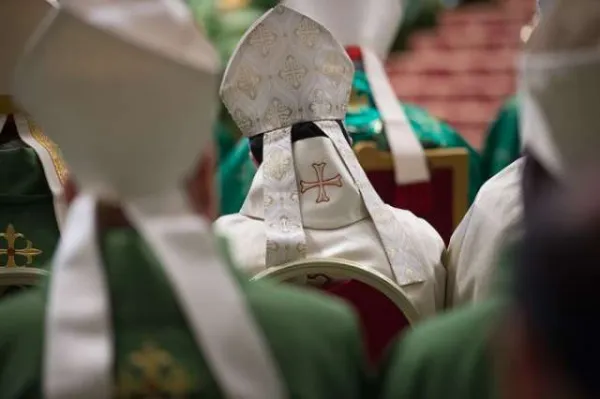
Richmond, Va., Jun 28, 2019 / 02:44 pm (CNA).- In the wake of recent sexual abuse scandals throughout the U.S., the Diocese of Richmond has announced that it will no longer name buildings and institutions after clergymen and religious founders.
The new policy went into effect on Thursday, as six names were added to the diocese’s list of clergy with credible sexual abuse accusations against them. The diocese said the additional names reflect new information recently brought forward.
“Overcoming the tragedy of abuse is not just about holding accountable those who have committed abuses, it is also about seriously examining the role and complex legacies of individuals who should have done more to address the crisis in real time,” said Bishop Barry Knestout of Richmond.
“The continued honorific recognition of those individuals provides a barrier to healing for our survivors, and we want survivors to know that we welcome and support them in our diocese,” he said in a June 27 statement form the Diocese of Richmond.
Schools, institutions, and parish buildings will from now on only be named after saints, titles of Jesus and Mary, mysteries of the faith, and the locations where the ministries were founded.
Buildings and institutions may no longer be named after bishops, pastors, or the founders of organizations. Rooms and parts of buildings that are already named are exempt from the policy. The archdiocese clarified that the new rules do not prohibit the placement of plaques which recognize historical figures or donors.
The only building that will require a name changes is Bishop Sullivan Catholic High School in Virginia Beach, which will return to its former name: Catholic High School.
“While the name of the school is changing, our mission remains the same, based firmly on Catholic teaching,” said Kelly Lazarra, superintendent of the Diocesan Office of Catholic Schools. “Catholic High School is dedicated to nurturing intellect, shaping character and forming Christian values.”
This move follows a nearly 10-year campaign by resident Thomas Lee, who says he was abused by a priest in the diocese and that Bishop Walter Sullivan covered up the abuse and allowed the priest to continue in ministry.
“This will go a long way in the healing process,” said Lee, according to WTKR.
Bishop Knestout issued a renewed apology to all those affected by clerical sexual abuse.
“It is my hope and prayer that the policy change is another way to continue to assist survivors of abuse in their healing, especially those who have, in any way, experienced the failure of Church leadership to adequately address their needs and concerns,” he said.
If you value the news and views Catholic World Report provides, please consider donating to support our efforts. Your contribution will help us continue to make CWR available to all readers worldwide for free, without a subscription. Thank you for your generosity!
Click here for more information on donating to CWR. Click here to sign up for our newsletter.

Lafayette, La., Jan 8, 2020 / 01:47 pm (CNA).- Last weekend, the property of a Catholic church in Louisiana was vandalized with black spray paint, including symbols of a satanic nature.
The graffiti was found on a statue, Marian grotto, and prayer altar outside of St. Theresa of the Child Jesus Catholic Church in Abbeville, La., just over 20 miles southwest of Lafayette.
One of the vandalized objects was a 70-year-old statue of Saint Therese of Lisieux. The symbols spray-painted on the statue included an upside-down cross, the word satan, and a pentagram. The police were called Jan. 4.
“Vandals came and defaced our statue of [St. Therese]. It’s sad that it’s not a random act of graffiti that some kids did. These are cult paintings, satanic cult, 666, an upside down cross,” said Trustee John T. Landry, according to KATC.
The damage to the grotto and prayer altar, which includes similar graffiti, was found this week when a parishioner came to pray at the Marian shrine. It is unsure if this vandalism occurred on the same night, and it had been overlooked when the police conducted their report.
Landry expressed sorrow for the attack, claiming the site as a place of peace and contemplation.
“Churches are places of peace and solitude and prayer. To see someone that malicious to not only put graffiti, but to put the devil’s work and signature on a Christian statue, is horrible,” he said, according to KATC.
While the property does have security cameras, the cameras were not pointed at the statue. Abbeville police department said the perpetrators are unknown and have offered a cash reward for information.
Orange, Calif., Jan 10, 2018 / 03:28 am (CNA/EWTN News).- Raised by an alcoholic mother and without her birth father, Cordiella James found out she was pregnant while she was in jail in Orange County.
Her future at the time seemed bleak, but today, Co… […]
An Easter Vigil procession at St. Dominic Parish in San Francisco. / Credit: St. Dominic Parish/Lorelei Low
CNA Staff, Mar 15, 2025 / 06:00 am (CNA).
Five years ago this week, public health orders issued amid the uncertainty of the novel coronavirus turned Mass schedules across the country and the world upside down.
In those early days following the WHO’s March 11, 2020, declaration of COVID-19 as a pandemic, the bishops of every U.S. diocese issued some form of dispensation, suspending the obligation that Catholics must attend Sunday Mass in person.
Thousands of parishes and ministries scrambled to develop plans to offer livestreamed Masses, deliver the sacraments in a “socially distanced” manner, and live out the Church’s life as best they could under extraordinary circumstances. Public Masses at most parishes were suspended entirely for a time, and those that were able to reopen were subject, in many areas, to distancing requirements and numerical or percentage-based attendance caps.
As Catholics nationwide adapted to the changes — not knowing how long this new reality might last — observers feared that many Catholics, barred from their parishes for so long and now accustomed to attending from the comfort of home, might not return after the parish doors reopened.
A study from the Pew Research Center found that most Catholics continued participating in Mass throughout the pandemic — but many were only able to do so virtually. In November 2022, when the survey was done, only about 4 in 10 U.S. Catholics said they attended Mass in person as often as they did before the pandemic.
Indeed, from the start of the COVID pandemic lockdowns in the U.S. to the declared end of the pandemic in May 2023, in-person Mass attendance averaged just 15% — a dismal figure, but not markedly lower than the 24% it was before. (The Catholic Church teaches that Catholics are obligated to attend Mass in person every Sunday, except for a serious reason such as illness or if they’ve been dispensed from their obligation by their pastor or bishop.)
Some bishops lifted the dispensations they had issued as early as late 2020, while a few held out until 2022. In lifting the dispensations they issued amid the lockdowns, many U.S. bishops implored Catholics to return to Mass in person.
While Mass attendance today among Catholics in the U.S. remains much lower than among Catholics in other countries, recent data has suggested that U.S. in-person Mass attendance levels have quietly returned to where they were in 2019 after years of uncertainty over whether they would ever rebound.
For some thriving parishes in the U.S., the lockdowns — while challenging — presented an opportunity to continue sharing the faith in a creative manner and come out even stronger than they were before.
Father John Mosimann, pastor at St. Mary of the Immaculate Conception Parish in Fredericksburg, Virginia, told CNA that the parish has seen its numbers grow since the pandemic.
On a typical weekend, Mosimann and his four parochial vicars celebrate 11 total Masses in English, plus another in Spanish at a different parish where they are kick-starting a Spanish Mass ministry.
All told, roughly 3,800 people attended St. Mary’s weekend Masses on a typical week in 2019. According to headcounts, the parish had already exceeded its pre-pandemic levels by 2023, with around 4,300 attendees on average. The parish, which is about 55 miles south of Washington, D.C., has 6,700 registered families and nearly 100 active ministries.
Father John Mosimann poses with altar servers and Bishop Michael Burbidge of Arlington, Virginia. Credit: Photo courtesy of Father John Mosimann
During the pandemic, St. Mary’s added extra Masses — since for a time, Masses were limited to a smaller-than-usual number of attendees — and continued hosting adoration. Like so many other parishes, the parish had to quickly adapt to a livestreaming paradigm in order to stay connected with the community.
“I was in the office and I was looking at Facebook and I said, ‘What if I hit this button and go live, what would happen?’” Mosimann remembers thinking as the lockdowns began.
“And so I started streaming on Facebook Live and everybody started jumping in … ’What’s going on, Father? What’s going to happen?’ And I didn’t have answers, because I wasn’t that great a prophet. But we did immediately start streaming.”
He said parishioners were grateful for the effort the priests made to stay in touch, despite the occasional technical challenge — a problem far from unique to St. Mary’s.
“If you want perfect sound and you want a studio, go to EWTN. They’ve got professional equipment. If you want to see your priests, come talk to us,” Mosimann said he told his parishioners.
“We’re not going to be anxious over having studio quality, because what’s important is for us to be connected to you. People responded to that. People were very grateful for that. It was very frequently cited by parishioners, how grateful they were for our staying in touch with them during that difficult moment.”
Father John Mosimann baptizes a child at his parish, St. Mary of the Immaculate Conception in Fredericksburg, Virginia. Credit: Ginny Foreman
The last of Virginia’s capacity-restricting public health orders on venues was lifted in late May 2021, and Bishop Michael Burbidge of the local Diocese of Arlington in the following month lifted the dispensation he had issued, inviting Catholics to return to Mass throughout the diocese. So far, as in most U.S. dioceses, Mass attendance overall in Arlington has risen significantly but has not quite returned to pre-pandemic levels.
Since the pandemic’s end, Mosimann said his focus has been on encouraging parishioners to use their time and talents generously to help rebuild and grow the parish community.
For Mosimann, the pandemic experience was proof that by remaining faithful even through troubling and difficult times, God can and does bring good out of bad situations through his grace.
“[We] did everything we could to provide the sacraments to God’s people and to make it available as much as possible with all the restrictions. That should be the goal of every parish, every day, whether there’s a pandemic or not,” Mosimann said.
‘We are proud to be who we are’
Father Michael Hurley, OP, pastor of St. Dominic Parish in San Francisco, said his parish, which offers what he believes is the largest young adult presence in the entire archdiocese, regularly sees attendance numbers today that are similar to pre-pandemic levels.
The parish was able to safely provide the sacraments to those in need during the pandemic and had, providentially, already set up livestreaming for Masses shortly before the start of the pandemic. To this day the parish maintains a healthy online base of Dominican laypeople who tune in for Masses and prayer.
Father Michael Hurley, OP, (left) and his fellow priests from St. Dominic Parish in San Francisco cross the street in a homage to “Abbey Road.” Credit: St. Dominic Parish/Ivi Fandino
Hurley said he personally never worried during lockdown about people not returning to Mass, instead trusting that Catholics would return when they could. He said his main concern was keeping the church building open safely during the pandemic — in a state with some of the strictest lockdown measures in the country — to maintain sacramental support.
California finally lifted all capacity restrictions on religious gatherings in April 2021 after previously implementing a near-total ban on indoor services that was contested all the way to the U.S. Supreme Court.
The sanctuary of St. Dominic Parish in San Francisco. Credit: St. Dominic Parish/Alex Mizuno
Though the demographics of St. Dominic Parish has changed somewhat, in-person worshippers, many of whom work in the Bay Area’s high-tech sector, have returned in large numbers.
“The Lord is always searching for the strays, right? … All you have to do is open the doors and do what you’re doing, and people will come,” Hurley told CNA.
That said, Hurley said he believes St. Dominic’s beautiful church building, welcoming atmosphere, and a strong sense of identity — as a Dominican-led parish that aims to “radiate the joy of the Gospel in the heart of the city” — helps to make it an attractive place for Catholics, especially young adults. They also keep the church building open for personal prayer throughout the day, a rarity in a city that occasionally struggles with crime.
“We are proud to be who we are as Catholics, and for us as clergy, as Dominicans. And that makes a huge difference,” Hurley said.
“The new policy went into effect on Thursday, as six names were added to the diocese’s list of clergy with credible sexual abuse accusations against them. The diocese said the additional names reflect new information recently brought forward.”
The rot continues to penetrate still more deeply, the filth continues to mount, the scandal continues to spread and deepen, and the bishops continue to ignore the rampant homosexuality and perversion in their own ranks and among their priests. Tell Bishop Knestout that his “renewed apology” is utterly meaningless. He is in Richmond by the grace of Mr. McCarrick and Cardinal Wuerl, his mentors while he was in Washington. He is a hireling and a wolf in sheep’s clothing.
“His Excellency” Knesout is “a nephew” of the sociopath abuser and fraud Uncle Ted McCarrick, having served as McCarrick’s secretary in the cesspool of the AD of Washington.
Knestout silenced and fired parrish priest Father Mark White who spoke candidly about the silence and abuse of justice by the CHurch in the sex abuse crisis, and the McCarrick case in particular.
Knestout also refuses to answer questions from the media.
“The new policy went into effect on Thursday, as six names were added to the diocese’s list of clergy with credible sexual abuse accusations against them. The diocese said the additional names reflect new information recently brought forward.”
The rot continues to penetrate still more deeply, the filth continues to mount, the scandal continues to spread and deepen, and the bishops continue to ignore the rampant homosexuality and perversion in their own ranks and among their priests. Tell Bishop Knestout that his “renewed apology” is utterly meaningless. He is in Richmond by the grace of Mr. McCarrick and Cardinal Wuerl, his mentors while he was in Washington. He is a hireling and a wolf in sheep’s clothing.
Paul is right about “His Excellency” Knestout, who owes his career to serving the sociopath sex abuser and fraud McCarrick.
Knestout demands silence from good shepherds, or else…
Begin with this report about the silencing of Fr. Mark White:
https://www.complicitclergy.com/2020/02/04/mccarricks-former-secretary-silences-priest-who-speaks-out-on-abuse-crisis/
“His Excellency” Knesout is “a nephew” of the sociopath abuser and fraud Uncle Ted McCarrick, having served as McCarrick’s secretary in the cesspool of the AD of Washington.
Knestout silenced and fired parrish priest Father Mark White who spoke candidly about the silence and abuse of justice by the CHurch in the sex abuse crisis, and the McCarrick case in particular.
Knestout also refuses to answer questions from the media.
Read another article here:
https://www.wavy.com/news/virginia/richmond/priest-with-the-richmond-diocese-told-to-stay-silent-or-lose-his-job/