Vatican City, Jun 23, 2019 / 05:12 am (CNA).- On the feast of Corpus Christi, Pope Francis said that Jesus gave the Church the Eucharist for the salvation of the world.
“Every year the feast of Corpus Christi invites us to renew the wonder and joy for this wonderful gift of the Lord, which is the Eucharist,” Pope Francis said at the Angelus prayer June 23.
“The Eucharist is the synthesis of the entire existence of Jesus, which was a single act of love for the Father and his brothers,” he said. It is “the sacrament of His Body and His Blood given for the salvation of the world.”
The Solemnity of Corpus Christi, meaning the “Body of Christ” in Latin, is traditionally celebrated on the Thursday following Trinity Sunday or, in some countries including the United States and Italy, on the Sunday following that feast.
The feast provides an opportunity for the Church to focus on Christ’s real presence in the Eucharist, which Pope Francis stressed should be welcomed “with gratitude, not in a passive, habitual way.”
“Whenever we approach the altar to receive the Eucharist, we must truly renew our ‘amen’ to the Body of Christ,” the pope said, urging that this “amen” should come from the heart.
“It is Jesus, it is Jesus who saved me, it is Jesus who comes to give me the strength to live. It is Jesus, Jesus alive,” Francis said of the Eucharist in a departure from his prepared remarks.
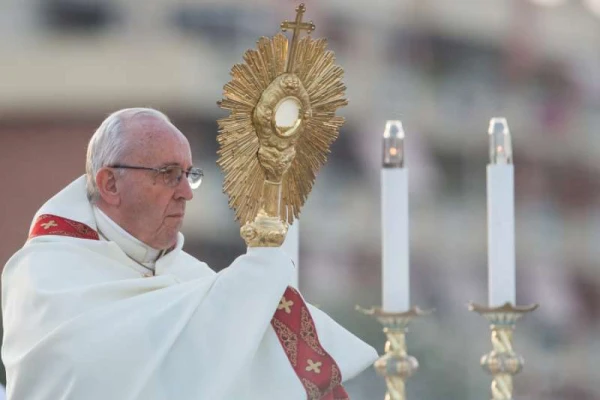
Pope Francis said that the processions with the Blessed Sacrament that take place around the world in celebration of the Corpus Christi feast are an “expression of the Eucharistic faith of the holy people of God.”
“I too will celebrate Mass this evening in the Roman quarter of Casal Bertone, followed by a procession. I invite everyone to participate, even spiritually, through radio and television,” he said.
“May Our Lady help us to follow Jesus with faith and love whom we adore in the Eucharist,” Pope Francis said.
If you value the news and views Catholic World Report provides, please consider donating to support our efforts. Your contribution will help us continue to make CWR available to all readers worldwide for free, without a subscription. Thank you for your generosity!
Click here for more information on donating to CWR. Click here to sign up for our newsletter.
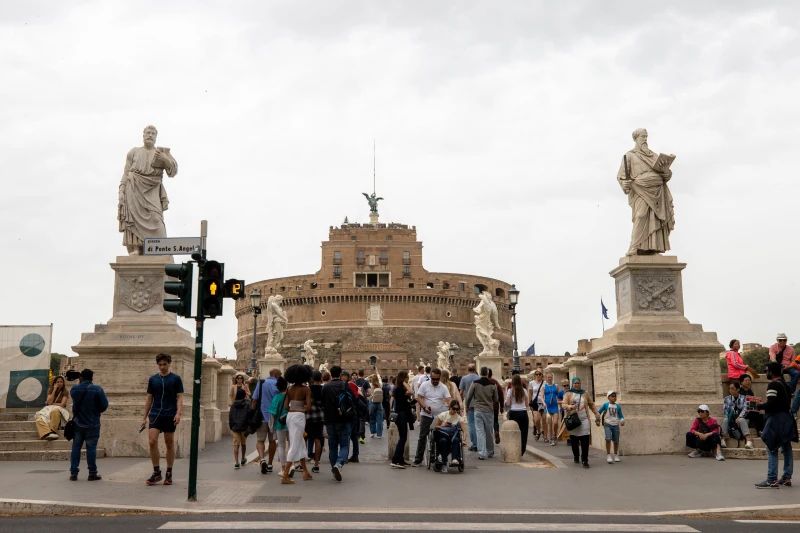
Saints Peter and Paul, the patron saints of Rome, guard the entrance to Ponte Sant’Angelo, welcoming pilgrims as they begin their journey toward St. Peter’s Basilica. / Credit: Daniel Ibáñez/CNA
Rome Newsroom, Apr 18, 2025 / 15:10 pm (CNA).
Each year, thousands of faithful pilgrims purposefully pass over the Tiber River via Rome’s Ponte Sant’Angelo, where marble messengers lining the bridge recall Christ’s passion through the sacred symbols they solemnly hold.
In 1535, Pope Clement VII ordered the placement of statues of Sts. Peter and Paul, the patrons of Rome, at the bridge’s entrance. However, it wasn’t until 1669 that Pope Clement IX commissioned a new balustrade designed by the renowned Gian Lorenzo Bernini.
Ten angels, each bearing an element of the Passion, were placed atop this structure, sculpted by Bernini’s students under his meticulous direction.
Today, on Good Friday, the Catholic Church commemorates the crucifixion of the Lord. The bridge has undergone extensive restoration in recent months, and this jubilee Holy Week unveils its newly refreshed marble.
The name “Ponte S. Angelo” etched in the bridge’s travertine stone, a testament to its centuries-old identity in the heart of Rome. Credit: Daniel Ibáñez/CNA
The iconic bridge, connecting the “Ponte” district with the Borgo and the castle that once served as a papal residence, a fortress in times of war, and a prison for criminals was reopened to pedestrians in January to mark the beginning of the Jubilee of Hope and the inauguration of the new Piazza Pia, which now links Via della Conciliazione directly to Vatican City.
The angels of Ponte Sant’Angelo were designed to serve as a spiritual guide for pilgrims on their journey toward St. Peter’s Basilica.
An angel embraces the column of Christ’s scourging, illustrating Antonio Raggi’s interpretation of “Tronus meus in columna” (“My throne is upon a column”). Credit: Daniel Ibáñez/CNA
Looking up while walking along the bridge, visitors first encounter an angel holding a column in its arms, a reminder of Christ’s scourging. At its base, the inscription reads: “Tronus meus in columna” (“My throne is upon a column”), a work attributed to Antonio Raggi.
Directly opposite stands an angel carrying whips, with the inscription: “In flagella paratus sum” (“I am ready for the scourging”), sculpted by Lazzaro Morelli.
An angel bearing the scourging whips, sculpted by Lazzaro Morelli, dramatically captures the suffering of Christ’s passion. Credit: Daniel Ibáñez/CNA
Further along, an angel holds the Veil of Veronica, the cloth used to wipe Christ’s sweat and blood, on which His face was imprinted. The base of this sculpture, created by Cosimo Fancelli, bears the inscription: “Respice faciem Christi tui” (Look upon the face of your Christ).
An angel holding the cloth representing the Veil of Veronica. Credit: Daniel Ibáñez/CNA
Notably, its pedestal bears a dent from a cannonball impact during the defense of the Vatican in 1870.
A visible cannonball dent marks the pedestal of an angel statue on Ponte Sant’Angelo, a battle scar from the defense of the Vatican in 1870. Credit: Daniel Ibáñez/CNA
On the opposite side, an angel holds the crown of thorns placed on Christ’s head, sculpted by Paolo Naldini and completed by Bernini himself. The original sculpture is now housed in the Roman church of Sant’Andrea delle Fratte. The inscription reads: “In aerumna mea dum configitur spina” (In my affliction, while the thorn is driven in).
An angel holding the crown of thorns gazes heavenward, showcasing the delicate craftsmanship of Bernini’s design against the Roman sky. Credit: Daniel Ibáñez/CNA
Next, an angel presents Christ’s tunic along with the dice used by the soldiers to cast lots for His garments. The inscription on this sculpture reads: “Super vestimentum meum miserunt sortem” (They cast lots for my tunic), a work by Paolo Naldini.
Another angel carries a cross, a piece sculpted by Ercole Ferrata, inscribed with “Cuius principatus super humerum eius” (And the dominion is upon His shoulder), referring to Christ as the prophesied Messiah and King.
An angel bearing the cross, created by Ercole Ferrata, stands as a centerpiece among the ten statues lining the bridge. Credit: Daniel Ibáñez/CNA
Following this, a second Bernini-designed angel holds a plaque with the inscription INRI. The sign above the cross explains the reason for His execution: Jesus of Nazareth, King of the Jews.
The inscription at the sculpture’s base reads: “Regnavit a ligno Deus” (God has reigned from the tree), referring to Christ’s cross. The original piece was also moved to Sant’Andrea delle Fratte.
Another angel holds a set of nails, symbolizing those used to pierce Christ’s hands and feet. The accompanying inscription, “Aspicient ad me quem confixerunt” (They will look upon the one they have pierced), frames this sculpture by Girolamo Lucenti.
An angel bearing the sponge used to give vinegar to the crucified Christ, with the inscription ‘Potaverunt me aceto’ (They gave me vinegar to drink) visible on its pedestal, with Castel Sant’Angelo in the background. Credit: Daniel Ibáñez/CNA
Opposite stands an angel carrying a sponge, recalling the one used by the soldiers to give vinegar to Jesus. Its inscription reads “Potaverunt me aceto” (They gave me vinegar to drink), a piece by Antonio Giorgetti.
Finally, there is the angel sculpted by Domenico Guidi, holding a lance—the weapon used by St. Longinus to pierce Christ’s side, from which blood and water flowed. At its base, the inscription reads: “Vulnerasti cor meum” (You have wounded my heart).
The angel with the lance of St. Longinus, sculpted by Domenico Guidi, bears the inscription ‘Vulnerasti cor meum’ (You have wounded my heart). Credit: Daniel Ibáñez/CNA
Vatican City, Jan 18, 2021 / 09:00 am (CNA).- The Vatican announced on Monday that the trial of an Italian woman for alleged embezzlement would begin soon.
A statement issued on Jan. 18 by the Holy See press office also indicated that the Vatica… […]





Leave a Reply