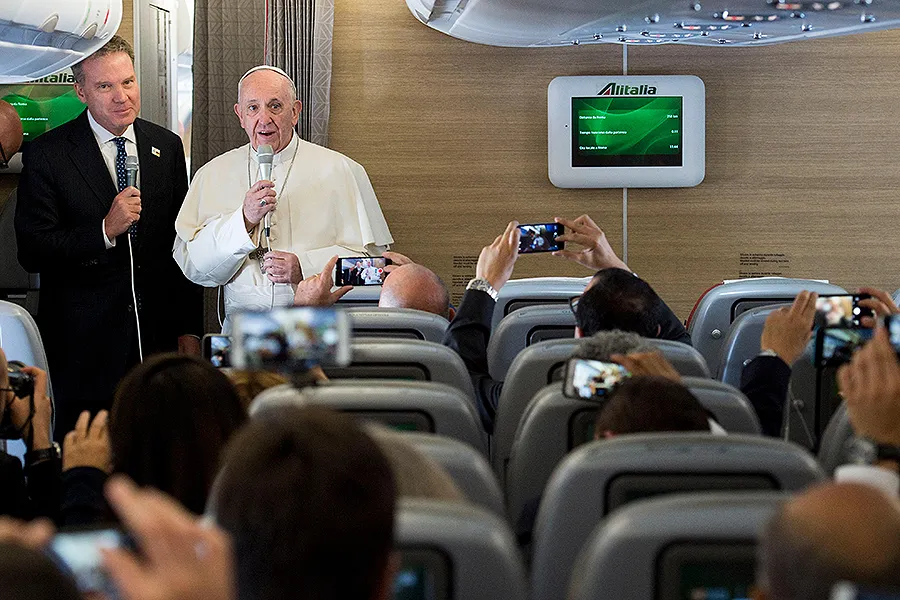
Aboard the papal plane, Sep 11, 2017 / 10:10 am (CNA/EWTN News).- In his conversation with journalists on the return flight from Cartagena to Rome on Monday, Pope Francis touched on a variety of topics, notably the US government’s decision to end DACA and the crisis in Venezuela.
He also touched on the peace process in Colombia, Hurricane Irma, climate change, and migration during his Sept. 11 flight.
Please find below CNA’s full transcript of the Pope’s in-flight press conference.
Greg Burke: Thank you, Holy Father, for the time you are dedicating to us today after an intense, tiring trip; very tiring for some, but also a very fruitful trip. On several occasions you thanked the people for what they taught you. We also learn many things in this culture of encounter and we thank you for it.
Colombia in particular, with its recent past, and not only recent, offered us some strong testimonies, some emotional testimonies of forgiveness and reconciliation. But it also offered us a continuous lesson of joy and hope, two words that you used a lot in this trip. Now perhaps you want to say something, and then we can go to the questions. Thank you.
Pope Francis: Good afternoon and thank you very much for your work. I am moved by the joy, the tenderness, the youth and the goodness of the Colombian people. A noble people that isn’t afraid to express how they feel, isn’t afraid to listen and to make seen how they feel. This is how I perceive it. This is the third time I remember [that I have been in Colombia] – but there is a bishop who told me: no, you have been a fourth time – but only for small meetings. One time in Laceja and the other two in Bogota, or three, but, I did not know Colombia well, what you see on the streets. Well, I appreciate the testimony of joy, of hope, of patience in suffering of this people. It did me a lot of good. Thank you.
Greg Burke: Okay, Holy Father. The first question is from César Moreno of Radio Caracol.
Moreno: Thank you, Your Holiness. Good evening. First of all, I would like to thank you on behalf of all the Colombian media that are accompanying us here on this trip, and all of the colleagues and friends for having come to our country, for having given us so many beautiful, profound and affectionate messages, and for such closeness that you demonstrated to the Colombian people. Thank you, Your Holiness.
You arrived, Holy Father, to a divided country. Divided on account of a peace process, between those who accept and those who don’t accept this process. What concretely can be done, what steps can be taken, so that the divided parts grow closer, so that our leaders stop this hate, this grudge? If Your Holiness returns, if you could return to our country in a few years, what do you think, how would you like to see Colombia? Thank you.
Pope Francis: I would like the motto to at least be: “Let us take the second step.” That at least it is this. I thought that there were more. I counted 60, but they told me 54 years of the guerrillas, more or less. And here it accumulates a lot, a lot. A lot of hatred, a lot of resentment, a lot of sickness in the soul. And the sickness isn’t to blame. It comes. The measles grabs and drags you…oh, sorry! I’ll speak in Italian. The sickness is not something to blame, it comes. And in these guerrilla wars – that they really waged, whether they were guerrillas, paramilitaries, or others – and also the corruption in the country, they committed gross sins that lead to this disease of hatred, of…But if they have taken steps that give hope, steps in negotiation, but it has been the last. The ELN ceasefire, and I am very grateful for it, very grateful for this. But there is something else that I perceived. The desire to go forward in this process goes beyond negotiations that they are being done or should be done. It is a spontaneous desire, and this is the strength of the people. This people wants to breathe, but we must help them with the closeness of prayer, and above all with the understanding of how much pain there is inside so many people.
Greg Burke: Now Holy Father, José Mojica, from El Tiempo.
José Mojica: Holy Father, it’s an honor to be here, to be here with you. My name is José Mojica and I am a journalist for El Tiempo, the editorial home of Colombia, and I also greet you in the name of my Colombian colleagues and all communications media in my country.
Colombia has suffered many decades of violence due to the war, the armed conflict and also drug trafficking. However, the ravages of corruption in politics have been just as damaging as the war itself, and although corruption is not new, we have always known that it exists, now it’s more visible because we no longer have news of the war and the armed conflict. What can we do in front of this scourge, up to what point can we stand the corrupt, how do we punish them? And finally, should the corrupt be excommunicated?
Pope Francis: You ask me a question I have asked myself many times. I put it to myself in this way: do the corrupt have forgiveness? I asked myself like this. And I asked myself when there was an act of…in the province of Catamarca, in Argentina, an act of mistreatment, abuse, the rape of a girl. And there were people stuck there, very attached to political and economic powers in this province.
An article published in La Nacion at that time moved me a lot, and I wrote a small book which is called “Sin and Corruption.” …always we are all sinners, and we know that the Lord is close to us, that he never tires of forgiving. But the difference: God never tires of forgiving, the sinner sometimes wakes up and asks for forgiveness. The problem is that the corrupt get tired of asking for forgiveness and forget how to ask for forgiveness, and this is the serious problem. It’s a state of insensitivity before values, before destruction, before the exploitation of people. They are not able to ask forgiveness, it’s like a condemnation, so it’s very hard to help the corrupt, very hard. But God can do it. I pray for that.
Greg Burke: Holy Father, now Hernan Reyes, from TELAM.
Hernán Reyes: Holiness, the question is from the Spanish language group of journalists. You spoke of this first step that Colombia has made. Today at the Mass, you said that there hasn’t been enough dialogue between the two parts, but was it necessary to incorporate more actors. Do you think it’s possible to replicate this Colombia model in other conflicts in the world?
Pope Francis: Integrating other people. Also today in the homily I spoke of this, taking a passage from the Gospel. Integrating other people. It’s not the first time, in so many conflicts many people have been involved. It’s a way of moving ahead, a sapiential way of politics. There is the wisdom of asking for help, but I believe that today I wished to note it in the homily – which is a message, more than a homily – I think that these technical, let’s say ‘political’, resources help and interventions of the United Nations are sometimes requested to get out of the crisis. But a peace process will go forward only when the people take it in their hands. If the people don’t take it in hand, it can go a bit forward, they arrive at a compromise. It is what I have tried to make heard during this visit: the protagonist of the peace process either is the people or it arrives to a certain point, but when the people take it in hand, they are capable of doing it well… that is the higher road.
Greg Burke: Now, Elena Pinardi.
Elena Pinardi (EBU): Good evening, Holiness. First of all, we would like to ask how you are doing. We saw that you hit your head… how are you? Did you hurt yourself?
Pope Francis: I turned there to greet children and I didn’t see the glass and boom!
Pinardi: The question is this: while we were flying, we passed close to Hurricane Irma, which after causing … deaths and massive damage in the Caribbean islands and Cuba, it’s feared that broad areas of Florida could end up underwater, and 6 million people have had to leave their homes. After Hurricane Harvey, there have been almost simultaneously three hurricanes in the area. Scientists say that the warming of the oceans is a factor that contributes to making the storms and seasonal hurricanes more intense. Is there a moral responsibility for political leaders who reject collaborating with the other nations to control the emission of greenhouse gas? Why do they deny that climate change is also be the work of man?
Pope Francis: Thanks. For the last part, to not forget, whoever denies this should go to the scientists and ask them. They speak very clearly. The scientists are precise. The other day, when the news of that Russian boat came out, I believe, that went from Norway to Japan or Taipei by way of the North Pole without an icebreaker and the photographs showed pieces of ice. To the North Pole, you could go. It’s very, very clear. When that news came from a university, I don’t remember from where, another came out that said, ‘We only have three years to turn back, otherwise the consequences will be terrible.’ I don’t know if three years is true or not, but if we don’t turn back we’re going down, that’s true. Climate change, you see the effects and scientists say clearly which is the path to follow. And all of us have a responsibility, all… everyone… a little one, a big one, a moral responsibility, and to accept from the opinion or make decisions, and we have to take it seriously. I think it’s something that’s not to joke around with. It’s very serious. And you ask me: what is the moral responsibility. Everyone has his. Politicians have their own. Everyone has their own according to the response he gives.
I would say: everyone has their own moral responsibility, first. Second, if one is a bit doubtful that this is not so true, let them ask the scientists. They are very clear. They are not opinions on the air, they are very clear. And then let them decide, and history will judge their decisions. Thanks.
Enzo Romeo (TG2): Good afternoon, Holy Father. I unite myself to the question my colleague made earlier because you frequently in the speeches you gave in Colombia, called again, in some way, to make peace with creation. Respecting the environment as a necessary condition so that a stable social peace may be created. The effects of climate change, here in Italy – I don’t know if you’ve been informed – has caused many deaths in Livorno…
Pope Francis: After three-and-a-half months of drought.
Romeo: … much damage in Rome. We are all concerned by this situation. Why is there a delay in taking awareness, especially by governments, that nevertheless appear to be solicitous perhaps in other areas, for example, in arms trade? We are seeing the crisis in Korea, also about this I would like to have your opinion.
Pope Francis: Why? A phrase comes to me from the Old Testament, I believe from the Psalm: Man is stupid. He is stubborn one who does not see, the only animal of creation that puts his leg in the same hole is man… the horse, no, they don’t do it… There is arrogance, the sufficiency of “it’s not like that,” and then there is the “pocket” God, not only about creation, so many decisions, so many contradictions (…) depend on money. Today, in Cartagena, I started in a part, let’s call it poor, of Cartagena. The other part, the touristic side, luxury, luxury without moral measure… but those who go there don’t realize this, or the socio-political analysts don’t realize… ‘man is stupid,’ the Bible said. It’s like that: when you don’t want to see, you don’t see. You just look in another direction. And of North Korea, I’ll tell the truth, I don’t understand. Truly, I don’t understand that world of geopolitics. It’s very tough for me. But I believe that what I see, there is a struggle of interests that don’t escape me, I truly can’t explain… but the other important thing: we don’t take awareness. Think to Cartagena today. Is this unjust. Can we take awareness? This is what comes to me. Thanks.
Valentina Alazraki, Noticieros Televisa: I’m sorry. Holy Father, every time you meet with youth in any part of the world you always tell them: ‘Don’t let yourselves be robbed of hope, don’t let yourselves be robbed of the future.’ Unfortunately, in the United States they have abolished the law of the “dreamers.” They speak of 800,000 youth: Mexicans, Colombians, from many countries. Do you think that with the abolition of this law the youth lose joy, hope and their future? And, after, abusing your kindness, could you make a small prayer, a small thought, for all the victims of the earthquake in Mexico and of Hurricane Irma? Thank you.
Pope Francis: I have heard of this law. I have not been able to read the articles, how the decision was made. I don’t know it well. Keeping young people away from family is not something that brings good fruit. Every young person has their family. I think that this law, which I think comes not from parliament [sic], but from the executive, if this is the case, which I am not sure, I hope that it will be rethought a little, because I have heard the President of the United States speak as a pro-life man. If he is a good pro-life man, he understands that the family is the cradle of life, and unity must be defended. This is what comes to me. That’s why I’m interested in studying the law well.
Truly, when youth feel, in general, whether in this case or another, exploited, in the end they feel that they have no hope. And who steals it from them? Drugs, other dependencies, suicide…youth suicide is very strong and comes when they are taken out from their roots. Uprooted young people today ask for help, and this is why I insist so much on dialogue between the elderly and the youth. That they talk to their parents, but (also) the elderly. Because the roots are there…[inaudible] to avoid the conflicts that can happen with the nearest roots, with the parents. But today’s youth need to rediscover their roots. Anything that goes against the root robs them of hope. I don’t know if I answered, more or less.
Alazraki: They can be deported from the United States…
Pope Francis: Eh, yes, the lose a root. But truthfully, on this law I don’t want to express myself, because I have not read it and I don’t like to talk about something I don’t understand.
And then, Valentina is Mexican, and Mexico has suffered a lot. I ask everyone for solidarity with the dean (Editor’s note: a reference to the journalist, who is a veteran reporter and on friendly terms with the Pope) and a prayer for the country. Thank you.
Greg Burke: Thank you, Holy Father. Now, Fausto Gasparroni from ANSA.
Fausto Gasparroni: Holiness, in the name of the Italian group, I’d like to pose you a question about the issue of immigrants, particularly about what the Italian Church has recently expressed, let’s say, a sort of comprehension about the new policy of the government of restricting the exit from Libya in boats. It has been written also that about this you had a meeting with the President of the Council, Gentiloni. We’d like to know if effectively in this meeting this topic was spoken about and especially what you think of this policy of closing the exits, considering also the fact that after the immigrants that stay in Libya, as has also been documented by investigations, live in inhuman conditions, in very, very precarious conditions. Thanks.
Pope Francis: The meeting with Minister Gentiloni was a personal meeting and not about that topic. It was before this issue, which came out later, some weeks later. Almost a month later. (It was) before this issue. Secondly, I feel the duty and gratitude toward Italy and Greece because they opened their hearts to immigrants, but it’s not enough to open the heart. The problem of the immigrant is: first an ever open heart, it’s also a commandment of God, no? “Receive them, because you have been a slave in Egypt.” But a government must manage that problem with the virtue proper of a governor: prudence. What does that mean? First: How many places do I have? Second: Not only to receive… (but to) integrate, integrate. I’ve seen examples, here in Italy, of precious integrations. I went to Roma Tre University and three students asked me questions. One was the last one. I looked at her and said, “I know that face.” It was one who, less than a year earlier, had come from Lesbos with me in the plane. She learned the language, is studying biology. They validated her classes and she continued. She learned the language. This is called integrating. On another flight, I think when we were coming back from Sweden, I spoke about the policy of integration of Sweden as a model. But also Sweden said prudently: this number I cannot do. Because there exists the danger of no integration. Third: it’s a humanitarian issue. Humanity takes awareness of these concentration camps, the conditions, the desert… I’ve seen photographs. First of the exploiters. The Italian government gives me the impression that it is doing everything, in humanitarian work, to resolve the problem that it cannot assume. Heart always open, prudence, integration, humanitarian closeness.
And there is a final thing that I want to say, above all for Africa There is a motto, a principle in our collective consciousness: Africa must be exploited. Today in Cartagena we saw an example of human exploitation, in any case. A chief of government said a truth about this: those who flee from war are another problem, but there are many who flee from hunger. Let us invest there so that it may grow, but in the collective consciousness there is the issue that when the developed nations go to Africa it’s to exploit it.
Africa is a friend and must be helped to grow. Today, other problems of war go in another direction. I don’t know if I clarified with this.
Xavier Le Normand (iMedia): Holy Father, today you spoke in the Angelus, you asked that all kinds of violence in political life be rejected. Thursday, after Mass in Bogota, you greeted five Venezuelan bishops. We all know that the Holy See is very committed to a dialogue with this country. For many months you have asked for an end to all violence. But President Maduro, on one hand, has many violent words against the bishops, and on the other hand says that he is with Pope Francis. Would it not be possible to have stronger and perhaps clearer words? Thank you.
Pope Francis: I think that the Holy See has spoken strongly and clearly. What President Maduro says, he can explain. I don’t know what he has in his mind, but the Holy See has done a lot, it sent there – with the working group of four ex-presidents there – it has sent a first-level nuncio. After speaking with the people, it spoke publicly. Many times in the Angelus I have spoken about the situation, always looking for an exit, helping, offering help to get out. It seems that it’s a very hard thing, and the most painful is the humanitarian problem, the many people who escape or suffer…we must help to resolve it in anyway (possible). I think the UN must also make itself heard there to help.
Greg Burke: Thank you, Holiness. I think we have to go.
Pope Francis: For the turbulence? They say there is some turbulence and we need to go. Many thanks for your work. And once more I’d like to thank the example of the Colombian people. I would like to conclude with an image. What most struck me about the Colombians in the four cities was the people in the streets, greeting me. What must struck me is that the father, mother, raised up their children to help them see the Pope and so the Pope could bless them, as if saying, ‘This is my treasure, this is my hope. This is my future.’ I believe you. This struck me. The tenderness. The eyes of those fathers, of those mothers. Precious, precious. This is a symbol, a symbol of hope, of future. A people that is capable of having children and then shows them to you, make them see as well, as if saying, ‘This is my treasure,’ is a people that has hope and future. Many thanks.
 […]
[…]






Did Cdn Pell receive any support, whatsoever, from the Vatican?
No.
Follow the money, always.
Have their been any public calls for prayer from Pope Francis for Cardinal Pell?
Exactly! Pell has been left on his own with Francis and the Vatican saying they have confidence in the Australian judicial system. Why is Francis afraid to stand by Pell! Is this just like bishops who abandon priests? Guilty or not.
I am not a “conspiratist” however, we must follow the money. Pell obviously has enemies in the secular world of Australia; fuethermore, sadly, he has been abandoned by those prelates who are in bed with that secular world.
Weird scenes in the goldmine
From the article — “…the cardinal has displayed a remarkable equanimity and good cheer that can only come from a clear conscience.”
That seems to be a conclusion rooted in opinion rather than in fact. Such ‘equanimity and cheer’ could also be from an amoral or immoral character trait that denies the wrongness of the act rather than the act itself.
Or such equanimity could come from the fact that he knows he is guiltless and must suffer this for the sake of Christ.
The ones who deny the wrongness of the act, the ones who pervert the truth are the ones in hegemony now in society – the LGBT and its Marxist cohorts
Come ON Jake !!!!!
Jake: You would have a marginally legitimate point if not for the actual evidence (facts) of the case which demonstrates to all rational minded people that the immoral act/s could not have been committed by Cardinal Pell as alleged.
And if you truly favor facts, you must favor a complete exoneration of Cardinal Pell based on the objective facts alone. If you wish to persecute Cardinal Pell without the objective facts, not only is that merely opinion on your part, it is purposely uninformed opinion in order to pursue a great injustice.
Fully agree with you Jake. In outside life his arrogance was clear for all to see and his contempt for the little man was barely concealed. Any religious person who has witnessed a boy being sodomized by another and refuses to do anything about it, is as guilty as the perpetrator. Why was his diocese paying fees for private boarding school tuition for a number of students? This man was never got for purpose.
And monkeys might fly out of my butt
Yes. Thank you.
Unlike Hollywood justice in too many instances comes after the accused has past on. I have zero faith in the Victoria legal system.
This man is innocent and MUST be freed! So many guilty are free yet this good man is behind bars? This is insanity! Where’s the proof of his wrong doing? There is none! Christ was condemned by lies and Cardinal Pell suffers the same kind of condemnation with no proof of wrong doing!
Well said, Gail Barringon, I agree 110%.
The prejudice and undisguised glee at the Cardinal’s conviction shown by the media after their relentless and biased coverage, together with the vitriol and hatred shown by victims groups and members of the public have forever ruined this good priest’s reputation, after a long and faithful life of service in the church . Even if his appeal is successful, many will remain convinced of his guilt. Even most of his brother priests have failed him, there have been no calls for prayer support from any pulpit that I’ve heard of -too afraid of public criticism. I hope those bearing false witness against the Lord’s anointed receive what is their due.
Cardinal Pell is a Prelate of great integrity and great humility who views his incarceration whilst awaiting trial as a prolonged Retreat. God bless you your Eminence so innocent of such vicious attack. St John Fisher and St Thomas More please accompany this servant of God in his trials.
The wierdness of the trial goes beyond what George Weigel has said. Close study of paragraph 26 of the judge’s sentencing remarks, freely available on the web, will show that Charges 3 and 4 of the five charges on which Cardinal Pell has been ‘convicted’ require him to have three hands. Charge 3 involves Pell’s supposedly doing something to the so-called victim with his hands, plural. The next sentence opens ‘While you were doing this’ (i.e. with the hands, plural’), you (Pell) began to do something to yourself with ‘your other hand’! Kafka meets Monty Python? If that is the best the Victorian justice (or should that be ‘justice’?) system can do, the case should be laughed out of court.
The legal saga will continue as the apex court, the High Court of Australia – the same lot who forced opened the unconstitutional redefinition of marriage in Australia in an act of constitutional treason and, sadly, supported by a numb skull parliament and negligent Governor General (whose primary duty is to protect the Constitution and keep it safe when the other arms of the tripartite system the Parliament and Judiciary run amok) has – by virtue of a protagonist Victorian State Director Of Public Prosecutions, a supportive or lazy Attorney General(?) who has bee running appeals against their own State judiciary and the HCA has recently been over turning similar appeals decisions from the apex State Appeals Courts.
That all said, the HCA has called out the same Victorian Police and DPP on their legal practices – https://www.abc.net.au/news/2019-02-06/lawyer-x-informer-3838-royal-commissioner-resigns/10784912
Law in Victoria make the US Wild West model practitioners of Magna Carta principles…
I ask myself who is George Weigel with respect to the following thoughts i have recently written:
The Church, the people of God, the followers of Jesus,
need to follow Jesus before, above and beyond
any social and political construct.
Therefore we must continually ask ourselves these questions:
Who is Jesus?
What is his character?
What are his priorities, principals and values?
How would he do life?
Then we must endeavour to apply the answers to these questions
in all aspects of our daily lives.
Our primary task as The Church, the people of God, the followers of Jesus,
is not to tell those who do not believe,
how they should live
and under what laws they should live.
Rather it is for us to live first and foremost in the
character and example of Jesus.
If we live primarily in a manner contrary
then despite the labels and names we use for our selfs,
our organisations and our Churches
We can not be authentically following Jesus
Instead we are misrepresenting
who he is…
what his character is…
and what his priorities, principals and values are.
Chris Hallam.
Um, okay. But is there something specific in Mr. Weigel’s essay that you take issue with?
All of it.