Denver Newsroom, Feb 14, 2021 / 02:00 am (CNA).- Mardi Gras in New Orleans has been canceled only a handful of times, including during World War I and II, and the Spanish flu pandemic in 1918. This year will be added to that list, as the mayor of New Orleans has canceled Mardi Gras because of the coronavirus pandemic. But seminarians at Notre Dame Seminary are still planning to celebrate Mardi Gras, in their own way.
“I can’t have everybody go home and then come back again, as we’re trying to keep the virus out of the seminary. Which means everybody has to stay here,” said rector Fr. Jim Wehner. “So we’re going to do our own celebrations.”
Many of the seminarians have pickup trucks, and Wehner said there will be a competition to transform those trucks into Mardi Gras floats. The seminarians will then have their own parade of floats in a space behind the seminary. The seminary invited residents at a nearby Catholic nursing home to sit outside to watch the makeshift parade.
“The whole point of Mardi Gras, one of the points, is to promote community…from the neighborhood, from the city, from the Church,” Wehner said. “This will be a chance for us here to step out of the academic world for a few days and just have some really strong community building.”
“Isn’t that what a pastor does, through the sacramental, spiritual life of the Church, we’re building a parish community and that can involve good social encounters. So we’ll model that here a little bit for those days here.”
Wehner was not always a fan of Mardi Gras. In fact, he remembers being scandalized his first year at Notre Dame Seminary, when he first realized seminarians had several days off for Mardi Gras celebrations.
“Why are seminarians participating in Mardi Gras events? Isn’t this pagan and secular?” Wehner said, recalling his memory of that time. “I was pre-judging what I thought Mardi Gras was, which is debauchery, heavy drinking, drugs. Just, you know, immorality.”
“And that maybe is what a lot of people who aren’t from here, the tourists or outsiders…that would have all of this perception of what Mardi Gras is. And there is an element of that that would be maybe more expressed in the tourist parts of the city, but that was completely not the case.”
“I fell in love with the city and then the culture, the history— and certainly Mardi Gras.”
More than one day
Notre Dame Seminary in New Orleans is closed the Friday before Mardi Gras until Ash Wednesday. But Mardi Gras actually begins much earlier— on the Feast of the Epiphany, traditionally celebrated January 6th.
“When we speak of Mardi Gras, it’s not just of course the day itself, but the whole season and the attitudes surrounding that,” said Earl Higgins, a Catholic author and New Orleans native. “On the traditional day of the Epiphany, which is January 6 … we shift from the Christmas season to the beginning of the Carnival season, Mardi Gras.”
January 6 is also the birthday of Saint Joan of Arc, the Maid of Orléans. One of the first parades of the Mardi Gras season is hosted by a group of women known as the ‘Krewe de Jeanne d’Arc.’ The parade passes through the French Quarter, beginning at the foot of a statue of St. Joan of Arc, gifted to the city by the town of Orléans in north-central France.
“There is actually a procession that is not a liturgical procession, a festival procession that goes from her statue to the cathedral and the rector of the cathedral is waiting,” Wehner said. “The person who’s dressed up on a horse as Saint Joan of Arc reaches out the lance and then…the rector…blesses it. And that’s become the informal unofficial start to Mardi Gras.”
January 6th is also the day New Orleanians traditionally eat their first King Cake of the season.
“We call it La Galette du Roi in French,” said Father Keenan Brown, a priest of the Diocese of Lafayette in southern Louisiana. “That tradition comes from France.”
Lafayette is about a two hour drive north west from New Orleans, but the city has a lot of the same Mardi Gras traditions.
“Traditionally, it’s a brioche batter that’s braided and baked, and it’s topped with this really sweet glaze in the three colors and sometimes sprinkles,” he said, referenced the three colors of Mardi Gras: green, gold and violet. The colors represent the gold, frankincense and myrrh that tradition holds the three kings brought to the baby Jesus.
Originally, a bean or a piece of jewelry was baked into the King Cake. But lately, at least in New Orleans, any tokens have been replaced by small plastic dolls representing the infant Jesus.
From Epiphany to Ash Wednesday, the city of New Orleans and many other cities and towns in southern Louisiana light up with masquerade balls – and, of course, parades.
“These parades always run on the same day, at the same time. So everyone in the city refers to the parade and not the day,” Wehner said.
Notre Dame Seminary sits along the path of Endymion, the largest Mardi Gras parade that runs through the city of New Orleans on the Saturday before Fat Tuesday.
“Leading up to this, the custom here – and everyone respects it – is that several days before each parade, you can reserve your spot,” Wehner said. “If you do it the right way, no one will confiscate it. So it’s a gentleman’s agreement— and it’s spray paint and tape.”
It is also customary for locals to man their spots at least 24 hours before the start of the parade.
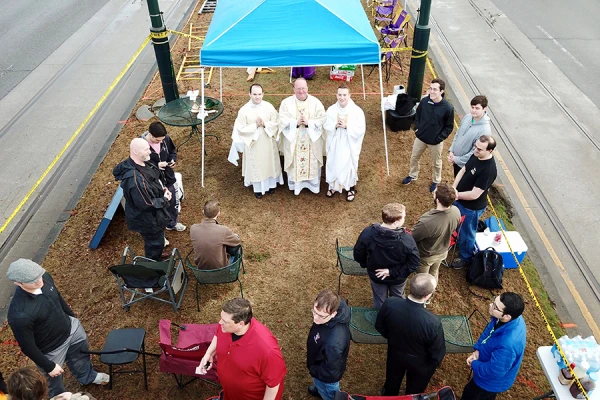
“So for two days before Endymion, the seminarians will sleep out during the night and we will protect our spot that we have spray painted,” Wehner said.
During that time, the seminarians are praying the rosary, playing cards. Wehner will even celebrate a sunrise Mass.
“People are very, very respectful of the fact that we’re doing this,” Wehner said. “Of course, we’re in our collars, and we’re not embarrassed of who we are. For the seminarians… this is the perfect time for evangelization.”
One of the last parades of Mardi Gras traditionally begins first thing Tuesday morning. I’m talking before dawn. A group called the Skull and Bones Gang runs through the Treme neighborhood of New Orleans dressed as skeletons.
“They go around and knock on the doors at five o’clock in the morning,” Higgins said. “And say ‘wake up, wake up!’ You don’t know how much time you have. It’s to remind people, ‘Hey, life is short! Get up and party!’”
As Fat Tuesday progresses, the historic French Quarter gets pretty saturated with tourists. Higgins said those tourists bring their own ways of celebrating Mardi Gras.
“The French Quarter is not a place where you want to bring your Aunt Maude, or any anybody with any, shall we say social sensibility because it’s pretty raunchy,” he said.
The partying continues until midnight, when yet another great New Orleans Mardi Gras ritual takes place: clean up.
“At one end of Bourbon Street, a team of the police lines up,” Higgins said. “The chief of police is usually at the head of the procession. And policemen on horses and dogs, and they have bullhorns. Right behind the police and the horses are the cleanup crews…And that marks midnight. Mardi Gras is over.”
Brown remembers the end of Mardi Gras was very clear to him as a child.
“We were very aware that when midnight hit, party’s over,” he said. “The next day, everybody goes to Ash Wednesday [Mass]…and everyone goes in for the ashes to begin the penitential season and to make the fast.”
“Now, the funny thing about that is, they’re not just Catholics that get ashes,” Brown said. “Everybody goes to get ashes. I’ve heard of Jews going to get ashes at the cathedral in New Orleans, because it’s just cultural. For some people, it’s very cultural.”
Higgins remembers a pastor who visited his church many years ago from out of town.
“He says he was amazed at the piety of the people in New Orleans. And the rest of us were kind of looking around. ‘What’s this guy talking about?’,” Higgins laughed. “The churches packed on Ash Wednesday in New Orleans, and by many, many people who are not only Catholic, probably don’t believe in anything. But part of the ritual of being in New Orleans is to get ashes on Ash Wednesday. That’s what you do.”
Celebrating Mardi Gras like a Catholic
Tradition runs deep in New Orleans, especially when it comes to Mardi Gras. These traditions have a Catholic flavor that is accepted and celebrated by everyone, even non-Catholics.
“In New Orleans, the culture and Catholicism are inextricably intertwined. You cannot imagine New Orleans without the Catholic Church. It’s just part of the history and the culture, and it affects everybody,” Higgins said.
Fr. Patrick Broussard is vocations director in the Diocese of Lafayette, and pastor of a parish in the town of Church Point. Broussard grew up in Lafayette, and he remembers going to parades with his family when he was a child. He never really enjoyed the Mardi Gras traditions who grew up with, until he moved away to study in Rome.
“Being so far removed from home, I realized how special South Louisiana is in a number of ways, particularly with the Catholic culture…Just seeing how ingrained the Catholic life is in people, even if they don’t practice it or don’t appreciate it,” he said.
“Everything that we do has that sort of Catholic flavor to it.
Higgins likened it to popular devotion to Our Lady of Guadalupe in Mexico.
“Mardi Gras has always been a mixture of, you know, secular and religious. In a way it’s like the Virgin de Guadalupe in Mexico. That’s just part of their culture, whether people believe in whatever they believe in. That’s just who they are. That’s Mardi Gras in New Orleans.”
Wehner was scandalized when he first heard that his seminarians got time off to join in Mardi Gras celebrations. But by now, he’s learned Mardi Gras isn’t something to be afraid of.
“You know, it can be if you’re in the wrong places, in the wrong spaces in the wrong times. But that’s really not the practice when you’re with parishes, you know, the different local parishes have their parishioners at different parts of the parade route, and it’s an all day cooking out and these types of things,” he said.
Plus, it can be a great opportunity to evangelize.
“We have to be careful not to throw the baby out with the bath water,” Broussard said. “if you think of Mardi Gras in New Orleans, you think of all the kind of scandal and craziness that goes on with it. But there is a lot of good in it too.”
“I think just to say, ‘we should not do Mardi Gras’…I think that would be a mistake because there is so much good tied up in it that we could draw from. And even, it could be very beneficial to us in our proclaiming the Gospel. So, hey, you love Mardi Gras. You know that’s a time of preparation for Lent, right? It’s intimately tied in with the Catholic faith. People may not realize it anymore, but I think that’s our sort of way to re-evangelize them.”
Wehner said celebrating Mardi Gras can be incredibly Catholic.
“I always preach to the seminarians, the Catholic Church is not counter-cultural,” he said. “We can be counter societal. Culture is an expression of God’s design. So we will critique anything that tears down what God wants. Society is what man produces. Culture is an expression of God’s Providence.”
“So we are not counter-cultural, we’re all about culture. We’re about promoting it. And at the heart of that is life. It’s family, and we know how to celebrate life very well, with festivals and food and family. That’s a part of our tradition, even tied into the saints. You go to various parts of the world where the whole town is celebrating that saint that came from their neighborhood. And it turns into a festival.”
“I think Mardi Gras is the same way. We’ve just come from the Christmas season. And in between, before we move into the Lenten season, we’re celebrating. The Gospel that can evangelize culture. And when that happens, everybody wins. And you could see that here in New Orleans, which has its own – like any culture – it has its issues and problems. But when the Christian faith speaks to it, you see the best of people.”
This story originally aired on Catholic News Agency’s podcast, CNA Newsroom. It has been adapted for print. Listen to the episode below.
CNA Newsroom · Ep. 91: Mardi Gras (and all that jazz)

[…]



So. A cardinal of the Holy Roman Church can’t even properly interpret the Catechism of the Catholic Church. Cardinal Muller was right. These guys are third-rate theologians.
Or not theologians at all.
This is why faithful Catholics are leaving; some to Orthodoxy; others to evangelical churches. This cardinal along with other cardinals and bishops, and Pope Francis, are destroying the Church for this generation and the upcoming generation.
And doesn’t “intrinsically disordered” offend the “human dignity” of each person…just like the death penalty (which for a practical purposes can be justified almost never?) …and the refusal to allow “death with dignity” for the terminally ill?
IMO, this shift started with JPII’s provisos for capital punishment…despite Veritas Splendor…a kind of workaround, a supra-Good in “the person” which makes little reference to particular goods such as “justice” really…but presents a card in moral theology that trumps natural law and Scripture…and ends all discussion?
What world does Cardinal Tobin live in that he thinks Catholics mistreat gay people? In the presence of our Lord, we are encouraged in the CCC to worship with proper disposition and decorum. Do you think that unmarried heterosexual couples, who also have a disordered attraction, and same-sex couples should display their relationships in the house of our Lord? It is unfortunate that a apostolic descendant cannot stand by the Church of the God he took an oath to completely obey.
“Tobin said of the book that “in too many parts of our church LGBT people have been made to feel unwelcome, excluded, and even shamed.”
Anybody who is committing a mortal sin *should* be ashamed.
“Father Martin’s brave, prophetic, and inspiring new book marks an essential step in inviting church leaders to minister with more compassion, and in reminding LGBT Catholics that they are as much a part of our church as any other Catholic.””
“LGBT” is an evil term, identifying a person with the sins he is tempted to commit and acting as if he has no will and no self-control. Catholics who are committing those sins are indeed as much a part of the Church as any other Catholic, and like any other Catholic who is committing mortal sin is called to repent and to stop sinning, not to celebrate his sin.
Unfortunately the reasons for calling anything immoral or intrinsincally evil are not addressed in any article I have ever seen. The reason is, it takes ones soul away from love and union with its creator which is what it even exists for and HIS truly holy and wholesome purposes. One stops off at the wrong station and becomes involved deeply and may never move on with eternal consequences. Who knows what lies ahead if you love God and HIS WORD which the catechism beautifully teaches. Personally I would not trust the one who says differently. (It has been tried so boringly often.) Careful what you give your power into. I stand with St. Michael who says “Who is like God?” I would seek union with HIM. Biology doesn’t lie either.
No matter how you slice it, it always comes down to the homosexual act. Tobin and Martin choose to look away. But as long as the homosexual community is unwilling or unable to separate the state of temptation and the conscious choice to act on that temptation, the Church has nothing more to say.
The best thing I can say relative to Archbishop Tobin is that he is at least not in the Indianapolis Diocese any longer.
It’s disturbing, to say the least, how the “LBGT” acronym is now being bandied about in the highest places as if it’s spumoni in relation to a *vanilla* Church teaching.
Has any Catholic moral theologian given a cogent argument as to what it means to “welcome” someone who practices B[isexuality], for example, other than to direct them to the confessional?
Too many prominent prelates have allowed themselves to be led into an intellectual sinkhole, unable to perceive today’s popular falsehood that opposes the clarity found in both the natural sciences and the Bible: that various and sundry sexual behaviors occur because people have/develop “identities” different from what’s evidenced by the obvious functional design of their God-given anatomies.
Perhaps the term “disordered” is not “unfortunate” but inadequate. Unnatural, irrational, hedonistic, self-destructive, are more fitting.
No one ever said that fighting for the truth would be easy.
St. Athanasius, pray for us.
Every time a member of the clergy makes a statement like this, they are effectively stating that they no longer believe in Christ, His teachings, the Bible or the Church. When it is coming from a Cardinal during Holy Week, we can be pretty assured of their lack of faith……. In this case, another of Pope Francis’s new Cardinals, it only enforces the thought that Francis too has walked away from the Lord. He can kiss all the feet he wants to, but as long as he is stacking the deck with his cadre of homosexual clergy, he cannot be believed as one who follows Christ. May the Lord have mercy upon their souls.
So I think the fundamental problem is that our Holy Father and company in their sentimentality have already ‘blessed’ contraception which opens the door to all the other sexual sins. Sex is no longer restricted to the procreative act.
Who is really surprised that Cardinal “Nighty Night Baby” Tobin does not believe same sex relationships are intrinsically disordered?
Nighty night baby!!! Give me a break. This is no Roman Catholic Bishop. Man of no faith. The Sodomy is an Act Of pure lust..please. Remove him from the priesthood. I am worried.
This is why faithful Catholics are leaving; some to Orthodoxy; others to evangelical churches. This cardinal along with other cardinals and bishops, and Pope Francis, are destroying the Church for this generation and the upcoming generation.
Could there be anything more hurtful, harmful, and demeaning, than identifying persons according to sexual desire/inclination/orientation in order to justify the engaging in of sexual acts that are hurtful, harmful, and demeaning no matter who is engaging in said acts, including a man and woman united in marriage as husband and wife? How can identifying persons according to sexual desire/inclination/orientation justify the engaging in of sexual acts, that by their very nature deny the inherent Dignity of the human person as a beloved son or daughter? How could anyone who Loves their child, dismiss the physical, psychological, emotional, and spiritual harm, that occurs, when engaging in demeaning sexual acts, that can never serve for the Good of one’s beloved or oneself? Apathy is always the result of a failure to Love; what is unfortunate is how apathetic a multitude who profess to be followers of The Christ have become because they no longer believe that Christ’s teaching in regards to sexual morality, serves out of respect for the inherent Dignity of all persons.